|
Hello again. Wayne here to continue guiding you down the path to becoming an “A+ Investor.” So far in this getting started series we have talked about A+ Investor offering a one-stop-shop solution for investment discovery, analysis and tracking as well as the new A+ Stock Grades. If you missed these emails, you can catch up at the Getting Started archive online.
Today, I am going to tackle a problem that can have a significant impact on your overall portfolio performance—asset allocation. Specifically, I am going to help you answer the question “Am I holding the right investments in the right proportion to one another?”
You may—like other investors—own stocks, mutual funds and/or exchange-traded funds (ETFs).
Individually, buying each may have made sense at the time of purchase, but do you know how well they fit together? Is there a chance you have too much exposure to a small number of sectors while unintentionally ignoring others? What about market capitalizations? Do you have any exposure to small-cap stocks? Is it more or less exposure than you think? Does your portfolio’s allocation make sense given the type of investor you are?
What about the attractiveness of your investments? Are the stocks you hold still attractively valued? Are they still the growth-type stocks they were when you bought them? What about your mutual funds and ETFs? Are they still good investments or should you start looking at their competitors?
Doing the analysis to figure out the answers may seem daunting at first. Fortunately, it doesn’t have to be. AAII.com’s My Portfolio gives the information to make the important decisions about your portfolio. At a glance, you can see whether your investments are still worth holding onto, whether you are taking on too much or too little risk and how diversified your portfolio truly is. Best of all, the data is customized for you and focused on the investments you are most interested in.
Tools for Making Informed Decisions About Your Portfolio
At the top of My Portfolio, you will see several tabs. Each provides specific information about your portfolio.

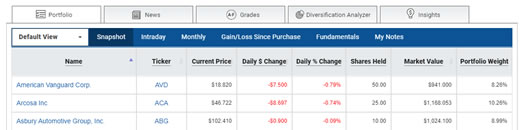
The Portfolio tab provides an overview of your holdings. You’ll find useful price, gain/loss, valuation and dividend data about your holdings. You can also add any personal notes, such as the reason you purchased a certain stock.
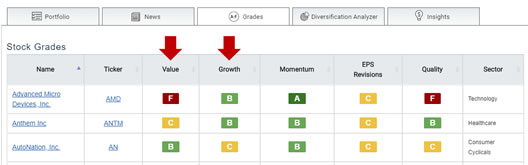
You can quickly judge the attractiveness of your investments with the Grades tab. Stocks, mutual funds and ETFs are assigned a grade of A, B, C, D or F. Just like in school, A’s and B’s are good while D’s and F’s are bad. At a glance, you can see whether your investments still warrant a spot in your portfolio based on the characteristics that matter to you most, be it low valuation, strong growth or positive earnings estimate revisions.
A growth-oriented investor owning the stocks shown below would get confirmation that the first two stocks’ growth rates remain comparatively good. The Growth Grade of C for the third stock may be a sign to look at the stock closer to determine if the growth rate is slowing and whether closer attention should be paid to it. A value-oriented investor may look at the stocks differently, viewing the first stock’s Value Grade of F as a sign of the stock now being expensively valued and potentially not a good fit for their style of investing.
Want to learn more about what’s driving the grades? Just click on the ticker symbol. Doing so will take you to the Stock Evaluator, where you can then click on the Grades tab to get more detail for that particular stock. (We also created mutual fund and ETF evaluators. Clicking on any ticker symbol in your portfolio will take you to the evaluator for that security.)
The Diversification Analyzer in My Portfolio gives you a breakdown of how your portfolio is allocated based on the number of shares you’ve entered for each stock, mutual fund and ETF plus any dollar amounts you’ve entered for cash and/or bond holdings. This information is used to tell you if you are being too aggressive or not aggressive enough given your chosen investing profile.
Once you have entered the number of shares you own, the Diversification Analyzer in the My Portfolio tool gives you a breakdown of how your portfolio is allocated.
In the example below, the investor considers themselves as being aggressive. As the Asset Allocation Analyzer shows below, the actual portfolio’s allocation is not as aggressive as the investor may realize. It lacks enough exposure to equities, while at the same time holding too much in bonds.
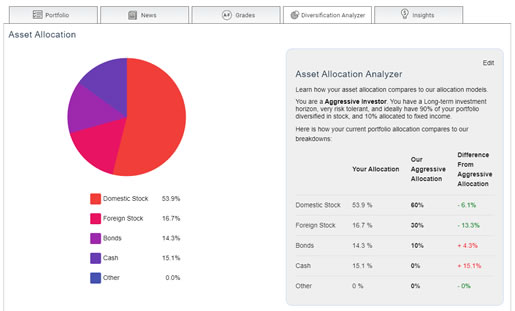
If this investor truly views themselves as someone who wishes to maximize long-term growth and has the ability to look past shorter-term market volatility, they could use information as a sign to consider increasing their exposure to stocks. On the other hand, if the investor is comfortable with their current allocation, the diversification analyzer is showing that they are not as aggressive of an investor as they may have previously thought.
Diversification is not just limited to stocks, bonds and cash. Diversifying within asset classes can help protect you against security-specific risks. Even when you hold many different investments, you may not be as diversified as you think. This can particularly occur when you hold too many stocks from one sector or just a few sectors. You can also diversify, and even boost your returns, by purposely allocating beyond large-cap stocks.
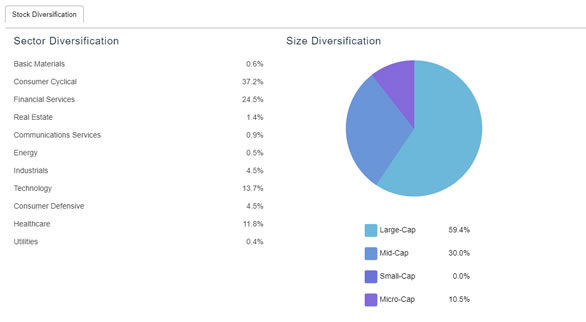
The Diversification Analyzer gives you a breakdown of your portfolio by sector, size and geography. In the example below, the investor is heavily allocated to consumer cyclical stocks. They also have little exposure to several sectors, including basic materials, energy and utilities.
When focusing on individual stocks, it can also be easy to lose sight of how little exposure you have to stocks of different sizes such as small caps. The Diversification Analyzer makes it easier to catch this. As shown below, this portfolio is heavily weighted toward large- and mid-cap stocks.
Making Smarter Portfolio Decisions
As you can see, we designed My Portfolio to be more than just a tool for monitoring the price changes of your investments. We included features designed to help you make better decisions. My Portfolio’s analytical tools will help you identify whether you are taking on too little or too much risk as well as whether you have too much or too little exposure to certain types of investments. You can use this information to determine whether you need to adjust your allocations or if you are on the right path.
Kind regards,

Wayne A. Thorp, AAII
Senior Financial Analyst
This email is being sent to you as part of your subscription to A+ Investor.
Questions regarding your AAII membership or subscriptions should be sent to members@aaii.com
Questions regarding the A+ Investor service should be sent to aplus@aaii.com.
For guidance on using the A+ Investor tools, see the A+ Investor User Guide:
www.aaii.com/plus/userguide.
| |