|
Hi, it’s Wayne again welcoming you back to the A+ Investor getting started series.
I have been investing in individual stocks for over 20 years as both an individual investor and as manager of several AAII portfolios. And do you want to know what I think is one of the most challenging aspects of investing in stocks? Knowing when to sell.
Open your email, flip through a financial publication or visit an investment website, and chances are you’ll come across some stock “recommendation.” However, these same plugs for a given stock rarely reveal when we should sell. Even if you take the time to perform an investment analysis of a stock and decide it fits into your portfolio, for many this is an easier process than deciding when to sell.
While perhaps an oversimplification, by and large, there are two reasons to buy a stock—the expectation that the stock price will rise and/or the stock generates dividend income.
On the back end, even if you are a long-term investor, there will come a time when you need to decide whether it is worthwhile to continue holding a given stock. The most obvious reason many investors consider selling a stock is because it is underperforming other stocks in your portfolio or the overall market. Too many times, though, we hold onto big losers in the hope of recouping some or all of those losses. But a stock that is down 30% since purchase will have to rebound nearly 43% in order to break even, a tall order for many stocks in a reasonable amount of time.
Alternatively, eventually we may want to turn a paper gain in a stock into cold hard cash. The problem, there, however, is that the typical investor is too quick to sell to lock in a profit, settling for undersized gains and increased portfolio turnover and transactions costs.
So, the question we are faced with is: When do you sell a stock?
With individual stocks, you should have a strategy in place to select and manage them. Your approach will determine what to buy and when, and why to sell. When making a sell decision, it is important not to let your emotions dictate your actions. Using a quant-based methodology to determine when to sell a stock will help keep emotions in check.
For most investors, the decision to sell is based on one of three factors:
- Portfolio rebalancing to pare down overweighted positions
- Stock no longer exhibits the qualities or characteristics that led to its initial purchase
- Price underperformance
A+ Investor offers several tools to help you decide whether it’s time to sell a stock:
- My Portfolio
- Portfolio Insights
- Stock Evaluator
- A+ Grades
Selling to Rebalance
The My Portfolio tool of A+ Investor not only allows you to track your portfolio’s holdings, but it also provides portfolio analysis tools to see how your portfolio is weighted among individual holdings as well as by asset class, sector and geographic location.
Depending on your portfolio, you may want to keep relatively equal investments across all your holdings. Alternatively, you may not want a single holding to become disproportionately large, thereby reducing the diversification benefits of your portfolio.
The figure below shows the percentage weighting of the holdings in a portfolio set up in My Portfolio.
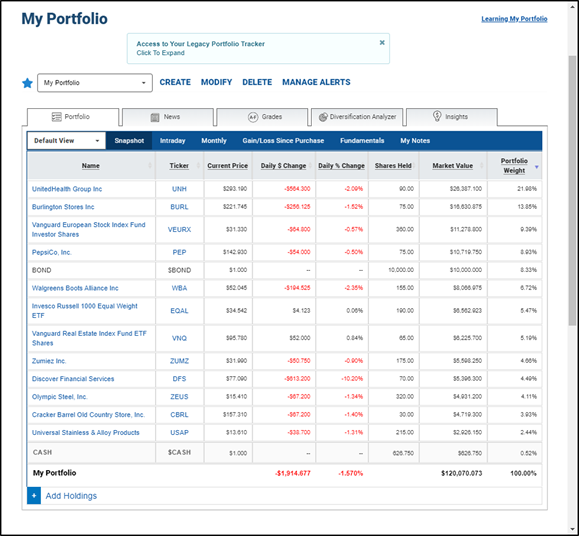
Clicking on the column heading labeled Portfolio Weight sorts the listing.
If this were the only portfolio you had, you probably wouldn’t want nearly 22% of your investment wealth in a single stock—UnitedHealth Group—or even almost 14% in Burlington Stores. In such cases, it would be prudent to scale back on some of the larger holdings and either reinvest the proceeds in lower-weighted holdings or invest in new holdings.
You may also be trying to achieve a specific asset allocation with your portfolio. The figure below shows how the same portfolio we discussed earlier is allocated across certain asset classes using the Diversification Analyzer available with My Portfolio.
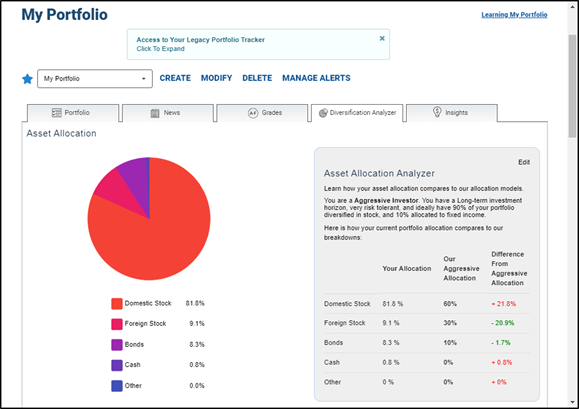
You can specify what kind of an investor you are—conservative, moderate or aggressive—and the Diversification Analyzer will list an asset allocation based on AAII’s asset allocation models. In this instance, the investor is aggressive and the suggested model is heavily weighted toward stocks (90%), with a 60%/30% allocation between domestic and foreign stocks, respectively. Based on the portfolio’s holdings, it is underweighted in foreign stocks and overweighted in domestic stocks.
Investing in different sectors is another way to achieve diversification. Certain sectors—historically—perform better depending on where we are in the business and economic cycle, so investing in multiple sectors can insulate from a downturn in certain segments of the market.
Here is an example of the sector diversification analysis performed by the Diversification Analyzer. The weightings relate to the stock portion of the portfolio—individual stocks and stocks held in mutual funds and exchange-traded funds (ETFs).
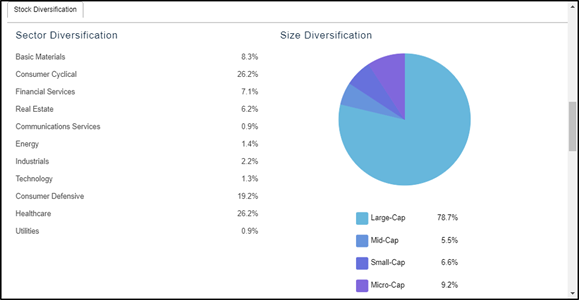
While it is easier to know your sector allocation when investing in individual stocks, it gets a little trickier with funds and ETFs. You may hold five seemingly different mutual funds, but there could still be a significant overlap in their holdings, thereby reducing the overall diversification of your portfolio.
In this example, over the half of the portfolio (52.4%) is held in two sectors—consumer cyclical (26.2%) and healthcare (26.2%). Another 19% of the equity portfolio of the portfolio is invested in the consumer defensive sector. If you hold individual stocks in those sectors, you could pare down their position size to lower the weighting in that sector. Alternatively, you may wish to investigate the holdings in your mutual fund or ETF to see the overlap among the top holdings across the funds.
The Diversification Analyzer also provides the size breakdown of the individual stock holdings of a portfolio, but it does not consider the equity holdings of mutual funds and ETFs in your portfolio.
Selling Based on Fundamentals
Often we buy stocks based on some underlying selection strategy or methodology. If you purchase a stock because it has certain fundamental characteristics, it makes sense to sell it once it no longer exhibits those same qualities. This may be because of a deterioration in fundamentals—declining growth rates, a reduction in dividend, etc.—or because of changes in valuation (rising price-to-book-value ratio, price-to-sales ratio, etc.).
Here is a listing of the holdings in our example portfolio showing the dollar and percentage gain or loss since purchase:
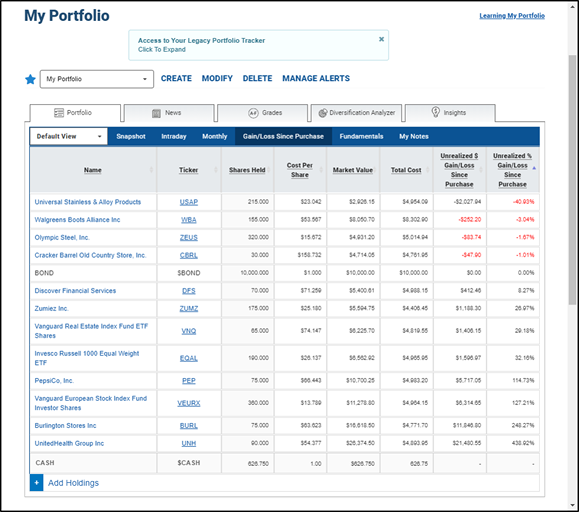
Walgreens Boots Alliance was added to this portfolio because of its dividend and income potential. Ideally, you will keep a stock if it still satisfies the criteria that led you to buy it in the first place. Since the holding periods could vary for securities in your portfolio, you might click on the Monthly tab to see performance over matching periods.
With A+ Investor, you can see if an individual stock passes any of the 60-plus screening strategies that AAII tracks. Clicking on the WBA ticker from My Portfolio or searching for WBA using the unified search throughout AAII’s website takes you to the Stock Evaluator for Walgreens.
At the bottom of that page, and for any stock ticker, you can see if that ticker passes any of AAII’s stock screening strategies (data as of the close on December 17, 2019):
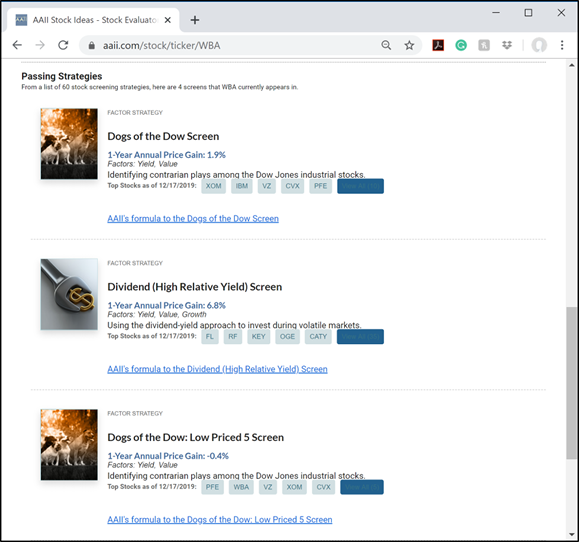
In the case of Walgreens, it was passing four dividend and yield-related screens: Dogs of the Dow, Dogs of the Dow Low Priced 5, High Relative Dividend Yield and AAII’s Dividend Investing. This serves as confirmation that the dividend and income story that led to Walgreens being added to this portfolio still holds true.
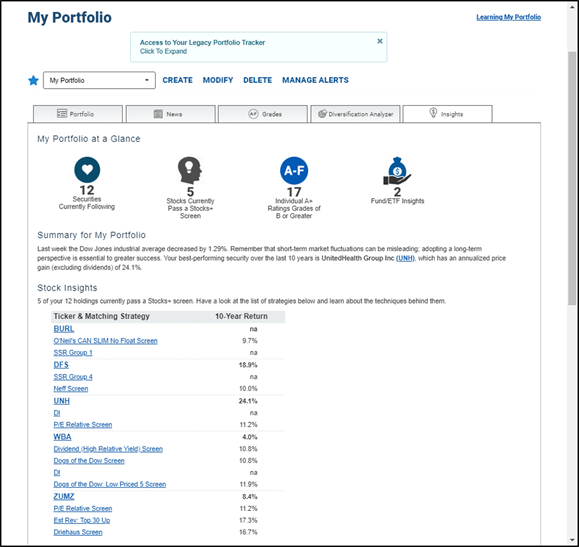
The Insights tab in the portfolio viewer will also reveal which stock strategies any of your holdings currently pass.
Selling Due to Underperformance
Deteriorating fundamentals can contribute to a decline in stock price, but not always. For almost all investors, there will come a time when you need to decide whether it’s time to move on from a stock with a large loss. In many cases, it’s best to move on and find a new stock with (hopefully) better prospects.
The portfolio listing above shows the performance of the holdings in our example portfolio. For the most part, the holdings are up since purchase, with one glaring exception—Universal Stainless and Alloy Products is down 40% since it was added to this portfolio. This means the stock would need to rebound more than 67% just to get back to breakeven.
At some point you need to take a long hard look at a big loser like this. Basing your sell decision on a fundamental framework will help keep you from making an emotional decision that could prove to be costly.
A+ Investor has created five quantitative stock grades that give you a quick snapshot of a company’s fundamentals based on five investment factors:
- Value
- Growth
- Momentum
- EPS Revisions
- Quality
The Grades tab of My Portfolio shows A–F grades for all of your holdings on the five factors.
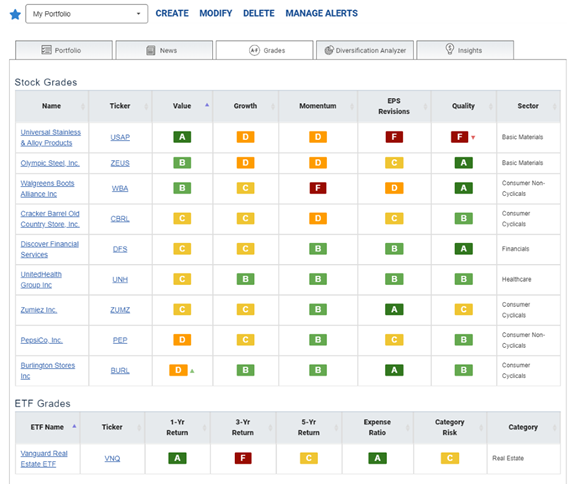
Clicking on the USAP ticker opens the stock evaluator page, then selecting Grades tab of gives you the company’s stock grades as of the close on January 23, 2020:
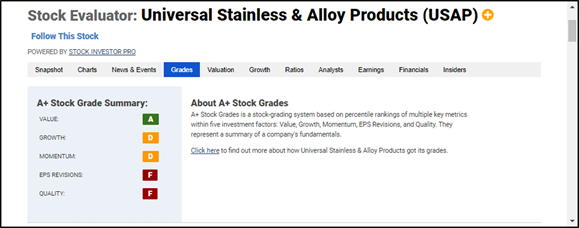
Given the stock’s price weakness, it is perhaps not surprising that it grades highly in terms of value and low for momentum. Beyond price-related factors, though, Universal Stainless & Alloy Products grades poorly in terms of growth, earnings estimate revisions and quality.
Scrolling down the page, you can see more detailed information on the data elements underlying each of the five factor grades:
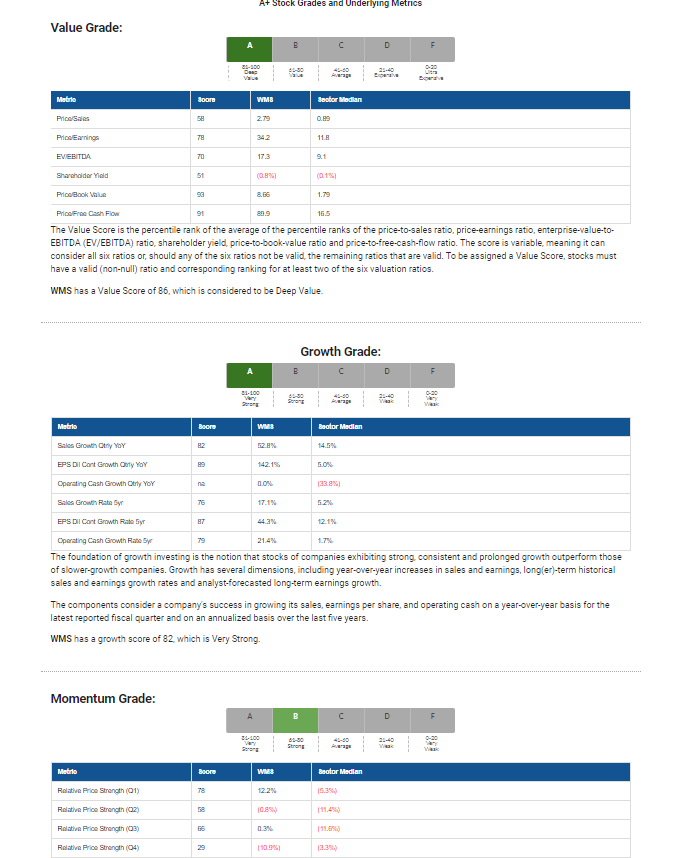
Armed with this information, you can start developing a picture of a stock’s current prospects, which should aid in the decision of whether to hold or sell the stock.
Selling a stock is an important investment decision, so it is crucial to arm yourself with the proper information to avoid making an emotional decision. Evaluating your stock holdings to see how they fit within your allocation strategy (sector, size, etc.) as well as how they rate on their fundamental characteristics will help you make an informed sell (or hold) decision.
In the end, we shouldn’t be paralyzed when it comes to deciding whether to sell a stock. By the same token, it is a good idea to have a clearly defined framework to use to aid in the sell decision-making process. There are some very good reasons to sell stocks, just be sure that you’re selling for the right reasons and not merely based on emotion.
This email is being sent to you as part of your subscription to A+ Investor.
Questions regarding your AAII membership or subscriptions should be sent to members@aaii.com
Questions regarding the A+ Investor service should be sent to
aplus@aaii.com.
For guidance on using the A+ Investor tools, see the A+ Investor User Guide:
www.aaii.com/plus/userguide.
| |