
Related

Portfolio Strategies
Article Highlights:
For investors looking to extract cash flows from their portfolios in today’s era of still fairly low yields, the bucket approach can seem like a godsend.
Simply structure the portfolio by spending horizon, setting aside a cash component for near-term spending needs, and then spend your way through a long and happy retirement.
That seems really straightforward, but implementation can be a bit messy. For one thing, the bucket approach isn’t an insurance policy that you won’t run out of money. Thus, the first job when implementing a bucket strategy is to ensure that your spending rate is sustainable.
In addition, those buckets don’t manage themselves. A cash “bucket” is the lynchpin of the bucket strategy, but how does that cash bucket get refilled, anyway? What about keeping the portfolio’s asset allocation on track? A strategy for “bucket maintenance” is essential for anyone who’s implementing a bucket approach.
Finally, there’s the fact that most retirees will hold their assets in different silos: traditional tax-deferred, Roth and taxable. How can the bucket approach work when you’re drawing upon multiple accounts? A strategy that seems so simple on paper gets pretty messy in a hurry when it collides with actual portfolios.
Before we get into the nitty gritty of implementing a bucket strategy, it’s important to define what we’re talking about. In a nutshell, the strategy involves building your portfolio based on your expected withdrawals from it. Note that when I say “withdrawals,” I’m talking about any dollars coming out of your portfolio—income, capital return/appreciation, or both. The overarching goal is to build enough of a bulwark in safe securities at the front end of your portfolio to ensure that you never have to spend from any asset when it’s in a trough.
Starting with the amount you need to spend from your portfolio each year (portfolio expenditures, not total household income needs), you can then position your portfolio based on your expected spending horizon. Enough money for the next year or two should go in cash (Bucket 1), the only asset class where your principal is guaranteed. Assets for which you have a slightly longer horizon can go into high-quality bonds (Bucket 2), which have historically returned more than cash while holding principal fairly steady for time horizons of five years or longer. The remaining assets can go into stocks and other higher-risk/higher-returning assets (Bucket 3). The big benefit of that structure is that it ensures that you’re taking an appropriate amount of risk in an effort to grow your portfolio over your retirement life cycle, but you’re not taking any more risk with your portfolio than you can afford to.
The bucket approach is an intuitive way to structure an in-retirement portfolio, but it’s not a miracle worker. It won’t save you if you haven’t saved enough to support your spending plan.
Thus, the first step in implementing a bucket strategy is to gauge the sustainability of your planned spending. Start with your annual income needs in retirement, then subtract out any certain, non-portfolio sources of income—namely, Social Security, pension and annuity payments. The amount that’s left over is what your portfolio will have to step up and replace. Divide that amount by your portfolio’s balance and that’s your spending rate.
The 4% guideline is the classic way to gauge whether a spending rate is reasonable. According to financial planner Bill Bengen’s seminal research, a 4% initial withdrawal, with that dollar amount inflation-adjusted annually, was sustainable even over the worst 30-year period in market history.
But it’s important for retirees to bear in mind the assumptions that Bengen used. Specifically, he assumed the retiree had at least half of their portfolio in stocks; retirees with more conservative portfolios will need to be even more conservative on the spending front.
Time horizon also matters: A 60-year-old retiree with a normal life expectancy will want to take an even lower withdrawal than 4% of their initial balance, since their retirement could stretch longer than 30 years. A 75-year-old, meanwhile, could take more. It’s also worth noting that Bengen assumed retirees wanted a fairly stable annual portfolio withdrawal, much like the paycheck they had when they were working. But if you’re willing to be somewhat flexible about your withdrawals—specifically, taking less in down markets—that can go a long way toward ensuring your portfolio’s sustainability.
In addition to gauging sustainability, would-be bucketers also need to lay out a system for implementation and portfolio maintenance. Just as you might craft an investment policy statement to delineate your investment criteria, I like the idea of crafting a retirement policy statement (RPS) to spell out how you’ll manage your portfolio on an ongoing basis. Your RPS can delve into non-portfolio matters, too, including when you expect to take Social Security.
Retirees employing a bucket strategy should determine, in advance, their approach to the following issues.
With any retirement portfolio, bucket or otherwise, you’ll need to wring cash out of it on an ongoing basis. Will you rely on organically generated income distributions, pure rebalancing (reinvesting dividends and selling appreciated positions to raise cash) or a combination of the two?
Spend income distributions: Any portfolio consisting of stocks and bonds is going to generate at least some current income, which can be used to provide a substantial share of a retiree’s living expenses. Spending dividends rather than reinvesting them can also help ensure that you’re not putting more money to work when the market is overheated. Right now, in June 2018, a 60% S&P 500/40% Bloomberg Barclays Aggregate Bond portfolio kicks off about 2.4% in income. That’s a good start, but it’s likely not enough cash flow for most retirees. To subsist on yield alone, they’ll likely have to nudge it up by focusing on higher-yielders, which have the potential to increase their portfolios’ volatility level. Moreover, spending income distributions in down markets rather than reinvesting them has a potential to reduce the portfolio’s long-run performance.
Reinvest income distributions, rely on rebalancing: A retiree employing this strategy would reinvest all income distributions back into the portfolio and instead look to rebalancing to supply living expenses on an ongoing basis. There are a couple of benefits to this approach. The first is that regular rebalancing helps keep the portfolio’s allocations in line with targets. The second benefit is that reinvesting all dividends can help ensure that no part of the portfolio gets spent during market downturns. In 2008, for example, a retiree using the pure total return approach would rely exclusively on cash (Bucket 1) to supply living expenses; income distributions reinvested back into the portfolio would increase the amount of the portfolio in place to recover with the market.
The drawback of this strategy is the opposite of the “spend income” strategy: In frothy market environments, it would actually be better to spend income distributions rather than reinvesting them back into expensive securities.
Rely on a combination of income distributions and rebalancing proceeds: You could employ this hybrid strategy mechanically or opportunistically. With the mechanical approach, you would spend current income distributions (or use them to refill Bucket 1). Then, once a year you could also rebalance, trimming appreciated positions to meet additional cash needs.
With an opportunistic approach, which is admittedly more complicated and subjective, you could use your view of the market’s relative valuation to guide next steps. When the market is expensive, you could spend those income distributions. When it seems inexpensive, income distributions could be reinvested back into the portfolio; you could instead rely on your cash bucket to supply cash for living expenses.
Do you want to maintain a more or less static asset allocation throughout your retirement years? Or are you targeting a portfolio that grows more conservative—or perhaps more aggressive—as the years go by? Having a view on what your asset allocation should look like over your retirement life cycle will have implications for how you rebalance your portfolio.
Target a static glide path: If steady asset-class exposure is your goal, you’ll want to regularly rebalance back to your target asset allocation.
Target a progressively more conservative portfolio: If you’re aiming for a heavier allocation to cash and/or bonds as the years go by, that calls for scaling back appreciated positions and redeploying the assets into cash or short-term bonds.
Target a progressively more aggressive portfolio: If you’re concerned about sequencing risk—encountering a lousy market environment early in retirement—one way to mitigate that problem is to maintain a conservative asset mix at the outset of retirement and gradually ramp up the equity allocation. That’s the approach put forth by retirement researchers Michael Kitces and Wade Pfau in a 2013 research paper. [See “Reduce Stock Exposure in Retirement, or Gradually Increase It?” by Michael Kitces and Wade Pfau, April 2014 AAII Journal.] The pair advanced the argument that an upward-sloping glide path can help improve a portfolio’s sustainability if a bear market occurs at the outset of retirement. Of course, you’d only want to undertake such a strategy if you know that you have nerves of steel, in that you’ll be adding to equities after they’ve taken a beating.
Rebalancing is a retirement portfolio’s great multitasker. It can help you extract cash flows for spending money, meet required minimum distributions (RMDs), make charitable contributions and reduce risk in your portfolio. But how will you rebalance? Will you focus on your asset-class exposures/glide path, as discussed above? Or will you also rebalance at the securities level, stripping back individual securities once they’ve exceeded certain preordained thresholds? Which thresholds will you use to trigger rebalancing? No matter what approach you take, it’s best to concentrate your rebalancing activity in your tax-sheltered accounts, where you won’t pay tax costs to harvest appreciated winners.
Rebalance at the asset class level: This is the classic version of rebalancing—periodically scaling back exposure to appreciated asset classes. Ultimately, your portfolio’s asset-class exposures will be the main determinant of how it behaves; this type of rebalancing helps to ensure that your portfolio’s risk level doesn’t get out of whack. On the downside, investors who are looking to shake cash flows out of their portfolios on an ongoing basis may not find enough rebalancing opportunities if they only make changes when their portfolios’ asset-class exposures have veered from their targets. (It takes a big market move to shift asset-class exposures meaningfully in one direction or another.)
Rebalance at the securities level: This type of rebalancing, whereby you scale back individual positions once they exceed specific thresholds, can be useful for retirees who are relying heavily on rebalancing—rather than just current income—to meet their cash flow needs. For example, if you’re stripping back on equities because your overall position is higher than you want it to be, you can also concentrate your rebalancing activity on your most highly appreciated large-growth fund.
This is a more mundane consideration. Assuming you’ve put in place some rules for managing your in-retirement portfolio, how often will you maintain it? Will you conduct a once-annual checkup/tune-up, or will you conduct maintenance more frequently? Keeping your portfolio management on a preset schedule—and documenting that in your retirement policy statement—may serve to inhibit ill-advised portfolio changes, such as bulking up your cash position during a period of volatility.
Check up annually: You can accomplish a lot with a single annual checkup in retirement, ideally as the year winds down. You can set aside your cash needs from the portfolio for the year ahead, conduct a year-end portfolio review and rebalance and address tax issues, including taking your RMDs. By limiting yourself to a single portfolio maintenance session per year, you’ll be less inclined to engage in off-schedule portfolio changes that you may come to regret.
Check up with greater frequency: If you take a more hands-on approach to portfolio management—for example, because you hold individual stocks in your portfolio—you may want to check in more frequently than once a year. Even so, it’s worthwhile to stick to a preset schedule for your portfolio review and maintenance, and clearly outline your triggers for making changes in an investment policy statement.
Another complicating factor for bucket portfolios is that very few investors will come into retirement with a single retirement portfolio that can be simply and elegantly bucketed. Investors typically accumulate assets in multiple silos—company retirement plans, IRAs, taxable accounts and/or various vehicles for self-employed folks—and those accounts are frequently multiplied by two for married couples. These retirement-savings wrappers vary in their tax treatment upon withdrawals, and some carry mandatory distributions post-age 70½.
Further complicating matters is that the composition of retiree portfolios varies widely, making it difficult to provide meaningful one-size-fits-all guidance. Some retirees have few taxable assets; others hold nothing in Roth. Moreover, retirees might approach withdrawal sequencing from their various accounts in completely different—but equally legitimate—ways. Thus, it’s too simplistic to say that taxable assets (often first in the queue under standard withdrawal-sequencing advice) should equate to Bucket 1, tax-deferred to Bucket 2 and Roth to Bucket 3.
That said, there are a few key concepts that retirees and pre-retirees can use to make bucketing work across multiple accounts.
While imperfect, standard guidance about which accounts should go first in the retirement-funding queue—and which should go last—is a good starting point to help you determine which account type should house which bucket. The conventional wisdom is to hang on to those investments with tax-saving features—whether traditional (tax-deferred) or Roth assets—until later in retirement. Taxable accounts, meanwhile, can go earlier in the distribution queue. And it goes (almost) without saying that retirees who are older than age 70½ will want to prioritize RMDs before all other distribution types so that they can avoid penalties.
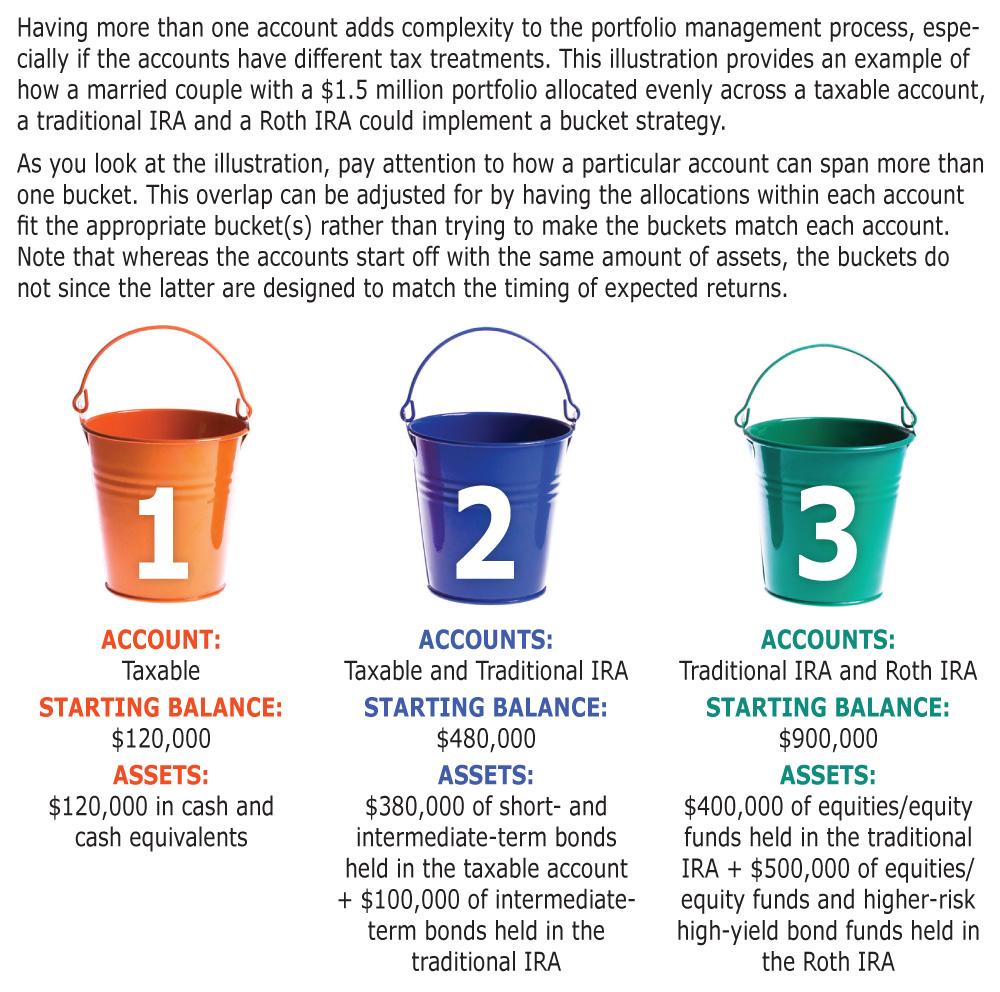
Given that general framework, a retiree employing these guidelines would want to maintain ample liquidity (Bucket 1) in their taxable accounts, while saving Roth accounts for the higher-risk/higher-return assets (Bucket 3, stocks). Assets that the retiree expects to tap in the intermediate years of retirement (Bucket 2, mainly bonds) could be housed in tax-deferred accounts.
To illustrate how this could work with a real portfolio, let’s assume Sam and Emily, both 65 years old, are positioning their $1.5 million portfolio for drawdown. Let’s further assume that they’re targeting a $60,000 per-year annual spending target with an annual inflation adjustment, and a 25- to 30-year time horizon. (They’re employing the 4% guideline.) For the purpose of this illustration, I’m also assuming their three accounts—taxable, tax-deferred and Roth—are of equal size.
Here’s how the bucket strategy would overlay their multiple accounts.
On an ongoing basis, Sam and Emily could periodically spill dividend and income distributions from their taxable and tax-deferred accounts into the cash portion (Bucket 1). If those income distributions were insufficient to refill Bucket 1, they could periodically rebalance their stock and bond positions in their taxable and tax-deferred accounts, steering the rebalancing proceeds into Bucket 1 as well.
Of course, that scenario is highly simplified. For starters, it’s a rare retiree who has equal amounts of assets in all three account types; most of today’s retirees will hold relatively less in Roth accounts and relatively more in tax-deferred and taxable accounts. That may make it easier from a planning standpoint, however. For many retirees, their taxable accounts can house Bucket 1 (cash), while their tax-deferred accounts can house most of Buckets 2 and 3. The Roth account can serve as a growth “caboose,” holding the tail-end of Bucket 3.
It’s also worth noting that while the sequence of withdrawals discussed previously is a good starting point when determining in-retirement cash flows, retirees’ situations will vary widely; a sequence that makes sense for one retiree may not be a good fit for another. And even for the same retiree, the “right” accounts to pull cash from will tend to vary from year to year.
For example, a retiree who would like to minimize RMDs later in life might decide to spend from their tax-deferred accounts before RMDs kick in—thereby reducing the amount that will later be subject to RMDs—rather than tapping their taxable portfolio early in retirement as standard withdrawal sequencing would dictate. Retirees may also choose to put tax-deferred distributions ahead of taxable distributions in years when they know they’ll have lots of deductions, to offset the income tax hit associated with the IRA distribution. In both situations, the retiree might choose to hold more liquid assets (Bucket 1) inside the tax-deferred account to help facilitate those distributions.
Alternatively, some retirees may want to tap their Roth IRAs for at least part of their living expenses, even in their early retirement years—especially in years when their tax bills will be on the high side. Because Roth distributions are not taxable, taking distributions from Roth accounts would help keep them in the lowest possible tax bracket. In that instance, they’d want to retain at least some liquid assets in their Roth accounts, to help ensure that they’re not withdrawing stock assets when they’re depressed.
Retirees who aren’t comfortable determining their most tax-efficient sequence of withdrawals—which, in turn, can inform each of their accounts’ positioning—can get a lot of bang for their buck by consulting with a tax-savvy financial adviser or an investment-savvy tax adviser.
As is clear from the above discussion, implementing a bucket portfolio isn’t as simple as it might seem at first blush. Gauging your portfolio’s sustainability given your planned spending is a key first step; codifying your strategy for bucket maintenance and attending to the tax efficiency of your portfolio is also crucial.
Those are obviously a lot of moving parts, and it can get tempting to overcomplicate. (I’ve talked to investors who are managing six or seven separate buckets!) Don’t do it. Instead, as you assess your in-retirement portfolio, focus on the key tenets of the bucket strategy—diversifying across asset classes and maintaining enough in cash to tide you through an extended period of market weakness. If your in-retirement portfolio has those features, you’re well on the road to success.
Portfolio Strategies

Portfolio Strategies

Financial Planning