Learning From the Mistakes Made by Legendary Investors
by Michael Batnick
Article Highlights:
-
Investors—including those who are legendary—make mistakes caused by behavioral follies. Even being aware of biases does not counter their effects.
-
Data on the performance of individual stocks and mutual fund managers show how hard it is to pick a winner. Even long-term winners incur significant drops.
-
Expecting the future to look like the past, overconfidence, thinking success in one area translates to success in another and not appreciating the importance of humility are among the 10 common mistakes investors make.
If you’re like most people, you’ve tried to beat the stock market.
And if you’re like most people, you’ve failed. Why is it so hard to outperform the S&P 500 index? It’s because of the mistakes we make along the way.
We’re human beings, not an Etch A Sketch. Every experience we have gets catalogued away, whether we realize it or not.
The novelist and social critic James Baldwin once said: “History, as nearly no one seems to know, is not merely something to be read. And it does not refer merely, or even principally, to the past. On the contrary, the great force of history comes from the fact that we carry it within us, are unconsciously controlled by it in many ways, and history is literally present in all that we do.”
Unfortunately, we tend to learn the wrong lessons from history. We think past is prologue. We create mental shortcuts. We anchor to irrelevant prices. And the thing is, we all do this. Even those who only manage a billion-dollar hedge fund or only have investable assets in a 401(k) account do not have a perfect batting average.
There are hundreds of books on Warren Buffett and thousands of books on how to get rich trading, but what’s lacking are books that focus on the stumbles that the best investors faced along the way. We tend to put people like Warren Buffett on a pedestal, with everybody wanting to know what his secret is. How did he amass an $80 billion fortune? Buffett’s real secret is super-human discipline. From June 1998 through the middle of March 2000, the S&P 500 gained 28%. Buffett’s Berkshire Hathaway lost 38% over the same period. Sticking with your knitting while going through this type of relative drawdown cannot be learned from reading a book. People want answers and shortcuts, even though they would be much better off understanding that Buffett makes mistakes just like the rest of us.
This is why I wrote “Big Mistakes: The Best Investors and Their Worst Investments” (Bloomberg Press, 2018). I wanted to shine a light on something people have too little appreciation for: How hard investing is. It’s really hard for all of us. I highlight some of the stumbles made by John Bogle, Benjamin Graham and Mark Twain among others.
Legendary and Non-Legendary Investors Make Mistakes
Mistakes mean different things to different investors. One person’s discipline can be another person’s complacency. And while each mistake that these legendary investors made was different, they all had a common theme.
A few of these mistakes were made due to a miscalculation—whether it was too aggressive of a growth rate or a wrong discount rate. Most of the errors were due to behavioral follies. It is now well-documented that investors are not rational creatures and do not necessarily calculate risk and reward with exact precision. Rather, we’re filled with biases: hindsight, confirmation and availability, to name a few. Just being aware of the existence of these biases does little to counter their pernicious effects. It’s common to think that they apply to other people and not to ourselves.
Why did I feel qualified to write this? I have fallen victim to every behavioral bias out there. I’ve made the same mistakes as many of the people I highlighted in my book. I tried to do macro analysis like George Soros and I tried to do deep-value investing like Graham. Neither worked. I tried trading commodities like Paul Tudor Jones and tried buying and holding like Bogle. I found one commonality among everything I’ve tried to do: They were all difficult.
I didn’t seek out to nor did I write a “how not to” book. The overarching theme of what I did write is that mistakes are going to happen, regardless of how hard you try or how much work you put in or how smart you think you are. If you can understand that there are going to be setbacks, and you set realistic expectations for yourself, you’ll have a better chance of achieving your financial goals.
It’s Not Easy to Beat the Market
Investors have options when it comes to approaching the stock market. They can pick individual stocks to suit their liking. Whether you prefer value, growth, momentum or a combination of different factors, technology has made accessing different areas of the market way easier than it was in the past. You can now even trade commission-free. However, stock-picking is no walk in the park. The market has gotten a lot more efficient over the years, leaving astute investors with less obvious mispricings. We have a lot more information now, and we know that most stocks just flat out don’t deliver very good returns. In fact, the majority of the market’s gains over the years are driven by a very small percentage of all stocks. According to “Do Stocks Outperform Treasury Bills?” by Hendrik Bessembinder (Journal of Financial Economics, forthcoming), from 1926–2015, just 30 stocks were responsible for 31.2% of total market wealth creation.
Most stocks fail to keep up with the benchmark and most stocks don’t even beat one-month U.S. Treasury bills. Bessembinder determined that out of all monthly returns for U.S. exchange-traded stocks during the period of 1926 to 2015 only 47.7% were larger than the one-month Treasury rate they were compared against. On a lifetime-return basis, just 42.1% of all stocks have a return in excess of one-month Treasury bills, according to the study. Worse yet, a separate analysis run by Longboard Asset Management (“The Capital Distribution”) found that 39% of individual U.S. stocks had a negative return over the period of 1983 through 2006.
JPMorgan reached similar conclusions. In a 2014 report, “The Agony & The Ecstasy,” the firm discussed how 40% of all stocks in the Russell 3000 index had experienced a catastrophic loss. Such losses were defined as a decline of 70% or more from the stock’s peak with little recovery. But the real agony here is that even the best stocks get annihilated along the way. During the 2007–2009 bear market, Apple Inc. (AAPL) and Amazon.com Inc. (AMZN) both saw their share prices get cut in half.
Most stocks are not very good investments. Identifying the best stocks is difficult and sticking with them over the long term is harder still. This is why so many people have decided that it was a better idea to let the professionals handle stock selection. However, and you probably already know this, it’s not easy for the professionals to beat the market either. According to S&P Dow Jones Indices’ 2017 SPIVA U.S. Scorecard, 86.7% of all domestic stock mutual funds underperformed their benchmark over the trailing five-year period.
One of the primary reasons why so many mutual funds fail to beat their benchmark, aside from fees, is because of the simple fact that so many stocks fail to beat their benchmark.
Winning managers might be more difficult to hold onto than winning stocks. First of all, we can never know which manager will select the winning stocks, and even the ones that do go through miserable periods of underperformance. Vanguard looked at mutual funds over the 15-year period of 1998 through 2012 and found that only 18% outperformed (“The Bumpy Road to Outperformance,” July 2013). Among those outperformers, two-thirds underperformed for three consecutive years during that 15-year span. In real time, it is very difficult to sit through three straight years of underperformance and, of course, we can’t know in advance who will come out a winner. Plenty of funds underperform for three straight years and don’t go on to win over a 15-year period.
Picking stocks on your own comes with the real risk of failure, and giving money to professional stock pickers is likely to have the same result. This is why there has been a stampede into index funds, which deliver market returns.
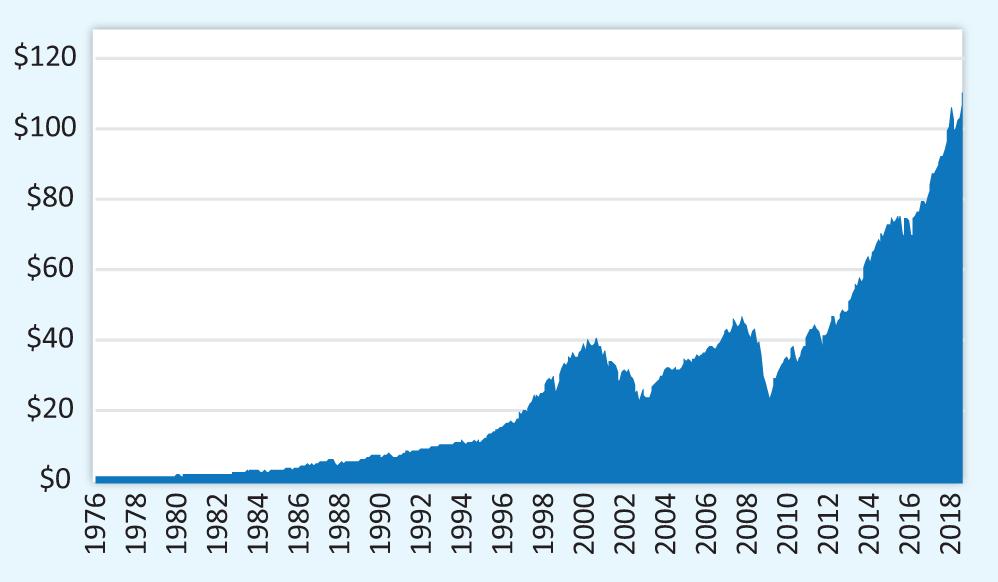
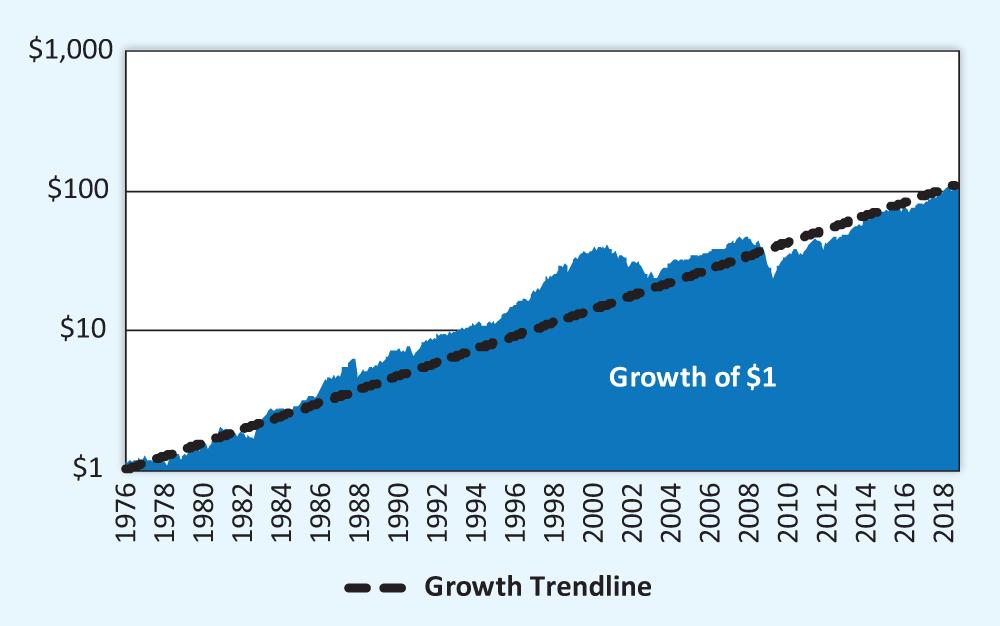
A person who invested in the Vanguard 500 Index fund (VFNIX) when it was created in 1976 and held it through the end of August 2018 would have grown $1 into $110.38. This gain equates to an annualized return of 11.7%, as shown in Figure 1.
But of course, there is a catch.
There is a huge difference between a compound annual growth rate and the path an investment takes to achieve those returns. Figure 2 is the same chart but displayed in logarithmic format. The $1 grew at 11.7% a year, but it didn’t grow at 11.7% every year. Variance from the dashed line is where unforced errors occured. We chase high-flying stocks when the market is doing well and we run for cover when the market is going south.
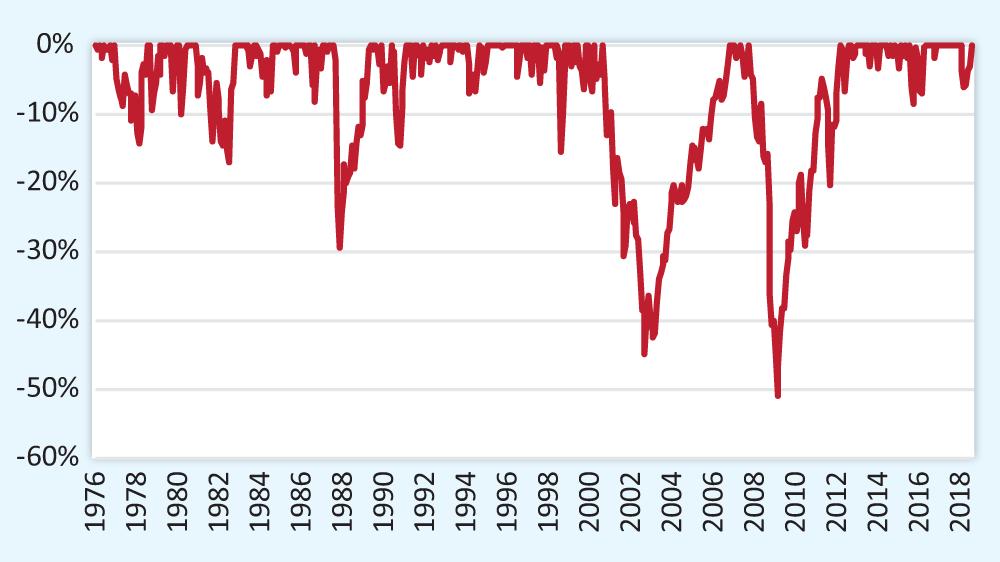
The other thing that gets lost in these “if you bought” conversations are the miserable drawdowns in between (shown in Figure 3), which we know is a price many investors are unwilling or unable to pay.
10 Common Investing Mistakes
From stock-picking to mutual funds to index funds, the numbers stack the odds against us. This is before considering our own biases, which can’t be quantified. Let’s look at 10 common mistakes that investors make.
1. Investors tend to expect the future to look like the recent past.
When stocks are going up, we expect them to continue, and the opposite is true. We believe that an object in motion will stay in motion. In 2007, after years of strong gains and with prices getting above the dot-com peak, many people surveyed thought that the market would go up the next year. And when stocks cratered during the great financial crisis, the percentage of people who thought the market would be higher 12 months into the future was cut in half. Successful investing is about finding the balance between being prepared for the good times to last while also understanding that the next bear market is always right around the corner.
2. Investors behave as if the price we paid for a security somehow should be factored into how we view the investment going forward.
Stocks don’t care that you hope to achieve a 20% return in the next 12 months.
Sir John Templeton said, “The four most dangerous words in investing are, it’s different this time.” I think the most dangerous words in investing are “I’ll sell when I get back to even.” Anchoring to your purchase price is dangerous because most stocks are losers. Most stocks won’t be sold at a profit or even at a breakeven price. There is nothing wrong with taking a small loss, but big losses are hard to recover from financially and emotionally. We can all hope that a stock comes back up in price. When waiting for this to happen, keep in mind this observation from hedge fund manager David Einhorn, “What do you call a stock that’s down 90%? A stock that was down 80% and then got cut in half.”
3. Investors make the mistake of thinking about the stock instead of the business.
Not everybody can be a security analyst, but first and foremost, shares represent a piece of ownership in a real business. With instantaneous access to information, especially the price of a stock, it’s easy to forget that a stock is more than a price on a computer screen. You don’t have to be Benjamin Graham to figure out whether a business has improved or deteriorated. If you are selecting individual stocks, at least be aware of the company’s historical and current business model and performance so you can identify when something significant changes.
4. People are loathe to admit that they were wrong about anything, and this is particularly true with investing.
Most people would rather hope they’re right than admit they’re wrong.
The best way to prevent large losses is to take small losses. The tricky thing with taking small losses is that you will be wrong again and again and again, and this can be difficult to deal with. In “The Money Game” (Vintage, 1976), the author who used the pen name “Adam Smith” described how emotional people get when investing. He wrote, “A stock is for all practical purposes, a piece of paper that sits in a bank vault. Most likely you will never see it. It may or may not have an Intrinsic Value; what it is worth on any given day depends on the confluence of buyers and sellers that day. The most important thing to realize is simplistic: The stock doesn’t know you own it. All those marvelous things, or those terrible things, that you feel about a stock, or a list of stocks, or an amount of money represented by a list of stocks, all of these things are unreciprocated by the stock or the group of stocks. You can be in love if you want to, but that piece of paper doesn’t love you, and unreciprocated love can turn into masochism, narcissism, or, even worse, market losses and unreciprocated hate.”
5. People often look to others for approval.
It’s comforting when somebody on financial television says something positive about a stock that you own. It’s natural to seek out opinions that agree with you and discard everything else. Confirmation bias is dangerous for obvious reasons, and when you catch yourself succumbing to it, you should refer back to this quote from Graham: “You are neither right nor wrong because the crowd disagrees with you.”
6. People are overconfident.
We all think we’re above average whether it comes to intelligence, driving ability or the likelihood that we can beat the market. One particularly dangerous way that overconfidence manifests with investors is leading them to believe they can handle more risk than they actually can. One of the most important characteristics of successful investors is that they know their limits. In markets, past performance is not indicative of future performance, but with investors, past behavior is quite indicative of future behavior.
7. Success in one area of life does not guarantee success in the market.
Michael Mauboussin, when he worked for Legg Mason, wrote, “Expertise is domain specific. When experts in one field shift their attention to another field, performance retreats to the novice level” (“Are You an Expert?” October 28, 2005). It’s hard to excel in a profession that is responsible for saving lives or building bridges, and then put your money in an index fund to receive “average” returns. Which brings me to one of my investing pet peeves, if most people fail to beat the market, then receiving index returns puts you well ahead of most people. The pejorative use of the word “average” should be banned from the investing lexicon.
8. People think that if they build the perfect model or if they have better information, then they will be able to beat the market.
It doesn’t work this way because there is one input that can’t be modeled and it’s arguably the one that matters most: How people will feel in the future. Investing is as much an exercise in psychology as it is accounting.
9. Talking to friends and family about investing is a mistake.
Little good can come of it. If you told your friend you like stock XYZ at $100 and it goes to $80, do you buy more, showing confidence in your decision? Or worse, what if the stock goes to $150 and then your friend buys just as the stock reaches its peak and then plunges back to $100? Talking about your investments removes objectivity and adds difficulty to an already difficult task. The only thing worse than losing money is watching a friend lose money because of a recommendation you made.
10. Intelligence is not enough.
Assume that everybody you’re competing with in the market is smart. People underestimate how many brilliant investors there are in the world. Humility is much more important to obtaining satisfactory results than intelligence is.
The Wall Street Journal’s Jason Zweig put it best when he said, “People are humble before nature—think about when you stand on the rim of the Grand Canyon, or you walk to the edge of the ocean, or you look up at the stars, people feel this sense of awe and wonder and smallness because we are small when we compare ourselves with the natural world. Well, individuals, and for that matter, policy makers, are small when we compare ourselves with the financial markets, but most of us forget that. And we think, oh, we have better data or we know something the other guy doesn’t, when in fact we should have that same sense of just being a speck of sand on a long beach and just remember that whatever we know is very small compared to the totality of the information that’s out there.” This doesn’t mean you need to invest all of your money in index funds and not do anything else, but we should be realistic with our abilities and our expectations.
Conclusion
Investing is hard. Mistakes will be made. When considering whether you would like to try your hand at beating the market, consider financier Bernard Baruch’s observation: “If you are ready to give up everything else and study the whole history and background of the market and all principal companies whose stocks are on the board as carefully as a medical student studies anatomy—if you can do all that and in addition you have the cool nerves of a gambler, the sixth sense of a clairvoyant and the courage of a lion, you have a ghost of a chance.”