Retirement Plans: Evaluating the New Roth IRA Conversion Opportunity
by Christine S. Fahlund
Starting in 2010, investors have the option of converting all or part of their money in a traditional IRA (Individual Retirement Account) into a Roth IRA regardless of how much they earn.
Until now, such conversions could be done only by those with modified adjusted gross incomes of $100,000 or less. This change is especially timely, given the growing number of Baby Boomers retiring in the near future and likely rolling over their nest eggs from their 401(k) accounts into IRAs.
Whether you are years from retirement or even approaching retirement, you may find it worthwhile to consider a Roth IRA conversion—either for yourself or to potentially leave tax-free assets to heirs.
The advantages include:
- The converted assets—“the principal”—in the Roth IRA can be withdrawn tax-free at any time;
- Any future earnings in the account are also tax-free (with some limitations); and
- The account owner will not be required to take any minimum distributions in retirement.
There is a downside, however: The taxable amount of a traditional IRA (earnings plus deductible contributions) converted to a Roth IRA is subject to current taxation.
So, investors must examine whether it is worthwhile to go through this tax toll booth today so they can withdraw earnings from a Roth IRA as tax-free income during retirement or perhaps leave those assets to heirs who would avoid taxes on the earnings as well.
Given that the values of many IRA accounts remain depressed by the recent financial crisis and that some investors expect tax rates to increase, a Roth conversion could pay off in the long run.
Among the general findings of a new T. Rowe Price analysis on this Roth IRA conversion opportunity:
- As a general rule of thumb, the farther away you are from drawing down from your IRAs—for income or required minimum distributions—the more advantageous pre-paying taxes to convert to a Roth IRA will be, because there are more years to potentially grow and compound earnings tax-free.
- The investor’s potential tax bracket in retirement is also important. If the investor’s tax rate drops significantly after retirement, it may not be as beneficial to convert, since the investor would be paying taxes on any earnings (and deductible contributions) at a higher rate now. But if the tax rate rises, converting now may be more attractive since taxes due as a result of the conversion would be paid at the lower current rate, while withdrawals from the traditional IRA in retirement would be taxed at a potentially higher rate. In this sense, a partial conversion made today could be viewed as a hedge against possible increases in income tax rates later, or as a tax diversification strategy.
- For investors who convert traditional IRA assets to a Roth IRA and do not intend to take retirement withdrawals from the Roth IRA unless needed for late-in-life emergencies, a conversion provides the opportunity to turn a relatively small amount of savings into a surprisingly sizeable bequest to their heirs.
- In any case, for the Roth IRA conversion to result in the most tax-deferred assets, any taxes due on the amount converted should be paid from a separate taxable account and not the IRA itself.
To Convert or Not to Convert
To examine the potential benefits of a Roth IRA conversion, here are some hypothetical cases of investors who are planning for, or entering, retirement.
Table 1 summarizes the results for three investors, ages 45, 55, and 65, planning to convert $25,000, $50,000, and $100,000, respectively, to a Roth IRA. In each case, the investor expects to rely on withdrawals from the accounts for income in retirement. When converted, the traditional IRA assets are subject to taxation because they consist of deductible contributions and earnings, and the taxes due on the conversion are paid from a separate taxable account.
Assuming tax rates remain the same after retirement, all three investors would modestly benefit overall from the conversion in the long run—and the more years from retirement, the greater the benefit. The assumptions used in this model result in a long-term aftertax advantage of about 10% for the retiree converting at age 65. However, the 55- and 45-year-old individuals could achieve long-term aftertax advantages of about 18% and 22%, respectively.
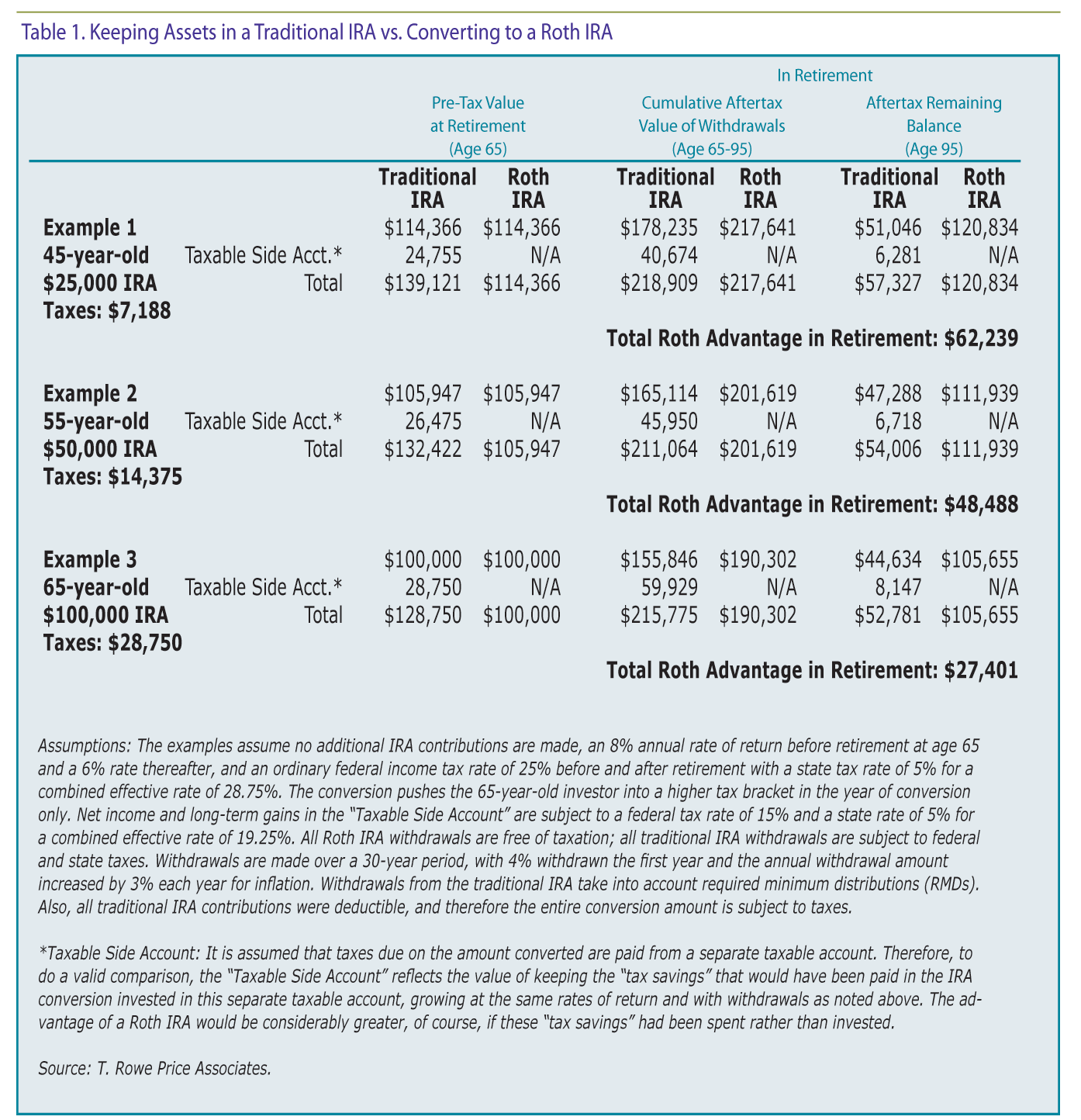
Keep in mind that the taxable amount converted into the Roth IRA is considered taxable income, so it is possible that a large conversion could push the investor into a higher tax bracket for a particular year, increasing the tax due on the converted amount. The 65-year-old investor in this example, for instance, saw her combined marginal federal-state tax rate jump from 28.75% to 31.6% for one year as a result of the $100,000 conversion.
That is one reason investors might prefer to convert portions of their traditional IRA over several years, rather than doing it all in one year. This approach may enable investors to avoid a big jump in tax liability in a single year.
Building a Tax-Free Nest Egg
While a Roth IRA conversion may not provide substantial additional benefits for investors who consider their IRAs a source of steady income in retirement, it could prove extremely worthwhile for those who can afford to accumulate a fund for possible emergency expenses later in retirement, or possibly leave tax-free assets to their beneficiaries.
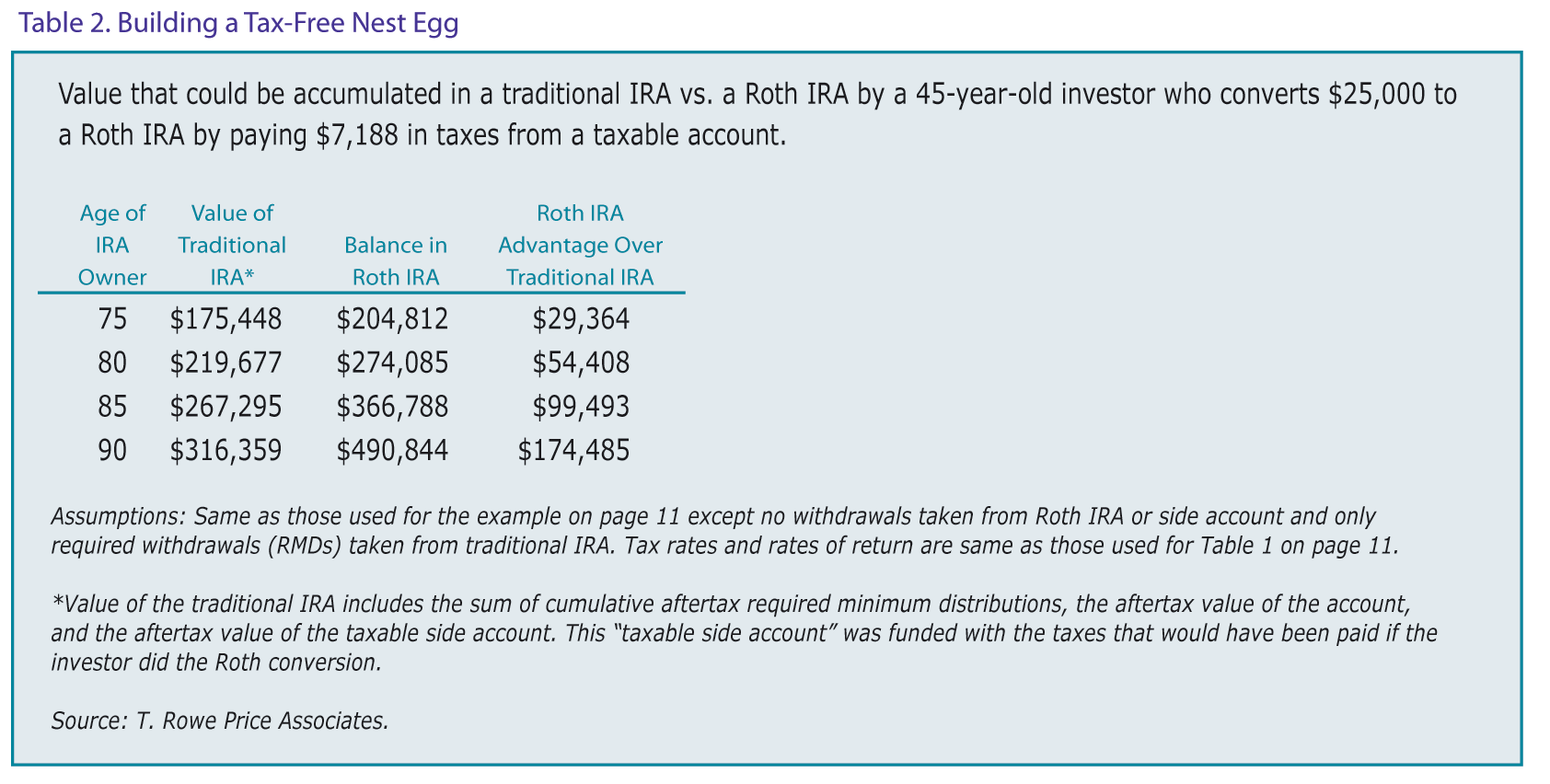
For example, what if the 45-year-old making a $25,000 Roth IRA conversion (as detailed in Table 1) made no withdrawals from the account? (Remember, a Roth IRA is exempt from required minimum distributions (RMDs), which the owner of a traditional IRA must make upon reaching age 70½ and for each year thereafter.)
Roth IRA Conversion Basics
If you are considering converting assets from a traditional IRA to a Roth IRA, here are some nuts and bolts:
- A key advantage is that the amount converted from a traditional IRA and any future earnings in the Roth IRA can be withdrawn tax-free in retirement (after age 59½) if the account has been established for at least five years. Beneficiaries inheriting a Roth IRA may also be able to take distributions tax-free.
- The investor must pay income taxes on the taxable amount of the traditional IRA (earnings plus any deductible contributions) converted to a Roth IRA. In 2010 only, investors who complete a Roth IRA conversion will have the option of paying taxes due on the conversion for that tax year, or spreading the taxable income equally between the 2011 and 2012 tax years.
- If tax rates remain the same or decline after 2010, it would most likely be advantageous to delay the tax payment for a Roth IRA conversion completed in calendar year 2010. If tax rates rise modestly after 2010—as they are set to do unless Congress passes a new tax law next year—it may be better to pay the tax for a 2010 conversion for the 2010 tax year, assuming the conversion itself does not push the investor into a higher tax bracket in 2010.
- Because taxes due on a Roth IRA conversion completed in 2010 would not be payable until April 15, 2011, the investor should know by then what new tax rates, if any, are in effect, and make the decision of when to pay the tax at that time. (In this case, the actual conversion would have to have taken place on or before December 31, 2010.)
- The taxable portion of the amount converted from a traditional IRA is calculated based on all the investor’s traditional IRA accounts—not just the one that may be tapped for conversion. So, if the investor had made any non-deductible contributions to a traditional IRA account, the portion of any conversion that is not subject to tax would be the total aftertax contributions to all his or her traditional IRAs divided by the total value of all the traditional IRAs at the time the conversion is made. The same rule applies to any additional Roth IRA conversions made in subsequent years.
- To minimize the tax impact in any one year, the investor can do several partial conversions spread out over different tax years, but only conversions in 2010 are eligible for a delay in paying taxes due on conversion.
- Those who make a Roth IRA conversion can later nullify it and “recharacterize” the amount converted to a traditional IRA (certain restrictions apply).
- No required minimum distributions must be made from a Roth IRA during the account owner’s lifetime. In a traditional IRA, required minimum distributions (RMDs) must be taken beginning for the year the investor reaches age 70½, and each year thereafter.
The accumulated results for this investor at various ages are shown in Table 2. By age 85, for example, the balance in the Roth IRA would have grown to more than $366,000, or about $100,000 more than the balance in the traditional IRA if the conversion had not been made. This money could provide a comfortable cushion for unexpected expenses late in retirement.
A Bonanza for Beneficiaries?
The Roth IRA could provide a significant advantage over a traditional IRA if it turns out the owner did not need the money and leaves it to beneficiaries.
Non-spouse beneficiaries of an inherited Roth IRA must take required minimum distributions from the account over their own remaining actuarial life expectancy (certain conditions apply). But such distributions over this extended period may be income-tax-free, whereas all earnings and deductible contributions withdrawn from an inherited traditional IRA are taxable to the beneficiary. Beneficiaries can take more than the minimum amount at any time.
If the 45-year-old investor used in previous examples died at age 85 and bequeathed the $366,000 accumulated in the Roth IRA to a 55-year-old child beneficiary, the total Roth IRA benefit could be more than $1 million by the time this beneficiary reached 75 (assuming only required minimum distributions were taken from the account and using the same return assumptions noted in Table 1). This would be almost double the amount left in the traditional IRA.
If the money were left to a 25-year-old grandchild instead of the 55-year-old child, it could grow to as much as $4.6 million by the time the grandchild reached 65 compared with $2.3 million from a traditional IRA, applying the same assumptions.
This strategy could also prove extremely worthwhile even for older investors entering retirement, who may be much more certain they want to carve out a tax-free bequest for heirs.


Consider the hypothetical 65-year-old investor who converts $100,000 to a Roth IRA and pays the $28,750 in taxes from a separate account. If she takes no distributions, she will have an account balance of more than $320,000 by age 85 (using the same return assumptions as in Table 1).
If she dies at that age and leaves the money to a 55-year-old child, for example, it could provide more than $1 million in cumulative tax-free distributions and the remaining account balance after 25 years—or more than twice as much as if the money had remained in the original traditional IRA. The potential benefit, at various ages of the beneficiary, is reflected in Table 3.
A Roth IRA is one of the most valuable assets people can leave their children or grandchildren. The investments are tax-sheltered, the income can be tax-free, and, after the death of the Roth IRA account owner, those who inherit the assets can make withdrawals based on their life expectancies, generally to age 80 or older.
While the benefits of a Roth IRA conversion could be considerable, investors must carefully weigh the upfront tax costs against the long-term tax advantages. Those considering a conversion should consult their tax advisors for the best strategy.