Related

Financial Planning
As 401(k) plans have largely replaced traditional pensions, baby boomers have become the first generation that must decide how much of their savings to spend each year in retirement. Boomers must find a strategy that best balances the risk of outliving their wealth against the cost of unnecessarily restricting their consumption.
This article, which is adapted from our recent paper and originally published on the Center for Retirement Research at Boston College’s website, explores the possibility of basing withdrawals on the Internal Revenue Service’s (IRS) rules for required minimum distributions (RMDs) for 401(k) retirement plans and individual retirement accounts (IRAs). The analysis compares an RMD strategy with existing rules of thumb and with a pattern of optimal withdrawals.
The first section details the rules of thumb, including the proposed RMD strategy. The second section defines an optimal strategy, which serves as a benchmark for comparing the rules of thumb. The third section provides the results of this comparison. The fourth section suggests a way to modify the RMD strategy to bring it closer to the optimal strategy. The final section concludes that the RMD strategies offer retirees a reasonable trade-off of the benefits and risks inherent in spending down one’s retirement savings.
People adopt rules of thumb for drawing down their assets because rules are relatively simple to follow. This section describes the traditional rules of thumb and then discusses the potential for an RMD strategy.
Traditional rules of thumb include relying on the investment earnings produced by the assets, calculating withdrawals based on life expectancy and adopting the so-called “4% rule.”
Spend interest only. Some retirees use the straight-forward strategy of leaving the principal in their retirement accounts untouched and spending only the dividends on stocks and the interest on bonds or certificates of deposit (CDs). This strategy can work for wealthy individuals, but has serious drawbacks for people who lack substantial retirement savings. One disadvantage is that, when they die, they will leave behind all of their initial wealth plus capital gains. This strategy may be desirable for those who want to leave a bequest, but in other cases it unnecessarily restricts retirement consumption.
Another drawback to the “interest only” strategy is that a retiree’s income—and consumption—are dictated by his asset allocation. The retiree then runs the danger that the tail (the desire to consume) may begin to wag the dog (investments), resulting in a portfolio allocation that does not minimize the risk for any given level of expected return on the portfolio. That is, the retiree may over-invest in dividend-yielding stocks, losing the benefits of portfolio diversification.
Base withdrawals on life expectancy. A second drawdown strategy used in retirement is to spend all financial assets over one’s life expectancy, as predicted by life tables. The equation for calculating annual withdrawals under this strategy is as follows, where r is a risk-free interest rate on the investments and year t is the remaining life expectancy:
Annual withdrawal = (r ÷ (1 – (1 + r)-t)) × wealth
This strategy has two significant drawbacks. First, the above equation is not a simple calculation for most people. Second, retirees face a high probability—a 50% chance—that they will outlive their savings and be forced to rely solely on Social Security.
Adopt the 4% rule. A third strategy is to spend a fixed percentage of one’s initial retirement savings. For example, under the so-called 4% rule advocated by some financial planners, the retiree each year withdraws 4% of that initial balance. The advantage is that the retiree has a low probability of running out of money. The downside is that such a rule does not permit retirees to periodically adjust consumption in response to investment returns. For example, if returns are less than expected in a given year, the retiree should respond by reducing consumption to preserve the assets—a fixed 4% withdrawal is not consistent with such flexibility.
An alternative strategy is to base withdrawals on the IRS’s required minimum distribution (RMD), a percent of assets that individuals are required to withdraw each year starting at age 70½. (Failure to take the required minimum distributions results in a 50% tax on the required withdrawal amount.) The IRS makes no claim that the RMD, which is designed to recoup deferred taxes, is the basis of an optimal drawdown strategy. Yet an RMD approach satisfies four important tests of a good strategy.

To determine which real-world strategy would produce the best possible outcome, the rules of thumb can be compared with an optimal wealth drawdown strategy.
Managing retirement wealth involves trading off the enjoyment of spending one’s assets on consumption against the risk of spending too much and prematurely depleting one’s resources. The household’s goal is to optimize this trade-off—in economic jargon, to maximize the expected utility of consumption. This analysis uses the example of a married couple in which the spouses are the same age and both retire at age 65. The husband receives Social Security benefits of $12,000 annually, and the wife receives $6,000 through a spousal benefit, for a total household income of $18,000 per year. Assume that the household has $250,000 in financial assets, excluding the equity in their house. The investment options include stocks and risk-free bonds. (The assumed real interest rate for the risk-free bonds is 3%, which is above current rates, but approximates the long-run average rate.) Each year the household decides how to allocate its assets between stocks and bonds and how much to take out of its account. The model yields a drawdown pattern that maximizes the expected utility of consumption.
The next step is to conduct a horse race in which the benefits generated by the optimal drawdown strategy are compared with the benefits of the traditional rules of thumb. This comparison uses a measure called Strategy Equivalent Wealth (SEW). The number for each strategy is the factor by which the dollar value of the household’s wealth, at age 65, must be multiplied so that the couple is as well off as a household that follows the optimal strategy.
The optimal strategy has an SEW of 1.0, and the SEWs for the suboptimal strategies are, by definition, greater than 1.0. [Editor’s note: SEW scores for suboptimal strategies are above 1.0 because it takes more assets to achieve the same benefits.]
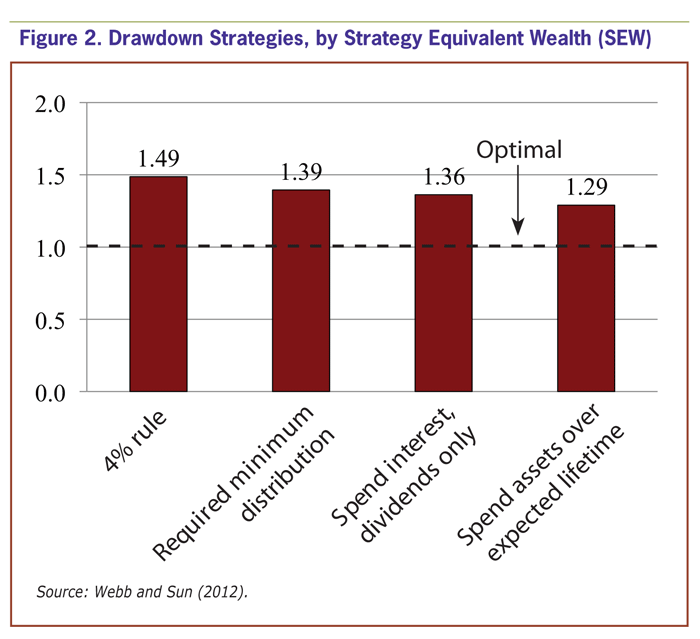
Figure 2 shows the results for the retired couple. For the rules of thumb, the SEW factors range from 1.29 for the life-expectancy strategy (the best) to 1.49 for the 4% rule (the worst). Interestingly, the RMD approach, with an SEW of 1.39, performs better than the 4% rule. In dollar terms, the couple would need about $25,000 more—or 10% (1.49 – 1.39) of their $250,000 savings—to be persuaded to use the 4% rule instead of the RMD strategy. The RMD approach also has advantages over the other rule-of-thumb strategies, as discussed earlier, that are not captured in the SEW calculations. For example, the RMD approach is easier to follow than the life-expectancy strategy. In addition, the RMD approach does not provide a temptation to chase dividends, which the interest-only strategy does.
A potential criticism of the RMD rule is that it results in relatively low consumption early in retirement. While this outcome might be optimal for some households, particularly those fearful of rising health care costs, others might prefer greater consumption at younger ages when they are better able to enjoy it. This result could be achieved by a modification to the RMD rule, namely to consume interest and dividends (but not capital gains), plus the RMD percentage of financial assets. To illustrate, a 65-year-old couple with financial assets of $102,000 who received $2,000 of interest and dividends in the last year, would spend $5,130: the $2,000 in interest and dividends, plus 3.13% (the annual withdrawal percentage at age 65 under the RMD strategy) of $100,000. In contrast, a household following the unmodified RMD rule would spend just $3,130.

Figure 3 compares the SEW of the modified RMD strategy with the SEWs of the strategies reported in Figure 2. At a factor of 1.03, it outperforms all the alternatives, including the unmodified RMD rule. The disadvantage of the modified RMD rule is its greater complexity. Although 401(k) and IRA statements report interest and dividends, households must extract this information and perform the necessary calculations to determine their withdrawal amount. One solution might be for 401(k) and IRA statements to report the amount available for spending under the modified RMD rule.
Rather than attempt the complex calculations necessary to arrive at an optimal strategy for drawing down and spending their retirement savings, retirees rely on easy-to-follow rules of thumb, such as the 4% rule advocated by some financial planners. This article suggests that the IRS’ required minimum distribution rules may be a viable alternative.
For financial and practical reasons, the effectiveness of the alternative RMD strategy compares favorably to traditional rules of thumb. And a modified RMD strategy does even better.
Financial Planning
Financial Planning