Related

Stock Strategies
One of the toughest decisions investors face is determining when to sell.
Selling can mean locking in a profit and potentially missing out on further gains. Selling can also mean locking in a loss, along with the regret of doing so.
Deciding when it is best to sell is tough for a few reasons. Comparatively little has been written about selling relative to the vast amount of insight published about how to choose which stocks to buy. We humans tend to value the things we own more than the things we don’t (the endowment effect). We are also more willing to sell investments that have risen in price than ones that have fallen in price (the disposition effect).
There are, of course, reasons for selling that go beyond merely parting with a stock. An investor may sell shares to fund portfolio withdrawals. Alternatively, shares may be sold to adjust a portfolio’s allocations. A stock may be sold for tax purposes, such as realizing a capital loss, with the intent of repurchasing the same shares 31 days or more later. [Wash sale rules disallow a loss being recognized for tax purposes if a substantially identical stock (or securities) is purchased within a 30-day period.]
Whatever the reason for selling, just as much prudence and discipline should go into the sell decision as goes into the purchase decision. The ultimate success or failure of an investment depends on the proceeds received when it is sold. Having a well-defined approach to selling is what helps separate the truly successful investors from all others.
In this article, I share insights from famous investors and experts in the field of finance. The guidance covers a broad range of investing styles, from contrarian value to momentum-driven technical analysis. Though there are similarities and differences, a common underlying theme should be evident: When the stock no longer matches the spirit of your investing strategy, get rid of it.
One of the most basic rules of investing is to sell an investment when the reasons for buying it no longer apply. This simple rule underlies all guidance on when to part with an investment. In the guidance that has been written about selling, this is one that is commonly referred to in one form or another.
For example, in “One Up on Wall Street” (Simon & Schuster, 1989), Peter Lynch wrote, “If you know why you bought a stock in the first place, you’ll automatically have a better idea of when to say good-bye to it.” This is why it is critical to write down the reasons you bought a stock: It sets up a marker in time about what attracted to you to the stock in the first place. By recording those details, you have a set of information to compare the stock against in the future.
While writing down the reasons for purchase, stop to think about what would cause you to sell the stock. You will be the least biased before purchase. Once you buy a stock, the endowment effect will cloud your judgment. Should the stock fall in price, your natural inclination to avoid a loss and admit to having made a mistake will cause you to downplay negative changes in the stock’s evolution and favor any signs of positive changes.
Our Model Shadow Stock Portfolio rules show how this works. The portfolio seeks out shares of companies that are too small to attract institutional investor interest (hence they trade in the “shadows” of Wall Street) and have very low price-to-book-value (P/B) ratios. Shadow stocks are sold if their market capitalization or their price-to-book ratio rises above three times the maximum limit for purchase. Currently, stocks must have market capitalization of between $30 million and $300 million to qualify for purchase and are sold if market capitalization rises above $900 million. The price-to-book ratio cannot exceed 1.0 to qualify for purchase and stocks whose price-to-book ratios rise above 3.0 are sold. The ranges may be adjusted from time to time based on market conditions, but the philosophy of buying micro-cap companies trading at low valuations and selling when they are no longer either micro-cap or cheaply valued never changes.
Though sell strategies vary, there are general rules that can be applied. Here are brief guidelines for the four major investing styles:
An alternative version of selling when the reason for purchase no longer applies is to ask: “If I didn’t own the stock, would I buy it today?” Asking this question and working through the answer can lead to more rational action. It only works if there is a disciplined approach to buying, however. Donald Cassidy’s “Hold vs. Sell” worksheet can assist with working through this question. The worksheet was published in the August 2008 AAII Journal (“How to Nail Down Your Profits: 20 Questions for a Disciplined Approach”). This article and all others mentioned here are linked in the online version of this article.
One way of identifying whether a stock’s potential risks now outweigh its potential for reward is to periodically analyze the company’s financial strength and business conditions. If either or both show signs of weakness, it may be time to get out. This is particularly the case if the stock was purchased based on its perceived fiscal soundness or the prospects for its business.
The exact criteria to look at depends on the type of strategy followed. Several authors suggest considering the company’s current and expected growth rates. John Neff, who ran Vanguard’s Windsor mutual fund (VWNDX), advised looking at a stock’s five-year growth rate and earnings estimates. Philip Fisher, whose (writings influenced Warren Buffett, said to sell a stock when a company no longer has the same prospects for increasing the market for its products the way it once did. Value Investor Insight newsletter founders John Heins and Whitney Tilson suggest parting with a stock when the company’s future earnings power is impaired by competition.
As far as the fundamentals are concerned, David Dreman advised in his book “Contrarian Investment Strategies: The Next Generation” (Simon & Schuster, 1998) to sell immediately when a company’s long-term fundamentals deteriorate significantly. Pay attention to that adjective “long-term”: Dreman does not think a stock should be sold simply because of a bad quarter or a temporary, negative surprise. Rather, he focuses on major changes that weaken a stock’s prospects. The Model Shadow Stock Portfolio will remove a stock if operating earnings for the trailing 12 months are negative and the firm has a subsequent negative quarter before operating earnings turn positive. At least two quarters are used to give companies an allowance for one bad quarter in which earnings may have been affected by one-time or temporary events. Lynch looked not only at slowing growth but also at limited opportunities to cut costs more, the loss of market share, rising inventories and slower turnover of those inventories (particularly at cyclical companies) and narrowing profit margins.
Viewed from another angle, Grizzly Short Fund (GRZZX) co-manager Greg Swenson pays attention to deteriorating profit margins, high levels of capital expenditures (identifiable on the cash flow statement) and growth in total assets as a sign that a stock may be at risk of falling in price. “[Companies] that really over-leverage themselves tend to not have everything turn out perfectly and run into issues,” opined Swenson in the March 2016 AAII Journal (“Shorting: A Strategy for Profiting From Price Declines”).
If a stock performs exceptionally well, but does not trigger any sell rules, its weight within a portfolio can become increasingly large. The larger weighting alters the risk profile of the portfolio by increasing the influence that one stock has on the portfolio’s overall returns.
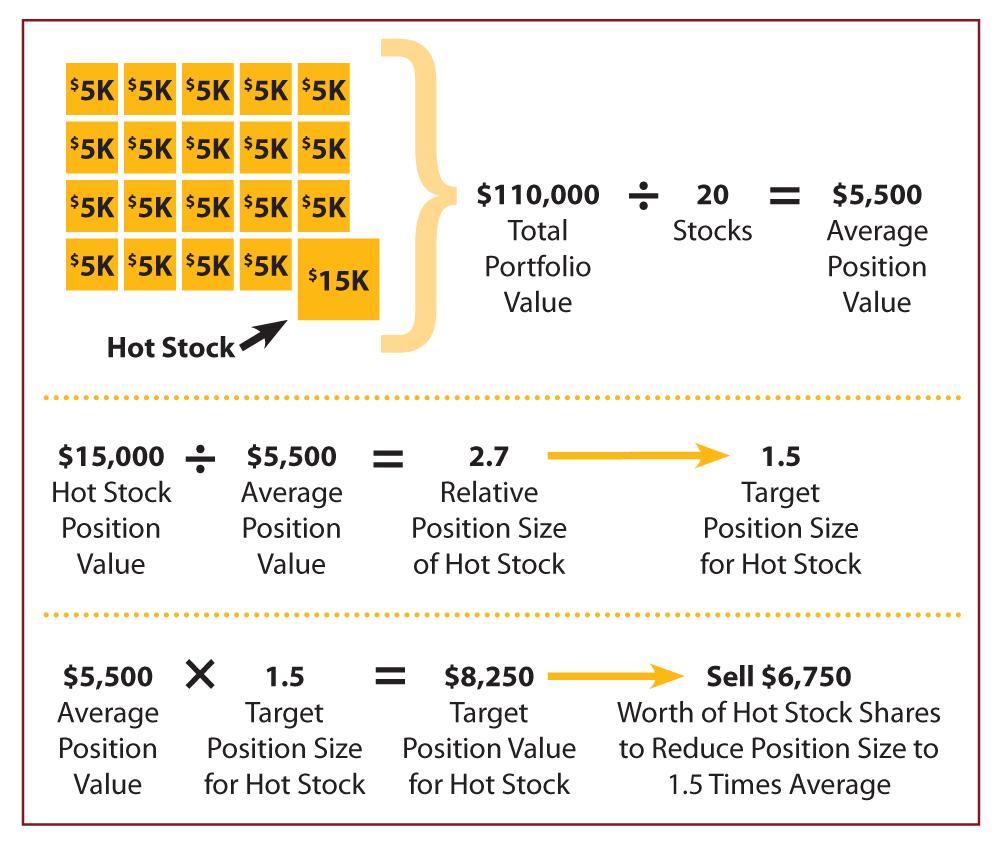
To prevent any single stock from exerting too much influence, both the Stock Superstars Report and the AAII Dividend Investing portfolio have a rule for paring down large positions. The rule caps the weighting of any single stock to a maximum of 2.5 times the average position size. When a stock’s weighting exceeds this limit and no other portfolio deletion rules are being violated, the holding will be pared down to 1.5 times the desired average position size.
The simplistic example presented in Figure 1 shows how this rule works. Say a portfolio starts with $100,000 invested equally in 20 stocks, or $5,000 per stock. One stock then triples in value to $15,000, while the other 19 stocks are unchanged. This causes the total portfolio to be worth $110,000 (19 stocks worth $5,000 and one stock worth $15,000). The average position size of all 20 stocks is now $5,500, instead of $5,000 ($110,000 ÷ 20 stocks = $5,500). The position size of the hot stock is 2.7 times the portfolio average ($15,000 ÷ $ 5,500 = 2.7).
If the hot stock does not violate any other portfolio deletion rules, some of the shares are sold to reduce its weighting. Specifically, using the above example, the position is reduced to $8,250, which is 1.5 times the average position size of $5,500. Doing this allows the winner to keep running, while at the same time reducing the stock’s influence on the overall portfolio to an acceptable level.
The use of preset targets for selling has been widely recommended by many. The criteria used for setting those targets varies, however.
Some experts have been more general in their guidance regarding targets. Neff said to sell a stock when the price approaches expectations. Heins and Tilson quoted several portfolio managers as saying to sell when a stock reaches fair value. Cassidy suggested setting a price target and selling above it.
Others have been more specific. Dreman called for selling a stock when its price-earnings (P/E) ratio approaches that of overall market. He cautioned to pay attention to the reason for the higher price-earnings ratio and avoid selling if the valuation is elevated by a one-time charge or a temporary change in business conditions. (Dreman believes mechanical guidelines are the safest approach to making sell decisions.) Lynch believed “stalwarts” should be sold when their price-earnings ratios rise above a normal range, such as three or four points above the industry average. A looser range for fast-growing companies can be applied, with an upper limit of 40 or 50. As previously noted, the Model Shadow Stock Portfolio rules call for selling a stock when its price-to-book ratio or market capitalization reaches three times the maximum limit for purchase.
Investor’s Business Daily founder William O’Neil discussed selling many stocks when their price gains totaled between 20% and 25% in the January 2004 AAII Journal (“When to Sell and Nail Down Your Profits—While You Still Have Them.”) Exceptions may be made if an overall strong bull market is occurring, if the stock is clearly one of the best performers and if the stock breaks out to the upside by 20% on good volume. He added, “If all of these ‘ifs’ apply, then I will hold a stock for at least eight weeks from its breakout buy point.”
Geraldine Weiss also looked to charts, but in a different way from O’Neil. She used charts to identify the range in which a stock’s dividend yield traded on a historical basis. Based on this analysis, she advised selling a stock when its yield fell to a historically low level. (Yields and valuations are inversely related.) In her book “Dividends Don’t Lie” (Longman Financial Services Publishing, 1988), Weiss also recommended selling stocks whose yields are within 10% of their overvalue range if the market is overvalued.
Ellis Traub’s method is similar to Weiss’. Traub calculates a “signature P/E,” which is the mean or median price-earnings ratio of the high and low price-earnings ratios for the past five-to-10 years. Stocks are candidates for sale if their current price-earnings ratio is 1.2 times or greater than their signature P/E. Traub further wrote that “it might be a good idea” to find a buyer before a stock reaches 1.5 times its signature P/E. A more detailed explanation of Traub’s methodology can be found in the October 2015 AAII Journal article, “Using Rational Value to Judge a Stock’s Worth.”
An alternative way of using valuation ratios as price targets is to sell when a stock becomes pricey. According to James O’Shaughnessy’s “What Works on Wall Street” (McGraw-Hill, 2012), stocks whose price-earnings, price-to-book or price-to-sales ratios rank in the highest 40% of all stocks underperform.
A notable opponent to price and valuation targets was Philip Fisher. In his book “Common Stocks and Uncommon Profits,” (John Wiley & Sons, 2003), he asked, “How can anyone say with even moderate precision just what is overpriced for an outstanding company with an unusually rapid growth rate?”
One of the most basic rules in investing is to sell a stock when the reasons you bought it no longer apply. But how are you going to recall what those reasons were? You could try to remember the price-earnings ratio, the revenue growth rate, the relative strength rank or the dividend yield, but memories tend to evolve over time. Plus, humans can be forgetful.
A better solution is to a keep a diary of your investing decisions. Write down the reasons why you bought the investment and what you perceive as possibly going wrong. By doing so, you are establishing a marker in time about what you think about the investment. This will establish a list of criteria you can compare your stock against in the future to determine if it has changed in a positive or negative manner.
A spiral notebook works great for this. It’s cheap, simple to use and what you write down will not change as long as nothing physically happens to the notebook. Alternatives include, but are not limited to, a pad of paper, a white board, a Microsoft Word document, a smartphone app such as Evernote, or even Google Docs. It really doesn’t matter what you use as long as you consistently jot down your observations and refer back to them when analyzing your portfolio.
A subject of greater disagreement is stop limits (selling a stock when its price reaches a specified limit). Lynch “always detested ‘stop orders.’” At the other end of the spectrum is O’Neil’s call for selling any stock whose price falls 8% from purchase. In between lies a range of opinions.
In his study of traders, portfolio manager Lee Freeman-Shor found many who will cut their losses between 20% and 33%. Weiss recommended parting from stocks with big profits and high valuations whose prices decline by 10%. She described this as “an especially wise tactic” for an investor who is emotionally attached to a stock.
Time is used as a limit as well. The same traders that Freeman-Shor found using price limits as a trigger to sell stocks also often cut stocks that underperformed the market over periods of three to six months if there were no signs of a recovery. He called such traders assassins in “The Art of Execution” (Harriman House, 2015). Dreman advised selling stocks that have not worked out after a period of two and a half to three years, three and a half years for cyclical stocks. Dreman further noted that Sir John Templeton parted with stocks whose prices underperformed after a period of six years.
Notably, in 2010, AAII founder Jim Cloonan removed a rule calling for any stock in the Model Shadow Stock Portfolio held for more than two years and not currently meeting the purchase criteria to be sold. He found that this rule did not improve returns and unnecessarily increased the number of transactions.
Fund manager Guy Spier has an alternative take on time limits. He will not sell a stock that has dropped in price after purchase for at least two years. About the seemingly long period he explained, “this rule acts as a circuit breaker, a way to slow me down and improve my odds of making rational decisions,” in the April 2015 AAII Journal (“Nine Rules for Smarter Investing.”)
Deciding what to do when it becomes obvious that purchasing a stock was a mistake is much simpler: Just sell it. Hedge fund manager David Einhorn explained to Heins and Tilson, “We try not to have many investing rules, but there is one that has served us well: If we decide we were wrong about something, in terms of why we did it, we exit, period. We never invent new reasons to continue with a position when the original reasons are no longer available.”
Fisher listed parting with a mistake as one of his three reasons for selling a stock. He wrote, “More money has probably been lost by investors holding a stock they really did not want until they could ‘at least come out even’ than from any other reason. If these actual losses are added to the profits that might have been made through the proper reinvestment of these funds if such reinvestment had been made when the mistake was first realized, the cost of self-indulgence becomes truly tremendous.”
Part of the challenge of correcting a mistake by a selling a stock is to overcome our natural inclination to avoid losses. Daniel Kahneman and Amos Tversky theorized that humans feel greater aggravation from losing money than pleasure from gaining the same amount. As such, investors often sell stocks with gains, but hold onto stocks with losses in hopes of getting back to breakeven. This behavior is known in behavioral economics circles as the disposition effect. University of California–Berkeley professor Terry Odean explained this behavior in the November 2014 AAII Journal (“Trading More Frequently Leads to Worse Returns”): “What I think happens is when people buy stocks or any investments, they really focus on the future. When they sell, I think a lot of investors focus on the past.”
Neff advised that whenever one feels like bragging about a stock, it’s probably time to sell. Having the discipline to do so is important because falling in love with a stock is very easy and very perilous. Dreman simply recommended not to be stubborn, not to be greedy and not to be afraid to take small losses.
There are a few final factors to take into consideration.
Both Lynch and O’Neil warned about stocks getting too much positive attention and CEOs who are overly optimistic. They suggested selling when the CEO is on the cover of magazines, the company is viewed as the next big thing or new corporate headquarters are built. Both also warned about acquisitions, particularly if the CEO goes on a buying spree and targets companies with no clear synergies or overlap.
On the other hand, Dreman and Fisher warned about selling just because another stock seems more attractive. Dreman cautioned that doing so creates an opportunity for error. Fisher pointed to the risk of some major element being misjudged with the new stock. He added that an investor is likely to have much better knowledge about the stocks currently owned than the ones considered as replacement candidates.
Do not let taxes determine the sell decision. Rather, a stock should be sold once it violates the sell rules. The only exception would be to hold onto a stock if a profit has been earned and if waiting a short period of time will extend the holding period to 12 months, thereby making profits eligible to be taxed at the reduced long-term capital gains tax rates. [Capital gains are not taxed on stocks held in individual retirement accounts(IRAs).]
Finally, consider this observation from John Neff:
“Successful stocks don’t tell you when it’s time to sell them…you can be right as rain about a stock’s potential, but if you hold on too long, you will end up with nothing.”
Stock Strategies

Behavioral Finance