Related

Computerized Investing
Many AAII members are either nearing or in retirement. Many also have years of investment experience. Since April is Financial Literacy Month, we wanted to find out what insights on investing are being shared with younger generations.
This issue’s “big question” inquired about the type of advice given to a child or young adult who is new to investing. Though there was variance in answers, we saw many similarities. A common refrain we heard was the importance of starting early and being a consistent saver.
 The question was asked as part of a survey about the subject. The survey itself is part of a newer, periodic initiative to give AAII members such as yourself a chance to talk about their investment decisions and challenges. Each survey asks what we’re describing as a “big question” about a subject affecting many investors. A randomly selected group of AAII members is asked a specific question, as well as follow-up questions intended to provide more clarity and background.
This third question in the series was emailed to AAII members in early March. The results were tabulated based on responses sent to us. We received 157 responses from the survey invitation. The average age of respondents was 69 and the median age was 70.
Q: What advice would you give to a child or young adult who is starting to invest?
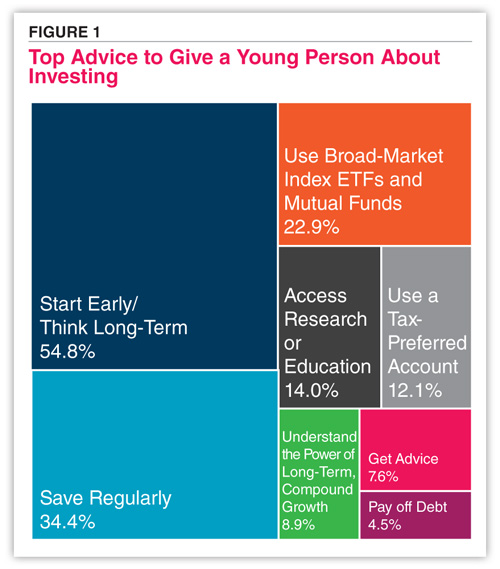
More than one-third of respondents (34%) advised children and young adults to start investing as early as possible and to think long-term when doing so. Nearly 22% of respondents emphasized the importance of saving.
There was much overlap between the two groups, with the differences attributable more to how we categorized the responses than the underlying message given. Several AAII members suggested to start saving at a young age and to then set the money aside into an investment account. Some respondents framed their advice in terms of budgeting by allotting a certain percentage of salary to investing.
Raymond Eisenberg, for instance, wrote, “At a young age, you have time to overcome volatility. When you are new to the workforce, set aside at least 10% of your salary to invest. Open a Roth IRA as soon as you are eligible.”
Eisenberg was not alone in suggesting the use of a tax-preferred account. About 8% of respondents specifically suggested an IRA, a Roth IRA or a 401(k). We also saw many respondents (14%) recommend the use of an index mutual fund or exchange-traded fund (ETF). Other common suggestions were understanding the concept of compounding and the importance of learning about investing.
“Put as much money as possible in a Roth IRA for the long term, investing 100% in stocks,” wrote Hemant Patel. He then added, “Save as much as possible and live frugally for the first 20 years or so to be able to invest.”
Most reviewed their advice as being universal. When asked “Would/do you give the same advice about investing to a young person who is not related to you as you would give to a relative,” 98% of respondents said yes.
Q: Have you helped a young person start investing?
Next, we asked AAII members if they have helped a young person start investing. Nearly four out of five respondents (78%) said yes, they have. More than half have helped their children (57%). A quarter helped their grandchildren while 18% helped other relatives. Notably, 22% said they helped a young person who was not a relative to start investing.
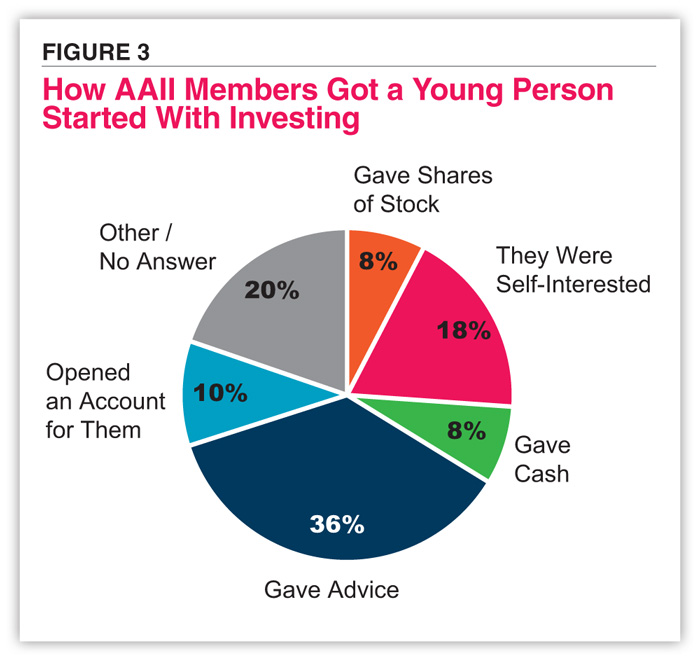
The most common way of getting a young person interested in investing was to simply give them advice. More than one-third of respondents (36%) said this is what they did. About 18% said the interest in investing came from the child or young adult. There was overlap between the two.
“I didn’t get them interested,” explained Norma Pappalardo when talking about her great-grandchildren. “They expressed an interest in investing (I think by observing me), told their mother that they wanted to invest too, and she asked me to guide them.”
Others used the power of compounding to raise interest in investing. George Rowlett was among them. He started by illustrating how savings grow with interest compounding. His next steps were to pick “a stock that they liked (they liked the product), find a good time to enter the imaginary (paper) trade and then track it. Next, a few more they found interesting—always growing the investment. After three to four months, greed hooked them for life!”
Some respondents either opened an account on behalf of the young person or helped them to make their first investment. Thomas Haugen gave his daughter and grandchildren “mutual funds for diversification and stocks in companies whose products they used or could relate to.” As an example, his grandson owns shares of PepsiCo Inc. (PEP), Kellogg Co. (K) and Deere & Co. (DE).
Approximately 36% of all respondents gave the gift of cash, stocks or funds. There was not a common amount given. Rather, amounts ranged from hundreds of dollars to tens of thousands of dollars. Some gave stocks or made contributions directly to a young person’s account. A few said they made regular gifts.
“I dollar cost averaged into [my children’s] accounts in small amounts every month ($100–$250 per month),” wrote Peter Heyl. “My youngest child had more to start with than my two older children, because I was more knowledgeable in making investments than I was (at age 27) when I had my first.”
In a separate email, Heyl expounded: “Unless one is indoctrinated very early in life into the ideas that, over the long term, the stock market is the best way to accumulate wealth, time is on one’s side and one chips off whatever little bit they can and gives it to a mutual fund on a monthly basis, they will be forced to start late, invest greater amounts to achieve the same accumulation goals and always feel a little bit behind.”
Q: What type of investment do you think a young person (child or young adult) should start with?
The majority of respondents thought children and young adults should start by owning mutual funds (54%) and/or ETFs (52%). Stocks were also a popular option (33%). In a nod to the lengthy time horizons, only 6% thought bonds were appropriate.
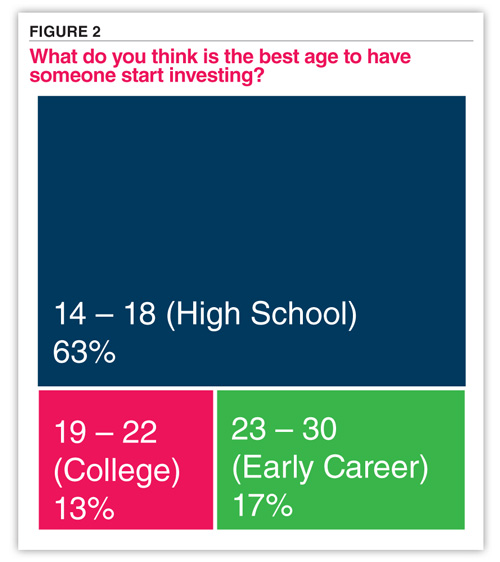
As far as what is the best age for a young person to invest, high school (defined as ages 14 to 18) was the most popular among the options given. It was picked by 63% of all respondents. Early career (defined as ages 23 to 30) was second at 17%. College (ages 19 to 22) was picked by just 13%.
Q: Who encouraged you to start investing?
Though AAII members are helping younger family members start investing, many were not as fortunate when they were young. Almost two out of five credited their own self-motivation or interest as the reason they began investing.
“Nobody. All my parents had were certificates of deposit (CDs). Everyone else kept their finances private. I didn’t start until I had enough money in an IRA that I had to decide where to put it,” explained Alcide Mann. In a follow-up email, he explained that his parents grew up during the Great Depression.
About one-third of respondents were either influenced or aided by a family member. Some respondents listed a specific relative, with responses like “my dad.” Others explained how they were influenced by their family members.
Hugh Blanchard was motivated both by the “prospects of someday being able to retire” and the experiences of his father. Blanchard told us, “My dad was not very well prepared to retire, so I did not want to end up in the same situation in my life.”
Steve Morehead was inspired by a different experience, one involving his grandmother. “She took me to a bank to watch an electronic stock ticker,” recalled Morehead.
Other respondents credited experts, such as Louis Rukeyser’s shows, or their peers.
Q: What specific investing advice do you wish you were given when you were starting out?
As far as what respondents wish they were told when they started out on their investing journey, the dual concepts of starting early and investing for the long term topped the list (32%). Coming in second was the concept of having a regular strategy.
Echoing the sentiment of others, Jim Otten wrote, “Start sooner.” He added, “Hold through long-term ups and downs (tougher to do than to say!)”
Close to 16% wished the basics of investing had been emphasized. We grouped a mix of responses in this category including an understanding of how stocks and funds work, the importance of paying attention to fees and knowing how to research investments.
Saving was brought up by 14% of respondents. They wished an emphasis on being a disciplined and regular saver had been instilled in them.
Q: What resources would you point a young beginning investor to?
Our final questions focused on resources.
First, we asked respondents what resources they suggest a young investor read or access. Close to two-thirds (62%) said a print and/or digital publication. These included investing-focused books, magazines, newsletters and blogs. The research reports, tools and educational materials available on brokerage websites were listed by 27% of respondents. Other web-based tools were suggested by 24% of respondents. It was not uncommon to see more than one resource listed.
John Hallquist suggested, “Websites like Morningstar and Yahoo Finance. I pass along my copies of the AAII Journal.” He views the two mentioned websites as “good for the young folks who don’t yet want to commit to a membership in AAII.”
Some AAII members listed specific books. Dennis Clark listed four books he thought covered the basic concepts: “Getting Started in Fundamental Analysis,” by Michael C. Thomsett; “Stocks for the Long Run,” by Jeremy Siegel; “Rich Dad Poor Dad,” by Robert T. Kiyosaki; “The Four Pillars of Investing,” by William Bernstein.
Then we asked what resources they wish existed for those who are just starting out with investing. Mandatory classes focused on personal finance and investing topped the list, with 18% asking for them. “I wish we had an economics class in high school back in the day. It would have been extremely valuable,” wrote Charles Freed.
Other respondents suggested financial publications [books, magazines, blogs, etc. (12%)] and better access to or improved awareness of web-based resources (11%).
Computerized Investing

Portfolio Strategies

Beginning Investor