

Related

Computerized Investing
This year’s broker guide includes the mobile services brokers offer and compares app-based capabilities against their web-based counterparts.
by AAII Staff | January 2020
Much has changed in the past year in the discount-brokerage space. Price competition has led to a slashing of commissions and to a big proposed merger.
Charles Schwab attempted to cement its position as the largest discount broker with an announcement in November of plans to acquire TD Ameritrade, itself the second-largest discount broker. This announcement came one month after Schwab’s other major announcement of zero-commission trading of stocks, exchange-traded funds (ETFs) and options listed on U.S. or Canadian exchanges across all its mobile and web trading channels. A similar move to zero commissions had already been made by Interactive Brokers for its IBKR Lite pricing plan and led many other competitors to follow suit, including Merrill Edge in early December.
The change in commissions by the large brokers is mimicking a similar ongoing practice that was already in place with app-based firms. Although still relatively new, low-fee mobile trading predates the broker industry’s most recent consolidation and revenue-structure changes. The digital startup Robinhood launched in 2012 and popularized both zero-commission and mobile trading among millennials. Some of the digital startups that have entered the investment and brokerage market offer services only through their mobile apps.
Thanks to expanding internet coverage and smarter technologies, the investment and brokerage services industry is undergoing changes at many levels within its marketplace. Technology-focused startups are reorganizing how investments are made from the bottom up, while older, industry-leading brokers are restructuring their fees and services, digital and brick-and-mortar based, from the top down.
Meeting somewhere in the middle, the largest brokers are onboarding the new tools, analysis and services that are being brought to market by tech startups, while their bread-and-butter services, such as trading, become cheaper and more accessible—all of which is good news for individual investors.
Despite the industry-changing zeal of new mobile-based investment services, the primacy of web-based trading platforms and the advanced features that most offer mean that the personal computer still reigns over the smartphone when comparing total functionality. In a survey of AAII members, only a third of respondents said they use a mobile brokerage app—a significant percentage but still a small amount of the whole.
Despite a smaller user base to draw from, there is a wide variety of mobile apps with an array of features. And, considering the improving computing power, screen size and interconnectivity of devices (smartphones, smartwatches and tablets), we thought it prudent to include coverage of the services brokers are offering through mobile apps. This year’s broker guide includes the mobile capabilities brokers offer and compares these app-based capabilities against their web-based counterparts.
Featured in the guide are the large, well-known brokerages offering typical services: Ally Invest, Charles Schwab, E-Trade, Fidelity, Interactive Brokers, Merrill Edge, Robinhood, TD Ameritrade and Vanguard. We’ve also included three mobile-app-only micro-investing brokers that offer alternative, less robust features focused on beginner investors and the ability to purchase fractional shares: Acorns, Stash and Stockpile.
AAII Survey: Has the Change to $0 Commissions Affected How You Invest?
We asked the AAII members who participated in our broker survey the above question to get a feel for the impact of the broker zero-commission trade policies.
The majority who responded said that zero-commission trading has not affected how they invest. In general, they follow long-term buy-and-hold strategies that already minimized commission costs.
However, respondents did mention behavioral changes. Without commissions costs, some said they were likely to trade more frequently and in smaller volumes, leveraging dollar cost averaging. Others said they would more frequently rebalance their portfolios and sell off minor holdings. With extra cash and upsides to trading, respondents also said they will broaden their diversification and take small chances on investments they found too speculative before.
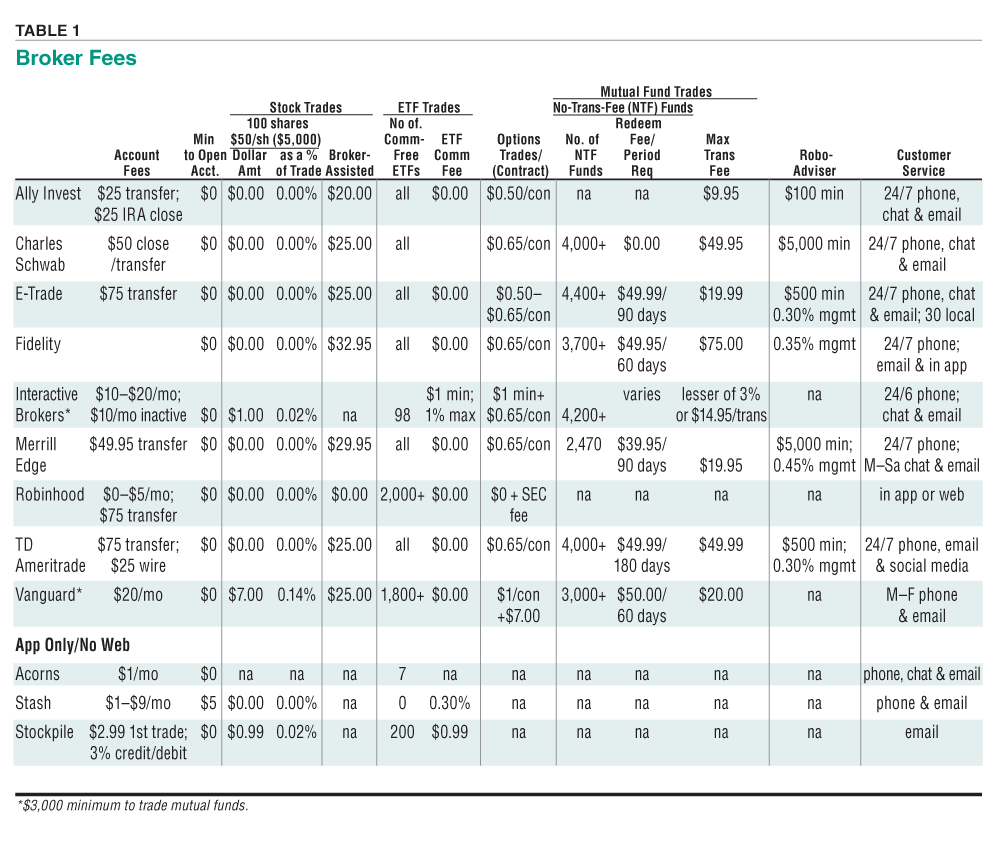
Brokerage fees are typically viewed from the standpoint of commission charges—the fee assessed for each trade. There are a number of additional fees that you should take into consideration when choosing a broker, particularly with commission charges on stock, ETF and option trades on their way to zero across the industry. A broker’s fee schedule details all services and costs and should be consulted.
Fees may be assessed for a number of services, including account transfers and closings, account maintenance (which may depend on activity or even the balance), investment management (if wealth advisory services are used) and wire transfers. E-Trade, for example, charges $75 for a full account transfer but doesn’t charge a fee for a partial transfer.
Broker assistance can be an additional charge when trading securities online, but it may be helpful if you are uncomfortable placing a trade yourself or otherwise require human assistance. Usually, the fee charged for an assisted trade is the same whether you are trading stocks, ETFs or options.
Although most fees and account balance requirements have been eliminated, some trades are still subject to small charges. Exchanges pay a transaction fee to the U.S. Securities and Exchange Commission (SEC) based on the volume of securities sold. The exchanges, in turn, levy a fee on brokers to offset what they pay the SEC. If the charge is then passed down to the investor, you may see it listed as an SEC or processing fee on your trade confirmations. These fees are typically nominal in size.
Robinhood’s basic account, Robinhood Instant, has no maintenance fee, but they charge $5 per month for their upgraded account that offers extra tools and data. The Instant account includes access to instant deposits and extended-hours trading, and participants don’t have to wait for their funds to process when they sell stocks or make a deposit (up to $1,000). A Robinhood Gold account is similar but gives investors access to more buying power and larger instant deposits. A third account type, Robinhood Cash, allows commission-free trades during standard and extended-hours trading sessions; however, investors won’t have access to instant deposits or instant settlements.
AAII Survey: Do You Use a Mobile Brokerage App and Which One?
There are two main ways to interact online with a broker today to invest, conduct research and analysis and access other broker features: through their website and/or via a mobile broker app. AAII members who responded to our survey indicated a preference for accessing their broker’s trading platform, resources and tools from their desktop computers rather than from the broker’s mobile app.
More than 760 individual investors participated in our survey. Here are a few highlights:
Do you use a mobile brokerage app? Which one?
Only 32% of respondents said they use a mobile brokerage app. Of those members who use an app, the most popular ones are Charles Schwab, at 23%; Fidelity, at 21%; and TD Ameritrade, at 19%. In the group of 15% of respondents who use multiple mobile apps, the majority use a combination of Fidelity, Schwab, TD Ameritrade and E-Trade.
What do you like or dislike about using an app for investing?
Of the AAII members who responded to our survey, 23% use Charles Schwab, 21% use Fidelity and 19% use TD Ameritrade—all of which now feature $0 commissions on stock, ETF and options trades. However, not all discount brokers have eliminated commission fees. Vanguard, whose services encourage buy-and-hold strategies, has a tiered structure based on the amount invested. Accounts with less than $50,000 pay a $7 commission fee on their first 25 trades and $20 thereafter. Commission prices are substantially reduced as the account size enters higher tiers. Accounts with $500,000 to $1 million pay commissions of $2 per trade for all trades.
Interactive Brokers also has tiered commissions. They charge $0.005 per share with a minimum transaction price of $1.00 per trade and a maximum of 1% of trade value. Unlike Vanguard, Interactive Brokers’ tiers are based on the volume of shares traded per month, with higher tiers for investors that trade in large volumes.
Also different from other brokers is Interactive Brokers’ tiered structure for account fees. Accounts with a balance below $100,000 incur trade commissions of $10 per month. For accounts with less than $2,000, the minimum amount of charged commission is $20. Interactive Brokers’ IBKR Lite plan offers zero-commission trades with no account minimum but with less functionality than its other plans.
With zero-commission stock trades now standard, the number of commission-free ETFs is no longer a distinguishing feature between brokers. Just one year ago, Vanguard led its competitors with about 1,800 ETFs offered commission-free. Now, most discount brokers are offering all approximate 2,400 U.S.-listed ETFs on a zero-commission basis.
Most of the discount brokers included in this guide offer no-transaction-fee (NTF) mutual funds. Ally Financial charges a $9.95 commission on the purchase or sale of no-load mutual funds, but not for load mutual funds.
Though options can now be traded for $0 commissions at most discount brokers, a $0.65 per contract fee is still common. Robinhood does not charge contract fees. Interactive Brokers and Vanguard have their own tiered structures.
More information about the fees charged by the brokers in this guide can be found in Table 1.
Most of the 12 online discount brokers discussed here facilitate the trading of stocks, ETFs, bonds, options and mutual funds. Investors have a limited choice of brokers that trade futures, currencies or commodities. Out of those covered in this article, only Charles Schwab, E-Trade, Interactive Brokers and TD Ameritrade facilitate futures trading. Forex, or foreign currency exchange, trading is only offered by Ally Invest, Charles Schwab and Interactive Brokers. Those who want to trade cryptocurrencies such as bitcoin and ethereum can do so through Robinhood in most U.S. states. TD Ameritrade allows the trading of bitcoin futures if certain requirements are met.
Robinhood does not offer trades for mutual funds or bonds. Stash only offers a few hundred stocks and 60 ETFs. Stockpile offers more than 1,500 stocks, ADRs and ETFs. Acorns automatically invest clients’ deposits into one of five ETF portfolios. Acorns does not facilitate the trading of individual stocks or ETFs; however, this app-based broker takes a unique approach, aiming to facilitate the needs of beginner traders by guiding investors toward diversified and risk-averse prebuilt portfolios.
Micro-investing is quickly becoming popular and includes the option to purchase fractional shares or invest spare change. Micro-investing allows investors with smaller balances or who are making small deposits to buy a portion of a stock. This can be helpful for newer investors who may lack enough savings to acquire a full share of a stock trading at a price above $100 or $1,000 per share. It makes investing more accessible, especially for those who are looking for an inexpensive way to buy and sell. Acorns, Robinhood, Stash and Stockpile all allow the purchase of fractional shares. In October 2019, Schwab announced that it is planning to offer the option to purchase fractional shares.
The interface systems for placing orders are not identical for any two online brokers, but web-based platforms for the traditional discount brokers provide similar options to facilitate and manage the execution of trade orders. Trading platforms commonly deliver a variety of advanced screening and analytical tools, such as streaming real-time quotes, integrated charts and backtesting. All in all, finding the right trading platform for you depends upon personal preferences and needs.
For active traders, Charles Schwab, Fidelity, Interactive Brokers and TD Ameritrade have both website and mobile-based platforms that deliver sophisticated trading features. TD Ameritrade has two different mobile trading apps, one of which targets advanced traders by offering additional tools and trading capabilities. Charles Schwab has two mobile apps, Schwab and StreetSmart, both with similar features. Schwab also offers an additional browser platform called StreetSmart Edge with advanced features including robust charting tools and free live streaming of CNBC. Fidelity also provides an additional resource for its active traders through the company’s browser platform at ActiveTraderPro.com. Although Interactive Brokers does not have an alternative trading platform, the broker’s mobile app provides advanced features and tools that aim to mimic the browser-based platform.
E-Trade has two mobile apps, E-Trade Mobile and OptionsHouse, that provide an integrated and easy-to-use interface with access to almost all the same features as the company’s browser. OptionsHouse includes additional features for a more complex trading experience.
For beginners, the best platforms should be user-friendly and provide a wide range of educational materials and market research. Acorns, Ally Invest, Robinhood, Stash and Stockpile are more suited for new investors with little trading experience. These brokers provide simple and easy-to-use browser and mobile-based platforms with similar features and trading capabilities.
While Merrill Edge’s website is easy-to-use and offers several screeners and analytical tools, the company’s mobile-based platform is less robust. The app provides far fewer analytical tools and does not include any screeners. Unlike most brokers, Vanguard does not facilitate trades through its mobile app, only allowing users to check accounts, analyze portfolios and conduct research.
Many of the broker apps covered in this article offer around-the-clock market news, research reports, earnings estimates, the ability to set alerts, watchlist tracking, fundamental stock data and educational videos. As would be expected, some offer more comprehensive tools than others.
Given the limited screen space, conducting technical analysis on mobile trading apps may not be ideal. During our data collection we noticed that screening and charting capabilities on mobile platforms are more limited than on the web. While many of the apps do offer technical analysis capabilities, it’s important to keep in mind that a majority offer more advanced features on their web-based platforms.
A Beginner’s Take on the Stockpile App
My grandfather has always been involved in the stock market. After I started working at Starbucks, he gifted me stock in it through Stockpile so I could feel more involved in the company and so I could learn about the stock market.
The app is very modern. It gives me all the information I need to stay informed about my stock, without being overwhelming for someone like me who is new to the stock market. The clean interface made it easy for me to learn how buying and selling works and watch my investment rise and fall in price.
Stockpile also let me automatically reinvest my Starbucks dividends. It was as easy as the click of a button—literally. Now, any time Starbucks issues cash dividends, the money goes directly back into my stock so I own more shares.
One drawback is Stockpile’s customer service. The company has no physical stores and no phone services, so emailing is the sole way to get in touch with someone. When I first created my account, I was confused about how to redeem my gift card and it took a couple of days before a representative responded to me.
What I think the app does best, though, is get young people excited about starting their journey with the stock market in a visually inviting and helpful way.
—Augusta Battoclette, college student
Some apps with more advanced research and analysis capabilities include those offered by E-Trade and TD Ameritrade. E-Trade’s app includes stock and ETF screeners, options chain filters, comparison and performance charts and CNBC Video on Demand. The TD Ameritrade mobile app’s tools include performance of buy/sell recommendations, broker ratings from 20+ research firms and charting capabilities. Additionally, TD Ameritrade offers a Mobile Trader and a thinkorswim app, both of which offer more advanced charting capabilities that cater to active traders looking to trade options, futures or forex on a mobile platform (not available to trade on the standard TD Ameritrade Mobile app).
Mobile platforms with more limited technical analysis capabilities include: Acorns, Robinhood and Stockpile. Notably, these apps do offer educational tools and may be a good starting point for first-time investors.
As always, if you are seeking out a specific feature, check the broker’s website to see if it is available.
Robo-advisers, like mobile brokerage apps, are quickly becoming mainstream, which is good news for consumers looking for low-cost financial advice. For those unfamiliar with the concept, robo-advisers provide portfolio recommendations and automatically adjust allocations based on an algorithm. Since robo-advisers have grown in acceptance, the range of services offered has expanded significantly. Many now offer socially responsible investment portfolios, access to human financial advisers and comprehensive digital financial planning tools. In general, they offer less personalized service than traditional full-service brokers and financial advisers, but they also charge less. Robo-advisers can work well for investors who desire professional guidance, but have smaller amounts to invest, don’t have complex financial situations, prefer a systematic approach over one based on human judgment and/or simply prefer a low-cost solution.
Because robo-advisory services are not traditionally mobile-app based, we looked at whether our list of brokers had automated advisory services on either their mobile or web platforms. A few apps that offer these services include: Ally Invest, E-Trade, Fidelity and TD Ameritrade. Acorns allocates investors’ money to one of five portfolios, similar to robo-advisers offering basic features. App-exclusive Stash and Stockpile do not offer robo-advisory services. [Editor’s note: To learn more about robo-advisers, see “Robo-Advisers Expand Services and Experience Some Growing Pains” by Ken Schapiro, in the June 2019 AAII Journal.]
| Broker Contact Info |
|
Acorns www.acorns.com |
|
Ally Invest www.ally.com/invest 855-880-2559 |
|
Charles Schwab www.schwab.com 800-435-4000 |
|
E-Trade www.etrade.com 855-432-6834 |
|
Fidelity www.fidelity.com 800-544-3455 |
|
Interactive Brokers www.interactivebrokers.com 877-442-2757 |
|
Merrill Edge www.merrilledge.com 888-637-3343 |
|
Robinhood https://robinhood.com |
|
Stash www.stashinvest.com 800-205-5164 |
|
Stockpile www.stockpile.com |
|
TD Ameritrade www.tdameritrade.com 800-454-9272 |
|
Vanguard www.vanguard.com 877-662-7447 |
There are some things in life that probably aren’t wise to do hands-free—like driving or eating a sandwich—but as online/mobile brokers continue to adapt to changing technology, we found that a handful of broker apps now offer smart watch and smart speaker capabilities.
Of the brokers covered in this article, Ally Invest, E-Trade, Interactive Brokers, Schwab, TD Ameritrade and Vanguard offer the ability to get real-time quotes and check your account balance via smart speakers like Amazon’s Alexa or Google Assistant.
Notably, the same apps are also available on smart watches from Apple (some offer Samsung) and closely mirror the apps on mobile devices. It’s important to take into consideration the very limited screen space on many smart watches, and always be sure to be aware of your surroundings when using voice-enabled services to ensure your account information isn’t compromised.
Most of the established discount brokers discussed in this article offer various banking services on a browser- and/or mobile-based platform. Mobile app banking features generally allow users to deposit checks, transfer money and pay bills.
Since Merrill Edge operates under Bank of America, it offers the most integrated online banking services. Reward credit cards are offered by Charles Schwab, Fidelity, Merrill Edge and TD Ameritrade.
Acorns does not offer the option to pay bills through any of its platforms. Interactive Brokers does not offer any check-writing services, including the option to deposit checks through its mobile app. Robinhood offers a debit card and, at the time of publication, had a waitlist for its cash management service. Stockpile does not offer any banking services.
For those who prefer to handle certain investing and wealth management activities in person rather than over the phone or the internet, the location of physical offices matters.
Charles Schwab, Fidelity, Merrill Edge and TD Ameritrade have the largest number of office locations worldwide. E-Trade also has locations in many cities, while Vanguard only has a handful of office locations. The brokers that do not have any physical offices include Acorns, Ally Invest, Robinhood, Stash and Stockpile.
All 12 brokers highlighted in this article bring a wide range of features and offerings, making each a potential choice for many investors.
Choosing the best online broker for you depends upon personal preferences relating to the website and mobile platform interface and your most desired features.
For those who are indecisive, choose the broker that offers the most desirable features and offers the lowest fees for the type of investing you plan on conducting.
Computerized Investing

AAII InvestoGraphic

Beginning Investor

Barry Estell from California posted over 6 years ago:
Barry C Johnson from Texas posted over 6 years ago:
Lawrence Brown from Illinois posted over 6 years ago:
Dave Cummins from Indiana posted over 6 years ago:
John Di Marco from New Jersey posted over 6 years ago:
Bois from CA posted over 6 years ago:
Dave G from WA posted over 6 years ago:
Derek from Minnestoa posted over 6 years ago:
You need to log in as a registered AAII user before commenting.
Log InCreate an account