

Related

Stock Strategies
A key to understanding the options to choose from when placing an order to buy or sell a stock or an ETF.
by AAII Staff | October 2018

When placing a trade for a stock, or an exchange-traded fund (ETF), you will be met with a myriad of options to choose from. Each choice has implications for the type of order placed and how—and whether—it will be executed. In this InvestoGraphic, we discuss the most common order types you are likely to see.
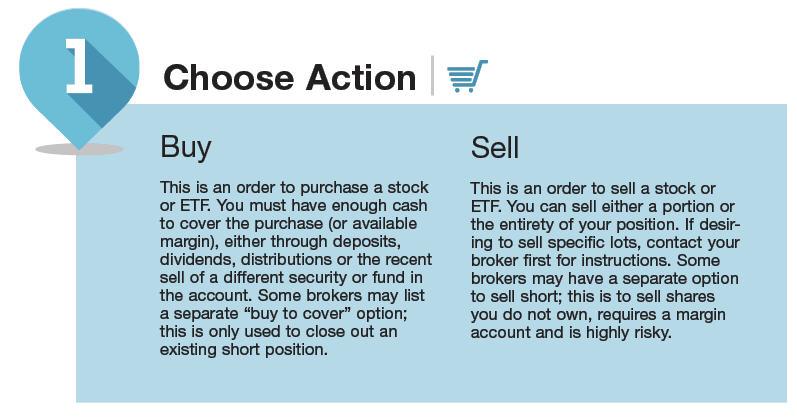
This is an order to purchase a stock or ETF. You must have enough cash to cover the purchase (or available margin), either through deposits, dividends, distributions or the recent sell of a different security or fund in the account. Some brokers may list a separate “buy to cover” option; this is only used to close out an existing short position.
This is an order to sell a stock or ETF. You can sell either a portion or the entirety of your position. If desiring to sell specific lots, contact your broker first for instructions. Some brokers may have a separate option to sell short; this is to sell shares you do not own, requires a margin account and is highly risky.
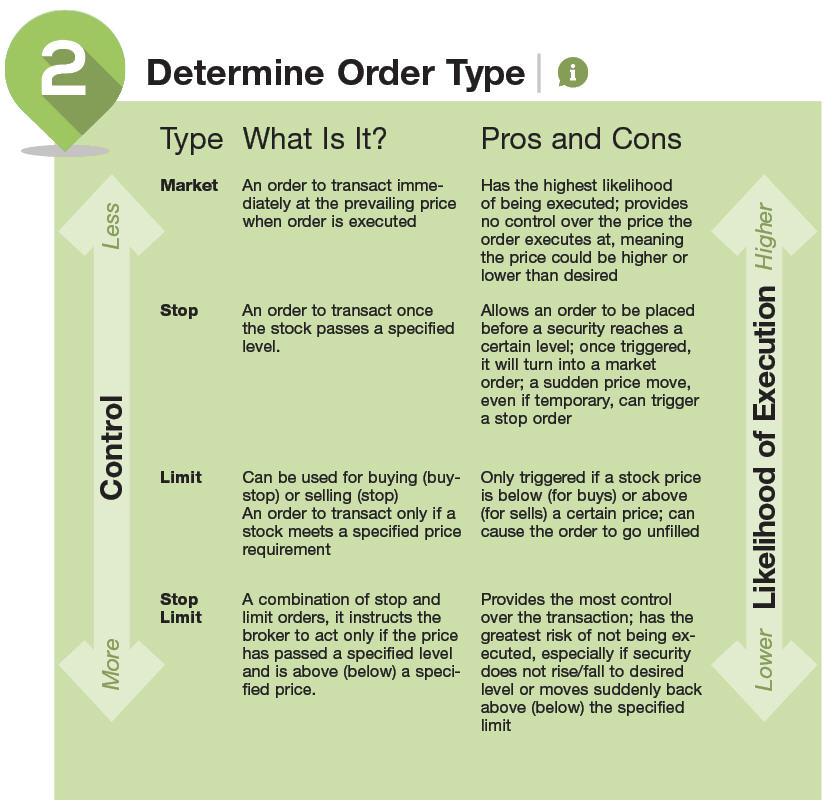
| Type | What Is It? | Pros and Cons |
|---|---|---|
| Market | An order to transact immediately at the prevailing price when order is executed | Has the highest likelihood of being executed; provides no control over the price the order executes at, meaning the price could be higher or lower than desired |
| Stop | An order to transact once the stock passes a specified level. | Allows an order to be placed before a security reaches a certain level; once triggered, it will turn into a market order; a sudden price move, even if temporary, can trigger a stop order |
| Limit | Can be used for buying (buy-stop) or selling (stop). An order to transact only if a stock meets a specified price requirement | Only triggered if a stock price is below (for buys) or above (for sells) a certain price; can cause the order to go unfilled |
| Stop Limit | A combination of stop and limit orders, it instructs the broker to act only if the price has passed a specified level and is above (below) a specified price. | Provides the most control over the transaction; has the greatest risk of not being executed, especially if security does not rise/fall to desired level or moves suddenly back above (below) the specified limit |
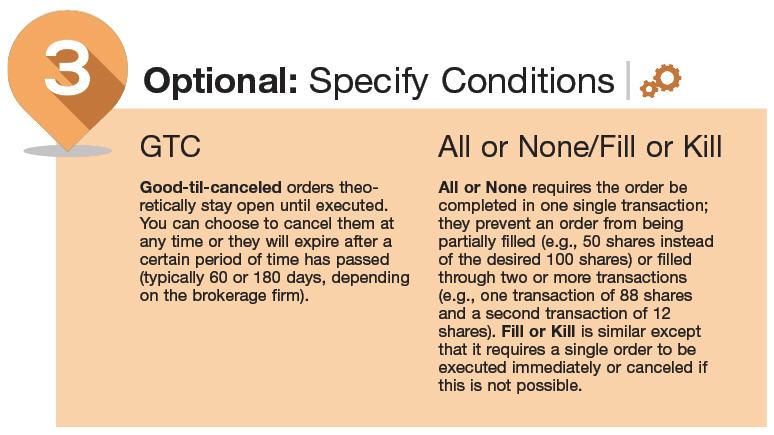
Good-til-canceled orders theoretically stay open until executed. You can choose to cancel them at any time or they will expire after a certain period of time has passed (typically 60 or 180 days, depending on the brokerage firm).
All or None requires the order be completed in one single transaction; they prevent an order from being partially filled (e.g., 50 shares instead of the desired 100 shares) or filled through two or more transactions (e.g., one transaction of 88 shares and a second transaction of 12 shares). Fill or Kill is similar except that it requires a single order to be executed immediately or canceled if this is not possible.
Stock Strategies

Beginning Investor

Gary Kraus from LA posted over 8 years ago:
Gary Kraus from LA posted over 8 years ago:
Belinda Romero from MO posted over 7 years ago:
You need to log in as a registered AAII user before commenting.
Log InCreate an account