Related

Value Investing
Article Highlights:
Josef Lakonishok and his colleagues have been quietly dispelling the adage “those who can’t do, teach.”
This professor-turned-money manager is the chief executive officer and chief investment officer of LSV Asset Management, which manages over $118 billion in value equity portfolios. LSV has academic roots and was named after its founding partners: Josef Lakonishok, Ph.D., (former William G. Karnes Professor of Finance at the University of Illinois at Urbana-Champaign), Andrei Shleifer, Ph.D. (professor of economics at Harvard University) and Robert Vishny, Ph.D. (Myron S. Scholes Distinguished Service Professor of Finance at the University of Chicago, Booth School of Business). The firm’s philosophy is to buy out-of-favor companies that are beginning to show signs of awakening.
Lakonishok is a contrarian who believes that investors with patience can profit from a value-oriented investment approach.
Over the long run, according to Lakonishok, value outperforms growth because investors don’t expect much from it. When a value stock does better than expected, investors are pleasantly surprised and are more apt to reward the company by bidding up the stock.
Lakonishok also believes that investors expect too much from growth stocks. It is unrealistic to believe that strong growth lasts forever. Eventually, the company will miss an earnings target or lower their earnings guidance, and the market will punish the stock price.
In the book “Investment Titans: Investment Insights From the Minds That Move Wall Street” (McGraw-Hill, 2001), Jonathan Burton talks with Lakonishok about his approach. The Lakonishok screen in AAII’s Stock Investor Pro fundamental stock screening and research program is AAII’s interpretation of Lakonishok’s methodology as outlined in this book. The screen seeks mid- and large-cap firms that have:
The AAII Lakonishok screen is built into AAII’s Stock Investor Pro. In addition, the companies meeting the criteria of this strategy are posted each month on AAII.com in the Stock Ideas section, where the performance of the stocks in hypothetical portfolios is tracked online.
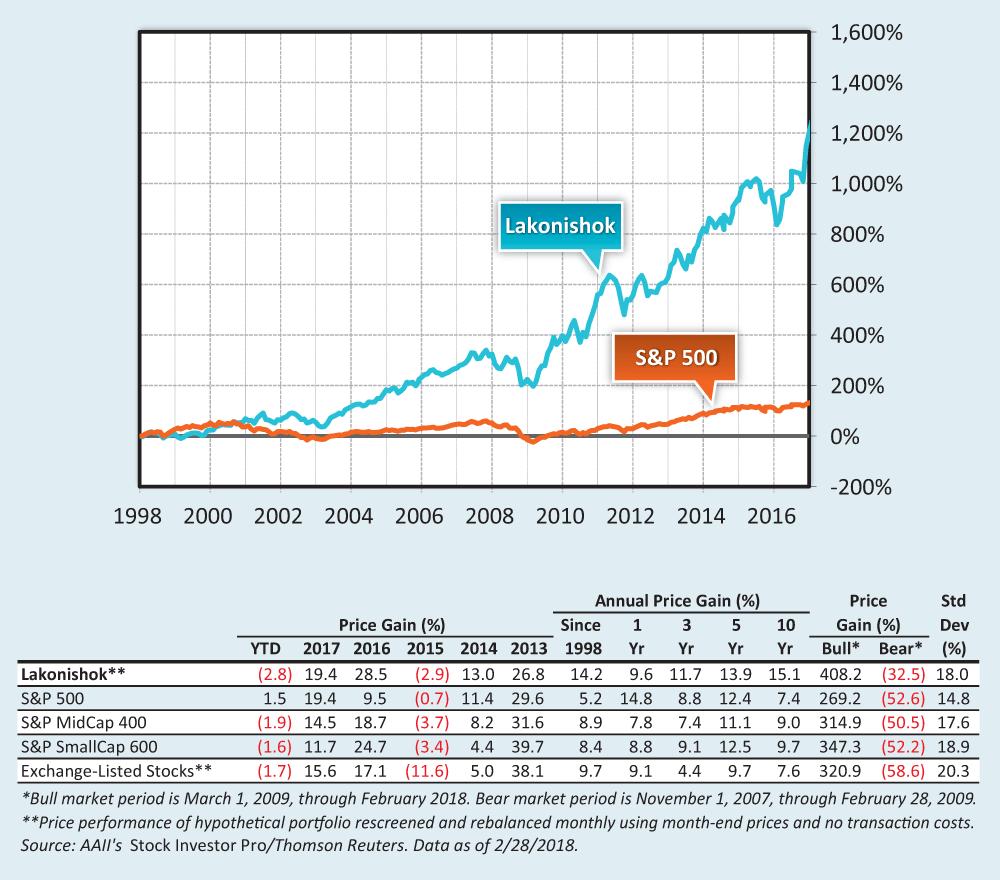
The Lakonishok approach has outperformed the large-cap S&P 500 index and other broad market indexes since the beginning of 1998.
Figure 1 shows that the Lakonishok approach has generated a compound annual price gain of 14.2% over the period from January 1998 through February 2018, while the S&P 500 is up only 5.2% annually over the same period. Overall, growth approaches have outperformed value approaches over the last 10 years, yet our interpretation of the Lakonishok strategy has outpaced the growth indexes across all market-cap segments during the last decade.
The strategy held up well during the last bear market (November 2007 through February 2009), down 32.5% versus a loss of 52.6% for the S&P 500, and has shined during the subsequent bull market (March 2009 through February 2018) gaining 408.2% compared to cumulative price gain of 269.2% for the S&P 500.
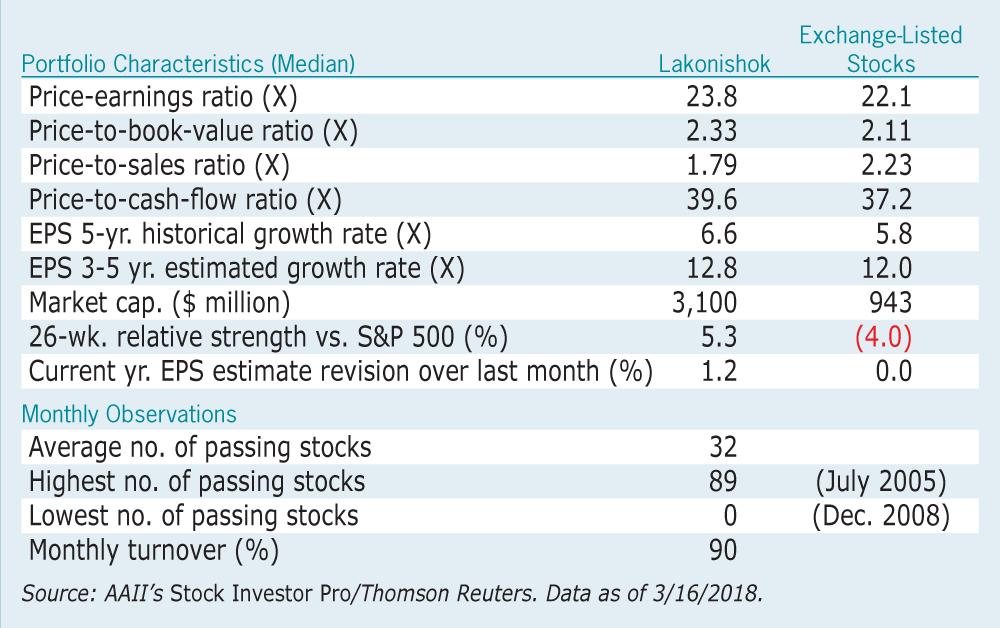
The Lakonishok approach is a unique filter that looks for any one of the primary price multiples—price-earnings ratio, price-to-book-value ratio, price-to-sales ratio or price-to-cash-flow ratio—to be below the norm for their industry. As revealed in the characteristics of the stocks currently matching the Lakonishok approach (presented in Table 1), the median values of these price multiples are generally low but not extremely low. Only the price-to-sales ratio median value of 1.79 for the stocks passing the Lakonishok screen is below the 2.23 median value of all exchange-listed stocks.
While there are no elements of growth in the AAII Lakonishok screening strategy, those companies currently meeting the criteria have a higher median historical earnings growth rate (6.6%) than that of the typical exchange-listed stock (5.8%). Interestingly, the median estimated earnings growth rate of the out-of-favor passing companies is 12.8%, while for all exchange-listed stocks the median is 12.0%.
The median market capitalization of the Lakonishok stocks is $3.1 billion, compared to only $943 million for all exchange-listed stocks. Larger stocks tend to be more mature, and older, more mature firms tend to have fewer growth opportunities going forward. The Lakonishok approach looks for a minimum market cap of $500 million.
The AAII Lakonishok strategy requires a stock to have outperformed the S&P 500 over the last 26 weeks and at least maintained that price strength over the last 13 weeks. The companies currently meeting the AAII Lakonishok criteria have outperformed the S&P 500 by a median value of 5.3% over the last 26 weeks. Meanwhile, the typical exchange-listed stock has underperformed the S&P 500 by 4.0% over the same period.
Lastly, Lakonishok looks for stocks with rising earnings estimates. Over the last month, the median consensus earnings estimate for the current fiscal year of the passing Lakonishok companies has increased 1.2%.
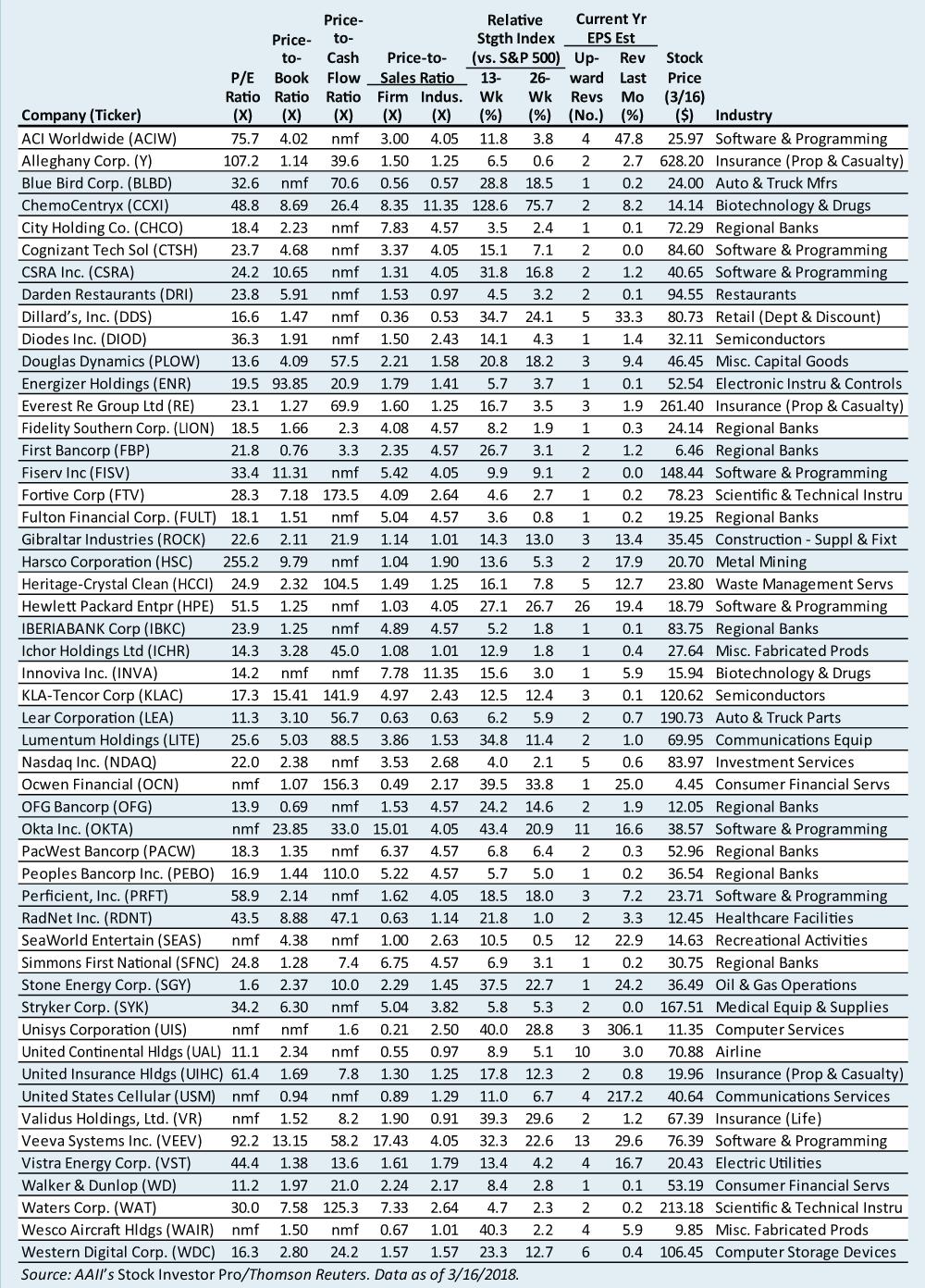
Fifty-one companies met the Lakonishok criteria as of March 16, 2018. They are listed in Table 2 in alphabetical order.
The current number of passing companies—51—is significantly greater than the historical monthly average of 32.
To meet the criteria and qualify as potentially undervalued, a company’s price-to-book, price-to-cash-flow, price-earnings or price-to-sales ratio needs to be below the median for its industry. The key consideration is that a firm can be included if just one of these four ratios is less than that of its industry.
A significant number of passing firms do not have meaningful figures for one of the price multiples. The underling variable must be positive for a firm to have a meaningful price multiple. For example, United Continental Holdings’ (UAL) large capital expenditures during 2017 exceeded its positive operating cash flow, resulting in negative overall cash flow for the firm.
Simply buying an out-of-favor stock is a risky endeavor, as there is a chance that the company will never rebound or, worse yet, that it will die altogether. Therefore, Lakonishok looks for value companies that appear to be making a resurgence in terms of stock price.
The AAII Lakonishok approach requires a stock to have outperformed the S&P 500 over the last 26 weeks and have a 13-week relative strength index that is equal to or greater than its 26-week relative strength index. Company performance that is equal to that of the S&P 500 is represented by a relative strength index of 0%; companies outperforming the S&P 500 have positive relative strength figures while those underperforming the S&P 500 have negative relative strength values. Over the last 13 weeks, ChemoCentryx (CCXI), a biopharmaceutical company developing new medications targeted at inflammatory and autoimmune diseases and cancer, has performed the best of the
Lakonishok stocks relative to the S&P 500. On January 4, 2018, ChemoCentryx announced that the European Medicines Agency (EMA) validated the company’s application for avacopan in the treatment of patients with anti-neutrophil cytoplasmic auto-antibody-associated vasculitis. This resulted in the company securing up to $100 million in new capital commitments that ChemoCentryx hopes to use to advance avacopan through topline data from the phase-three Advocate trial as well as potential registration filings in the U.S. and European Union.
Another way Lakonishok gauges whether a company’s prospects are improving is by examining analyst sentiment, as measured by consensus estimate revisions.
In order to meet the AAII Lakonishok criteria, a company cannot have any downward revisions to its current fiscal-year earnings estimate over the last month and must have at least one upward revision over the same period. Furthermore, the strategy requires the company’s consensus estimate for the current fiscal year to have increased over the last month. Intuitively, you may expect that if there has been at least one upward revision and no downward revisions, the consensus estimate would automatically increase. However, this is not always the case, as analysts may drop coverage, which could lower the consensus estimate without an actual downward revision.
Hewlett Packard Enterprise (HPE) has seen 26 of the 27 analysts tracking the firm raise their fiscal-year estimates this past month. The consensus estimate has jumped from $1.180 to $1.409 for the 2018 fiscal year ending in October and is reflected in the 19.4% estimate revision.
What It Takes: Josef Lakonishok Criteria
Value investing has proven to be successful over long periods of time. However, don’t expect to succeed simply by buying stocks that are undervalued based on one simple value measure. Lakonishok looks for underappreciated companies that look like they may be coming in from the rain. By finding undervalued companies that are beginning to stir, you may be able to get in on the “ground floor” if and when the rest of the market catches on.
No matter how well a stock screening methodology has performed (or how badly it has underperformed) over the long term, stock screening is only the first step in the stock selection process.
You will want to do your homework to see why these companies are at their current levels. Only then will you gain insight into those that will continue to languish and those that may eventually flourish.
The stocks meeting the criteria of the AAII Lakonishok approach do not represent a “recommended” or “buy” list. It is important to perform due diligence to verify the financial strength of the passing companies and to identify those stocks that match your investing tolerances and constraints before committing your investment dollars. Keep in mind that the quantitative screens we have developed are based upon our interpretations of published works tied to the market gurus.
AAII Stock Ideas
AAII has been developing, testing and refining a wide range of screening strategies over the years. Many of the screens follow the approaches of popular investment professionals, while others are tied to basic principles of investing. These approaches run the full spectrum, from those that are value-based to those that focus primarily on growth, while most fall somewhere in the middle.
Screens following the approach of an investment professional do not represent their actual stock picks. The rules of each screen are defined by our interpretations of their respective investment approaches. The results of the screening strategies, as well as the criteria for each screen, are programmed into the Stock Investor Pro program and are also posted in the Stock Ideas area of AAII.com.
Each month over 60 separate screens are performed using AAII’s Stock Investor Pro and the current companies passing each individual screen are reported. Stock Investor Pro subscribers can run the screens themselves on a weekly basis, while AAII members can access the screening results by going to the Stock Ideas area. The results are posted to AAII.com on the 15th of each month (excluding holidays and weekends) using data from the previous month’s end. The AAII Stock Ideas Update email will notify you when the strategies have been updated on AAII.com and provide a more in-depth look at a featured screen each month. You can sign up for this complimentary newsletter at www.aaii.com/emails.
The performance of the stocks passing each approach is tracked on a monthly basis. The month-to-month closing price is used to calculate the return, with equal investments in each stock at the beginning of each month assumed. The impact of factors such as commissions, bid-ask spreads, time slippage (the time between the initial decision to buy a stock and the actual purchase) and taxes is not considered. This overstates the reported performance, but all approaches are subject to the same conditions and procedures. Higher turnover portfolios typically benefit more from these simplified rules.
Keep in mind, however, that performance figures for the AAII stock screening strategies represent price change only, and do not include dividend payments or dividend reinvestment. Therefore, the results of screens that tend to isolate large, dividend-paying stocks—such as the Dogs of the Dow (in the value category) —do not receive a boost from dividend payments or reinvestment. The 10 stocks passing the Dogs of the Dow screen at the end of November were yielding 3.5%, the same as at the end of November 2016; investors holding shares in these stocks, therefore, would have a higher annual return by approximately this amount for the coming year.
Sell rules are the same as the buy rules: The hypothetical portfolios are completely reallocated using each subsequent month’s data. Thus, a stock is sold (no longer included in the portfolio) if it ceases to meet the initial criteria, and new stocks are added if they qualify.
Stocks that no longer qualify are dropped even if the strategist behind a particular approach suggests different sell rules versus buy rules. This may shorten the holding period and increase the turnover relative to what the strategist would suggest for an actual portfolio.
Value Investing
Value Investing