Level3 Rules for Withdrawal Stage
Chapter 5 of Investing at Level3 provides detailed instructions on how to start transferring assets from equity into “safe” assets as you near retirement.
Remember that until this point the portfolio is 100% in equities.
- Beginning four years before your retirement date, estimate the annual dollar amount you will need to withdraw with a maximum of 5% of your portfolio and move that amount of assets into safe investments (the nature of safe investments is discussed later).
- Transfer the same amount in each of the next three years so that when you reach retirement you have four years of necessary portfolio income in safe investments.
- Decisions will generally be made once a year. There may have to be exceptions to this if your requirements change significantly, but acting only once a year will reduce short-term volatility and risk as well as simplify activity and record-keeping. Making a strategic process as simple as possible greatly increases the chances that it will be followed.
- If you don’t retire at the exact end of a year, make a one-time adjustment so that your decisions are always near year end. This makes all kinds of market data easily available and, more importantly, gives you a chance to act just before or just after the calendar year based on income tax considerations.
- At decision day each year (December 31), check the level of the S&P 500 index at that time and compare it to the all-time highest level of the S&P 500. If the current level is more than 5% below the all-time high of the S&P 500, put your portfolio in defensive mode. Your withdrawal in the year you determine as a down year will be taken from the safe investment part of your portfolio.
- Please note that using 5% is arbitrary. You could use 1%, 10% or even 20%, which is the usual definition of a bear market. The higher the criteria, the less activity there will be. It’s your choice, but pick one and stick to it. Consistency will reduce the chance of mistakes coming from behavioral pressures.
- Continue withdrawing from the safe portion each year until on a decision day the S&P 500 is above the level that you used to choose defensive mode. At this point, you not only resume annual withdrawals from the equity holdings of your portfolio but you immediately begin to restore the four-year withdrawal level to the safe investment segment. I recommend doing this over two years, restoring half of the deficit (the amount below four years of withdrawal) each year. Any restoration would stop if a new down year occurred and withdrawals would revert to the safe portion.
If the defensive mode lasts long enough that the safe investment part of the portfolio is depleted, you would have to withdraw from the equity part, but based on the recommended portfolios of Chapter 6, this has not happened since the Great Depression of 1929.
If a down market occurs at decision time while you are in the process of building the safe investment portion of the portfolio (one to four years before retirement), don’t put the one-
year withdrawal amount into the safe investment portion of the portfolio until your definition of the end of defensive mode applies. If the down market continues into the actual withdrawal period, withdraw from any safe assets until they are used up and then sell equities. Build the safe investment portion up again after the market recovers.
There are choices in determining how to measure market highs. The market could be measured by a number of indexes or by your own portfolio. I have chosen the S&P 500 because it is generally accepted as the primary market measure. The performance of the S&P 500 is used to represent the weighted average of all portfolios. This is not quite true since there are considerably more than 500 stocks, but the totality of all the remaining stocks is minuscule compared to the 500. In addition, data on the S&P 500 is readily available. However, I have and will also continue to refer to the Wilshire 5000 and the equal-weight Wilshire 5000 because they more closely represent the type of portfolios recommended here.
Since we are much more concerned with our own portfolio than with the overall market, why not use our own portfolio as the market indicator? We could, but this involves extensive record-keeping and we would have to make adjustments for withdrawals and additions. Rule simplicity avoids rule violation.
An additional problem involves assigning market highs. We can use intraday levels, closing daily levels or closing levels of the week, month or even year. Looking at the market only once a year would likely be the wisest thing any of us could do, but in the real world it is unrealistic to think that the vast majority of investors can ignore market behavior in the short run.
Preferably, you would look at monthly levels in making decisions, but most of the market highs quoted will be based on daily closing and that will work. Don’t use intraday highs in your decision-making. Based on the type of equity investments suggested, the Guggenheim S&P 500 Equal Weight ETF (RSP) will be a better market indicator than the cap-weighted S&P 500 itself or an exchange-traded fund investing in it.
The process described in moving into retirement mode is shown here:
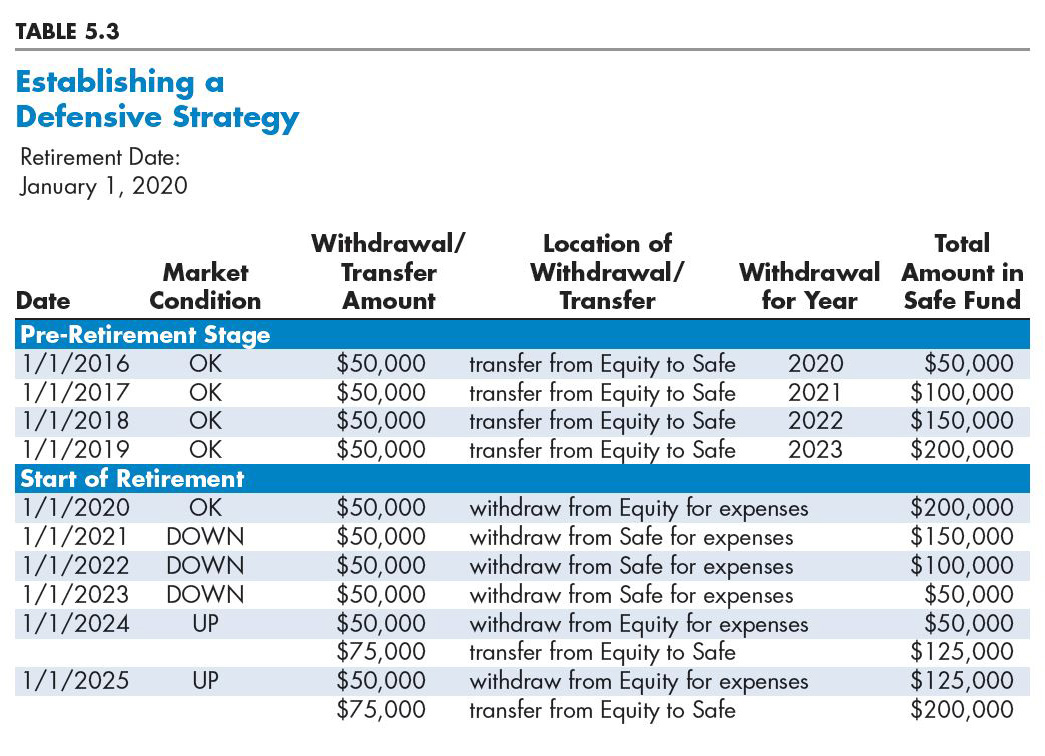
As you can see, based on a retirement date of January 1, 2020, money begins to be shifted into the safe portion of the portfolio at one year’s withdrawal rate during the four years prior to retirement. Withdrawals are made from the equity portion of the portfolio while the market is in a flat or up mode.
When on January 1, 2021, the market is 5% below its previous all-time high, we switch to defensive mode. Annual withdrawals are taken from the safe portion of the portfolio until the market returns to within 5% of its previous high. At that time, annual withdrawals once again are taken from the equity portion of the portfolio. Any deficit is restored to the safe portfolio in annual transfers spaced equally over a two-year period.
The Withdrawal Strategy in Down Markets
The key to the strategy is to use the funds put aside for rainy days when it rains. As stated, if the market has not fully recovered in four years then the safe funds may have run out and you may have to liquidate some stock. But with the strategic approach developed in Chapter 6, this scenario would not have occurred in the last 50 years.
The table below traces the Level3 defensive strategy through the Great Recession until the recovery. Actual S&P 500 returns are used rather than the advanced Level3 portfolio strategies to illustrate how the defensive approach would have worked during that time. Four percent is used as the return on the safe investment portion of the portfolio, which could be a blend of short-term Treasuries and other very safe investments.
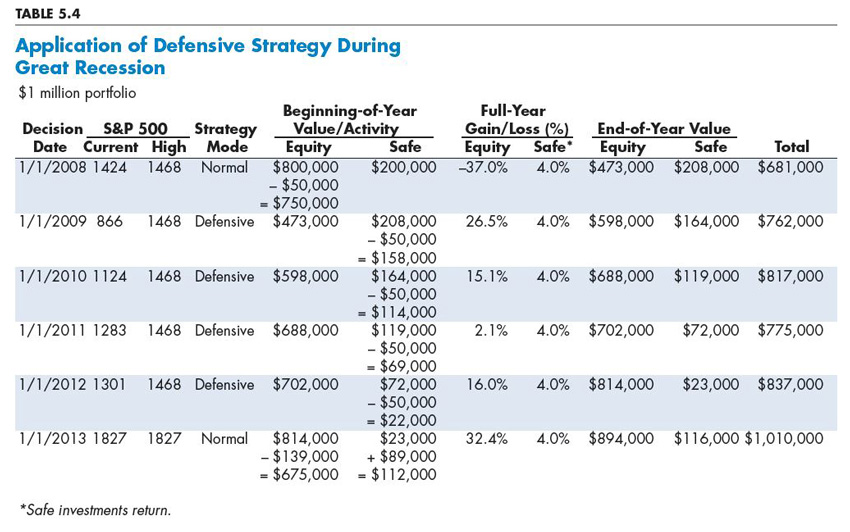
The impact of inflation is ignored on the $50,000 annual withdrawal in order to simplify the example; inflation was not very significant over this short period and would not have impacted any decisions. The 5% withdrawal rate, however, is inflation-adjusted.
It is important to note that the withdrawal amount is in dollars, not in percentage of the portfolio. If the market drops 10%, your mortgage payment doesn’t. You would still need $50,000 a year, even though that is now 5.56% rather than 5% of your portfolio.
In Table 5.4, the portfolio had $1 million on January 1, 2008, and an annual withdrawal rate of $50,000. The market was not lower than the previous January and so the normal withdrawal process was used, taking the funds from the equity portfolio.
The portfolio took a 37% hit that year, and so at January 2009 the portfolio was put in defensive mode and the $50,000 withdrawal was taken from the safe portion of the portfolio. The table shows the results of the strategy and the returns for each year.
At January 1, 2013, the market was above the old high and the strategy reverted to normal mode, taking the $50,000 withdrawal from the equity part of the portfolio along with restoring half ($89,000) of the existing shortfall in the safe portion.
Going into 2014, there was $897,000 in equities and $116,000 in bonds (if you allow the bond to grow at 4% during 2013). The portfolio was back above its original value even after taking $300,000 out in cumulative withdrawals.
Despite the severe downturn, the four-year reserve of $200,000 in the safe portion of the portfolio was enough to handle all the withdrawals. However, one more down year would have required going into the equity holdings.
A Simplified Withdrawal Strategy
The very specific defensive approach illustrated in this example was taken for two reasons:
- If you have a very specific approach with defined rules, it is easier to avoid deviating randomly and substituting guesses about market direction at various points in time. Certainly, withdrawing a full year’s needs at one time or acting only on the first of the year is not a requirement for the Level3 defensive approach.
- A specific version of the Level3 approach was needed to illustrate its application. Different variations of the general approach will give different results depending on the actual market behavior over time.
A more generalized version of the rules would be:
- In the safe portion of your portfolio, keep four years of living expenses.
- Make withdrawals as you need them.
- When you make a withdrawal, see if the market is above or within 5% of its all-time high. If it is, take the withdrawal from the equity segment. Otherwise take it from the safe segment.
- Whenever the market is back above its previous high after a pullback, return to taking withdrawals from the equity segment and also begin to gradually restore the safe portion from the equity portion.