

John Bajkowski
is the president of AAII.
 BSET
BZH
DCO
EBF
HOFT
HURC
KTCC
NAESX
ORN
PANL
PERI
RYAM
SIF
STRT
ULBI
VFINX
VSEC
BSET
BZH
DCO
EBF
HOFT
HURC
KTCC
NAESX
ORN
PANL
PERI
RYAM
SIF
STRT
ULBI
VFINX
VSEC
The Model Shadow Stock Portfolio limped across the finish line for year, giving up 0.2% during December for an annual gain of 35.3% during 2021. The annual gain is more than double the long-term compound annual return of 14.9% of the Model Shadow Stock Portfolio. The strongest gains for the Model Shadow Stock Portfolio came in the first half of the year when investors were most optimistic about a return to pre-pandemic life with a strong economic rebound and not so focused on inflation, rising interest rates, supply shortages and coronavirus variants.

The large-cap Vanguard 500 Index fund  (VFINX) gained 4.5% during December, contributing to a gain of 28.6% during 2021.
There was a generally strong reversal in sector performance during 2021. Some of the weakest-performing sectors during 2020 shone in 2021, as shown in the heat map of sector performance here.
Energy led the market during 2021, gaining 53.4% after a loss of 33.7% during 2020. Other sector leaders during 2021 included real estate (+46.2%) and financials (+35.0%). All three of these sectors were in the red during 2020. Technology had a strong fourth quarter gain of 16.6%, which helped push up its 2021 performance to 34.7%. Technology had been the strongest-performing sector during 2020 and 2019.
While communication services was the weakest-performing sector during 2021, it was still up 16.0% for the year. Other relatively weak sectors during 2021 include consumer staples (+17.3%) and utilities (17.7%).
In the realm of size and value, the leading segments were large-cap growth stocks and small-cap and mid-cap value stocks during 2021.
In the large-cap segment, growth stocks were up 2.5% for the month, giving them a positive 32.0% gain during 2021. Large-cap value stocks were up 7.0% during December, for a gain of 24.9% for 2021.

In the mid-cap segment, growth stocks were up 18.9% for the year, after gaining 4.1% during December. Mid-cap value stocks were up 30.7% for 2021, after gaining 5.9% during December.
Small-cap growth stocks were up 22.6% during 2021, after gaining 0.4% during December. Small-cap value stocks were up 31.0% during 2021 after gaining 4.1% during December.
Since its inception in 1993, the AAII Model Shadow Stock Portfolio has a compound annual average return of 14.9% versus the Vanguard 500 Index fund’s gain of 10.6% per year on average over the same period. The Vanguard Small Cap Index (NAESX) also had an average annual gain of 10.6% since 1993.

With a gain of 35.3% for the year, the Model Shadow Stock Portfolio managed to outperform the Vanguard 500 Index fund, which gained 28.6% in 2021. The strong annual performance snapped a four-year winning streak for the S&P 500 index. The relative performance of small-cap stocks often runs in streaks. Small-company stocks have outperformed large-company stocks over the long term, but they certainly do not best large-cap stocks every year, and they tend to exhibit flashes of outperformance followed by periods underperformance.
Over its 29-year existence, the Model Shadow Stock Portfolio outperformed the Vanguard 500 Index fund in 17of the 29 calendar years, or 59% of the years.
Since calendar years are somewhat arbitrary start and end dates, rolling periods are often used to smooth out seasonality. There have been 337 rolling 12-month time periods over the last 29 years. The Model Shadow Stock Portfolio has outperformed the Vanguard 500 Index fund in 57% of the one-year periods. When it comes to three-year holding periods, the Model Shadow Stock Portfolio has outperformed the Vanguard 500 Index fund in 52% of the periods, while outperforming the Vanguard 500 Index fund in 66% of the five-year rolling periods and in 90% of the rolling 10-year periods over last 29 years.
It is important to consider that a historical pattern may not repeat itself in the future, but longer holding periods normally provide a greater likelihood that stocks exhibit their potential for positive returns. A very practical way to view investor risk is to examine the likelihood that your invested money will diminish from the time of the initial investment to the end of the holding period time frame. Also, keep in mind that the variability of expected annual return is reduced with longer holding periods.
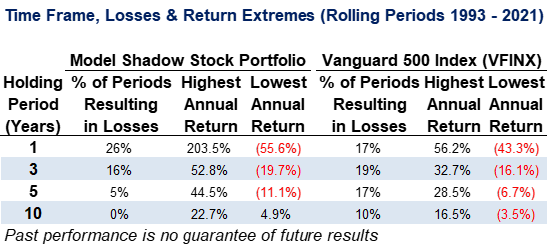
The table here assumes an investment in the Model Shadow Stock Portfolio or the Vanguard 500 Index fund and remains invested for the holding period indicated; the table indicates the percentage of times the portfolio would have suffered a loss from 1993 through 2021. The table also notes the greatest compound annual gain and loss observed for the various holding periods.
The table helps to reinforce the important lesson that the impact of the large variability in short-term stock market returns is reduced with longer holding periods. The Model Shadow Stock Portfolio gained as much as 203.5% during one 12-month holding period, but it has also lost more than half its value during a 12-month holding period. Stocks offer the potential for greater returns over the long term compared to safer holdings such as Treasury bills, but you must have a longer time horizon to help realize the potential. The variability of returns—risk as measured by the chance of loss—goes down as the holding period gets longer.
Thirty-three stocks met the initial selection criteria for the Model Shadow Stock Portfolio as of January 12, 2022, down from 35 passing stocks one month ago. AAII members can see and research which companies are currently passing the initial selection criteria in the Shadow Stock Ideas table on AAII.com. The list of Shadow Stock Ideas is updated daily—Tuesday through Saturday.
Of the 33 qualifying companies, four are currently held in the Model Shadow Stock tracking portfolio: Bassett Furniture Industries Inc. (BSET), Hurco Companies Inc. (HURC), Key Tronic Corp. (KTCC) and Strattec Security Corp. (STRT). Qualifying companies are those held in the Model Shadow Stock Portfolio that currently meet the initial purchase rules. (They are designated as “currently qualifies” in the notes column of the Model Shadow Stock Portfolio table on AAII.com. However, if you go online, the notes may not match the list discussed here since the notes on the website table are dynamically updated daily.)
Mesa Air Group (MESA) came off the list of qualifying stocks when it reported negative quarterly earnings, while VOXX International Corp. (VOXX) reported negative GAAP earnings, but positive normalized earnings.
As of January 12, 2022, Ranger Oil Corp. (ROCC) had the highest price-to-book-value ratio in the Model Shadow Stock Portfolio. Its ratio of 2.76 is above the 1.10 maximum value used for initially qualifying a stock for inclusion to the portfolio. However, stocks are not removed from the portfolio until their price-to-book-value ratio rises to three times the initial maximum value (3.30).
Ranger Oil also had the highest market capitalization in the portfolio, with a value of $1,351.9 million as of January 12, 2022. The Model Shadow Stock Portfolio looks for stocks with a market capitalization (share price times shares outstanding) greater than $30 million but less than $500 million when adding stocks to the portfolio. Shadow stocks with a market cap three times the initial market cap maximum ($500 million × 3 = $1,500 million) at the time of a quarterly review are removed from the portfolio, assuming there is a suitable replacement.
Click here to see the current purchase and sell rules for the portfolio.
The next quarterly review of the AAII Model Shadow Stock Portfolio will take place around the beginning of March 2022, after most of the holdings have announced their quarterly earnings. Any changes to the portfolio will be announced at the time they are made in a special Model Shadow Stock Portfolio Update email (sign up at www.aaii.com/email).
Beazer Homes USA Inc. (BZH) was the top-performing stock in the portfolio for December, up by 18.2%. The company had no significant news this month.
Ultralife Corp. (ULBI) was also a top performer, up by 12.9% for December. During the month, Ultralife announced the acquisition of Excell Battery Co., along with a new contract from the U.S. Government Defense Logistics Agency (DLA). Read more about Ultralife below.
SIFCO Industries Inc. (SIF) was the bottom-performing stock in the portfolio for December, down by 20.9%. During the month, the company reported fourth-quarter earnings. The earnings report was a disappointment, with the company delivering net loss per diluted share of $0.43. Read more about SIFCO Industries earnings below.
Mesa Air Group (MESA) was also a bottom performer, down by 20.7% for the month. During December, the company reported fourth-quarter earnings. The company underachieved, reporting a $0.06 per share net loss. Read more about Mesa Air earnings below.
Here are some news highlights from December for the holdings in the Model Shadow Stock Portfolio:
Ducommun Incorporated (DCO) completed a sale-leaseback with CenterPoint Properties, as of December 16, 2021. The transaction revolved around industrial property located on Gardena Blvd. in Carson, California, and sold for $143 million, netting $110 million in aftertax cash proceeds. A portion of the proceeds will be used to pay down the revolving credit facility that was used to acquire Magnetic Seal Corp. (MagSeal) on the same date.
“I am delighted to welcome the MagSeal business and its team to Ducommun as we continue our strategy of adding high value added A&D engineered products with recurring aftermarket to our portfolio,” said CEO Stephen G. Oswald. “MagSeal is an excellent business with a strong reputation and further advances the company’s industry offering, and I look forward to the many years of growth ahead.”
Ennis Inc. (EBF) reported third-quarter 2021 earnings of $0.29 per share, missing the I/B/E/S consensus estimate by 9.4%. Earnings per share were down year over year by 9.4%. Revenues were $103.0 million for the quarter compared to $92.4 million for the same quarter last year, an increase of 11.5% year over year. Gross profit margin was 28.4%, down from 30.4% in the same quarter from the following year.
“Our results for the quarter were within our expectations. Our recent acquisitions added approximately $7.8 million in revenues and $0.03 in diluted earnings per share for the quarter,” said CEO Keith Walters. “Our gross profit margin percentage, 28.4% for the current quarter and 30.4% for the prior-year quarter, continues to be impacted by inflationary factors as well as the consolidation of a few of our underperforming manufacturing facilities. We believe we have one of the strongest balance sheets in the industry, with low debt and significant cash. We opted to not renew our long-term bank line of credit, which expired in November 2021, and anticipate our profitability and strong financial condition will allow us to continue operations and fund acquisitions without incurring debt.”
Ennis also declared a dividend of $0.25 per share, in line with previous declarations. The dividend is payable on February 3, to shareholders of record as of January 6. The stock traded ex-dividend on Wednesday, January 5.
Hooker Furniture Corp. (HOFT) reported a third-quarter 2022 net loss of $0.10 per share, missing the I/B/E/S consensus estimate by 63.3%. The loss per share compares to earnings per share of $0.84 for the prior-year quarter. Revenue was $133.4 million for the quarter, reflecting a 10.9% year-over-year decrease of $16.3 million.
“Despite favorable demand for home furnishings and a historically strong order backlog triple typical levels for Hooker Furnishings, we were challenged by ongoing supply chain disruptions, especially the slower-than-expected reopening of Vietnam and Malaysia factories,” said CEO Jeremy Hoff. “The COVID-related factory closings in Vietnam and Malaysia began around August 1 and did not begin reopening until late in the quarter, and then at only about 25% capacity. We expect the factories will begin to approach 50% capacity in the near future.”
The company also declared a dividend of $0.20 per share, reflecting a 11.1% increase over the last quarterly dividend. This is the company’s sixth consecutive annual dividend increase. The dividend was paid on December 31, 2021, to shareholders of record as of December 17, 2021.
Mesa Air Group (MESA) reported a fourth-quarter 2021 net loss of $0.06 per share, missing the I/B/E/S consensus estimate by $0.18 per share, or by 148.8%. This compares to positive earnings per share of $0.32 for the same quarter last year. Revenue for the quarter was $130.8 million, increasing 21.1% year over year. Mesa Air reported adjusted earnings before interest, taxes, depreciation and amortization (EBITDA) of $25.8 million, down from $44.6 million in fourth-quarter 2020.
“The rapid contraction and expansion of demand has been taxing for the industry and 2021 has proven to be a difficult year as a result,” said chairman and CEO Jonathan Ornstein. “Due to the timing of regular and deferred maintenance events, the supply of labor and fluctuating prices in the supply chain, exiting COVID is proving to be more challenging than entering it. While we fared better than most majors and regionals, we were not immune to these challenges, and we are expecting these issues that are currently impacting our costs to spill over through the next two quarters.”
Orion Group Holdings Inc. (ORN) was awarded multiple contracts for its marine segment totaling about $33 million. One project is a $28.3 million contract to repair a facility of the Naval Facilities Engineering Command Southeast located in the Bahamas. This project is expected to be completed in 2024. The remaining $4.4 million is for a project to revamp a barge dock on the Gulf of Texas. The project will commence in first-quarter 2022 and will end during third-quarter 2022.
Earlier in December, the company indicated that it had gained additional contracts worth around $44 million.
Pangaea Logistics Solutions Ltd. (PANL) announced the death of its chairman, CEO and co-founder Ed Coll.
The board of directors appointed chief operating officer (COO) Mark Filanowski as the CEO. Additionally, director of the company Richard du Moulin has been appointed chairman of the board of directors.
Perion Network Ltd. (PERI) had a public offering of 8,372,092 shares at $21.50 per share, less underwriting discounts and commissions. The shares sold by the company resulted in gross proceeds of $180.0 million before deducting underwriting discounts and commissions and estimated offering expenses payable by the company.
Rayonier Advanced Materials Inc. (RYAM) announced that its board of directors elected Vito J. Consiglio to succeed Paul G. Boynton as president, CEO and board member effective January 1, 2022. Boynton, who served as president and CEO since 2014, will assume the role of vice chair of the board until May 2022.
SIFCO Industries Inc. (SIF) reported a fourth-quarter 2021 loss of $0.43 per share, which decreased from $0.86 earnings per diluted share reported in fourth-quarter 2020. Net sales of $24.3 million were 16.5% lower than net sales for the same quarter of 2020.
The company reported a net loss of $2.5 million, a decrease from $5.0 million net income in fourth-quarter 2020. EBIT was negative $2.8 million, a decrease from EBIT of $5.1 million reported in the comparable period of 2020. Gross loss for the quarter was $0.6 million, a decrease from $3.0 million gross income for the comparable quarter of 2020.
“Our commercial aerospace customers continue to confront operational and pandemic-related softness in their business. We remain focused on serving our customers across the aerospace and energy markets, growing our content on key platforms, and seeking opportunities in adjacent markets. We continue to support our customers with class-leading quality and delivery. Cash management and cost controls have helped position us well during these challenging times.”
The company did not give a financial outlook or any forward-looking statements. During the month, the company’s stock price decreased over 20% on the heels of the poor fourth-quarter financials.
Ultralife Corp. (ULBI) announced the acquisition of Excell Battery Co., an independent manufacturer and designer of battery systems. The deal is for $23.5 million in cash, and Ultralife expects the deal to be accretive on an earnings-per-share basis within 12 months of the deal closing. Excell Battery generated revenues of $21.2 million over the trailing 12 months ending November 2021.
The company also received a contract from the U.S. Government Defense Logistics Agency (DLA) worth $9.9 million.
VSE Corp. (VSEC) declared a quarterly cash dividend increase. The declared dividend of $0.10 per share for VSE common stock is an 11% increase over the previous dividend paid. The dividend is payable on February 9, 2022, to shareholders of record as of the close on January 26, 2022.
 Get updates about the portfolio that has outperformed the market by 211.9%
since inception!
Get updates about the portfolio that has outperformed the market by 211.9%
since inception!