The Model Shadow Stock Portfolio finished the year on a positive note, gaining 3.4% in December, which helped to lift the portfolio’s gain to 19.6% for the year. A 19.6% annual gain is above the long-term compound annual return of 14.2% of the Model Shadow Stock Portfolio, but the gain fell short of the 31.3% return realized by the large-cap Vanguard 500 Index fund (VFINX) during 2019.
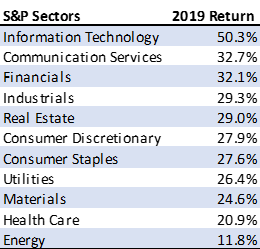
Recent strong market gains have been more concentrated in the technology sector, which gained 50.3% during 2019. Other sector leaders during 2019 include communication services (+32.7%) and financials (+32.1%). Energy was the weakest-performing sector during 2019, up 11.8%, followed by health care (+20.9%) and materials (+24.6%). The table below provides the 2019 returns for the primary S&P sectors. All the sectors had gains during 2019, but there is a large difference between the top- and bottom-performing groups.
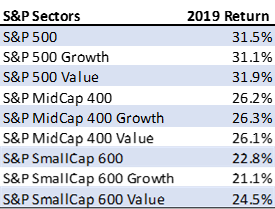
The performance of growth-oriented versus value-oriented stocks was slanted toward value stocks in the large-cap and small-cap segments within the S&P indexes during 2019. Meanwhile, growth stocks just beat value stocks in the mid-cap segment during the year.
The completion of 2019 also marked the completion of another decade. The Model Shadow Stock portfolio had a compound annual return of 13.5% over the last 10 years, slightly better than the Vanguard 500 Index fund, which gained 13.4% over the same time period. The Model Shadow Stock Portfolio outperformed the Vanguard 500 Index fund in five of the last 10 calendar years, with the strongest relative calendar year gains for the Model Shadow Stock Portfolio coming early in the decade.
This type of pattern is consistent with historical observations of the relative performance of small-company stocks to that of large-company stocks. Small-company stocks have outperformed large-company stocks over the long term, but they certainly do not best large-cap stocks every year, and they tend to exhibit streaks of outperformance followed by underperformance.
With the Model Shadow Stock Portfolio completing 27 years, we can take a deeper look at its performance. Examining calendar years, it has outperformed the Vanguard 500 Index fund for 16 of the years, or 59% of the time.
Since calendar years are somewhat arbitrary start and end dates, rolling periods are often used to smooth out seasonality. There have been 313 rolling 12-month time periods over the last 27 years. The Model Shadow Stock Portfolio has outperformed the Vanguard 500 Index fund in 59% of the periods. When it comes to three-year holding periods, the Model Shadow Stock Portfolio has outperformed the Vanguard 500 Index fund in 56% of the periods, while outperforming the Vanguard 500 Index fund in 74% of the five-year rolling periods and in 99% of the rolling 10-year periods over last 27 years.

It is important to consider that a historical pattern may not repeat itself in the future, but longer holding periods normally provide a greater likelihood that stocks exhibit their potential for positive returns. A very practical way to view investor risk is to examine the likelihood that your invested money will diminish from the time of the initial investment to the end of the holding period time frame and to keep in mind that the variability of expected annual return is reduced with longer holding periods.
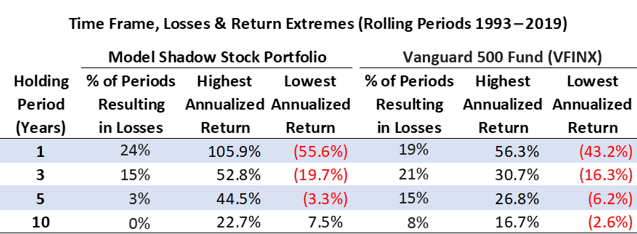
The table above assumes an investment in the Model Shadow Stock Portfolio or the Vanguard 500 Index fund and remains invested for the holding period indicated; the table indicates the percentage of times the portfolio would have suffered a loss from 1993 through 2019. The table also notes the greatest compound annual gain and loss observed for the various holding periods.
The table helps to reinforce the important lesson, that the impact of the large variability in short-term stock market returns is reduced with longer holding periods. Stocks offer the potential for greater returns over the long term, but you must have a longer time horizon to help realize the potential. The variability of returns—risk as measured by the chance of loss—goes down as the holding period gets longer.
Since its inception in 1993, the AAII Model Shadow Stock Portfolio has a compound annual average return of 14.2% versus the Vanguard 500 Index fund’s (VFINX) gain of 9.7% per year on average over the same period. Over the same 27-year period, the Vanguard Small Cap Index fund (NAESX) posted an average annual gain of 10.0%.
Model Shadow Stock Portfolio News
As of the end of December, 14 stocks met the initial selection criteria for the Model Shadow Stock Portfolio. Of these, four are currently held in the Model Shadow Stock tracking portfolio: Container Store Group Inc. (TCS), CPI Aerostructures Inc. (CVU), Mesa Air Group (MESA) and Universal Stainless & Alloy Products (USAP). Qualifying companies are those held in the Model Shadow Stock Portfolio that currently meet the initial purchase rules. (They are designated as “qualifies” in the notes column of the Model Shadow Stock Portfolio table on AAII.com. However, the notes may not match the list here since the passing list on the website is revised daily and the notes are dynamically updated based on the revised list.)
Currently, none of the holdings in the Model Shadow Stock Portfolio are approaching the price-to-book value valuation limit of 2.7 or the market cap cut-off of $900 million.
Mesa Air was the strongest stock in the Model Shadow Stock Portfolio with its 23.0% gain for December. As noted in the news section bellow, Mesa Air reported earnings and announced a plan to add to its airline fleet and extended its contract agreement with United Express.
REX American Resources Corp. (REX) was the weakest stock in the Model Shadow Stock Portfolio, dropping 10.8% during December. REX American Resources has interests in six ethanol production facilities, which in aggregate shipped approximately 702 million gallons of ethanol over the 12-month period ended April 30, 2019. During December, REX American Resources reported that revenue of $86.7 million for the third quarter of 2019 decreased by 30% year over year. Net loss per diluted share for the quarter was $0.32, compared to earnings per diluted share of $1.86 in the same period one year ago.
The next quarterly review of the AAII Model Shadow Stock Portfolio will take place around the end of February 2020, after most of the Shadow Stock holdings have announced their quarterly earnings. Any changes to the portfolio will be announced at the time they are made in a special Model Shadow Stock Portfolio Update email (sign up at www.aaii.com/email).
Here are some news highlights from December for the holdings in the Model Shadow Stock Portfolio:
Ennis Inc. (EBF) reported a year-over-year increase of 6.3% in revenues to $114.9 million for the third quarter of 2019. Earnings per diluted share of $0.41 increased by 3% year over year and beat the I/B/E/S consensus estimate of $0.39 by 5%.
Gross profit margin fell from 31.2% to 29.5% sequentially, impacted by the consolidation of expenses from Ennis’ past four acquisitions. Ennis doesn’t expect to see a meaningful impact of the acquisitions until the first half of 2021. Over the past nine-month period, the acquisitions have accounted for over $73 million and over $0.18 per diluted share.
Additionally, Ennis declared a dividend of $0.225 per share, in line with the previous declaration. The dividend is payable February 7 to shareholders of record January 10. The stock traded ex-dividend on Thursday, January 9.
Flexsteel Industries Inc. (FLXS) declared a regular quarterly dividend of $0.22 per share, in line with the previous declaration. The dividend was payable January 6, 2020, to shareholders of record as of December 20, 2019.
Hibbett Sports Inc. (HIBB) announced the appointment of Michael Longo as president and CEO of the company, effective December 16, 2019. Longo succeeds Jeff Rosenthal, who announced his planned retirement in March 2019. Longo came to Hibbett Sports in 2018 through its acquisition of City Gear LLC, where he served as CEO after founding the company in 2006.
Hooker Furniture Corp. (HOFT) reported consolidated net sales of $158.2 million, down 7.7% year over year, for the third quarter of fiscal 2020. Earnings per diluted share of $0.33 were down 58.2% year over year and missed the I/B/E/S consensus estimate of $0.48 by 31.2%.
Hooker Furniture’s Home Meridian segment saw sales fall 9.7% year over year, which was mostly due to a volume reduction from a single major retail customer. The company said that during the quarter it also faced the lingering effects of tariffs on finished goods and component parts imported from China and spotty retail demand during the first nine months of the year.
Looking forward, Hooker Furniture said it expects earnings to improve sequentially to the next quarter. Despite reduced volume from a major retail customer, Hooker Furniture expects earnings performance momentum to improve significantly across all its segments quarter to quarter.
Additionally, Hooker Furniture declared a dividend of $0.16 per share, a 7% increase from the previous declaration. The dividend was payable December 30, 2019, to shareholders of record as of December 16, 2019.
Mesa Air Group (MESA) reported adjusted earnings per share of $0.36, which were down year over year from adjusted earnings per share of $0.65 but in line with the I/B/E/S consensus estimate.
The company said that the difference in year-over-year results was primarily due to the timing of scheduled heavy maintenance and airframe maintenance valued at about $9 million. During the quarter, Mesa Air said that it also invested $1 million in its cargo operations, expenses that if excluded would have brought adjusted earnings per share up to $0.38.
Looking forward, Mesa Air is targeting earnings per share of $1.50 to $1.80 for 2020 and $1.90 to $2.30 per share for 2021. In 2020, pilot hours are expected to be about the same as 2019 while Mesa Air operates fewer aircraft.
Separately, Mesa Air announced that it will add 20 new Embraer E175 LL aircraft to its United Express fleet. The aircraft will be owned and financed by Mesa Air and be covered under a 12-year capacity purchase agreement. Deliveries are scheduled to begin May 2020 and expected to be completed by the end of the year.
Mesa Air and United Express also extended their contract for 42 E175s by five years. The aircraft, which are owned by United, are now contracted through the end of 2024 with rights to extend through 2027. The 18 Mesa Air-owned E175s are contracted through 2028. In connection with the deal, Mesa Air’s 20 Bombardier CRJ-700 aircraft will be leased to another United Express carrier for a term of seven years.
RCI Hospitality Holdings (RICK) reported that preliminary total revenues of $45.2 million for the fourth quarter of 2019 increased year over year by 11%. Preliminary results accompanied the announcement of a delay in the filing of RCI Hospitality’s 10-K report for the quarter with the U.S. Securities and Exchange Commission (SEC), which the company said was disappointing but not unexpected given its change in auditors.
For the year, RCI Hospitality expects full-year total revenues to increase 9% year over year. Through the first two months of the first quarter of fiscal 2020, total and same-store sales from the company’s nightclubs segment and Bombshells brand are up over the same period last year.
REX American Resources Corp. (REX) reported that revenue of $86.7 million for the third quarter of 2019 decreased by 30% year over year. Net loss per diluted share for the quarter was $0.32, compared to earnings per diluted share of $1.86 in the same period one year ago.
Although ethanol and corn oil pricing strengthened for the quarter, lower distiller grain pricing and the company’s lower ethanol production resulted in the year-over-year performance declines. Reduced availability of affordable corn was blamed on the wet spring conditions and, in key areas, uncertainty for the year’s total production of corn. This is only the second time that REX American Resources has experienced a loss in its ethanol production segment. The first was due to a drought in 2012.
 Get updates about the portfolio that has outperformed the market by 211.9%
since inception!
Get updates about the portfolio that has outperformed the market by 211.9%
since inception!


