

John Bajkowski
is the president of AAII.
 BSET
CVLG
CVU
DCO
HOFT
KTCC
NAESX
PERI
RCKY
RICK
STRT
VFINX
VSEC
BSET
CVLG
CVU
DCO
HOFT
KTCC
NAESX
PERI
RCKY
RICK
STRT
VFINX
VSEC
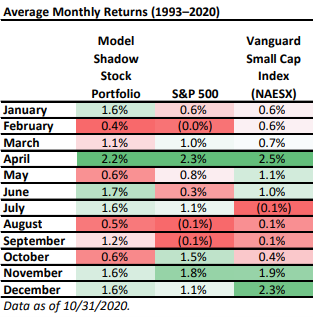
As the days grow shorter, the stock market is actually entering the time of the year when its typical performance is brightest. The table of average monthly returns below indicates the monthly performance of the Model Shadow Stock Portfolio alongside the S&P 500 index and the Vanguard Small Cap Index fund (NAESX) over the nearly 28-year existence of the actual portfolio.
The cells are shaded so that the months with the strongest performance are show in dark green, while the weakest months are displayed in dark red for each individual portfolio or index.
While on average the month with the highest average monthly return was April for all three portfolios, November through January have been relatively strong on average. August and September have generally had the weakest average monthly performance over the last 28 years.
Since its inception in 1993, the AAII Model Shadow Stock Portfolio has a compound annual average return of 13.1%. For comparison, the Vanguard 500 Index fund’s (VFINX) gain of 9.5% per year on average over the same period, which matches the Vanguard Small Cap Index fund’s average annual gain of 9.5%.
Concerns over the worldwide spike in active coronavirus cases weighed on the stock market during October, with the S&P 500 down 2.7% for the month. Notably, more defensive value-focused segments performed better than more expensive growth-oriented securities and smaller companies outperformed stock prices of larger companies. The Model Shadow Stock Portfolio gained 2.6% during October, while the Vanguard Small Cap Index fund was up 2.0% during the month.
The utilities sector was among the market leaders for the second month in a row with a 5.0% gain for the month. Even with the strong monthly performance, utilities are down 0.9% for the year on a total-return basis. The only other sector up for the month was communications services, with a gain of 0.8%. The information technology sector continued its weak performance, giving up another 5.1% during October. Information technology is still the strongest-performing sector during 2020 with a gain of 22.1%. The only other sector showing double-digit gains for the year is the consumer discretionary segment, up 19.8% for the year after losing 2.9% during October. The volatile energy sector was down 4.4% during the month and is now down 50.4% year to date.
In the large-cap segment, growth stocks were down 3.1% for the month, giving them a positive 16.9% gain year to date for 2020. Large-cap value stocks were down 2.0% during October and are now down 13.2% year to date.
In the mid-cap segment, growth stocks were up 1.2% for the month and are now up 2.6% for the year. Mid-cap value stocks are down 16.6% for the year, after gaining 3.5% during the month.
Small-cap growth stocks are up 4.7% year to date after a small gain of 0.8% during the month. Small-cap value stocks are down 18.8% for the year after gaining 3.6% during October.
Thirteen stocks met the initial selection criteria for the Model Shadow Stock Portfolio as of November 12, 2020, up from eight passing stocks one month ago. Qualifying companies are those held in the Model Shadow Stock Portfolio that currently meet the initial purchase rules. (They are designated as “currently qualifies” in the notes column of the Model Shadow Stock Portfolio table on AAII.com. However, if you go online, the notes may not match the list discussed here since the notes on the website table are dynamically updated daily.)
AAII members can see and research which companies are currently passing the initial selection criteria at the Shadow Stock Ideas table on AAII.com. The list of Shadow Stock Ideas is updated daily—Tuesday through Saturday. Of the 13 qualifying companies, two are currently held in the Model Shadow Stock tracking portfolio: Big 5 Sporting Goods Corp. (BGFV) and Key Tronic Corp. (KTCC).
As of November 12, 2020, Hibbett Sports Inc. (HIBB) had the highest price-to-book-value ratio in the Model Shadow Stock Portfolio. Its ratio of 1.75 is above the 0.90 maximum value used for initially qualifying a stock for inclusion to the portfolio. However, stocks are not removed from the portfolio until their price-to-book ratio rises to three times the initial maximum value (2.70).
It is helpful to think about price-to-book values below 0.90 as being very attractive, while values three times above the initial maximum are expensive. Allowing the price-to-book ratio to expand for stocks that you own allows your winners to run up a little, since the price-to-book ratio typically gets larger as the stock price goes up. The initial price-to-book level is adjusted over time to reflect changing market conditions, and valuation and size requirements are being examined for the next quarterly portfolio review.
The Model Shadow Stock Portfolio also seeks out stocks with a market capitalization (share price times shares outstanding) greater than $30 million but less than $300 million when adding stocks to the portfolio. Shadow Stocks with a market cap three times the initial market cap maximum ($300 million × 3 = $900 million) at the time of a quarterly review are removed from the portfolio, assuming there is a suitable replacement. Hibbett Sports also has the highest market cap in the portfolio, with a value of $625.8 million as of November 12, 2020.
Click here to see the current purchase and sell rules for the portfolio.
The next quarterly review of the Model Shadow Stock Portfolio will take place following the end of November 2020. Any changes to the portfolio will be announced at the time they are made in our Model Shadow Stock Portfolio Update emails (sign up at www.aaii.com/email).
For the second month in a row, Container Store Group Inc. (TCS) was the strongest stock in the Model Shadow Stock Portfolio, up by 53.3% in October. The company reported a substantial year-over-year increase in earnings per share for the second quarter of 2020 during the month. The company benefited from an increase in digital sales, and it continues to see momentum for other factors.
Strattec Security Corp. (STRT) was the second-best-performing stock with a gain of 45.9% during the month. The company also reported a significant year-over-year increase in earnings per share for the first quarter of its fiscal 2021. The improvement in profit was primarily due to stronger operating margins following cost-cutting measures in response to the coronavirus pandemic.
Key Tronic was the weakest stock in the Model Shadow Stock Portfolio for the month, down by 22.4%. The company reported year-over-year revenue growth but also reported increased expenditures related to the coronavirus pandemic. Guidance for the next quarter noted that the pandemic still has the potential to disrupt business operations.
Penn Virginia Corp. (PVAC) followed as the second-worst-performing stock with a loss of 22.0% during the month. The energy sector and in particular the oil and gas exploration and production industry have faced a tough market for their products in 2020 due to a drop in demand for fuel because of the pandemic and concerns of oversupply from high production levels earlier in the year. Penn Virginia’s stock price reflects these realities; however, during October the company reported positive free cash flow for the third quarter and that it had restarted some drilling operations.
Here are some news highlights from October for the holdings in the Model Shadow Stock Portfolio:
Bassett Furniture Industries Inc. (BSET) reported third-quarter 2020 net income of $2.2 million, or $0.22 per diluted share, compared to net income of $2.2 million, or $0.21 per diluted share, in the prior-year quarter. Third-quarter earnings per diluted share beat the I/B/E/S consensus estimate for a loss per share of $0.07. Consolidated sales for the quarter fell by 16.3% year over year to $91.56 million.
The company’s wholesale segment posted sales of $55.4 million, down 11.6% year over year. Third-quarter sales for the retail segment declined by 27.6% year over year to $48.1 million. The company’s logistical services unit reported that revenues declined by 5.6% year over year to $17.8 million. Consolidated retail operating loss for the quarter was $1.6 million compared to a loss of $0.4 million in the third quarter of 2019.
Bassett Furniture also declared a regular quarterly dividend of $0.125 per share, up 56.3% from its previous declaration. The dividend is payable on November 27 to shareholders of record as of November 13.
Big 5 Sporting Goods Corp. (BGFV) reported third-quarter 2020 net income of $1.31 per diluted share, compared to net income of $0.30 per diluted share for third-quarter 2019. Net sales increased by 14.6% to $305.0 million compared to net sales of $266.1 million one year ago. Same-store sales increased by 14.8% during the quarter, compared to a 0.3% increase in the same period one year ago.
“Our success navigating the [coronavirus] environment to date has substantially strengthened our balance sheet and enhanced our financial flexibility,” said CEO Steven Miller. “Looking at the fourth quarter, we have continued to see solid momentum, with sales increasing 15.1% for our fiscal October period. We believe our inventory is well positioned for the upcoming winter and holiday seasons. That said, we recognize there is tremendous uncertainty impacting the consumer environment over the coming months and we are prepared to be nimble and make adjustments as necessary.”
The company ended the quarter with zero borrowing under its revolving credit and a cash position of approximately $56 million. The improved financial performance has positioned the company to return to paying a regular quarterly dividend at double its previous rate.
Big 5 Sporting Goods declared a cash dividend of $0.10 per share, up 100% from its previous declaration. The dividend is payable on December 15 to shareholders of record as of December 1. The stock will trade ex-dividend on Monday, November 30.
Container Store Group Inc. (TCS) reported preliminary consolidated net sales of $248.2 million for the second quarter of 2020, up 5.0% compared to the prior-year quarter. Earnings per share of $0.43 for the quarter more than doubled year over year and beat the I/B/E/S consensus estimate for earnings per share of $0.30.
Container Store Group reported that online customer sales increased by 86.4% year over year. Other expenses for the quarter increased to $1.1 million, primarily due to severance costs associated with the reduction in workforce as a result of the coronavirus pandemic.
“We believe that many of the key factors driving our strong second-quarter performance have continued into the third quarter of fiscal 2020,” said CEO Melissa Reiff. “As we look ahead, we are excited about the sales momentum we are driving and October trends to date have improved from September levels. While the macro backdrop remains uncertain, we are proud of our excellent execution and believe we are well positioned to continue capitalizing on the many opportunities that lie ahead.”
Covenant Logistics Group (CVLG) reported third-quarter 2020 adjusted earnings per share of $0.56, compared to adjusted net loss per share of $0.15 for the third quarter of 2019. Adjusted earnings beat the I/B/E/S consensus estimate of $0.548 per share by 2.2%. Total revenue of $210.8 million decreased by 4.4% over the same period.
Freight revenue of $196.2 million, excluding revenue from fuel surcharges, declined 0.6% year over year. The $17.5 million decrease in freight revenue was primarily related to an 8.7% average operating fleet reduction and a 3.2% decrease in average freight revenue per tractor. Truckload operating cost per mile improved $0.22 per share, or 11.8% on an adjusted basis, compared to the prior-year quarter.
“While acknowledging one quarter does not make a trend, we are motivated by the progress surrounding the execution of our strategic plan,” said CEO David Parker. “In the near term, we are focused on delivering superior service to our customers in what is expected to be robust peak shipping season with limited trucking capacity. Due to changes in business mix, we do not expect to have the excess asset-based capacity to “flex up” and take advantage of the peak spot market to the same extent we did in peak markets of 2014 through 2018. However, we expect fourth-quarter volumes and pricing to be favorable and to support sequential margin improvement.”
CPI Aerostructures Inc. (CVU) announced that it received multiple purchase orders with a total value of about $1.4 million from Turkish Aerospace Industries. In September 2019, CPI Aerostructures announced that it received a multi-year contract over an estimated period of five years from Turkish Aerospace to manufacture window assemblies on up to 104 T70 aircraft. The combined orders received to date under this contract total $2.1 million against a ceiling price of $4.6 million. The company anticipates starting deliveries in 2021.
Cumulus Media Inc. (CMLS) announced the completion of the initial closing of its tower portfolio monetization transaction for $208 million in gross proceeds on September 30, 2020. The company received about $202 million in net proceeds after transaction fees and costs and will continue to operate from the properties under a new 10-year lease. The use of those proceeds is governed by the company’s term loan and 6.75% first lien notes, both of which are due in 2026.
“We are thrilled to have expeditiously completed the first closing of this significant transaction,” said CEO Mary Berner. “Pro forma for its completion and based on our second-quarter ending cash balance, we will have reduced net debt by nearly $325 million during 2020 and by nearly $580 million since emerging from bankruptcy in 2018. Our further improved liquidity position and covenant-lite, long-dated debt will continue to support our growth initiatives and allow us to take advantage of accretive opportunities as we navigate through near-term uncertainties to drive long-term shareholder value.”
Delta Apparel Inc. (DLA) announced preliminary fourth-quarter 2020 results. The company expects fourth-quarter net sales to increase by about 8% to $116 million compared to $108 million in the prior-year quarter, with growth in each of its business units. The Delta group and Salt Life group segments are anticipated to report fourth-quarter net sales growth of approximately 8% and 12%, respectively. Delta Apparel also expects to report an expansion of operating income during the quarter compared to the prior-year period, exceeding its previous commitment to deliver fourth-quarter profitability on both a reported and adjusted basis.
“In what has remained an unprecedented period for our nation and our industry, we are proud of the strong finish to our 2020 fiscal year,” said CEO Robert Humphreys. “Our stellar preliminary fourth-quarter sales results were broad-based, with growth in each of our business units. The advantages of the Delta Apparel strategic model with our diversified sales channels and broad geographic footprint, combined with our unique, integrated manufacturing platform, once again contributed to remarkable results this quarter and positions us well for profitable growth into the foreseeable future.”
Ducommun Incorporated (DCO) reported net income of $0.62 per diluted share for the third quarter of 2020, compared to earnings per diluted share of $0.70 in the prior-year third quarter. Earnings per diluted share for the quarter beat the I/B/E/S consensus estimate of $0.485 per share by 27.8%. Revenues declined by 17.0% year over year to $150.4 million.
Lower revenues from the company’s commercial aerospace end-use markets due to lower build rates on large aircraft platforms were partially offset by higher revenues from the military and space end-use markets due to additional content and higher build rates. Gross margins increased to 22.3%, primarily driven by a favorable product mix, asset utilization, effective cost controls and value-added pricing.
Commercial aerospace demand was negatively impacted by the coronavirus pandemic; however, the company’s defense business and operational performance improved during the third quarter of 2020. The company’s defense business grew 40% year over year, reflecting a diverse array of demand for almost all aspects of the company’s product portfolio. Also, the company’s military and space backlog increased to $505.7 million, remaining at record levels and bolstering the company’s outlook for this business.
“While near-term shipments within the commercial aerospace market will remain under pressure, our operations’ footprint and capacity are ready to support the eventual demand increases,” said CEO Stephen Oswald. “We are also cautiously optimistic given the recent positive statements about the 737 MAX’s return to service. Overall, Ducommun is well-positioned to weather the remaining headwinds and is prepared for strengthening economic fundamentals and a return to revenue growth for the company in 2021.”
Hibbett Sports Inc. (HIBB) announced sponsorship of the Southern Made Creatives SMC2020 Virtual Experience, an event that features panels, discussions and musical performances for entrepreneurs in Birmingham. SMC is a Black woman-owned creative agency that specializes in curating data-driven campaigns for millennials and Generation Z.
Hooker Furniture Corp. (HOFT) announced that its Home Meridian international (HMI) division will be consolidating its operations in a new distribution facility in Liberty County, Georgia. The distribution center is expected to be operational by the fall of 2021, and the company will continue to maintain its west coast facility in California. HMI will be moving out of multiple warehouses in North Carolina to fully staff the new distribution center.
“We are pleased by the opportunity to better support our customers through consolidating our HMI inventory in this state-of-the-art, high-bay, 800,000-square-foot facility located near a major port,” said CEO Paul Toms Jr. “As robust demand for products serviced out of our warehouses continues to increase, this will better position us to grow.”
Key Tronic Corp. (KTCC) reported earnings of $0.16 per share for the first quarter of its fiscal 2021, which increased year over year by 14.3%. Total revenue of $123.2 million increased by 17.3% over the same period.
The increase in revenue was due to the successful ramp up of new customer programs and increased demand from existing customers in light of some economic recovery. However, Key Tronic’s revenue was constrained by labor shortages at its facilities in Juarez, Mexico, due to the coronavirus pandemic and associated public health measures. The company incurred costs of $0.10 per share as it increased employee compensation in order to offset turnover in Juarez and implemented preventative measures against the coronavirus at all of its facilities in the U.S., Mexico, China and Vietnam.
“Moving into the second quarter of fiscal 2021, the [coronavirus] crisis continues to present macroeconomic uncertainty and multiple business challenges, but we continue to see the favorable trend of contract manufacturing returning to North America,” said CEO Craig Gates. “We remain focused on protecting the health of all of our employees by adhering to current health guidelines, as well as increasing retention of available employees. We expect continued strong revenue growth in the second quarter and continue to invest in new capacity to prepare for long-term growth.”
For the second quarter of fiscal 2021, Key Tronic expects to report revenue of about $125 million to $135 million, and earnings of about $0.15 to $0.25 per share.
Mesa Air Group (MESA) reported a 40% year-over-year decrease in operating hours for September while beginning its first cargo operations. Mesa Air operated two Boeing 737-400F aircraft on behalf of DHL for a five-year term. This agreement makes Mesa Air the first regional airline to operate a narrow-body aircraft.
Separately, Mesa Air committed to avoid furloughing any employees for the remainder of 2020 after reaching an agreement with its pilots, represented by the Air Line Pilots Association (ALPA). The company remains hopeful that Congress will extend the Payroll Support Program to further protect its employees and their families should the pandemic continue to have a negative impact on air travel demand into 2021.
New Home Company Inc. (NWHM) chose to report selected preliminary results for the third quarter of 2020. Some highlights are as follows: net new orders of 124, a 102% increase year over year; home sales revenue of $117.4 million, in line with last year’s third-quarter home sales revenue of $118.8 million; average sales price of $748,000 as compared to $958,000 in third-quarter 2019; and a monthly sales absorption of 3.5 per community, a 75% increase year over year.
The company also actively raised debt capital, announcing that it has priced a private offering of $250 million in aggregate principal amount of 7.25% senior notes due 2025. Proceeds from that debt offering will be used for redemption of all the company’s outstanding 7.25% senior unsecured notes due 2022.
Penn Virginia Corp. (PVAC) reported ahead of its third-quarter earnings release that estimated sales for the quarter were above the midpoint of its guidance range at about 18,383 barrels of oil per day. This level of production with a realized oil price of about $48.28 per barrel and capital expenditures below the company’s guidance range allowed Penn Virginia to generate positive free cash flow for the quarter and lower debt by about $35 million from the second quarter of 2020.
Based on its strong production profile and high realized pricing, Penn Virginia restarted its drilling program with one rig after drilling but not completing five wells in the third quarter. “Given the uncertainty on completion timing, we currently do not forecast a material contribution to production until early next year,” said CEO Darrin Henke. “The company will continue to remain focused on capital discipline, preservation of our strong balance sheet and cash on cash returns.”
Perion Network Ltd. (PERI) reported third-quarter earnings of $0.08 per share, which were down year over year by 27.0%. However, earnings beat the I/B/E/S consensus estimate of $0.075 per share by 6.7%. Total revenues of $83.4 million were up by 27% over the same period.
The increase in total revenues was driven by a 76% year-over-year increase in advertising revenues to $37.9 million. This business line was boosted by 200% revenue growth in connected television advertising, which is an ad for a website that streams content over the internet and allows ads to be programmed per household. Advertising revenues also benefited from the integration of two recent acquisitions. In Perion Network’s other main line of revenue, search and other, a growing number of monetizable search queries led to year-over-year growth of 3% to $45.5 million.
“In addition to accelerated revenue growth, we delivered a meaningful improvement in profitability and cash flow in the third quarter, which we expect to continue,” said CEO Doron Gerstel. “As announced earlier in October, we raised our expectations for the second half of 2020 to revenue of $164 million to $174 million and adjusted [earnings before interest, taxes, depreciation and amortization] of $16 million to 18 million. Perion has the well-diversified strategy and financial model to deliver long-term growth and attractive returns for our stakeholders.”
RCI Hospitality Holdings Inc. (RICK) reported sales for the fourth quarter of 2020 ahead of its full earnings release. Results reflected a continued rebound from April when all locations were closed due to the coronavirus pandemic, with total sales of $28.4 million up 98.5% from sequentially from the third quarter.
Bombshells locations reported a same-store sales increase of 50.4% year over year. Total sales for Bombshells were $15.5 million for the quarter with eight of 10 locations open. Club locations reported a decline in same-store sales of 13.2% year over year. Total sales for clubs were $12.9 million with 16 locations open the whole quarter and 34 locations by its end on September 30.
“The geographic and format diversity of our locations, the resiliency of our businesses and the agility of our teams continue to prove successful,” said CEO Eric Langan. “The Bombshells chain is doing fantastic even as other restaurants reopen in Texas. Recently initiated third-party delivery services also contributed to Bombshells’ fourth-quarter 2020 sales. In addition, most clubs are continuing to demonstrate their ability to steadily rebuild customer traffic after reopening.”
The company also said it is looking for new Bombshells locations and club acquisitions as it builds its cash reserve and reviews opportunities to refinance its real estate debt to take advantage of the increased value of its properties and low interest rates.
Rocky Brands Inc. (RCKY) reported that third-quarter 2020 earnings per share of $1.04 increased year over year by 38.7%. Earnings beat the I/B/E/S consensus estimate of $0.58 per share by 79.3%. Third-quarter net sales increased year over year by 15.8% to $77.8 million.
Wholesale sales for the third quarter increased by 19.3% to $56.3 million, retail sales increased by 11.4% to $16.1 million and military segment sales were roughly flat at $5.3 million. Gross margin was $29.8 million, or 38.4% of sales, compared to $25 million, or 37.2% of sales, for the same period last year. The increase was primarily due to higher wholesale margins driven by increased full-priced selling in stores and online, along with higher retail margins, partially offset by lower military margins compared to 2019.
“Our recent performance amidst ongoing challenges created by [the coronavirus] underscores the strong consumer appeal of our current footwear offering, the importance of our brands to our retail partners, and the work we’ve done creating a more efficient organization,” said CEO Jason Brooks. “While there are uncertainties around the near and long-term impact that [the coronavirus] will have on our industry and the overall economy, we are currently on track for a solid finish to the year, and I’m confident that we’ll emerge from this pandemic well-positioned financially to continue investing in future growth.”
Strattec Security Corp. (STRT) reported earnings of $2.11 per share for the first quarter of 2021, which compared to earnings of $0.33 per share in the same period one year ago. Earnings beat the I/B/E/S consensus estimate of $0.22 per share. Net sales increased by 5.2% to $126 million over the same period.
The significant increase in net profit for the quarter was mostly the result of improved efficiencies and a permanent reduction in the company’s headcount. Strattec Security attributed its sale strength to a combination of market demand as dealers tried to restore inventory to their lots following the manufacturing shutdown and a subsequent increase in car demand because of the coronavirus pandemic.
The company said industry forecasts indicate a continuation of its current production levels for the next two to three quarters, depending on the severity of the pandemic and its impact on the company’s supply sourcing to meet orders.
“All in all, I am very proud of the efforts of our team at Strattec and how it has been reflected in our earnings,” said CEO Frank Krejci. “We have used our time wisely when the industry was shut down, continued the pace of technical innovation in these very rapidly changing markets and are rapidly ramping up production to serve the demanding needs of our customers.”
Universal Stainless & Alloy Products Inc. (USAP) reported net loss of $0.79 per share for the third quarter of 2020, which compared to earnings of $0.09 per share in the same period one year ago. Adjusted net loss of $0.44 per share missed the I/B/E/S consensus estimate for a loss of $0.36 per share by 22.2%. Net sales for the third quarter of $37.4 million decreased year over year by 33.8%.
Sales of premium alloys in the third quarter of 2020 were $9.2 million, or 24.5% of sales, compared with 23.7% of sales in the second quarter of 2020 and 14.2% of sales in the third quarter of 2019. Universal Stainless & Alloy said it remains focused on shifting its sales mix further toward premium alloys, which are its highest priority for targeted growth based on projected demand for defense and specialty applications.
“The third quarter was consistent with our expectation for a sequential step-down in quarterly sales and operating activity, which took its toll on profitability,” said CEO Dennis Oates. “[The coronavirus] continues to impact demand, especially in the aerospace and oil & gas end markets. On a more promising note, order entry improved over second-quarter levels, with September bookings at their highest level since March. Additionally, cancellations slowed during the quarter. We continue to expect measured improvement in activity levels beginning in 2021.”
Looking forward, the company is focused on pursuing its market opportunities while adapting its operations to current demand, as well as focusing on its inventory levels and debt reduction.
VSE Corp. (VSEC) reported third-quarter 2020 earnings of $0.73 per share, which declined by 23.2% year over year. Earnings beat the I/B/E/S consensus estimate of $0.595 per share by 22.7%. Total revenues of $165.5 million declined by 16.5% over the same period.
Aviation segment revenue decreased by 26% year over year to $36.2 million in the third quarter due to the adverse impact of the coronavirus pandemic on commercial air traffic. Fleet segment revenue increased by 15.1% to $63.7 million due to a nonrecurring order of $26.6 million for personal protection equipment supplies related to the pandemic. Federal and defense segment revenue declined by 21.7% to $65.6 million primarily due to the completion of a U.S. Department of Defense program during the first quarter of 2020.
“In recent months, we streamlined our organizational structure, improved systems and processes to support business expansion, won multiple new customer awards and recompetes, introduced new product and service lines within underserved niche markets, and removed fixed overhead from operations, consistent with cost reductions announced earlier this year,” said CEO John Cuomo. “Looking ahead to the fourth quarter, we expect to generate sequential revenue growth within our aviation segment, as continued market share gains and a continued gradual recovery within our business and general aviation markets serve to offset lower repair activity with commercial airline customers.”
Separately, VSE Corp. announced that it has secured a five-year exclusive distribution agreement with a total estimated value of about $100 million to produce hydraulic landing gear components and electromechanical parts. The agreement will commence in January 2021.
 Get updates about the portfolio that has outperformed the market by 211.9%
since inception!
Get updates about the portfolio that has outperformed the market by 211.9%
since inception!