

John Bajkowski
is the president of AAII.
 AP
BSET
BZH
CVLG
CVU
DFSCX
GSL
HNRG
HOFT
HURC
KE
KTCC
NAESX
ORN
PERI
RCKY
RICK
STRT
TITN
TSQ
VFINX
VPG
VSEC
AP
BSET
BZH
CVLG
CVU
DFSCX
GSL
HNRG
HOFT
HURC
KE
KTCC
NAESX
ORN
PERI
RCKY
RICK
STRT
TITN
TSQ
VFINX
VPG
VSEC
The Model Shadow Stock Portfolio is reviewed quarterly to determine stock sales and additions, a practice put in place since the portfolio’s inception in 1993. The quarterly portfolio review cycle is tied to the standard reporting cycle of most publicly traded firms in the U.S. Companies are examined for violating the earnings, valuation, size and age rules of the Model Shadow Stock Portfolio. Click here to see the current purchase and sell rules for the portfolio.
The primary Model Shadow Stock Portfolio selection criteria target the intersection of the smallest 10% of domestic stocks as measured by market capitalization, along with the “cheapest” 10% of domestic stocks as measured by the price-to-book (P/B) ratio. These decile breakpoints are determined by examining domestic companies that are listed on the New York Stock Exchange (NYSE) and change over time. Given the dramatic market moves over the last year, it was not surprising to see the need for a slight adjustment to the Model Shadow Stock Portfolio rules.
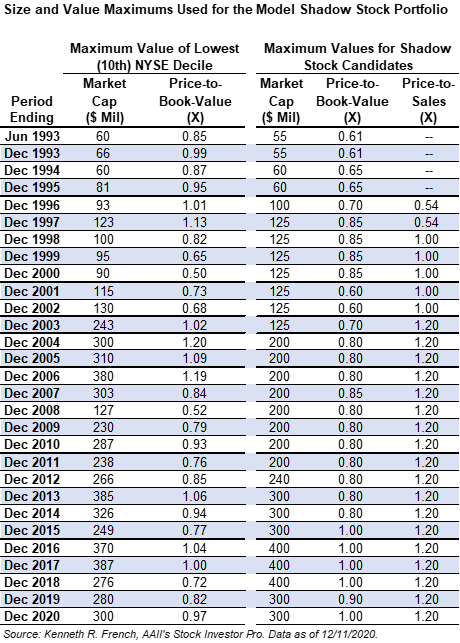
The table here provides a history of the size and value maximums used to manage the Model Shadow Stock Portfolio. The initial $55 million market-cap maximum for inclusion in the Model Shadow Stock Portfolio had grown to $400 million but was reduced to $300 million at end of 2019. The price-to-book-value ratio has fluctuated as well. It was lowest during 2001 and 2002, at 0.60, and has been as high as 1.00.
At the end of 2019, the NYSE price-to-book-value cutoff for the lowest decile stood at 0.82, so the maximum value for inclusion to the Model Shadow Stock Portfolio was adjusted one year ago from 1.00 to 0.90. As we performed the quarterly review of the Model Shadow Stock Portfolio on December 11, 2020, the price-to-book-value ratio cutoff had increased from 0.82 to 0.97, leading to an adjustment of the value used for the model portfolio from 0.90 to 1.00.
The NYSE market-cap cutoff for the lowest decile is currently $300 million, compared to $280 million one year ago, so the size cutoff was not adjusted for the Model Shadow Stock Portfolio during the quarterly review.
Note that stocks are removed from the portfolio if they have values that exceed the initial market cap or price-to-book ratio by a factor of three during the quarterly portfolio review. Stocks are also sold if earnings turn negative.
The Model Shadow Stock Portfolio has basic company profitability rules in place when selecting candidates and pruning holdings as a basic quality measure to filter out the many troubled companies found amid the pool of stocks trading with low price-to-book values. Notably, when adding stocks, positive quarterly and trailing 12-month earnings from continuing operations are required and analysts must be providing positive earnings estimates for the current quarter and year.
Stocks are removed for negative earnings after a period of probation. If the trailing 12-month earnings are negative, the stock is put on probation. If a subsequent quarter has negative earnings prior to 12-month earnings from continuing operations becoming positive, the stock is removed. When available, adjusted (non-GAAP) earnings are used to put stocks on probation or remove them. Non-GAAP earnings have been adjusted to eliminate the impact of nonrecurring events, such as markdown of inventory or goodwill. These are the earnings used by the earnings reporting services such as I/B/E/S; if not available from one of these services, earnings from continuing operations are used.
The impact of the coronavirus pandemic on the economy has been dramatic and swift this year. However, while most economic sectors have suffered, some industries and companies have flourished. The sudden economic slowdown resulted in many of the Shadow Stock holdings being placed on earnings probation. About half of the holdings had negative GAAP trailing earnings per share at the start of the quarterly review, with seven holdings on probation.
Three of the holdings that reported negative adjusted quarterly earnings and are being removed from the portfolio: Cumulus Media Inc. (CMLS), Olympic Steel Inc. (ZEUS) and Universal Stainless & Alloy Products (USAP).
Bassett Furniture Industries Inc. (BSET), Covenant Logistics Group Inc. (CVLG), Hurco Companies Inc. (HURC) and Strattec Security Corp. (STRT) remain on probation, as their trailing earnings are still negative after reporting positive quarterly earnings. The notes column of the table listing the current Model Shadow Stock Portfolio (www.aaii.com/model-portfolios/portfolio) indicates which companies are on earnings probation.
Eight of the holdings have negative trailing GAAP earnings, but positive adjusted trailing earnings: Delta Apparel Inc. (DLA), Hallador Energy Co. (HNRG), Hooker Furniture Corp. (HOFT), New Home Company Inc. (NWHM), Penn Virginia Corp. (PVAC), RCI Hospitality Holdings Inc. (RICK), Townsquare Media Inc. (TSQ) and VSE Corp. (VSEC). These companies are designated with “TTM adjusted earnings positive” in the notes column. When companies have analyst coverage, we use the adjusted earnings per share reported in I/B/E/S found in AAII’s Stock Investor Pro to determine the adjusted earnings figure.
As we have previously reported, CPI Aerostructures Inc. (CVU) had to restate its financial statements after discovering errors in the revenue recognition process. CPI Aerostructures started to publish restated financials in August and has been bringing its financials up to date in an accelerated fashion. In cases of company restatements that do not lead to delisting, the normal procedure is to wait for the firm to provide current financials before removing it for earnings probation. We have observed that the biggest share price hit normally occurs when a company first announces the need for a restatement, and it can be advantageous to wait the process out—provided the company gets exchange approval of meeting reporting standards.
In summary, after conducting the quarterly review of the Model Shadow Stock Portfolio, Cumulus Media, Olympic Steel and Universal Stainless & Alloy were removed from the portfolio because they reported negative quarterly earnings after previously posting negative trailing earnings. With the proceeds from the sale of the three stocks, three stocks were added (even though they would constitute below-average positions) to continue to introduce fresh holdings into the portfolio. Ampco-Pittsburgh Corp. (AP), Global Ship Lease Inc. (GSL) and Orion Group Holdings Inc. (ORN) were added to the model portfolio during regular trading hours on Monday, December 14, 2020.
Cumulus Media Inc. (CMLS)
Cumulus Media was removed because of the Model Shadow Stock Portfolio’s negative earnings rule. Cumulus Media went on earnings probation after reporting negative quarterly earnings per share of $1.56 on August 10, 2020. On November 5, 2020, the company reported a loss of $0.78 per share for the fiscal third quarter, while trailing 12-month earnings remained negative. The results were better than expected, but the negative earnings still violated the management rules of the portfolio.
Cumulus Media is a leading audio-first media and entertainment company, with local programming through 422 owned-and-operated stations across 87 markets. The company delivers nationally syndicated sports, news, talk and entertainment programming from well-known brands—including the NFL, the Masters, the Olympics and the Academy of Country Music Awards—across nearly 8,000 affiliated stations through Westwood One, the largest audio network in America. The company’s performance was hurt earlier this year by the reduction of live sports programming during the pandemic. Readers will note that Cumulus Media was up by 73.3% during November after posting its positive earnings surprise. As a possible end to the coronavirus pandemic nears, Cumulus Media should see its business recover as advertising revenues return, especially those related to broadcast coverage of live events.
It is the policy of the Model Shadow Stock Portfolio to remove a stock once its trailing 12-month adjusted earnings go negative and the company reports a quarterly loss in a subsequent quarter while trailing earnings are still negative.
Olympic Steel, Inc. (ZEUS)
Olympic Steel was removed because of the Model Shadow Stock Portfolio’s negative earnings rule. On November 5, 2020, the company reported a fiscal-third-quarter loss of $0.14 per share, while trailing 12-month earnings remained negative. Trailing earnings had turned negative after reporting a $0.35 loss per share for the fiscal second quarter ending June 30, 2020. Olympic Steel provides metals processing and distribution services for a range of customers. It operates through three segments: carbon flat products, specialty metals flat products and tubular and pipe products.
Universal Stainless & Alloy Products (USAP)
Universal Stainless & Alloy was removed because of the Model Shadow Stock Portfolio’s negative earnings rule. On October 21, 2020, the company reported a fiscal-third-quarter loss of $0.44 per share, while trailing 12-month earnings remained negative. Trailing earnings had turned negative after reporting a $0.27 loss per share for the fiscal second quarter ending June 30, 2020. Universal Stainless & Alloy produces semi-finished and finished specialty steel long products and plate including nickel alloy, stainless steel, tool steel and aircraft-quality low alloy steels in a wide variety of grades and product forms. Its products are used in a variety of industries including aerospace, power generation, oil & gas and heavy equipment manufacturing.
With the updated price-to-book maximum of 1.00, 14 stocks met the revised initial selection criteria for the Model Shadow Stock Portfolio. Without the increase in the price-to-book maximum, eight stocks would have passed the initial filter. Last month, 13 stocks met the initial criteria that were in place at the time.
Small-cap companies tend to be more sensitive to economic conditions, and investors rotated into economically sensitive stocks as positive results of coronavirus vaccine trials surfaced during November.
AAII members can see and research which companies are currently passing the initial selection criteria in the Shadow Stock Ideas table on AAII.com. The list of new Shadow Stock Ideas is updated daily—Tuesday through Saturday.
Two of the qualifying stocks were already held in the model portfolio, Big 5 Sporting Goods Corp. (BGFV) and Key Tronic Corp. (KTCC). The remaining 12 stocks were examined to ensure adequate liquidity, timely financial filings and appropriate industry and foreign considerations. For example, under stock order guidance it is recommended that the average daily dollar volume should be at least 10 times the amount needed for your position. This will ensure liquidity to get in and out of the position, even if you need to grow the position gradually and sell gradually. This rule results in a varying number of qualifying stocks for each investor. Three stocks were eliminated because their average daily trading volume was too low, and the resulting bid-ask spread was too wide for inclusion in the model portfolio.
Price momentum is used as the tiebreaker among qualifying stocks. Two relative strength figures were examined: the short-term four-week relative strength rank and the weighted relative strength ranking, which looks at price performance over the last year but places a higher weight on the most recent quarterly price performance.
Portfolio Addition: Ampco-Pittsburgh Corp.  (AP)
(AP)
Ampco-Pittsburgh manufactures and sells specialty metal products and specialty industrial equipment to commercial and industrial users worldwide. The company has two primary segments: the forged and cast engineered products segment, and the air and liquid processing segment. The forged and cast engineered products segment produces forged and cast rolls for the worldwide steel and aluminum industries and supplies ingot and open-die forged products for the oil and gas, aluminum and plastic extrusion industries. The air and liquid processing segment includes Aerofin, Buffalo Air Handling and Buffalo Pumps subsidiaries.
There is only one analyst currently following the company. The analyst expects the company to earn $0.45 per share for the current fiscal year ending in December 2020. The estimate is up from the loss of $0.59 per share expected three months ago. Earnings are expected to contract to a positive $0.23 per share in the next fiscal year, but this is up from a $0.09 loss per share expected three months ago.
Ampco-Pittsburgh has a book value per share of $5.84 as of the end of September 30, 2020. If you wish to stay within the 1.00 price-to-book-value maximum, you should pay no more than $5.84 per share. However, if the stock price has moved up a bit after being added to the portfolio, it is still OK to purchase the stock unless the ratio goes above 1.10, which equates to a price of $6.42 per share. To calculate the maximum purchase price based on the maximum desired price-to-book ratio, multiply the current book value per share ($5.84 for Ampco-Pittsburgh) by the maximum price-to-book ratio to be considered for the Model Shadow Stock Portfolio (currently 1.00, or 1.10 for loosened consideration). The calculation is: $5.84 × 1.00 = $5.84.
There is only one analyst currently following the company, truly placing it in the shadows of Wall Street. For the first quarter of fiscal-year 2021, the company expects to report revenue in the range of $118 million to $125 million. It warns investors that while its facilities in the U.S., Mexico, China and Vietnam are currently operating and rigorously following current health guidelines, uncertainty as to the possibility of future temporary closures, customer demand and costs and future supply chain disruptions during the rapidly changing pandemic environment could significantly impact operations in coming periods.
Portfolio Addition: Global Ship Lease Inc. (GSL)
Global Ship Lease is a containership owner, leasing ships to container shipping companies under industry-standard, fixed-rate time charters. The company is a Marshall Islands corporation, with offices in London and Athens, and its shares are listed on the NYSE. Global Ship Lease focuses on mid-size Post-Panamax and smaller containerships, which tend to serve the faster-growing non-mainland and intra-regional trades.
The Model Shadow Stock Portfolio normally avoids pure leasing and rental companies that are primarily financial corporations. Global Ship Lease owns and charters its fleet of ships. Its fleet consists of mid-size and smaller containerships that can be deployed on a wide range of trading routes. As of September 30, 2020, it owned 43 ships— 25 of its ships are classified as wide-beam Post-Panamax ships, of which nine are fuel-efficient and new-design wide-beam units. The average age of its vessels is around 13 years, and the company indicates that it gives an average remaining useful economic life of around 17 years for its fleet.
Two analysts are currently following the company. Analysts expect the company to earn $1.34 per share for the current fiscal year ending in December 2020. The estimate is up from the $1.09 per share consensus estimate three months ago. Analysts expect earnings to expand to $2.055 per share the next fiscal year, up from $1.635 per share three months ago.
Based upon the current price-to-book-value limit, you should pay no more than $24.90 per share if you wish to acquire the company with a price-to-book ratio of 1.00 or below. Global Ship Lease reported its book value as $24.90 per share as of the end of September 30, 2020.
Portfolio Addition: Orion Group Holdings Inc. (ORN)
Orion Group Holdings is a heavy marine civil contractor that specializes in a full spectrum of marine, industrial and infrastructure construction services. Its services include dredging, marine industrial and transportation facilities, environmental remediation and protection, commercial diving and a wide range of other specialty services. Orion Group services coastal regions throughout Alaska, the Pacific Northwest, Western Canada, Gulf Coast, East Coast and the entire Caribbean Basin.
Four analysts are currently following the company. Analysts expect the company to earn $0.43 per share for the current fiscal year ending in December 2020. The estimate is up from the $0.28 per share consensus estimate three months ago. Analysts expect earnings to contract to a positive $0.338 per share in the next fiscal year, and then expand to $0.810 per share in the following year.
Based upon the current price-to-book limit, you should pay no more than $5.12 per share if you wish to acquire the company with a price-to-book ratio of 1.00 or below. Orion Group reported its book value as $5.12 per share as of the end of September 30, 2020.
The next quarterly review of the Model Shadow Stock Portfolio will take place following the end of February 2021. Any changes to the portfolio will be announced at the time they are made in our Model Shadow Stock Portfolio Update emails (sign up at www.aaii.com/email).
The Model Shadow Stock Portfolio accelerated its rebound for the year with a 21.9% gain during November 2020. The Model Shadow Stock Portfolio is now up 98.5% since the end of March and is up 2.3% year to date. The S&P 500 index as measured by the performance of the Vanguard S&P 500 Index fund (VFINX) had a gain of 10.9% during November and is now up 13.9% during the first 11 months of the year. The Vanguard Small Cap Index fund (NAESX) is up 10.8% for the year after gaining 16.0% in November. The DFA U.S. Micro Cap (DFSCX) gained 16.4% during November but remains down 1.7% for the year.
The 21.9% monthly gain for the Model Shadow Stock Portfolio is the greatest single-month advance since the portfolio increased 25.0% during the month of April 2009. The 35.1% loss during March of this year and the 21.9% gain during November serves as a strong reminder of how quickly the market can move and the difficulties of trying to time movements into and out of the market.
With the possibility of a return to a more normal life made conceivable by the hope of a successful coronavirus vaccine, investors rotated into smaller, value-oriented stocks.
In the large-cap segment, growth stocks were up 9.7% for the month, giving them a 28.2% gain year to date for 2020. Large-cap value stocks were up 12.9% during November, remaining down 2.1% year to date.
In the mid-cap segment, growth stocks were up 12.5% for the month, boosting the year-to-date return to a positive 15.4% for this segment. Small-cap value stocks were up 16.6% during November yet remain down 2.8% for the year through November.
Small-cap growth stocks were up 17.6% for the month, increasing their year-to-date return to a positive 23.1%. Small-cap value stocks were up 19.3% during November yet remain down 3.1% for the year through November.
Since its inception in 1993, the AAII Model Shadow Stock Portfolio has a compound annual average return of 13.8% versus the Vanguard 500 Index fund’s gain of 9.9% per year on average over the same period. Over the same period, the Vanguard Small Cap Index fund posted an average annual gain of 10.1%.
Mesa Air Group (MESA) was the top-performing stock in the Model Shadow Stock Portfolio for November, up over 100%. As an operator of regional air carriers, Mesa Air saw its stock rise with a bullish market reaction to the news that a successful coronavirus vaccine is imminent. Investors became bullish toward stocks that have been hampered by the pandemic, as a successful vaccine allows for more concrete speculation about of the pandemic’s initial economic impact coming to an end.
Container Store Group Inc. (TCS) was the weakest-performing stock in the portfolio for November, down by 2%. This follows two months of leading the portfolio with top performance, up 46% for September and 53% for October. The large gains were in reaction to pandemic benefits that its business experienced due to changes in consumer spending, so news of a vaccine did not affect Container Store’s stock to the same degree as other stocks, such as Mesa Air. Last month, Container Store said it benefited from an increase in digital sales and it continues to see momentum for other factors.
Hurco Companies Inc. (HURC) followed as the second-worst-performing stock with a loss of 0.1% during the month. There has been little company-specific news since Hurco reported third-quarter results in September. The company has maintained profitability through the cyclicality of the industrials sector and the economic downturn of the pandemic, retaining shareholder value with dividends and share repurchases. The stock has been relatively stable over the last quarter.
Here are some news highlights from November for the holdings in the Model Shadow Stock Portfolio:
Beazer Homes USA Inc. (BZH) reported that fiscal fourth-quarter 2020 net income of $25.6 million, or $0.80 per share, was up year over year compared to adjusted net income of $23.8 million a year ago. Earnings per share for the quarter beat the I/B/E/S consensus estimate of $0.58 per share by 37.9%. Homebuilding revenue declined by 12.2% to $679.1 million compared to the prior-year quarter.
Home closings during the fourth quarter decreased by 13.8%, to 1,737 homes, combined with a 1.8% increase in average selling price to $390,900. Net new orders rose by 37.8% year over year, to 2,009 units, the highest fourth-quarter level in more than a decade. The increase in net new orders was driven by a 52.6% increase in the absorption rate to 4.4 sales per community per month, partially offset by a 9.7% decrease in average community count to 151. The cancellation rate for the quarter declined by 410 basis points to 12.2% year over year. At the end of the quarter, Beazer Homes’ backlog remained relatively flat at a total dollar value of $995.3 million, or 2,509 homes, compared to $665.1 million, or 1,708 homes, at the same time last year.
Beazer Homes said that given the 50% increase in the dollar value of its backlog compared to last year, and anticipations of significantly lower interest expense, it expects double-digit growth in earnings per share for fiscal 2021 despite a reduction in community count.
“With our deleveraging objective of reducing debt below $1 billion clearly in sight, we expect increased land and development spending during 2021 will allow us to increase the number of lots we own or control through options by year-end, which we believe positions us for top- and bottom-line growth in the years ahead,” said CEO Allan Merrill.
CPI Aerostructures Inc. (CVU) reported that second-quarter 2020 revenue declined by 1.8% to $19.7 million year over year. Net loss for the quarter was $0.05 per diluted share, compared to a net loss of $0.07 per share in the second quarter of 2019. Earnings per share for the quarter missed the I/B/E/S consensus estimate of $0.06 per share.
Revenue remained relatively flat year over year, primarily due to increases in its defense business, offset by weakness in the commercial aviation business. As anticipated, second-quarter gross profit margin rebounded from last year and the company expects full-year 2020 gross margin to be higher than 2019. Operating cash flow for the quarter rose increased to $0.6 million compared to the prior-year period, despite headwinds from cash payments of about $0.8 million for nonrecurring professional fees related to the restatement.
“Our second-quarter results demonstrate continued solid execution of our funded defense backlog and the business stability our high-quality backlog affords us,” said CEO Doug McCrosson. “The results also support our expectation that ramping production of newer programs and our defense backlog will fuel a stronger half of the year and position us to end 2020 with higher revenue and operating income in 2019. Our preliminary outlook for 2021 is for growth in revenue, operating income and operating cash flow compared to 2020. We expect to share more insights into 2021 when we announce our third-quarter results sometime in late December.”
Delta Apparel Inc. (DLA) reported fiscal fourth-quarter 2020 diluted earnings per share of $0.71, compared to earnings per share of $0.50 in the prior-year quarter. Diluted earnings per share for the quarter beat the I/B/E/S consensus estimate of a net loss of $0.55 per share by 29.1%. Net sales increased by 8.1% year over year to $116.7 million.
Fourth-quarter gross profit was $24.9 million, compared to $22.9 million in the prior-year fourth quarter. Operating income increased to $8.3 million, compared to operating profit of $4.8 million in the prior-year quarter.
“While uncertainty remains around the pandemic and general economy, Delta Apparel has a proven track record of successfully navigating uncharted territory,” said CEO Robert Humphreys. “As we enter our new fiscal year, we are well positioned to capitalize on numerous market demand opportunities across our businesses. We remain confident that our diversified sales channels and uniquely positioned business model place us on a strong path for continued profitable growth.”
Hallador Energy Co. (HNRG) reported third-quarter earnings per share of $0.06, missing the I/B/E/S consensus estimate of $0.07 per share by 14%. The company reported quarterly revenues of $65.13 million, a 21.6% year-over-year decrease, with a net income of $1.9 million. The third quarter saw improvements in shipping over the second quarter with a reported cost of $29.30 per ton, remaining within Hallador’s expectations.
The company decreased bank debt by $33 million in the first nine months of 2020 and saw an operating cash flow of $34.1 million. Coal inventories decreased by $4.5 million in the third quarter. Hallador improved its liquidity to $52.7 million and its leverage ratio of 2.46x stayed under its covenant of 3.5x.
The company anticipates increased shipping levels in the fourth quarter as well as decreased inventory, which will further improve operating cash flow.
“We are intensely focused on creating positive cash flow to aggressively pay down debt,” said CEO Brent Bilsland. “Year to date, we have paid down $33 million and are on pace to reduce our total bank debt by 20% to 25% for the year.”
Hibbett Sports Inc. (HIBB) reported a 20.3% increase in net sales to $331.4 million for the third quarter of fiscal 2021. Adjusted earnings totaled $1.45 per share, far above analysts’ expectations for $0.45 per share and Hibbett Sports’ adjusted earnings of $0.13 per share in the same period one year ago.
Third-quarter comparable sales growth of 21.2% was driven by several factors, including new customer retention, the timing of back-to-school spending and availability of in-demand footwear, apparel and accessories. These factors drove customers toward additional transactions and higher average transactions in stores and online.
Hibbett Sports’ end-of-quarter cash balance approximated $10 per share outstanding. When asked if they would consider using it to make an acquisition, the company’s executives didn’t reveal much about how the cash would be deployed other than to ensure there was enough inventory to meet growing sales. The company’s fourth-quarter earnings guidance of $1.00 to $1.10 per share compares to the current I/B/E/S consensus estimate of $0.45 per share.
Hurco Companies Inc. (HURC) declared a quarterly dividend of $0.13 per share, in line with its previous declaration. The dividend is payable on January 20 to shareholders of record as of January 6.
Kimball Electronics Inc. (KE) reported first-quarter fiscal 2021 earnings per share of $0.65, beating the I/B/E/S consensus estimate of $0.33 per share by 97%. Earnings were up year over year from $0.26 per share. The company realized revenue of $331.75 million, a 5.9% year-over-year increase. Gross margin was reported to be 9.2%, an all-time high for the company, and selling, general and administrative (SG&A) expenses clocked in at 3.8% of net sales.
Operating income came in at $17.8 million and cash flows from operating activities were $20.7 million. Leading the charge with 38% of sales was Kimball Electronics’ medical group, closely followed by the automotive group at 36%. Industrials accounted for 21% of sales, public safety for 4% and other for 1%.
“We expect the sales in our medical vertical to normalize and begin to approximate [pre-coronavirus] run rates during the second quarter of fiscal-year 2021,” said CEO Donald Charron. “Sales in our automotive vertical continued to gain momentum during the first quarter of fiscal-year 2021 increasing 61% from the previous quarter and down just 5% from the first quarter of fiscal-year 2020. We expect the sales in our automotive vertical will return to [pre-coronavirus] levels in the second quarter and steadily increase throughout fiscal-year 2021.”
Mesa Air Group (MESA) entered into a five-year term loan for $200 million under the CARES Act, borrowing $45 million on the day of issuance. Later in the month, the company entered into a second closing, borrowing an additional $152 million.
“I’d like to again express my sincere gratitude to everyone involved in making this deal happen. Our people have been working very hard to ensure Mesa and its employees are prepared to weather this storm,” said CEO Jonathan Ornstein. “These additional funds will substantially benefit our airline and the communities we serve as we continue to navigate the obstacles created by the pandemic.”
New Home Company Inc. (NWHM) reported a quarterly net income of $1.2 million, or $0.06 per share, an increase of 126% year-over-year. The company brought in revenue of $130.8 million, a decrease of 21% year-over-year. Home sales revenue for the quarter came in at $117.4 million and new home deliveries increased by 27% year over year to 157. The gross margin for home sales was 14.2%, an increase compared to last year’s third-quarter gross margin of 9.5%.
Net new orders were reported to be 251, a 102% year-over-year increase, and the monthly sales absorption of 3.5 per community increased by 75% year over year. Cash flow from operations was $20 million and cash and cash equivalents were $126.4 million. The company’s debt-to-capital ratio stands at 59.4%, a 980 basis-point improvement year over year.
“The New Home Company made significant progress during the third quarter through strong sales, improved gross margins and solid operating cash flows,” remarked CEO Larry Webb. “We experienced strong monthly sequential order growth during the quarter with September generating the highest monthly order total in our company’s history.”
Penn Virginia Corp. (PVAC) announced a strategic investment by Juniper Capital Advisors of $188.4 million that will see Juniper own about 59% of Penn Virginia’s equity at the closing of the transaction, expected by the end of the first quarter of 2021. The investment consists of a $150 million cash investment at $8.75 per share of Penn Virginia stock, a 13% premium to the company’s closing share price on November 2 and a contribution of complementary oil and gas assets valued at $38.4 million.
Penn Virginia expects to use $50 million of the cash proceeds to pay down and restructure its second-lien term loan (balance of $200.0 million as of October 30, 2020), with the balance of the cash proceeds used to significantly reduce the amount outstanding under the company’s credit facility (balance of $314.4 million as of October 30, 2020) and to pay transaction fees and expenses. In connection with the closing of the transaction, holders of Penn Virginia’s second-lien term loan have agreed to extend the maturity date from September 2022 to September 2024, in addition to other modifications to the term loan agreement.
Following the closing, Edward Geiser, Juniper’s managing partner and CEO, will serve as Penn Virginia’s board chairman, and Juniper will appoint four additional members to the board. Darrin Henke, Penn Virginia’s president and CEO, and the other members of Penn Virginia’s senior management are expected to continue in their roles, and the company’s current directors, including Henke, will remain on the board immediately following the closing.
“The transaction significantly strengthens our balance sheet, adds complementary assets and allows us to highlight our premier asset base,” said Henke. “We evaluated several capital providers, and we are moving forward with Juniper, given their history of successful operations in our area of the Eagle Ford and our similar operational and financial views. This transaction further solidifies our position as a leader in the small-cap [exploration and production] space, with a focus on value creation for our shareholders, with consistent free cash flow generation and low leverage among our top priorities.”
Separately, Penn Virginia reported adjusted earnings of $1.14 per share for the third quarter of 2020, which were down by 41% year over year. Adjusted earnings per share beat the I/B/E/S consensus estimate for earnings of $0.881 per share by 29%. Total revenues of $69.4 million were up over the same period by 53%. Crude oil revenue of $63.2 million was up by 53% year over year.
“Generating free cash flow is a top priority for Penn Virginia. To achieve that goal, we continue to focus on driving down our capital costs, increasing operational efficiencies, and protecting our margins by prudent risk management,” said Henke. “During the third quarter, we generated significant free cash flow, and we judiciously used that cash to reduce our outstanding debt. Given our Gulf Coast pricing, low-cost structure, strong hedge positions and resumption of our drilling program, we anticipate living within cash flow in the fourth quarter.”
Perion Network Ltd. (PERI) announced the renewal of a multi-year strategic partnership with Microsoft Corp. (MSFT) to drive search and advertising business growth through Perion Network’s search technology division and provide a more immersive experience across desktop and mobile platforms. The continuing collaboration between the companies will enable Perion Network to further grow its publisher relationships offering, lucrative search technology solutions and sophisticated expertise for monetizing their digital properties. These include shopping, product comparison and content websites, applications, browser extensions, mobile launchers and white label search engines.
RCI Hospitality Holdings (RICK) reported that October sales for clubs and restaurants totaled $15.3 million, the company’s best since April when all locations were closed due to government restrictions related to the coronavirus pandemic. October sales were down year over year by 3% but were up from September by 34%. Forty-seven of 48 locations were open (37 clubs and all 10 restaurants) during October.
Despite positive results in October, the latest wave of the pandemic is leading to increased restrictions, including reduced occupancy levels and operating hours for some businesses. As of the report in November, 32 clubs and all 10 restaurants were open.
RCI Hospitality said it plans to develop 10 new Bombshells restaurants over the next three years, assuming it can find the right locations and structure the development in line with its capital allocation plan. The expansion is being launched due to the chain’s overall success since its 2013 founding, including its particularly strong performance through the coronavirus, Bombshells’ ability to easily self-fund the new units and a significantly improved real estate market.
RCI Hospitality is currently negotiating leases or real estate purchases and bank financing for four of the proposed new locations. Target markets are Dallas-Fort Worth, where the first Bombshells is located; Houston, where there are eight Bombshells; and Miami-Fort Lauderdale, where subsidiaries own two large nightclubs.
Rocky Brands Inc. (RCKY) declared a regular quarterly dividend of $0.14 per share, in line with its previous declaration. The dividend is payable on December 16 to shareholders of record as of December 2.
Titan Machinery Inc. (TITN) reported third-quarter adjusted earnings of $0.58 per share, which increased year over year by 21%. Adjusted earnings per share beat the I/B/E/S consensus estimate for earnings of $0.348 per share by 68%. Revenue over the same period was flat at $360.9 million.
Equipment sales were down year over year for the third quarter by 2%, to $240.9 million, while parts sales were up by 8%, to $76.8 million. Service revenue was up by 11%, to $30.7 million. On the strength in its parts and service business during the quarter, Titan Machinery’s largest segment, agriculture, increased revenue by 3% year over year to $220.6 million. The company increased its gross profit margin year over year from 19.9% to 20.1%, primarily due to an increased mix of higher-margin parts and service business.
“Due to the strong third-quarter performance and our outlook for the remainder of fiscal 2021, we are increasing our revenue expectations for all three of our operating segments and raising our earnings per share guidance,” said CEO David Meyer. “We are actively monitoring the current environment and the associated impacts that it may have on our customers, the commodities markets and our business. We remain focused on keeping our business in a sound condition while we pursue our long-term growth initiatives.”
Townsquare Media Inc. (TSQ) reported adjusted earnings of $0.12 per share for the third quarter of 2020, down by 33% year over year. Adjusted earnings beat the I/B/E/S consensus estimate for a net loss of $0.08 per share. Net revenue over the same period decreased by 15%, to $95.4 million.
Overall net revenue improved sequentially from the second quarter of 2020, which saw net revenue shrink by 34.5% year over year due to the coronavirus pandemic. Compared to the third quarter of 2019, Townsquare interactive net subscription revenue increased by 14.5% to $18.2 million, advertising net revenue decreased by 17.2% to $77.1 million and live events net revenue decreased by 98.2% to $0.1 million. Growth in Townsquare interactive and advertising revenues led to results that exceeded the company’s expectations for the quarter.
“Our focus on underserved small and mid-sized local markets, our investment and commitment to our ‘Local First’ strategy and our investment in world-class personnel, technology and infrastructure that allowed us to build a strong digital platform with best of breed products, services and solutions that contributes 44% of our total revenue, have all contributed to our ability to mitigate revenue declines and manage quite effectively through this downturn,” said CEO Bill Wilson. “We believe these actions will position Townsquare to quickly emerge from this crisis and return to our market-leading performance quickly once this crisis abates.”
Vishay Precision Group Inc. (VPG) reported third-quarter adjusted earnings of $0.40 per share, up year over year by 8.0%. Adjusted earnings beat the I/B/E/S consensus estimate of $0.25 per share by 60%. Revenue of $67.5 million was about the same year over year, up by 0.2%.
Two of the company’s three business segments reported year-over-year increases in sales. Foil technology products was up by 2.5% to $32.9 million and weighing and control systems was up by 8.8% to $20.8 million, while force sensors was down by 14.5% to $13.9 million. However, on a sequential basis from the second quarter of 2020, all three segments reported an increase in sales, driven by ongoing strength in demand for Vishay’s advanced sensors products. Sequential growth was also driven by strength in Vishay’s consumer-related markets and the partial recovery in some of its end-markets, which continue to face headwinds from the pandemic.
“I am pleased with our financial performance for the third quarter, as we achieved solid margins, grew our earnings per share and continued to generate strong cash from operations,” said CEO Ziv Shoshani. “This performance reflects both the short-term cost controls we have in place as well as the cost-savings initiatives we have implemented across the business over the past few years.” The company expects net revenues to grow sequentially in the fourth quarter and be in the range of $69 million to $75 million.
 Get updates about the portfolio that has outperformed the market by 211.9%
since inception!
Get updates about the portfolio that has outperformed the market by 211.9%
since inception!