

John Bajkowski
is the president of AAII.
 BSET
BZH
CVLG
GM
GSL
HNRG
HURC
KTCC
NAESX
ORN
PERI
RCKY
STRT
TSQ
VSEC
BSET
BZH
CVLG
GM
GSL
HNRG
HURC
KTCC
NAESX
ORN
PERI
RCKY
STRT
TSQ
VSEC
The Model Shadow Stock Portfolio continued its strong run during January, while the S&P 500 index retreated slightly during the month. The Model Shadow Stock Portfolio gained 9.2% in January, compared to a 1.0% loss for the S&P 500. The gain for the Model Shadow Stock Portfolio marks the 10th straight monthly gain and the portfolio is now up 141.1% since the end of March 2020. By way of comparison the S&P 500, is up 45.6% and the Vanguard Small-Cap Index fund (NAESX) is up 73.9% since the end of March.
The recent outperformance of small-cap stocks comes after many years of lagging the performance of larger companies. This relative return pattern is somewhat characteristic of small-cap stocks, their performance often runs in streaks during which they outperform larger companies after a period of underperformance.
Now that small-cap stocks have posted strong returns, how does their relative valuation stand? We examined relative valuations of the S&P 500 compared to the S&P SmallCap 600 index in the May 2020 AAII Journal. As of April 17, 2020, the median price-to-book value of the stocks in the S&P 500 was 2.71, while the median for the stocks in the S&P SmallCap 600 was 1.28.
Dividing the price-to-book ratio of the S&P 500 stocks by that of the constituents of the S&P SmallCap 600 provides a helpful ratio that can be used to track the relative relationship over time. Near the market bottom last year, the price-to-book value of large-cap stocks was 2.1 times that of small-cap stocks.
With the market near all-time highs again, the median price-to-book value of the stocks in the S&P 500 has increased from 2.71 to 3.93, while the median for the stocks in the S&P SmallCap 600 went from 1.28 to 2.19 as of February 5, 2021. The price-to-book value of large-cap stocks is now at 1.8 times that of small-cap stocks.
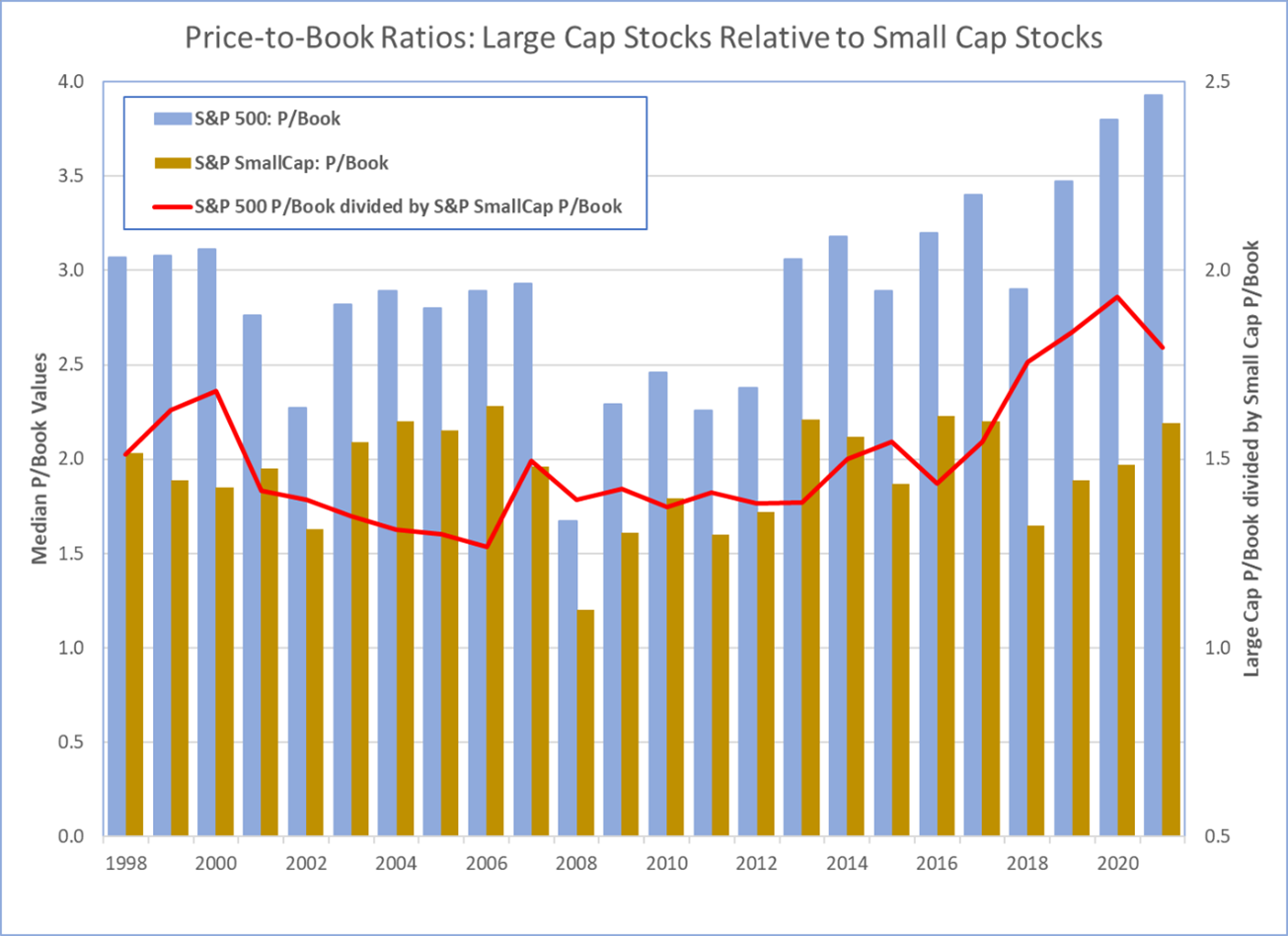
The valuation gap between large- and small-cap stocks has certainly narrowed. The figure below displays the year-end price-to-book median values for the companies within the S&P 500 and the S&P SmallCap 600. The large-cap values are represented by the blue bars, while small-cap values are displayed by the gold bars. The axis on the left side of the chart lists the price-to-book values. The 2021 bar captures the price-to-book ratios as of February 5, 2021. The year-end median of the S&P 500 stocks has averaged 2.85 over the last 23 years. The highest year-end value of 3.80 was registered at the end of 2020, while the lowest year-end value of 1.67 for the S&P 500 stocks was observed at the end of 2008. Stocks within the S&P SmallCap 600 have an average year-end price-to-book ratio of 1.92, with the highest value of 2.28 at the end of 2006 and the lowest value of 1.20 at the end of 2008 during the financial crisis. Today’s 3.93 median price-to-book value of the S&P 500 stocks exceeds the year-end values observed over the last 23 years. The 2.19 median price-to-book value of the S&P SmallCap 600 stocks is above the year-end average of 1.96 but not a hitting new high.
The red line plots the ratio of large-company price-to-book valuations to that of small-company stocks. When the red line goes higher, large-cap stocks are relatively more expensive than small-cap stocks. Small-cap stock valuations were the highest on a relative basis in the mid-2000s. In contrast, the divergence in the price performance and related valuations for large versus small companies is dramatically captured over the last several years. Large-cap stocks grew more expensive, while small-cap stocks languished and became relatively cheaper until recently. The current ratio stands at 1.79 (3.93 divided by 2.19), still above the 1.47 average observed over the last 23 years. The recent price run-up has pushed price-to-book valuations above their historical averages, but small-cap companies remain more attractive than large-cap stocks on a relative valuation basis.
Ten stocks met the initial selection criteria for the Model Shadow Stock Portfolio as of February 5, 2021, down from 12 passing stocks one month ago. AAII members can see and research which companies are currently passing the initial selection criteria in the Shadow Stock Ideas table on AAII.com. The list of Shadow Stock Ideas is updated daily—Tuesday through Saturday.
Of the 10 qualifying companies, two are currently held in the Model Shadow Stock tracking portfolio: Key Tronic Corp. (KTCC) and Mesa Air Group (MESA). Global Ship Lease Inc. (GSL) came off the list of qualifying companies over the course of the last month, while none were added. Qualifying companies are those held in the Model Shadow Stock Portfolio that currently meet the initial purchase rules. (They are designated as “currently qualifies” in the notes column of the Model Shadow Stock Portfolio table on AAII.com. However, if you go online, the notes may not match the list here since the notes on the website table are dynamically updated daily.)
Covenant Logistics Group (CVLG) and Strattec Security Corp. (STRT) came off probation during the month when they reported adjusted earnings that lifted their trailing 12-month earnings into positive territory.
As of February 5, 2021, Perion Network Ltd. (PERI) had the highest price-to-book-value ratio in the Model Shadow Stock Portfolio. Its ratio of 3.18 is more than three times the 1.00 maximum value used for initially qualifying a stock for inclusion to the portfolio.
The Model Shadow Stock Portfolio looks for stocks with a market capitalization (share price times shares outstanding) greater than $30 million but less than $300 million when adding stocks to the portfolio. Shadow Stocks with a market cap three times the initial market cap maximum ($300 million × 3 = $900 million) at the time of a quarterly review are sold from the portfolio, assuming there is a suitable replacement. Hibbett Sports Inc. (HIBB) has the highest market cap in the portfolio with a value of $989.7 million as of February 5, 2021.
The initial market cap and price-to-book levels are adjusted over time to reflect the changing market conditions. We are examining the valuation and size levels of the market for the next quarterly portfolio review, which will take place in early March. Any changes to the portfolio will be announced at the time they are made in a special Model Shadow Stock Portfolio Update email (sign up at www.aaii.com/email).
Townsquare Media Inc. (TSQ) was the top performer in the Model Shadow Stock Portfolio for January, up by 49.8%. The company was up after reporting that preliminary fourth-quarter results would be better than expected in December. Revenue and earnings results will both beat the company’s expectations as the economy continues recovering. CEO Bill Wilson said net revenue has improved sequentially since bottoming out in the second quarter with a decrease of 35% year over year.
Container Store Group Inc. (TCS) was the runner-up for the month, up by 42.9%. The company reported year-over-year revenue growth for the third quarter of 2020 and beat the I/B/E/S consensus earnings estimate during January. Chairwoman Melissa Reiff said results surpassed the company’s expectations. See more details in the news below.
VSE Corp. (VSEC) was the bottom performer for January, down by 10.1%. The company priced a previously announced public offering of shares that pressured the stock down near the end of the month. Net proceeds are expected to be used for general corporate purposes such as financing strategic acquisitions, funding working capital requirements for new program launches and repaying outstanding borrowings under its revolving credit facility. See more in the news below.
Hallador Energy Co. (HNRG) was down by 8.8% for the month. There was no company-specific news to associate with its decrease. Hallador Energy’s January performance follows from a large gain of 48.5% during December.
Here are some news highlights from January for the holdings in the Model Shadow Stock Portfolio:
Bassett Furniture Industries Inc. (BSET) reported fourth-quarter 2020 net income of $6.5 million, or $0.65 per diluted share, compared to a net loss of $5.1 million, or $0.51 per diluted share, in the prior-year quarter. Fourth-quarter earnings per diluted share beat the I/B/E/S consensus estimate of $0.45 per share. Consolidated sales for the quarter grew by 4.2% year over year to $10.0 million.
The company’s wholesale segment posted sales of $67.5 million, up 8.0% year over year. Third-quarter sales for the retail segment declined by 7.4% year over year to $64.8 million. The company’s logistical services unit reported that revenues grew by 7.3% year over year to $20.7 million. Consolidated retail operating income for the quarter was $2.5 million compared to a loss of $0.6 million in the fourth quarter of 2019.
Bassett Furniture also declared a regular quarterly dividend of $0.125 per share, in line with its previous declaration. The dividend is payable on February 26 to shareholders of record as of February 12.
Beazer Homes USA Inc. (BZH) reported that fiscal first-quarter 2021 net income of $12.0 million, or $0.40 per share, was up year over year compared to adjusted net income of $2.7 million a year ago. Earnings per share for the quarter beat the I/B/E/S consensus estimate of $0.295 per share by 35.6%. Homebuilding revenue declined by 1.6% to $424.2 million compared to the prior-year quarter.
Home closings during the first quarter increased by 0.2% to 1,114 homes, combined with a 1.4% increase in average selling price to $380,800.
Net new orders rose by 15.3% to 1,442 units year over year. The increase in net new orders was driven by a 42.4% increase in the absorption rate to 3.5 sales per community per month, partially offset by a 19.0% decrease in average community count to 136. The cancellation rate for the quarter declined by 260 basis points to 12.3% year over year. At the end of the quarter, Beazer Homes’ backlog increased 58.8% to a total dollar value of $1.16 billion, or 2,837 homes, compared to $732.1 million, or 1,847 homes, at the same time last year.
“With the strong results we generated in the first quarter, a healthy demand environment and a dollar value of backlog of sold homes up nearly 60% compared to this time last year, we have confidence that we will generate substantial growth in book value while continuing to reduce leverage,” said CEO Allan Merrill. “Our pivot to growth this year, supported by our differentiated and comprehensive ESG program, has positioned us to create durable and growing value for our customers, employees, partners and shareholders in the years ahead.”
Container Store Group Inc. (TCS) reported preliminary consolidated net sales of $275.5 million for the third quarter of 2020, up 20.5% compared to the prior-year quarter. Earnings per share of $0.42 for the quarter increased from $0.05 per share in the prior-year quarter and beat the I/B/E/S consensus estimate for earnings per share of $0.327 by 28.4%.
Container Store reported that online customer sales increased by 98.1% year over year. Other expenses for the quarter increased to $1.1 million, primarily due to severance costs associated with the reduction in workforce as a result of the coronavirus pandemic.
“Our third-quarter results meaningfully exceeded our original expectations. The strong customer demand we saw in the second quarter persisted into the third quarter, and our entire organization continued to make significant strides against our strategic priorities, positioning us extremely well to capitalize on our business opportunities,” said Chairwoman Melissa Reiff. “I am very proud of our teams and the accomplishments we have made the last several years, and specifically these past 11 months. With our business firing on all cylinders both financially and operationally, and the strength of our performance quarter-to-date, we are very confident we will end our fiscal year with strong momentum.”
Covenant Logistics Group (CVLG) reported fourth-quarter 2020 adjusted earnings per share of $0.61, compared to adjusted earnings per share of $0.09 for the fourth quarter of 2019. Adjusted earnings were in line with the I/B/E/S consensus estimate. Total revenue of $225.2 million decreased by 2.3% over the same period.
Freight revenue of $210.9 million, excluding revenue from fuel surcharges, rose 1.7% year over year. The decrease in freight revenue was primarily related to a 17.8% average operating fleet reduction, partially offset by a 4.5% increase in average freight revenue per tractor per week. Truckload operating cost per mile improved $0.13 per share, or 5.0% on an adjusted basis, compared to the prior-year quarter.
“Taking into account the commercial and cost environment, we expect results for the first half of 2021 will significantly exceed the prior year’s adjusted results for the comparable period,” said CEO David Parker. “Our comparative results for the second half and full year of 2021 will depend on factors such as our ability to reduce driver turnover, the number and significance of auto liability claims and the outcome of contract negotiations with customers, many of which won’t see a full quarter impact until the third quarter of 2021. Over the longer term, we expect to be a stronger, more profitable and more predictable business with the opportunity for significant and sustained value creation.”
Global Ship Lease Inc. (GSL) announced that it will declare a new regular quarterly cash dividend of $0.12 per share starting with the first quarter of 2021.
Additionally, the company closed the full redemption of its 9.875% first-priority secured notes due 2022. Upon closing, Global Ship Lease issued an aggregate of 12,955,188 Class A common shares to Kep Vi (Newco Marine) Ltd. and Kia Viii (Newco Marine) Ltd., affiliates of U.S. private equity firm Kelso & Co. The company also underwent a $5.4 million equity offering, pricing new Class A common stock at $13 per share for gross proceeds of $70.2 million. The proceeds are to be used for the funding of the expansion of the company’s fleet.
Hurco Companies Inc. (HURC) reported a fourth-quarter loss per share of $0.54. The company brought in $44.46 million in revenue for the quarter, a 25.9% decrease year over year. Orders for the quarter also decreased by 8% year over year to $48 million. The company ended the quarter with $57 million in cash and cash equivalents and a 21% gross margin.
Sales in the Americas for the fourth quarter decreased by 38% year over year, while American orders decreased by 30% year over year. European sales decreased by 20% year over year, including a favorable currency impact of 4%, while European orders increased by 11%. Asia Pacific sales decreased year over year by less than 1% and orders increased by 8%.
“We remain focused on a return to profitability and value to our shareholders. Even though this year was challenging, we are encouraged by growing demand we saw in certain markets in the second half of the fiscal year, particularly in Europe and Asia, and look ahead to 2021 with optimism that our financial strength, preparedness and product mix will position us for a strong recovery,” said CEO Michael Doar.
Key Tronic Corp. (KTCC) reported second-quarter 2021 earnings of $0.14 per share, which were up year over year by 75.0%. Revenue of $128.3 million was up over the same period by 9.9%. The revenue increase was due to the successful ramp of new customer programs and increased demand from existing customers. During this quarter, the company took on approximately $1.8 million in coronavirus-related expenses. Gross margin was 8.3% and operating margin was 2.1%, compared to last year’s second-quarter gross margin of 7.0% and operating margin of 1.3%.
For the third quarter of 2021, Key Tronic expects revenue of approximately $130 million to $140 million and earnings of approximately $0.20 to $0.25 per share. “We’re pleased with the successful ramp of new programs and our strong revenue growth in the second quarter of fiscal 2021, despite the continued headwinds from COVID-19,” said CEO Craig Gates. “During the second quarter of fiscal 2021, we continued to see the favorable trend of contract manufacturing returning to North America and won new programs involving security and home automation and industrial products.”
Mesa Air Group (MESA) reported December 2020 operating performance. The company reported a decrease of 33.9% year over year as a result of reduced schedules during the coronavirus pandemic. The company also reported a controllable completion factor of 99.87% and 100% for its American Airlines and United Airlines operations, respectively.
Orion Group Holdings Inc. (ORN) announced that its concrete segment was awarded several contracts to provide concrete and associated paving services totaling approximately $27 million. Work on all these projects will commence late in the first quarter to early in the second quarter of 2021 and be completed before year-end.
Penn Virginia Corp. (PVAC) announced the closing of the Juniper transaction after 77% of its shareholders voted in favor of all proposals associated with the strategic investment. Following the closing, Juniper owns approximately 59.6% of Penn Virginia’s equity. Additionally, the company has increased its board from four members to nine members with Edward Geiser serving as the new chairman.
Perion Network Ltd. (PERI) announced that it closed its previously announced public offering. The company sold a total of 5.74 million ordinary shares at a public offering price of $11.50 per share, less underwriting discounts and commissions. The shares sold resulted in aggregate gross proceeds to the company of approximately $66 million before deducting underwriting discounts and commission, which Perion Network intends on using for additional working capital and funding the growth of its business.
Rocky Brands Inc. (RCKY) announced that it entered a definitive agreement to acquire the performance and lifestyle footwear business of Honeywell International for $230 million, which includes The Original Muck Boot Company and XTRATUF footwear brands.
“With the acquisition of The Original Muck Boot Company along with the XTRATUF, Servus, NEOS and Ranger brands, we will greatly enhance our powerful portfolio of footwear brands and significantly increase our sales and profitability,” said CEO Jason Brooks. “We’re acquiring a well-run business with a corporate culture and a customer base similar to ours, which provides meaningful growth opportunities within our existing categories as well as an entrée into new market segments.”
Strattec Security Corp. (STRT) reported second-quarter fiscal-2021 revenue of $127.4 million, up 19.8% from $106.3 million in the second quarter of fiscal 2020. This revenue increase was led by a 53.5% year-over-year increase in net sales to General Motors Co. (GM), which was reduced by approximately $7 million in the prior-year quarter due to the General Motors UAW strike that took place that year.
Net income was $7.1 million in the current-year quarter, up 646.2% compared to a net loss of $1.3 million in the prior-year quarter. Diluted earnings per share were $1.85, up 613.9% year over year from a loss of $0.36 per diluted share and beating the I/B/E/S consensus estimate of $1.22 per share by 51.6%. The current-year quarter included a customer reimbursement for costs incurred in prior periods, which increased the current-year quarter’s diluted earnings per share by $0.26.
“We are beginning to see the fruits of years of our new product development efforts. We were one of four companies in the world to win the General Motors Innovation Award, in our case for our power tailgate offered on the Chevrolet Silverado pick-up truck,” said CEO Frank Krejci. “As a customer option, the take rate is exceeding initial sales projections. In addition, a similar product for the market share leader Ford F-150 pick-up is just beginning to be introduced.”
Townsquare Media Inc. (TSQ) announced that it entered an agreement to repurchase a minimum of 10 million of the 12.5 million shares of Class A common stock, shares of Class B common stock and warrants held by Oaktree Capital Management for $6.40 per share. The aggregate purchase price is expected to be approximately $64 million, subject to Townsquare Media’s ability to elect to purchase additional securities at the closing of the repurchase. These repurchased securities will be retired upon closing and the company’s outstanding securities will be reduced from approximately 28 million to approximately 18 million.
VSE Corp. (VSEC) announced that it entered an exclusive life-of-program distribution agreement with Pratt & Whitney Canada, a Canada-based aircraft engine manufacturer. Under the terms of this agreement, VSE Corp. will be appointed as the exclusive licensed distributor for more than 1,500 after-market parts and components supporting Pratt & Whitney Canada’s APS500 auxiliary power unit. The agreement term is for the commercial life of the program, which will be implemented and executed throughout 2021.
VSE Corp. also announced that it has priced its previously announced public offering of 1.43 million shares of its common stock at $35.00 per share. The company has also granted underwriters a 30-day option to buy up to an additional 0.21 million shares. Net proceeds from the public offering are expected to be around $47 million, net of underwriting discounts and commissions but before the estimated offering expense. Net proceeds are expected to be used for general corporate purposes such as financing strategic acquisitions, funding working capital requirements for new program launches and repaying outstanding borrowings under its revolving credit facility. The offering was expected to close on February 2, 2021.
 Get updates about the portfolio that has outperformed the market by 211.9%
since inception!
Get updates about the portfolio that has outperformed the market by 211.9%
since inception!