

John Bajkowski
is the president of AAII.
 AAL
CVU
DCO
DFSCX
GSL
HOFT
KE
KTCC
NAESX
ORN
PERI
RCKY
RICK
SIF
STRT
TSQ
UAL
ULBI
VFINX
VPG
AAL
CVU
DCO
DFSCX
GSL
HOFT
KE
KTCC
NAESX
ORN
PERI
RCKY
RICK
SIF
STRT
TSQ
UAL
ULBI
VFINX
VPG
The Model Shadow Stock Portfolio is reviewed quarterly to determine stock sales and additions, a practice put in place since the portfolio’s inception in 1993. The quarterly portfolio review cycle is tied to the standard reporting cycle of most publicly traded firms in the U.S. Companies are examined for violating the earnings, valuation, size and age rules of the Model Shadow Stock Portfolio.
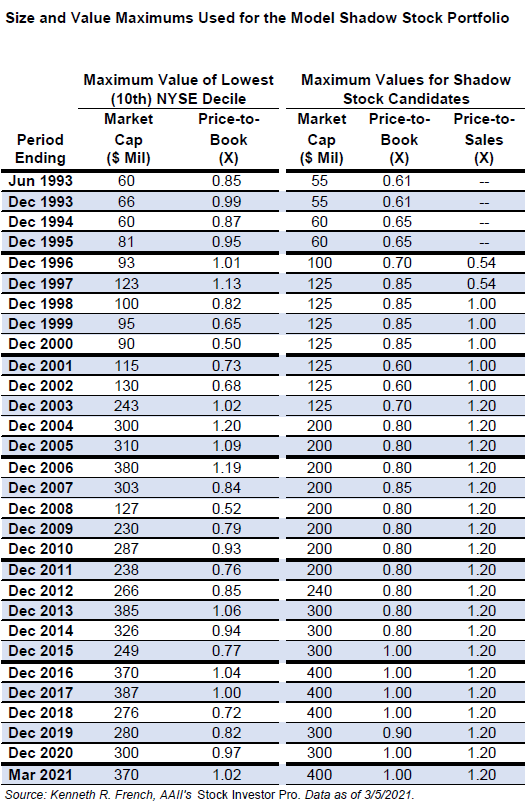
The primary Model Shadow Stock Portfolio selection criteria target the intersection of the smallest 10% of domestic stocks as measured by market capitalization, along with the “cheapest” 10% of domestic stocks as measured by the price-to-book (P/B) ratio. These decile breakpoints are determined by examining domestic companies that are listed on the New York Stock Exchange (NYSE) and change over time.
As the quarterly review was conducted at the start of March, the NYSE price-to-book-value cutoff was 1.02, near the portfolio’s current maximum initial price-to-book ratio of 1.00. Therefore, the maximum price-to-book value was left unchanged at 1.00 for initial inclusion and 3.00 (three times the initial criterion) as the maximum level for a stock held in the portfolio at the time of a quarterly portfolio review.
The NYSE market-cap cutoff for the lowest decile is currently $370 million, compared to the portfolio’s $300 million maximum in December, so the size cutoff was adjusted for the Model Shadow Stock Portfolio during the quarterly review from $300 million to $400 million. The maximum market cap for inclusion in the Model Shadow Stock Portfolio is now $400 million, and holdings are sold if their market cap goes above three times the initial criterion at the time of the quarterly review: $1,200 million.
The other major factor that leads to portfolio turnover is tied to negative earnings. If a company reports trailing 12-month earnings from continuing operations that are negative, the stock is placed on probation; if a subsequent quarter has negative earnings prior to trailing 12-month earnings becoming positive, the stock is sold. When available, adjusted (non-GAAP) earnings are used to put stocks on probation or sell them. These are earnings that have been adjusted to eliminate the impact of nonrecurring events such as markdown of inventory or goodwill. These are earnings reported in the media and firms reporting consensus estimates. The I/B/E/S adjusted earnings reported in Stock Investor Pro are used for Model Shadow Stock Portfolio decisions when they are available.
A stock can also be sold if it has been held over four years, if it also no longer meets the initial rules for qualifying and has not gained at least 10% annually from its purchase price and there is a new qualifying stock to replace it.
After conducting the quarterly review of the Model Shadow Stock Portfolio, RCI Hospitality Holdings Inc. (RICK) and Townsquare Media Inc. (TSQ) were removed from the tracking portfolio during regular trading hours on Monday, March 8, 2021. With the proceeds from these two sales, as well as the cash held in the portfolio, two new stocks were added to the Model Shadow Stock Portfolio. SIFCO Industries Inc. (SIF) and Ultralife Corp. (ULBI) were added to the model portfolio during regular trading hours on Monday, March 8, 2021.
RCI Hospitality Holdings Inc.  (RICK)
When conducting the quarterly review with data as of March 5, 2021, RCI Hospitality Holdings exceeded the price-to-book ratio sell cut-off of 3.00 with a price-to-book ratio of 3.67. It is the policy of the Model Shadow Stock Portfolio to sell a stock if its price-to-book-value ratio exceeds three times the initial purchase limit, which is currently 1.00.
RCI Hospitality Holdings owns and operates gentlemen’s clubs and sports bars/restaurants. The company had seen its price increase 248.5% over the last 52 weeks, pushing up its price-to-book ratio.
Townsquare Media Inc. (TSQ)
When conducting the quarterly review with data as of March 5, 2021, Townsquare Media exceeded the price-to-book ratio sell cut-off of 3.00 with a price-to-book ratio of 3.10. It is the policy of the Model Shadow Stock Portfolio to sell a stock if its price-to-book ratio exceeds three times the initial purchase limit, which is currently 1.00.
Townsquare Media is a media, entertainment and digital marketing solutions company principally focused on small and mid-sized markets across the U.S. Its price-to-book ratio has risen due to a combination of rising price and declining book value per share. Townsquare Media’s price increased 123.6% over the last 26 weeks, but negative GAAP earnings have contributed to a decline in retained earnings, pushing up its price-to-book ratio.
As of March 5, five stocks met the initial selection criteria for the Model Shadow Stock Portfolio, down from 10 stocks one month ago. As noted last month, surging interest in small caps has resulted in a decline in the number of qualifying companies. AAII members can see and research which companies are currently passing the initial selection criteria in the Shadow Stock Ideas table on AAII.com. The list of new Shadow Stock Ideas is updated daily—Tuesday through Saturday.
One of the qualifying stocks is already held in the model portfolio: Key Tronic Corp. (KTCC). The remaining four stocks were examined to ensure adequate liquidity, timely financial filings and appropriate industry and foreign considerations. For example, the Shadow Stock Portfolio Rules currently exclude companies in the rental and leasing industry. Price momentum is used as the tiebreaker among qualifying stocks. Stocks were ranked using the weighted relative strength ranking, which looks at price performance over the last year but places a higher weight on the most recent quarterly price performance.
SIFCO Industries Inc. (SIF)
SIFCO Industries is engaged in the production of forgings and machined components for the aerospace, defense and energy markets. SIFCO Industries supplies flight-critical forged components and machined assemblies to all of the leading aircraft and engine manufacturers. These components are used on commercial and military fixed-wing aircraft as well as helicopters and business jets. SIFCO products are also supplied to the leading steam and gas turbine manufacturers and oil producers serving the energy sector.
SIFCO Industries has a book value per share of $8.63 as of December 31, 2020. If you wish to stay within the 1.00 price-to-book-value maximum, you should pay no more than $8.63 per share. However, if the stock price has moved up after being added to the portfolio, you can still purchase the stock unless the price-to-book ratio goes above 1.10, which equates to a price of $9.49 per share. To calculate the maximum purchase price based on the maximum desired price-to-book ratio, multiply the current book value per share ($8.63 for SIFCO) by the maximum price-to-book ratio to be considered for the Model Shadow Stock Portfolio (currently 1.00, or 1.10 for loosened consideration).
Ultralife Corp. (ULBI)
Ultralife offers products and services ranging from power solutions to communications and electronics systems to customers across the globe in the government and defense; medical, safety and security; energy; industrial and robotics sectors. The company designs and manufactures power and communications systems, including rechargeable and non-rechargeable batteries, charging systems, communications and electronics systems and accessories and custom engineered systems.
Ultralife has a book value per share of $7.33 as of December 31, 2020. If you wish to stay within the 1.00 price-to-book-value maximum, you should pay no more than $7.33 per share. However, if the stock price has moved up after being added to the portfolio, you can still purchase the stock unless the price-to-book ratio goes above 1.10, which equates to a price of $8.06 per share.
The next quarterly review of the Model Shadow Stock Portfolio will take place following the end of May 2021. Any changes to the portfolio will be announced at the time they are made in our Model Shadow Stock Portfolio Update emails (sign up at www.aaii.com/email).
The Model Shadow Stock Portfolio continued its strong run with a 18.2% gain during February 2021. The Model Shadow Stock Portfolio is now up 29.1% for the first two months of the year. The S&P 500 index as measured by the performance the Vanguard S&P 500 Index fund (VFINX) had a gain of 2.8% during February and is now up 1.7% during the first two months of the year. The Vanguard Small Cap Index fund (NAESX) is up 8.5% for the year after gaining 6.1% in February. The DFA U.S. Micro Cap fund (DFSCX) gained 10.4% during February and is up 16.0% for the year.
Value stocks are outperforming growth stocks for the first two months of this year. It is the first time that value stocks have outperformed growth stocks by this stage of the year since 2016. The outperformance is the strongest seen since 2001, which coincided with the bursting of the dot-com bubble.
In the large-cap segment, growth stocks were unchanged for the month, giving them a 0.5% loss year to date for 2021. Large-cap value stocks were up 5.9% during February and are now up 4.2% year to date.
In the mid-cap segment, growth stocks are up 6.0% for the year, after gaining 4.1% during February. Mid-cap value stocks are up 10.8% for the year, after gaining 9.5% during the month.
Small-cap growth stocks are up 8.3% year to date, while small-cap value stocks are up 15.2%. Small-cap growth stocks gained 3.3% during February, while small-cap value stocks gained 9.4% during the month.
The energy sector was the clear market leader during February with a 22.7% gain for the month and 32.9% gain year to date. Financials also posted double-digit gains for the month with their 11.5% gain contributing to a 16.4% gain year to date. The market looks to be rotating money into segments hurt by the pandemic last year as expectations of increased activity and higher inflation take hold. The interest-sensitive utilities were down 6.1% during February. Other segments in the red for the month included health care (–2.1%), consumer staples (–1.4%), and consumer discretionary (–0.9%). Many of the weakest sectors during 2020 are now leading the market this year.
Since its inception in 1993, the AAII Model Shadow Stock Portfolio has a compound annual average return of 15.2% versus the Vanguard 500 Index fund’s gain of 10.0% per year on average over the same period. Over the same period, the Vanguard Small Cap Index fund posted an average annual gain of 10.6%.
Mesa Air Group (MESA) was the top performer in the Model Shadow Stock Portfolio for February, up by 86.8%. The company was up after reporting first-quarter results that beat analyst expectations. Mesa Air continues to see its stock price improve as it adjusts its business to the pandemic and the economy recovers.
RCI Hospitality Holdings Inc. (RICK) was the runner-up for the month, up by 67.0%. The company reported first-quarter results that beat analyst expectations. Operating restaurants and nightclubs, RCI Hospitality’s business has fluctuated over the last year with restrictions to mitigate the pandemic. Similar to Mesa Air, RCI Hospitality has seen its stock price improve as the economy recovers.
New Home Company Inc. (NWHM) was the bottom performer for February, down by 9.7%. The stock was down despite the company reporting fourth-quarter results that improved year over year. During the earnings conference call, CEO Lawrence Webb discussed short-term headwinds for the company, though the company expects business to grow during the first quarter of 2021.
Strattec Security Corp. (STRT) was down by 5.9% for the month. There was no company-specific news to associate with its decrease. Strattec Security’s consensus earnings estimate of $1.29 per share for the next quarter remains recently unchanged but up from $0.85 per share three months ago.
Here are some news highlights from February for the holdings in the Model Shadow Stock Portfolio:
Container Store Group Inc. (TCS) issued a secondary offering of five million shares of its common stock by the Selling Stockholders. The stock is being sold by the company’s largest shareholder, Leonard Green & Partners L.P., and represents 9.9% of the outstanding shares. The company said that it will not receive any proceeds from this sale of common stock from the Selling Stockholders.
CPI Aerostructures Inc. (CVU) was awarded an $8.7 million purchase order by the U.S. Air Force under a previously announced contract to provide structural modification kits, program management, logistics and other sustainment services in support of phase three of the T-38C Pacer Classic III Fuselage Structural Modification Kit Integration program (PCIII) and the Talon Repair Inspection and Maintenance (TRIM) program. In July 2019, the company said that the PCIII and TRIM contract was valued at about $65.7 million. The new purchase order brings the total funded value of the contract to $24.0 million and extends the currently funded period of performance into 2024.
Delta Apparel Inc. (DLA) reported fiscal first-quarter 2021 diluted earnings per share of $0.28, up 115% compared to the prior-year quarter. Diluted earnings per share for the quarter beat the I/B/E/S consensus estimate of $0.06 per share by 366.7%. Net sales declined by 1.2% year over year to $94.7 million.
The first-quarter gross profit was $20.3 million, compared to $19.9 million in the prior-year first quarter. Operating income increased to $3.1 million, compared to operating profit of $2.6 million in the prior-year quarter.
CEO Robert Humphreys commented, “Fiscal 2021 is off to a strong start with our first-quarter sales and profitability results well ahead of our internal expectations. Despite notable headwinds from inventory constraints, hurricane-related disruptions in Central America and freight carrier limitations during the holiday season, our results were bolstered by strong order demand and impeccable manufacturing and operational execution at all levels.”
Ducommun Incorporated (DCO) reported net income of $0.80 per diluted share for the fourth quarter of 2020, compared to earnings per diluted share of $0.75 in the prior-year third quarter. Earnings for the quarter beat the I/B/E/S consensus estimate of $0.773 per share by 3.5%. Revenues declined by 15.6% year over year to $157.8 million.
The company’s military and space revenue rose more than 25% in both fourth-quarter and full-year 2020, resulting in total revenue of almost $425 million for the year, a new record high for the company. Gross margins increased to 22.1%, primarily driven by favorable product mix, partially offset by unfavorable manufacturing volume and higher compensation and benefit costs.
CEO Stephen G. Oswald said, “With a defense backlog at all-time highs and some forecasted stability in our commercial business, we are optimistic about the quarters to come. Given improving fundamentals in aircraft production, and pent-up demand for air travel post-pandemic, the company is in great shape to weather the remaining headwinds and drive higher growth in the second half of 2021, with the 2022 outlook being even better. I want to thank our employees for their dedication to our success, Ducommun’s investors for their support, and our customers for their loyalty throughout 2020.”
Global Ship Lease Inc. (GSL) announced an agreement to purchase and charter back seven 6,000 TEU Post-Panamax containerships with an average age of approximately 20 years for an aggregate purchase price of $116 million. The ships will be chartered to leading liner operators for a minimum firm period of 36 months each, followed by two one-year extensions at the charterer’s option. The vessels are expected to generate aggregate adjusted earnings before interest, taxes, depreciation and amortization (EBITDA) of approximately $95 million over the average firm period of 3.1 years.
Hibbett Sports Inc. (HIBB) released preliminary fourth-quarter results. Fourth-quarter comparable sales increased by 21.9%, diluted earnings per share are expected to be in the range of $1.30 and $1.40 per share and fiscal-2022 diluted earnings per share are expected to be in the range of $5.00 and $5.50 per share.
Additionally, Hibbett Sports announced the opening of a second store in Colombia. The store is 5,000 square feet and will offer convenient shopping options such as buy online, pick up in-store; reserve online, pick up in-store; and curbside pick up.
Hooker Furniture Corp. (HOFT) had several changes in its C-suite and board during February. Jeremy Hoff was elected as the company’s new CEO, set to succeed Paul B. Toms effective February 1. Hoff served as president of several Hooker Legacy companies and Toms will say on as chairman of the board in a nonexecutive capacity, as well as serve as a member of the board of directors. Additionally, Anne Smith was promoted to chief administrative officer and president of domestic upholstery,and Mike Harris was promoted to president of Hooker Casegoods. Finally, Johne Albanese was promoted to chief marketing officer and Tod Phelps was promoted to senior vice president of operations, both new positions within the company.
Key Tronic Corp. (KTCC) announced that it will file its second-quarter results for fiscal 2021. During the final preparation of the Form 10-Q, senior management of the company received a notification from an employee regarding irregularities in the classification of inventory between raw material and work-in-process at a production facility, which prompted an audit. Key Tronic does not anticipate a material adverse impact on its historical financial statements.
Kimball Electronics Inc. (KE) reported second-quarter earnings of $0.60 per share in early February, beating the I/B/E/S consensus estimate of $0.34 per share by $0.26 or 76%. The company brought in revenue of $320.6 million, a 4.4% year-over-year increase. Kimball Electronics managed to bring in record quarterly cash flows from operating activities of $51.6 million.
Kimball Electronics brought in net sales of $321 million, a 4% year-over-year increase, and adjusted operating income was 5.3% of net sales. Three million dollars was returned to shareholders through stock repurchases during the quarter and investments in capital expenditures totaled $6.1 million. Cash and cash equivalents were $93.6 million at the quarter’s end.
“Our strong results were primarily driven by improved operating execution, favorable product mix and a weaker dollar. Looking ahead, we expect that our performance should approximate our long-stated goal of 4.5% operating income. The persistence of the pandemic continues to draw our attention, and it’s difficult to predict what we will face in the future. However, we are confident that our business will remain strong, and we are optimistic about our new business opportunities funnel. We remain committed to our goal of 8% organic growth and believe the goal is well within our reach for fiscal-year 2021.” said CEO Donald D. Charron.
Mesa Air Group (MESA) reported first-quarter earnings of $0.36 per share beating by 614% the I/B/E/S consensus estimate for a loss of $0.07 per share. Mesa Air reported revenue for the quarter of $150.37 million, a year-over-year decrease of 18.3%. The company reported EBITDA of $47.4 million and adjusted EBITDA of $57.7 million.
During the quarter, the company received a $195 million loan under the CARES Act, signed a five-year extension with American Airlines Group Inc. (AAL) for 40 aircraft, launched cargo operations for DHL with two 737-400F aircraft and placed 12 new E-175 aircraft into service with United Airlines Holdings Inc. (UAL), all with no employee furloughs.
“While 2020 has been a challenging year for the industry, we were pleased to remain profitable and cash flow positive throughout the pandemic. In addition, we implemented a number of important strategic initiatives with our partners at American, United and DHL. Lastly and importantly, we avoided employee furloughs despite the expiration of the PSP program,” said chairman and CEO Jonathan Ornstein.
In February, the company reached an agreement with air mobility company Archer Aviation and United Airlines to receive 20% of United’s warrant to purchase 14,645,614 shares of Archer’s common stock with a $0.01 per share exercise price, meaning that Mesa Air will receive a warrant exercise for 2,929,123 shares. This is all part of the airline’s effort to invest in decarbonization technology for air travel.
New Home Company Inc. (NWHM) reported fourth-quarter earnings per share of $0.26 with a revenue of $145.6 million that was down 34.5% year over year. Adjusted gross margin improved 260 basis points to 19.4%, compared to last year’s 16.8%.
Net orders were up 89% while the monthly sales absorption rate increased 68% to 3.7, compared to 2.2 in the prior year. The unit backlog was up 175% and the dollar value of homes in the backlog increased 88% compared to last year to $236.0 million. The ending cash balance for the company was $107.3 million and the debt-to-capital ratio was 55.4%, an 820-basis-point improvement.
“We substantially improved our financial condition in the fourth quarter through the successful refinance of our senior notes, the extension of our revolving credit facility and by unwinding our position in a capital intensive joint venture. Moving forward, we look to execute a balanced approach of acquiring new land positions and improving our operating metrics to generate positive shareholder returns as we head into 2021. I am excited about the future of New Home Company and look forward to building on the momentum we established in 2020.” said executive chairman Leonard Miller.
Orion Group Holdings Inc. (ORN) reported net income of $3.7 million, or $0.12 per diluted share for the fourth quarter of 2020, compared to net income of $0.2 million, or $0.01 per diluted share for the fourth quarter of 2019. Adjusted net income was $3.5 million, or $0.12 per diluted share. Earnings per share beat the I/B/E/S consensus estimate of $0.08 per share by 50%.
The company had revenues of $170.2 million, down 14.8% from $199.8 million in the prior-year period, primarily driven by the timing of projects for their marine and concrete business segments. Gross profit margins saw a 33.3% year-over-year increase from 9.6% to 12.8%, mainly attributable to production efficiency gains in both the marine and concrete segments.
“We continue to be confident in our ability to profitably execute our projects in backlog, and in our ability to maintain and grow our backlog level by targeting and winning new bid opportunities. We believe chances for a new infrastructure bill have improved, and if enacted, will be a further catalyst for continued strength in our end-market opportunities,” said CEO Mark Stauffer. “We continue to focus on our liquidity position, which remains strong and provides us with more than sufficient financial flexibility to continue to pursue new awards and execute on existing projects in backlog. Our diverse end markets, broad range of construction capabilities and assets and our highly experienced and professional personnel make us confident in our ability to deliver increasing levels of profitability and free cash flow, particularly in a post-pandemic environment.”
Perion Network Ltd. (PERI) reported fourth-quarter revenues of $118.3 million, up 51% from $78.3 million in the prior-year quarter. This increase was primarily attributable to a 159% year-over-year increase in display and social advertising revenues, which resulted from the acceleration of the company’s connected TV advertising offering and the contribution of its content monetization offering.
Non-GAAP net income for the quarter saw a 55% increase to 13.8 million compared to $8.9 million in the fourth quarter of 2019. The company had earnings of $0.27 per share, beating the I/B/E/S consensus estimate of $0.18 per share by 48.4%. The company’s cash flow from operations also enjoyed a pick-up, increasing by 14.3% year over year from $11.2 million to $12.8 million.
In 2021, management expects to generate revenues of $350 million to $370 million. “During the fourth quarter, we renewed and expanded our strategic partnership with Microsoft Bing for an additional four years,” stated CEO Doron Gerstel. “The continuing collaboration with Microsoft is a significant factor in Perion’s multi-year strategic plan to achieve sustainable and highly profitable double-digit annual revenue growth, with a desired target of $500 million in annual revenue by 2023. We enter 2021 in a strong position,” Gerstel concluded.
Rocky Brands Inc. (RCKY) reported fourth-quarter revenue of $87.6 million, up 16.3% from $75.3 million in the prior-year quarter, primarily driven by a 21.7% year-over-year increase in wholesale sales from $49.3 million to $59.9 million. Gross margins increased 27.8% year over year to $36.1 million, or 41.2% of sales, compared to $28.3 million, or 37.5% of sales in the fourth quarter of 2019.
Fourth-quarter adjusted net income, which excludes acquisition-related expenses, saw a 101.7% year-over-year increase from $5.1 million to $10.3 million. Adjusted earnings per share also increased year over year, up 107.4% from $0.68 per share to $1.41 per share. Earnings beat the I/B/E/S consensus estimate of $0.82 per share by 72%.
“The solid foundation we’ve built at Rocky Brands over the past several years allowed the company to successfully weather the initial challenges created by COVID-19 last spring, and more recently capitalize on the opportunities that emerged as the economy reopened and consumers returned to shopping at brick-and-mortar retail,” said president and CEO Jason Brooks. “We believe we have the right strategies in place to continue expanding our market share both organically and through our proposed acquisition of the performance and lifestyle footwear business of Honeywell that is on track to close in March. I am extremely proud of our organization’s many recent accomplishments and I am confident that we are on course to deliver even greater value to shareholders in the years to come.”
Rocky Brands also declared a regular quarterly dividend of $0.14 per share, in line with its previous declaration. The dividend is payable on March 16 to shareholders of record as of March 2.
Vishay Precision Group Inc. (VPG) reported fourth-quarter revenue of $75.4 million, up 9.1% from $69.1 million in the fourth quarter of 2019. This increase was primarily driven by a 23.1% year-over-year increase in the company’s foil technology products segment revenue from $29.6 million to $36.5 million, which was mainly the result of an increase in its advanced sensors product line. The company’s adjusted gross profit margin was 38.0%, up 3.3% year over year from 36.8%.
Fourth-quarter adjusted net earnings attributable to Vishay Precision Group stockholders were $5.8 million, up 48.7% from $3.9 million for the comparable prior-year period. Earnings per share also saw a year-over-year increase, up 53.6% from $0.28 per diluted share to $0.43 per diluted share. Earnings missed the I/B/E/S consensus estimate by less than 1%. Cash from operating activities was $12.5 million with adjusted free cash flow of $5.9 million.
“Given the improving business environment, our strong cash flow, financial position and strategic investments give us confidence that we can achieve growth in 2021 as the global economy and our markets continue to recover from the pandemic. For the first fiscal quarter of 2021, at constant fourth fiscal quarter 2020 exchange rates, we expect net revenues to be in the range of $63 million to $70 million,” said CEO Ziv Shoshani.
 Get updates about the portfolio that has outperformed the market by 211.9%
since inception!
Get updates about the portfolio that has outperformed the market by 211.9%
since inception!