

John Bajkowski
is the president of AAII.
 AP
BSET
DFSCX
EBF
GSL
HNRG
HOFT
HURC
KTCC
NAESX
PERI
RCKY
SIF
TITN
VFINX
VSEC
AP
BSET
DFSCX
EBF
GSL
HNRG
HOFT
HURC
KTCC
NAESX
PERI
RCKY
SIF
TITN
VFINX
VSEC
What a difference a year makes. We are now 12 months into the bull market run that is producing eye-popping performance numbers. The S&P 500 index as measured by the Vanguard 500 Index fund (VFINX) is up 56.2% over the last 12 months. The Vanguard Small Cap Index fund (NAESX) is up 87.5%, and the Model Shadow Stock Portfolio has gained 203.5% over the last 12 months.
While we noted that the less-liquid micro-cap stocks typically go down more deeply during bear market, only to bounce back more strongly in the subsequent bull market in our April 2020 Model Shadow Portfolio Update, the magnitude of the rebound in the short period of time is striking.
Generally, riskier and less-liquid assets are the stronger-performing groups during a recovery. During the financial crisis, the Model Shadow Stock Portfolio lost more than the large-cap S&P 500 index (down 63.4% versus 51.0%) but recovered to its previous high more quickly (3.4 years versus 4.8 years). It is important to note that past patterns do not always repeat, but it is helpful to study historical patterns.
The Model Shadow Stock Portfolio has been in operation for just over 28 years. Its 15.4% annualized rate of return since inception is meaningfully greater than that of the Vanguard 500 Index fund, which gained 10.1% over the same time period, but that higher return has come with more frequent corrections and bear market periods for the Model Shadow Stock Portfolio.
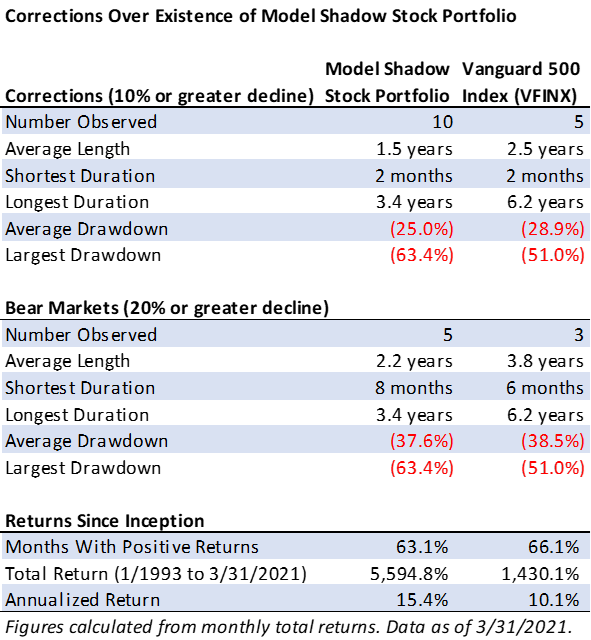 We examined the monthly total returns of the Model Shadow Stock Portfolio along with the Vanguard 500 Index fund to gain a sense of the frequency, duration and severity of corrections and bear markets over its 28-year history.
Drawdowns measure the severity of a loss. The drawdown is the decline from a prior high in portfolio or market value. Drawdowns reflect the total drop experienced during a bear market, but the duration is longer since the drawdown also reflects time needed before the full loss is recouped, not just when the downturn is reversed. For example, the Vanguard 500 Index fund hit is bottom last year during March, but it did not recoup its losses until June.
Corrections are generally classified as declines of 10% or greater. The Model Shadow Stock Portfolio has had 10 observed corrections, and five of them have turned into bear markets of 20% or greater. The average correction has been 1.5 years in length, with an average drawdown of 25.0%. The longest correction for the Model Shadow Stock Portfolio was 3.4 years and had a drawdown of 63.4% (July 2007 to November 2010).
The Vanguard 500 Index fund has had five observed corrections and three of them have gone on to become bear markets of 20% or greater over the same time period. The average correction has been 2.5 years in length with an average drawdown of 28.9%. The longest correction (September 2000 to October 2006) was 6.2 years with a drawdown of 44.8%, but the greatest drawdown of 51.0% was with the 2007 bear market that lasted 4.8 years (November 2007 to July 2012).
The Model Shadow Stock Portfolio has more frequent corrections and bear market cycles than the S&P 500, but the down periods have generally been shorter in duration and bull market reversals stronger.
The Model Shadow Stock Portfolio gained 6.5% during March, bringing its year-to-date gain to 37.5%. In contrast, the S&P 500 as measured through the Vanguard 500 Index fund was up 4.4% in March and is up 6.2% year to date, while the Vanguard Small Cap Index fund gained 1.6% in March and is up 10.2% year to date through March. The DFA U.S. Micro Cap fund (DFSCX) was up 4.7% during March and is up 21.3% during the first quarter of the year.
The performance of growth- versus value-oriented stocks was slanted toward value stocks during the month, with value stocks showing greater gains across all market-cap segments.
In the large-cap segment, value stocks were up 6.3% for the month, bringing their year-to-date performance to a gain of 10.8% for 2021. Large-cap growth stocks were up 2.6% during March and are now up 2.1% year to date.
In the mid-cap segment, value stocks are up 18.4% for the year, after gaining 6.9% during March. Mid-cap growth stocks are up 8.6% for the year, after gaining 2.4% during the month.
Small-cap value stocks are up 21.2% year to date, while small-cap growth stocks are up 4.9% for the year. Small-cap value stocks gained 5.2% during March, while small-cap growth stocks lost 3.2% during the month.
Stocks in the energy (+30.8%), financial (+15.9%) and industrial (+11.4%) sectors are the best-performing groups in the market this year.
Sectors that are lagging this year include consumer staples (+1.2%), information technology (+2.0%) and utilities (+2.8%). All of the sectors are up for the year, but there is a large difference between the top- and bottom-performing groups.
As of April 9, 2021, four stocks met the initial selection criteria for the Model Shadow Stock Portfolio, down from five stocks that passed one month ago and down from 39 stocks that passed on April 13, 2020. Of the four passing stocks, one is currently held in the Model Shadow Stock tracking portfolio: Key Tronic Corp. (KTCC). Qualifying companies are those held in the Model Shadow Stock Portfolio that currently meet the initial purchase rules. (They are designated as “qualifies” in the notes column of the Model Shadow Stock Portfolio table on AAII.com. However, the notes may not match the list here since the passing list on the website is revised daily and the notes are dynamically updated based on the revised list.)
Currently, Hibbett Sports Inc. (HIBB) is the primary holding approaching the price-to-book valuation limit of 3.0 and the market-cap cutoff of $1.2 billion. On April 14, 2021, Hibbett Sports’ price-to-book ratio was 2.93 and its market cap was $1.13 billion.
The next quarterly review of the Model Shadow Stock Portfolio will take place following the end of May 2021. Any changes to the portfolio will be announced at the time they are made in our Model Shadow Stock Portfolio Update emails (sign up at www.aaii.com/email).
SIFCO Industries Inc. (SIF) was the top performer in the Model Shadow Stock Portfolio for March, up by 54.4%. There was no company-specific news to associate with its increase.
Rocky Brands Inc. (RCKY) was the runner-up for the month, up by 24.0%. The company reported first-quarter results that beat analyst expectations. Fourth-quarter revenue of $87.6 million was up 16.3% from the prior-year quarter. Adjusted earnings per share also increased year over year, up 107.4% from $0.68 per share to $1.41 per share. Earnings beat the I/B/E/S consensus estimate of $0.82 per share by 72%.
Ampco-Pittsburgh Corp. (AP) was the bottom performer for March, down by 11.6%. The company reported results that fell year over year for the fourth quarter. See more in the news below.
Perion Network Ltd. (PERI) was down by 9.8% for the month. The company’s stock fell after rising quickly on updated, better financial guidance early in March. See more in the news below.
Here are some news highlights from March for the holdings in the Model Shadow Stock Portfolio:
Ampco-Pittsburgh Corp. (AP) reported fourth-quarter 2020 net income of $2.2 million, or $0.12 per diluted share, compared to a net income of $3.1 million, or $0.24 per diluted share in the prior-year quarter. Sales from continuing operations declined by 10.3% year over year to $87.0 million. The company significantly improved capitalization from 2019, reducing total debt by $33.6 million or 47% from December 31, 2019.
“Despite the decline in sales driven by the global pandemic, Ampco-Pittsburgh delivered another profitable quarter in fourth-quarter 2020 and improved sequentially over prior-quarter EPS,” said CEO Brett McBrayer. “The restructuring initiatives and efficiency improvements our team has been engaged in over the past two years have positioned us to face these challenges and deliver our first profitable year since 2015 while improving our liquidity position. We are cautiously optimistic that order activity levels will increase moving into the second half of 2021 as the lingering impacts of the pandemic subside.”
Bassett Furniture Industries Inc. (BSET) reported first-quarter 2021 net income of $4.0 million, or $0.40 per diluted share, compared to a net income of $1.2 million, or $0.12 per diluted share, in the prior-year quarter. First-quarter earnings per diluted share beat the I/B/E/S consensus estimate of $0.235 per share by 70.2%. Consolidated sales for the quarter grew by 1.4% year over year to $113.7 million.
The company’s wholesale segment posted sales of $70.3 million, up 8.3% year over year. First-quarter sales for the retail segment declined by 8.3% year over year to $60.4 million. The company’s logistical services unit reported that revenues declined by 5.8% year over year to $20.1 million. Consolidated retail operating income for the quarter was $1.1 million compared to a loss of $1.2 million in the first quarter of 2020.
Bassett Furniture also declared a regular quarterly dividend of $0.125 per share, in line with its previous declaration. The dividend is payable on May 28 to shareholders of record as of May 14. The stock will trade ex-dividend on Thursday, May 13.
Big 5 Sporting Goods Corp. (BGFV) reported fourth-quarter 2020 net income of $0.83 per diluted share, compared to net income of $0.02 per diluted share for fourth-quarter 2019. Fourth-quarter earnings per diluted share missed the I/B/E/S consensus estimate of $0.90 per share by 7.8%.
Net sales increased by 19.1% to $290.6 million compared to net sales of $244.1 million one year ago. Same-store sales increased by 10.5% year over year during the quarter. The company ended the quarter with zero borrowings under its revolving credit and cash and cash equivalents of $64.7 million.
“Our strong fourth-quarter results highlight our exceptional performance in fiscal 2020 with record earnings driven by top-line sales growth, merchandise margin expansion and an improved cost structure,” said CEO Steven Miller. As we faced the many challenges of 2020, we remained focused on providing our customers with a convenient shopping experience to find products to stay active and healthy. Our team did a tremendous job of recognizing and capitalizing on key product trends. Additionally, in 2020 we successfully implemented cost reduction initiatives that are continuing to provide significant operating leverage. Looking back on the year, I want to once again thank our entire team for their dedication and execution during a challenging period.”
Big 5 Sporting Goods declared a cash dividend of $0.15 per share, up 50% from its previous declaration. The dividend was payable on March 26 to shareholders of record as of March 12.
Ennis Inc. (EBF) declared a dividend of $0.225 per share, in line with last quarter’s dividend. The dividend was payable on March 3 to shareholders of record as of April 12.
Global Ship Lease Inc. (GSL) reported fourth-quarter net income of $11.31 million, or $1.60 per share. Earnings beat the I/B/E/S consensus estimate of $0.43 per share by 272%. The company brought in revenue of $69.67 million for the quarter, a 3.6% year-over-year increase. Earnings before interest, taxes, depreciation and amortization (EBITDA) for the quarter were reported to be $161.7 million.
During the quarter, the company raised $11.9 million in 8.75% Series B Preferred Shares and $0.8 million from their 8.00% Senior Unsecured Notes due 2024. The company ended the quarter with $80.76 million in cash and cash equivalents.
“With a strengthened financial foundation, a highly in-demand fleet and substantial momentum in unlocking value for our shareholders, we believe that GSL is well placed to continue executing our accretive growth strategy, taking full advantage of the attractive opportunities ahead of us whilst also improving the resilience, flexibility and cost-effectiveness of our balance sheet,” said executive chairman George Youroukos.
Hallador Energy Co. (HNRG) reported a net loss of $4.7 million for the fourth quarter of 2020, representing a loss per share of $0.15. The company missed the I/B/E/S consensus estimate of $0.02 per share by 850%. Quarterly free cash flow was $2.9 million while adjusted EBITDA came in at $9.4 million. The company was able to decrease its bank debt by $9.2 million throughout the fourth quarter. Shipments for the quarter totaled 1.6 million tons and coal inventories were reduced by $2.8 million.
“The global pandemic brought huge disruptions to the energy markets as people stay home and sheltered in place,” said president and CEO Brent Bilsland. “Oil prices went negative for the first time. Natural gas prices dropped to multi-decade lows and coal plants struggled to dispatch for at least two months in early 2020. Despite these challenges, Hallador displayed great resiliency as evidenced by generating strong operating cash flow of $52.6 million.”
Hibbett Sports Inc. (HIBB) reported adjusted fourth-quarter earnings of $1.40 per share. Comparable sales increased by 21.9%. Both matched the company’s preliminary results, though earnings were at the high end of the guidance. The I/B/E/S consensus estimate had called for adjusted earnings of $1.37 per share. On the conference call, CEO Mike Longo cited the closures of J.C. Penney and Stage Stores locations for helping to drive new customers to Hibbett Sports.
Nothing significantly changed from the fiscal-2022 guidance the company gave last month. Full-year earnings are still expected to range between $5.00 and $5.50 per share versus $6.12 per share in fiscal 2021. Gross margins are projected to narrow by 1.3 to 1.7 percentage points next year.
Hooker Furniture Corp. (HOFT) declared a quarterly dividend of $0.18 per share, in line with the previous dividend. The dividend was payable on March 31 to shareholders of record as of March 17.
Hurco Companies Inc. (HURC) reported first-quarter fiscal-year earnings per share of $0.10, or a net income of $663,000. This beats out last year’s first-quarter earnings of a loss of $0.13 per share by $0.23 or 177%. Sales and service fees increased by 24% year over year to $54.1 million including a favorable currency impact of $1.64 million. Sales in the Americas increased by 33% year over year to $22.2 million, European sales saw a 21% year-over-year increase to $24.2 million and sales in the Asia-Pacific region totaled $6.6 million, a 9% increase. Overall orders for the quarter were $57.3 million, an increase of $11.7 million or 26% year over year.
“With all geographic regions experiencing some level of recovery during our first quarter of fiscal 2021, we remain cautiously optimistic,” said CEO Michael Doar. “Orders outpaced sales for the second consecutive quarter, which is a trend we often see during an economic recovery. We must continue to be responsive to their need to work harder and smarter in order to recover faster. We believe that technology innovation can certainly support recovery for our customers, and we will continue our product development plans, which will position us to meet demand from both current customers and prospective customers as activity at their businesses increases.”
Also during the month, Hurco increased its dividend by 7.7% from $0.13 to $0.14 per share. The dividend is payable on April 12 to shareholders of record as of March 29. The company also announced a buyback program that will return up to $7 million to shareholders through repurchases until March 10 2023.
New Home Company Inc. (NWHM) will be expanding into Denver, Colorado, with the acquisition of Epic Homes, a well-established homebuilder in the market. Epic Homes’ president and founder Christina Presley will remain on the board as president of Epic Homes, the new division of New Home Company. With this acquisition the company gained Epic Homes’ backlog of 102 homes, valued at $100 million, as well as Epic Homes’ land assets.
“With the addition of Epic Homes, The New Home Company enters a very attractive market with an established operator,” said CEO Leonard Miller. “Not only do our two brands align, but Chris’ proven track record, deep relationships and leadership qualities are what really stood out in making our decision to enter the Denver market. In the short term, the transaction will provide us with an immediate boost to our revenue and earnings thanks to the homes in backlog and actively selling communities. Longer term, we view this as a great strategic move for our company as it further diversifies our geographic presence, enhances our opportunities for growth and establishes us in a market with great homebuilding fundamentals.”
Later in the month, New Home Company announced that it will debut Element d in Mesa, Arizona, at Eastmark, a neighborhood of 135 single-family detached residences. “Element will be one of the most attainably priced offerings within Eastmark, so we think it is well-positioned to attract buyers who are looking to be part of a vibrant community close to jobs with an abundance of family-friendly activities,” said Arizona division president Christopher Cady. “We’re excited to be a part of Eastmark and look forward to supporting the community’s standing as one of the top-selling master plans, not only in Arizona but the entire nation.”
Penn Virginia Corp. (PVAC) reported fourth-quarter revenue of $67 million, down 46% from $124 million in the fourth quarter of 2019. This decrease in revenue is primarily attributable to a 25% year-over-year decline in the sales volume of crude oil, as well as a 30% year-over-year decline in the price per barrel of crude oil from $56.40 per barrel to $39.66 per barrel.
The company had a net loss of $136 million, or $8.92 per diluted share for the fourth quarter of 2020, down year over year by 4,208% and 4,155%, respectively. Adjusted net income saw a 45% year-over-year decrease from $40 million, or $2.60 per diluted share, to $22 million, or $1.43 per diluted share, beating the I/B/E/S consensus estimate of $0.995 by nearly 44%.
“For 2021, we have outlined several strategic areas of emphasis for Penn Virginia,” said president and CEO Darrin Henke. “Our primary objective will be to increase cash-on-cash returns. We will strive to accomplish this by focusing on maximizing the value of every barrel of oil and MCF of gas we produce and scrutinizing every capital project to ensure they meet our robust risk-adjusted return hurdle. In addition, we will continue to execute on opportunities to improve our operational performance through cost control and ongoing improvements. We are linking our compensation to achieving short-term and long-term performance metrics, thus coupling management’s compensation to shareholder returns.”
Penn Virginia’s first-quarter 2021 sales guidance reflects approximately 120,000 barrels of oil production that was shut-in or constrained due to winter storm Uri and is based on maintaining a two-rig development program.
Perion Network Ltd. (PERI) updated its full-year 2021 revenue and adjusted EBITDA guidance due to a strong start to the year. Revenue for the full year has been upgraded from the previous range of $350 million to $370 million to a range of $370 million to $380 million. Adjusted EBITDA was upgraded from the previous range of $35 million to $37 million to a range of $37 million to $38 million for full-year 2021.
“Based on the strong business momentum, we expect revenue for the first quarter of 2021 to range between $86 million to $87 million, reflecting a 31% year-over-year growth. Adjusted EBITDA in the first quarter of 2021 is expected to be at least $7.2 million, compared to $6.2 million in the first quarter of 2020,” said CEO Doron Gerstel.
Rocky Brands Inc. (RCKY) completed its acquisition of the performance and lifestyle footwear business of Honeywell International Inc., including The Original Muck Boot Company and XTRATUF footwear brands for $230 million. The purchase was funded with an $80 million senior secured asset-backed credit facility with Bank of America, a $130 million senior secured term loan facility with the direct lending group of TCW Asset Management Company LLC, as well as Rocky Brands’ cash on hand.
The company also appointed Ohio-based insurance executive Robyn R. Hahn to its board of directors, effective April 1, 2021. Hahn is currently the president of the small business division of Westfield Insurance. “Robyn brings a wealth of business and leadership experience to our governance team. She strongly complements our existing board members, and we anticipate her vision will be incredibly beneficial as we set our company’s path forward in the coming years,” said president and CEO Jason Brooks.
Titan Machinery Inc. (TITN) reported fiscal-2021 fourth-quarter revenue of $437 million, up 24% compared to the fourth quarter of fiscal 2020. This increase was primarily driven by a 35% year-over-year spike in equipment revenue from $263 million to $353 million, partially offset by a 29% year-over-year decline in revenue from rental and other and a 5% year-over-year decline in parts revenue. From a segment perspective, the company’s agriculture and construction segments saw year-over-year increases of 41% and 2%, respectively, while its international segment saw a 7% year-over-year decline.
On an adjusted basis, net income for the fourth quarter of fiscal 2021 was $5.3 million, or $0.23 per diluted share, compared to net income of $0.6 million, or $0.02 per diluted share for the fourth quarter of fiscal 2020, increases of 783% and 1,050%, respectively. Earnings beat the I/B/E/S consensus estimate of $0.128 per share by nearly 80%.
“While the pandemic and adverse weather conditions have created additional obstacles across our international store footprint, we experienced growth in our international segment parts and service business during the fourth quarter and full year, which has been a focus for us. Looking ahead to fiscal 2022, Titan Machinery is in a great position,” said chairman and CEO David Meyer. “We are benefiting from renewed strength in the commodities cycle, we’ve stayed close to our customers with exceptional service, and we’ve carefully managed our cost structure and balance sheet to ensure that we drive profitability and remain nimble to react to future opportunities.”
VSE Corp. (VSEC) reported fourth-quarter revenue of $150 million, down 23.2% from $195.3 million in the fourth quarter of 2019. This decrease in revenue can be attributable to both a 26% year-over-year decline in the company’s aviation segment as a result of reduced commercial maintenance, repair and overhaul (MRO) activity and a 29% year-over-year decline in the company’s federal and defense segment due to the completion of a U.S. Department of Defense (DOD) program during the first quarter of 2020.
The company reported adjusted net income of $5.8 million, or $0.52 per diluted share, down 50% year over year from $11.5 million, or $1.04 per diluted share. Earnings missed the I/B/E/S consensus estimate of $0.533 by less than 3%.
“Given the net proceeds from our recently completed follow-on equity offering and the existing availability under our credit facilities, VSE is well-capitalized to support growth in 2021,” stated CFO Stephen Griffin. “This year, our primary capital allocation priorities include working capital investments associated with new distribution agreement wins and investments in additional bolt-on acquisitions. While we expect to allocate operating cash flow toward discretionary growth investments during the first half of 2021, debt reduction remains a key priority, consistent with our disciplined approach to long-term balance sheet management.”
Additionally, VSE Corp. declared a regular quarterly dividend of $0.09 per share, in line with its previous declaration. The dividend is payable on May 12 to shareholders of record as of April 28. The stock will trade ex-dividend on Tuesday, April 27.
VSE Corp. announced that its acquisition of HAECO Special Services (HSS) from a division of HAECO Americas in an all-cash transaction. HSS is a leading provider of fully integrated maintenance, repair and operations support for military and government aircraft. It offers scheduled depot maintenance, contract field deployment and unscheduled drop-in maintenance for a DOD contract specifically for the sustainment of the U.S. Air Force KC-10 fleet.
 Get updates about the portfolio that has outperformed the market by 211.9%
since inception!
Get updates about the portfolio that has outperformed the market by 211.9%
since inception!