

John Bajkowski
is the president of AAII.
 AP
CVU
DCO
DFSCX
GSL
HNRG
HURC
KE
KTCC
NAESX
ORN
PANL
RCKY
SIF
STRT
TITN
VFINX
VPG
VSEC
AP
CVU
DCO
DFSCX
GSL
HNRG
HURC
KE
KTCC
NAESX
ORN
PANL
RCKY
SIF
STRT
TITN
VFINX
VPG
VSEC
The Model Shadow Stock Portfolio is reviewed quarterly to determine portfolio sales and additions, a practice put in place since the portfolio’s inception in 1993. The review cycle is tied to the standard quarterly reporting cycle of most publicly traded firms in the U.S. Companies are examined for violating the earnings, valuation, size and age rules of the Model Shadow Stock Portfolio.
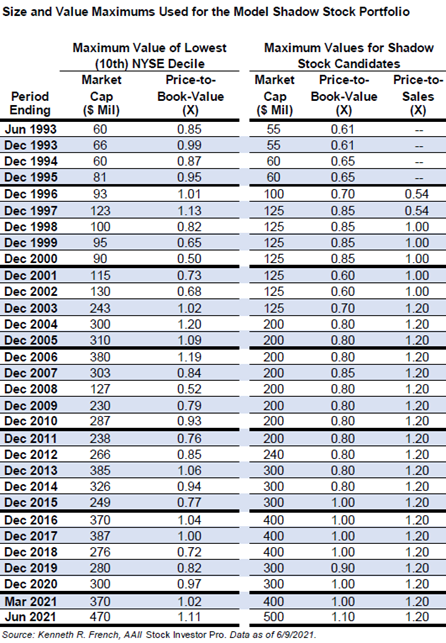 The primary Model Shadow Stock Portfolio selection criteria target the intersection of the smallest 10% of domestic stocks as measured by market capitalization, along with the “cheapest” 10% of domestic stocks as measured by the price-to-book-value (P/B) ratio. These decile breakpoints are determined by examining domestic companies that are listed on the New York Stock Exchange (NYSE) and then applying the size and value breakpoints for stocks listed in all domestic exchanges.
When the quarterly review was conducted at the start of June, the NYSE price-to-book cutoff had increased to 1.11, more than 11% above the model portfolio’s maximum initial price-to-book ratio of 1.00. Therefore, the maximum minimum initial price-to-book ratio is being raised from 1.00 to 1.10. Stocks are sold for valuation if they exceed three times the minimum initial price-to-book ratio at the time of a quarterly portfolio review. We used a price-to-book cutoff of 1.10 to screen for stocks to add to the Model Shadow Stock Portfolio and 3.30 (1.10 × 3) as the maximum price-to-book ratio to keep stocks in the portfolio.
The NYSE market-cap cutoff for the lowest decile is currently $470 million, compared to the portfolio’s $370 million maximum in March, so the size cutoff was also adjusted for the Model Shadow Stock Portfolio during the quarterly review from $400 million to $500 million. The maximum market cap for inclusion in the Model Shadow Stock Portfolio is now $500 million, and holdings are sold if their market cap goes above three times the initial criterion at the time of the quarterly review: $1,500 million.
The other major factor that leads to portfolio turnover is tied to negative earnings. If a company reports trailing 12-month earnings from continuing operations that are negative, the stock is placed on probation; if a subsequent quarter has negative earnings prior to trailing 12-month earnings becoming positive, the stock is sold. When available, adjusted (non-GAAP) earnings are used to put stocks on probation or sell them. These are earnings that have been adjusted to eliminate the impact of nonrecurring events such as markdown of inventory or goodwill. These are earnings reported in the media and firms reporting consensus estimates. The I/B/E/S adjusted earnings reported in Stock Investor Pro are used for Model Shadow Stock Portfolio decisions when they are available.
A stock can also be sold if it has been held over four years if it also no longer meets the initial rules for qualifying and has not gained at least 10% annually from its purchase price and there is a new qualifying stock to replace it.
After conducting the quarterly review of the Model Shadow Stock Portfolio, CPI Aerostructures Inc. (CVU) and Hallador Energy Co. (HNRG) were removed from the tracking portfolio during regular trading hours on Monday, June 14, 2021. With the proceeds from these two sales, as well as the cash held in the portfolio, there were only enough funds to purchase one new holding—Pangaea Logistics Solutions Ltd. (PANL).
Stocks are removed from the Model Shadow Stock Portfolio if at the time of quarterly review, their price-to-book ratio exceeds three times the initial ceiling used to add stocks to the portfolio: 3.30 (1.10 × 3). As of June 10, 2021, Hibbett Sports Inc. (HIBB) had the highest price-to-book-value ratio in the Model Shadow Stock Portfolio with a ratio of 3.07. Hibbett Sports was a sell candidate due to valuation, but its strong quarterly performance increased its book value per share from $23.65 to $26.92, a 13.8% increase. This increase in book value per share reduced Hibbett Sports’ price-to-book ratio from 3.49 to 3.07 with the share price of $82.54 at the time of review on June 10, 2021.
Shadow stocks with a market cap three times the initial market cap maximum ($500 million × 3 = $1,500 million) at the time of a quarterly review are sold from the portfolio, assuming there is a suitable replacement. Hibbett Sports also has the highest market cap in the portfolio with a value of $1,358.0 million as of June 10, 2021. Hibbett Sports is the only stock in the Model Shadow Stock Portfolio at risk of being sold for exceeding this ceiling.
CPI Aerostructures, Inc.  (CVU)
(CVU)
As we have previously noted, on February 14, 2020, CPI Aerostructures announced that it prematurely or inaccurately recognized certain revenues and would need to restate prior-period financial statements. Last August, the company provided restated financials for 2018 and published its 2019 results. Because of the restatement, the firm’s equity or book value was adjusted down and became negative. With a negative book value, one cannot calculate a meaningful price-to-book ratio.
CPI Aerostructures is being removed from the portfolio because the firm is not trading with a meaningful price-to-book ratio and the price-to-book ratio is the primary valuation metric used to select and remove stocks from the Model Shadow Stock Portfolio.
We have a free financial statement classroom (www.aaii.com/classroom) for members who would like to learn more about financial statements and their analysis on AAII.com.
CPI Aerostructures was added to the Model Shadow Stock Portfolio on May 31, 2017, and is down 53.0% since purchase, also triggering a sale based upon the “four-year rule.” The four-year rule seeks to sell stocks that have been in the portfolio for a meaningful period of time and are underperforming the market if qualifying stock candidates exist. Stocks are sold under the four-year rule if they have been held for over four years, they do not currently qualify for inclusion to the portfolio, they are up less than 10% annually since purchase and there are qualifying stocks available to replace them.
Hallador Energy Co. (HNRG)
Hallador Energy is an energy exploration company focused on developing coal reserves in the Illinois Basin. Hallador Energy is primarily involved in mining coal for the electric power generation industry, but has also branched out into gas exploration, generation of renewable energy and energy logistics.
Hallador Energy is being removed from the portfolio because of the Model Shadow Stock Portfolio’s negative earnings rule. On May 3, 2021, the company reported an adjusted fiscal first-quarter loss of $0.07 per share, while trailing 12-month earnings remained negative. Adjusted trailing 12-month earnings per share first turned negative on March 9, 2021, when the company reported a loss of $0.15 per share on adjusted fourth-quarter earnings.
It is the policy of the Model Shadow Stock Portfolio to sell a stock once its trailing 12-month adjusted earnings go negative and the company reports a quarterly loss in a subsequent quarter while trailing earnings are still negative.
Hallador Energy is also in violation of the four-year rule. Hallador Energy was added to the Model Shadow Stock Portfolio on September 1, 2016, and is down 53.4% since purchase.
As of June 10, 16 stocks met the initial selection criteria for the Model Shadow Stock Portfolio. This is up from six passing companies last month; however, last month the price-to-book maximum was 1.00 and the market-cap ceiling was $400 million. Using the old cutoffs, nine companies passed the initial selection criteria. AAII members can see and research which companies are currently passing the initial selection criteria in the Shadow Stock Ideas table on AAII.com. The list of new Shadow Stock Ideas is updated daily—Tuesday through Saturday.
Five stocks already in the Model Shadow Stock Portfolio passed the updated criteria at the time of the review: Hurco Companies Inc. (HURC) Key Tronic Corp. (KTCC), Mesa Air Group (MESA), Orion Group Holdings Inc. (ORN) and Strattec Security Corp. (STRT).
Note: Key Tronic is passing based upon older financials that may need to be revised. As we noted previously, the company disclosed on February 10, 2021, that during the preparation of its quarterly filings, it received a notification from an employee regarding “irregularities of the classification of inventory between raw material and work-in-process at a production facility.” The company continues to perform an internal investigation. At the time of the disclosure, Key Tronic stated that it did not anticipate a material adverse impact on its historical financial statements.
The remaining 11 stocks were examined to ensure adequate liquidity, timely financial filings and appropriate industry and foreign considerations. Two real estate investment trusts (REITs) and a limited partnership were excluded. Two stocks were also excluded from consideration because their average daily dollar trading volume was too low, indicating that they might be difficult to purchase without severely impacting the share price. The Shadow Stock Portfolio Rules on AAII.com provide guidance for factors to consider when selecting stocks for your portfolio.
Price momentum is used as the tiebreaker among qualifying stocks. The remaining stocks were ranked using the weighted relative strength ranking, which considers price performance over the last year but places a higher weight on the most recent quarterly price performance.
The positions in CPI Aerostructures and Hallador Energy were relatively small, so only one new holding was added to the portfolio: Pangaea Logistics.
Pangaea Logistics Solutions Ltd. (PANL)
Pangaea Logistics is a U.S.-based maritime logistics and transportation company servicing a broad base of customers who require the transportation of a wide variety of dry bulk cargoes. The company operates a fleet of approximately 45 to 60 Supramax, Panamax and Handymax vessels, of which 21 are owned or partially owned. Pangaea Logistics is a leader in the high ice class sector, secured by its control of the majority of the world’s large dry bulk vessels with ice class 1a designation.
Pangaea Logistics has a book value per share of $4.31 as of March 31, 2021. If you wish to stay within the 1.10 price-to-book maximum, you should pay no more than $4.74 per share (4.31 × 1.10). However, if the stock price has moved up after being added to the portfolio, you can still purchase the stock unless the price-to-book ratio goes above 1.21, which equates to a price of $5.22 per share. To calculate the maximum purchase price based on the maximum desired price-to-book ratio, multiply the current book value per share ($4.31 for Pangaea) by the maximum price-to-book ratio to be considered for the Model Shadow Stock Portfolio (currently 1.10, or 1.21 for loosened consideration).
The next quarterly review of the Model Shadow Stock Portfolio will take place following the end of August 2021. Any changes to the portfolio will be announced at the time they are made in our Model Shadow Stock Portfolio Update emails (sign up at www.aaii.com/email).
The Model Shadow Stock Portfolio continued its strong run with a 4.4% gain during May 2021. The Model Shadow Stock Portfolio is now up 49.5% for the first five months of the year and has posted positive monthly gains for 14 straight months. The S&P 500 index as measured by the performance the Vanguard S&P 500 Index fund (VFINX) had a gain of 0.7% during May and is up 12.6% for the first five months of the year. The Vanguard Small Cap Index fund (NAESX) is up 14.7% for the year after gaining 0.1% in May. The DFA U.S. Micro Cap fund (DFSCX) gained 3.1% during May and is up 27.1% for the year.
Value stocks outperformed growth stocks during May across all size segments, and value stocks are significantly outperforming growth stocks during 2021.
In the large-cap segment, growth stocks were down 0.9% during May, giving them an 8.2% gain year to date for 2021. Large-cap value stocks were up 2.4% during May and are now up 17.7% year to date. The largest sector weighting in the large-cap growth index is information technology, while financials are the largest sector weighting within the large-cap value index.
In the mid-cap segment, growth stocks are up 11.1% for the year, after giving up 1.8% during May. Mid-cap value stocks are up 26.5% for the year, after gaining 1.9% during the month.
Small-cap growth stocks are up 4.1% year to date, while small-cap value stocks are up 27.5%. Small-cap growth stocks lost 2.9% during May, while small-cap value stocks gained 3.1% during the month.
The energy sector was the market leader during May with a 5.8% gain for the month and 39.2% gain year to date. The materials industry was a close second with a 5.2% monthly gain as money continues to rotate into segments hurt by the coronavirus pandemic last year on expectations of increased activity and higher inflation. Financials also benefited from a slightly steeper yield curve, posting a 4.8% gain for the month and a 29.4% increase year to date.
The interest-sensitive utilities were down 2.3% during May. Other segments in the red for the month included consumer discretionary (–3.8%), information technology (–0.9%) and communication services (–0.1%).
Since its inception in 1993, the AAII Model Shadow Stock Portfolio has a compound annual average return of 15.6% versus the Vanguard 500 Index fund’s gain of 10.3% per year on average over the same period. Over the same period, the Vanguard Small Cap Index fund posted an average annual gain of 10.7%.
Big 5 Sporting Goods Corp. (BGFV) was the top performer in the Model Shadow Stock Portfolio for May, up by 67.8%. The stock rose on reported first-quarter results that beat analyst expectations and dividend news. See more details in the news below.
Penn Virginia Corp. (PVAC) was the runner-up for the month, up by 41.5%. The stock rose on the company’s first-quarter financial results, which beat analyst expectations. See more details in the news below.
SIFCO Industries Inc. (SIF) was the bottom performer for May, down by 17.6%. The company reported quarterly financial results that decreased year over year, as pressure from the pandemic on SIFCO’s end markets, such as commercial air travel, begins to recede. See more details in the news below.
Mesa Air Group (MESA) was down by 13.7% for the month. The stock fell after the company reported quarterly financial results. Earnings beat analyst expectations, but total operating revenue decreased year over year. See more details in the news below.
Here are some news highlights from May for the holdings in the Model Shadow Stock Portfolio:
Ampco-Pittsburgh Corp. (AP) reported first-quarter 2021 earnings per share of $0.01, down year over year from $0.33 per share. Net sales of $86.8 million were down 4.7% over the same period. The company said the declines were due to lower shipments of mill rolls compared to pre-pandemic levels, offset in part by higher shipments of forged engineered products.
Income from operations for the first quarter was $0.9 million, compared to $4.4 million for the first quarter of 2020. Interest expense declined in comparison to the previous year based on reduced debt, which remained sequentially stable with the previous quarter. Loss on foreign exchange was $1.2 million for the quarter.
“These results reflect a significant negative foreign exchange impact as well as higher production costs due in part to lower production levels in our forged and cast engineered products facilities,” said CEO Brett McBrayer. “We anticipate a recovery in order activity for our roll business in the second half of the year as customer inventories deplete with expected higher mill utilization rates.”
Big 5 Sporting Goods Corp. (BGFV) reported first-quarter 2021 earnings per share of $0.96, which increased year over year from a loss of $0.22 per share. Earnings per share beat the I/B/E/S consensus estimate of $0.50 per share by 92.0%. Net sales of $272.8 million increased 25.3% over the same period.
Same-store sales increased 31.8% for the first quarter. Gross profit increased to $97.9 million from $64.6 million in the first quarter of 2020. Big 5 Sporting Goods saw broad-based strength across apparel, footwear and hard goods, including demand for winter-related products.
“These results were especially remarkable given the headwinds impacting sales of team sports products due to the widespread suspension of league play over most of the quarter,” said CEO Steven Miller. “Our sales accelerated beyond expectations in March, benefiting from the resumption of team sports activities, along with school reopenings and stimulus checks.”
Big 5 Sporting Goods said it expects first-quarter momentum to carry into the second quarter. Same-store sales for the second quarter are expected to increase in the range of 22% to 27%, and earnings per share are expected in the range of $1.05 to $1.25.
Also, Big 5 Sporting Goods announced an increase to its regular quarterly dividend and a special dividend. “We are excited by the strength in our business, which has translated to our balance sheet, as we continue to operate with zero debt while growing our cash position,” said Miller.
Big 5 Sporting Goods raised its regular quarterly dividend by 20% to $0.18 per share. The dividend is payable on June 15 to shareholders of record as of June 1. The company’s special dividend of $1.00 per share is payable on June 1 to shareholders of record as of May 17.
Container Store Group Inc. (TCS) reported fourth-quarter 2020 earnings per share of $0.71, which increased year over year from earnings per share of $0.21. Earnings beat the I/B/E/S consensus estimate of $0.57 per share by 25.2%. Net sales of $314.7 million increased 30.4% over the same period.
Net sales for Container Store retail business were $294.2 million, up 31.3%, with an increase of 41.6% in general merchandise categories and an increase of 22.2% in custom closets. Online sales increased 22.2%. Elfa International AB third-party net sales were $20.5 million, up 18.8% compared to the fourth quarter of 2019.
“As we look to fiscal 2021 and the next chapter for the Container Store, we have developed our strategic priorities and supporting initiatives to make this great company the best version of itself,” said CEO Satish Malhotra. “We will strive to deepen our relationship with our customers, expand our reach and strengthen our capabilities through continuous improvement and by being an employer of choice.”
Container Store expects first-quarter 2021 consolidated sales growth of about 50% year over year. Earnings are expected to be in the range of $0.08 to $0.09 per share on an adjusted basis.
Delta Apparel Inc. (DLA) reported earnings per share of $0.62 for the second quarter, beating the I/B/E/S consensus estimate by 3.3%. Earnings per share were up over 200% year over year. The company reported net revenue of $108.63 million, a 12.4% year-over-year increase.
Delta Apparel is a major provider of active wear and lifestyle apparel. Net sales in the Delta Group segment grew 12%, driven by the demand in the market for activewear apparel, particularly in direct-to-retail and brand-direct channels. Net sales in the Salt Life Group segment increased 16% with notable performance in direct-to-consumer channels, with sales growth at branded retail stores and online.
“In every aspect, our March quarter results showcase the positive trajectory of the company. With double-digit sales growth and significant profitability expansion in both business segments, we have proven the benefits of our broad customer base and diversified channels of distribution,” said chairman and CEO Robert Humphreys. “We believe the momentum is just beginning, and we are excited by the many opportunities we see for continued growth.”
Ducommun Incorporated (DCO) reported first-quarter adjusted earnings per share of $0.55, missing the I/B/E/S consensus estimate by 2.2%. Adjusted earnings per share were down 13.4% year over year. Net revenue for the quarter was $157.15 million, a 9.41% year-over-year decrease.
The company had a gross margin of 2.1% and adjusted earnings before interest, taxes, depreciation and amortization (EBITDA) of 13.5% of revenue. Segment revenues were flat or down year over year due to decreased demand from the aerospace end-markets.
“Our first-quarter performance continued to illustrate the resilience of Ducommun’s product portfolio and operating strength, especially in our defense sector, which is building the foundation for a solid year ahead and a return to revenue growth in 2021,” said chairman, president and CEO Stephen Oswald. “Military demand once again served to offset weakness in our commercial business and continued overall strong product mix resulted in solid gross margins and adjusted EBITDA across the company.”
Global Ship Lease Inc. (GSL) reported first-quarter earnings of $0.33 per share, missing the I/B/E/S consensus by 26.7%. Net revenue was reported to be $72.98 million, reflecting a 2.87% year-over-year increase. Adjusted EBITDA was $44.7 million for the first quarter of 2021, up from $40.0 million for the first quarter of 2020, with the net increase being mainly due to increased operating days.
“The strong containership market momentum of late 2020 has further accelerated in 2021, positioning the sector for levels of profitability not seen in many years,” said executive chairman George Youroukos. “While factors such as port delays, shortage of equipment, and congestion in the Suez Canal have provided support at the margin in tying up containership capacity, the present market conditions are based on the fundamentals of underlying strong demand growth set against limited supply, resulting in effectively full employment of the global containership fleet.”
Additionally, Global Ship Lease declared a dividend of $0.25 per share, more than double the $0.12 per share dividend announced in January 2021. The dividend was payable on June 3 to shareholders of record as of May 24.
Hibbett Sports Inc. (HIBB) reported earnings per share of $5.00 for the first quarter of 2022, beating the I/B/E/S consensus estimate by 80.3%. Revenue for the quarter was $506.86 million, reflecting an 87.84% year-over-year increase and beating projections by $117.21 million.
Comparable sales grew 87.3%. Brick and mortar comparable sales increased 113.5%. E-commerce sales grew 1.0% and represented 11.7% of total net sales for the first quarter compared to 22.3% in the prior-year first quarter.
“Our fiscal 2022 is off to an excellent start as our business continues to build on the strong momentum we experienced last year,” said president and CEO Michael Longo. “Record quarterly sales and earnings were a result of our continued commitment to offering a compelling assortment of merchandise combined with our trademark superior customer service and a best-in-class omnichannel platform.”
Additionally, the company announced plans to expand its existing stock repurchase program from the initial $500 million to $800 million. As of May 26, the company had bought back 7,469,387 shares for around $201 million.
“Our strong financial results have enabled us to invest in growing our business while returning cash to our shareholders through our repurchase program,” said Longo regarding the program’s expansion. The board’s approval to expand this program reflects continued confidence in Hibbett’s future performance and long-term cash flow generation capabilities.”
Key Tronic Corp. (KTCC) announced preliminary results for the third quarter of 2021. The company expects revenue of about $134.6 million and earnings per share between $0.10 and $0.12. These earnings would be lower than previously projected. Despite underwhelming estimates, the company reports that consumer demand is still quite strong and is projected to exceed $150 million if component supply meets demand. The company’s estimates at the moment are preliminary and subject to change.
Separately, Key Tronic announced it is undergoing an internal audit to investigate any irregularities in the classification of inventory on its balance sheets for its second and third fiscal quarters of 2021. The company said it is working diligently to finalize quarterly financial statements.
Kimball Electronics Inc. (KE) reported adjusted earnings for the third quarter of 2021 of $0.43 per share, missing the I/B/E/S consensus estimate by 9.3%. Revenue was $310.33 million, a 5.6% year-over-year increase. Consolidated net sales increased 6%. Kimball Electronics is a global manufacturing solutions provider of electronics and diversified contract manufacturing services.
“We are very pleased with our operating results for the third quarter of fiscal 2021. Our team remains resilient as we work through the ongoing challenges caused by the pandemic and the global semiconductor shortage,” said chairman and CEO Donald Charron. “Despite the adversity, we again delivered solid operating income, exceeding our goal of 4.5%, and we continued to deliver excellent cash flow from operations, which on a year-to-date basis has more than doubled from the prior year.”
Mesa Air Group (MESA) reported adjusted earnings for the second quarter of 2021 of $0.23 per share, beating the I/B/E/S consensus estimate by 25.0%. Adjusted earnings per share increased 360.0% year over year. Revenue was $97.28 million, reflecting a 45.9% year-over-year decrease. The company’s quarterly results include a one-time non-cash lease termination expense of $4.5 million regarding previously leased CRJ-900 aircraft.
Revenue decreased due to the impact of the pandemic, fewer aircraft at American Airlines Group Inc. (AAL), lower temporary contract rates and the winter storm and subsequent power outages in Texas.
“The last year has emphasized the importance of innovation in the face of significant challenges,” said CEO Jonathan Ornstein. “Given change is the one constant of our industry, we have focused on positioning the company for the future and taken the regional industry’s initial steps toward sustainability and decarbonization of air travel.”
Penn Virginia Corp. (PVAC) reported adjusted earnings for first-quarter 2021 of $0.39 per share, beating the I/B/E/S consensus estimate by 15.7%. Adjusted earnings per share decreased 79.4% year over year. Net revenue of $88.3 million was a 34.2% improvement over the previous quarter, but a 2.84% decrease compared to first-quarter 2020.
“Our sales volumes for the first quarter exceeded the high end of our guidance range, while capital expenditures were below the low end of our guidance range,” said CEO Darrin Henke. “Our strong performance to date provided us the confidence to raise our full-year 2021 production guidance by more than 6% while still maintaining the previous capital expenditures target.”
Penn Virginia also announced a plan to raise $350 million through the issuance of unsecured debt. These notes will be due in 2028. The proceeds will be used to repay a portion of outstanding borrowings, pay related fees and expenses and terminate its second-lien term loan.
Rocky Brands Inc. (RCKY) reported first-quarter adjusted earnings of $1.19 per share, beating the I/B/E/S consensus estimate by 101.7%. Adjusted earnings per share increased 340.7% year over year. Net sales increased 57.3% versus first-quarter 2020, rising to $87.7 million.
Gross margin for Rocky Brands increased 5.4% to $87.7 million versus $55.7 million one year ago. Wholesale revenue also increased, up 69.1% to $59.2 million.
“It has been an excellent start to the year for Rocky Brands as we delivered a strong first-quarter performance and completed a highly transformative acquisition,” said CEO Jason Brooks. “We experienced robust demand for our Rocky, Georgia and Durango brands across our wholesale and direct-to-consumer channels, which when combined with an easier comparison due to the impact on our business from COVID-19 in the year-ago period, resulted in a dramatic improvement in revenue and earnings per share.”
Rocky Brands also declared a dividend of $0.14 per share, in line with the previous declaration. This dividend is payable on June 16 to shareholders of record as of June 2.
SIFCO Industries Inc. (SIF) reported a loss of $0.26 per share for the second quarter of fiscal 2021, which compared year over year to earnings of $0.57 per share. Net sales for the quarter decreased 18.6% to $24.9 million versus the $30.5 million reported in the second quarter of 2020. Gross profit decreased 56.3% to $2.74 million versus the same period in 2020.
“While our results for the quarter reflect the pressures on the [aerospace and energy] markets caused by the COVID-19 pandemic, we are all thankful that the impacts of the pandemic are finally showing signs of receding in many places in the world and we are excited that commercial air travel is showing signs of recovery,” said CEO Peter Knapper. “We continue to work with our customers as we navigate the impacts on our markets together.”
Titan Machinery Inc. (TITN) reported first-quarter earnings for fiscal 2022 of $0.47 per share, beating consensus estimates by almost 200%. Earnings per share increased 360.0% year over year. Revenue for the quarter increased 20.14% over last year’s first quarter, rising from $310.2 million to $372.2 million.
Gross profit for the quarter tallied $71 million, a 19% increase over the $58.4 million in the first quarter last year. Titan Machinery saw significant increases in year-over-year revenue across its three segments: agriculture, construction and international.
“The fiscal first quarter exceeded our expectations on all fronts with impressive operating leverage that showcases the earnings power of our efficient dealership network,” said CEO David Meyer. “I am proud of our team’s performance and pleased to share this success with all our stakeholders.”
Titan Machinery expects fiscal 2022 to continue strong, with projected annual earnings per share between $1.65 and $1.85. This projection takes into account its first-quarter 2022 report of $0.47 per share.
Vishay Precision Group Inc. (VPG) reported first-quarter 2021 earnings of $0.36 per share, beating the I/B/E/S consensus estimate by 9.5%. Year over year, earnings per share increased 50.0%. Revenues for the quarter tallied $70.6 million, a 4.3% increase from a year ago.
Gross profit margin increased to 40.5%, compared to 37% a year ago. Vishay Precision saw year-over-year revenue growth across two of its three product segments, foil technology (7.3%) and force sensors (15.2%).
“We executed well in the first quarter and achieved financial results within our target model,” said CEO Ziv Shoshani. “We grew our adjusted gross margin compared to the fourth quarter of 2020 and the same quarter a year ago. Our strong cash from operations and solid balance sheet give us the foundation to continue to make the strategic investments in our business to create additional stockholder value.”
As of May 11, 2021, all of Vishay Precision’s facilities are operational after the coronavirus pandemic. The company expects net revenues to increase in the coming quarters, and to be in the range of $71 million to $77 million for the second fiscal quarter of 2021.
VSE Corp. (VSEC) declared a regular quarterly dividend of $0.09 per share, in line with the previous declaration. The dividend is payable on July 28 to shareholders of record as of July 14. The stock will trade ex-dividend on July 13.
 Get updates about the portfolio that has outperformed the market by 211.9%
since inception!
Get updates about the portfolio that has outperformed the market by 211.9%
since inception!