

John Bajkowski
is the president of AAII.
 BSET
BZH
DCO
EBF
GSL
HOFT
HURC
KTCC
NAESX
ORN
PANL
PERI
STRT
TITN
VFINX
VPG
BSET
BZH
DCO
EBF
GSL
HOFT
HURC
KTCC
NAESX
ORN
PANL
PERI
STRT
TITN
VFINX
VPG
The Model Shadow Stock Portfolio’s streak of positive monthly returns came to an end during June with the portfolio down 1.8% for the month. The Model Shadow Stock Portfolio had posted 14 straight monthly gains since hitting bottom during March 2020, which translated into an overall 229.9% gain from the end of March 2020 through the end of May 2021. By way of comparison, the S&P 500 index, as measured by the Vanguard S&P 500 Index fund (VFINX), had a total return of 65.7% over the same time period while the Vanguard Small-Cap Index fund (NAESX) is up 95.2% since the end of March 2020 through the end of May 2021.
The Model Shadow Stock Portfolio is now up 46.8% during the first half of 2021, while the Vanguard S&P 500 Index fund gained 15.2% and the Vanguard Small-Cap Index fund gained 16.3%. Since its inception in 1993, the AAII Model Shadow Stock Portfolio has a compound annual average return of 15.5% versus the Vanguard 500 Index fund’s gain of 10.4% per year on average over the same period. Over the same period, the Vanguard Small-Cap Index fund posted an average annual gain of 10.7%.
Information technology was the best-performing sector during June, gaining 7.0%, followed by energy with a 4.6% gain and consumer discretionary with a 3.8% monthly gain. Materials was the weakest sector, losing 5.3% during June, followed by financials (down 3.0%) and industrials (down 2.2%). The energy sector is still the strongest-performing sector during 2021 with a 45.6% gain during the first six months of the year. Financials are in a distant second place with a 25.6% gain and real estate is in third place with gain of 23.3% during the first half of 2021. No sectors are in the red year to date, but utilities are the weakest sector with a 2.5% gain, followed by consumer staples (up 5.0%) and health care (up 11.9%).
In a reversal of fortunes, growth stocks posted gains during June, fueled by the technology rally during the month. In contrast, value stocks showed losses across all market capitalization sectors during June.
In the large-cap segment, growth stocks were up 5.7% during June, giving them a 14.3% gain year to date for 2021. Large-cap value stocks were down 1.2% during June and are up 16.3% year to date.
In the mid-cap segment, growth stocks are up 12.3% for the year, after gaining 1.1% during June. Mid-cap value stocks are up 23.0% for the year, after giving up 2.8% during the month.
Small-cap growth stocks are up 9.0% during the first half of the year, while small-cap value stocks are up 26.7%. Small-cap growth stocks gained 4.7% during June, while small-cap value stocks lost 0.6% during the month.
With the overall strong relative performance of small-cap stocks to large-cap stocks since the 2020 bear market, we thought it might be interesting to update our chart of relative valuation.
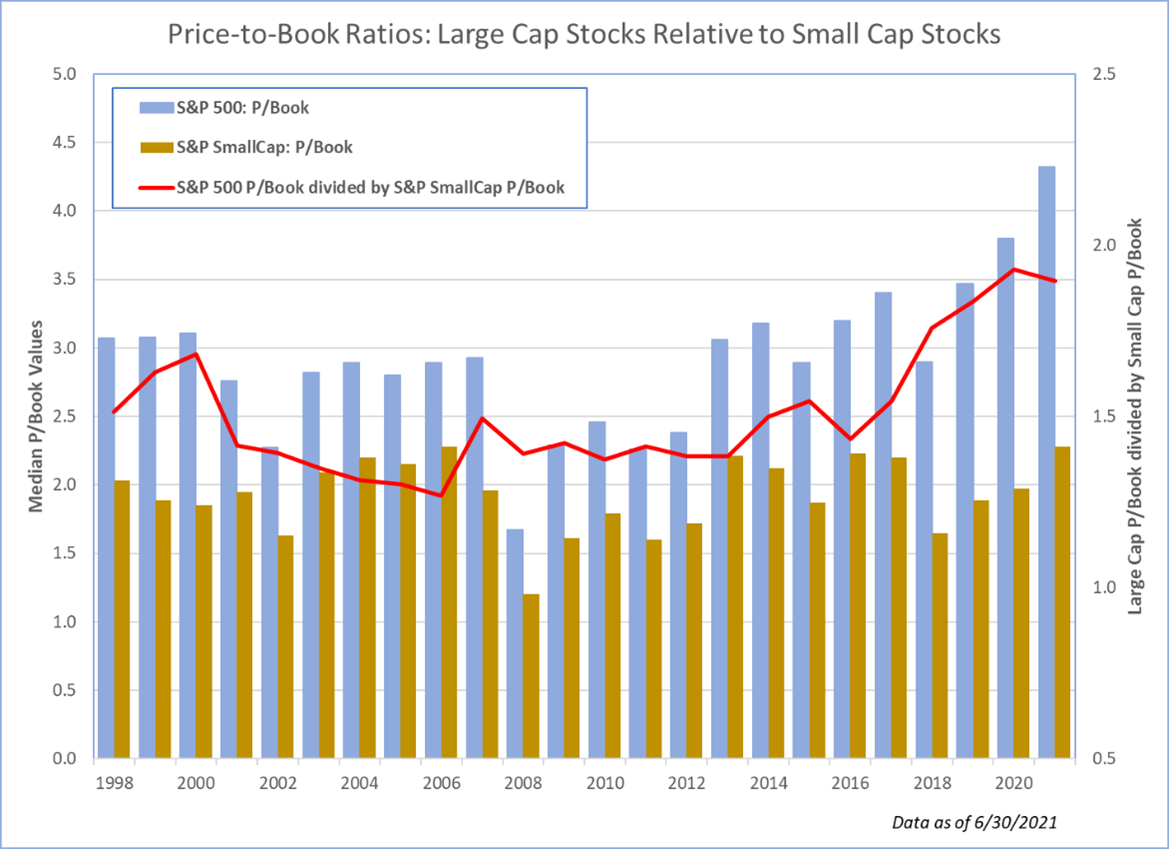
We first examined relative valuations of the S&P 500 (large-cap stocks) compared to the S&P SmallCap 600 index in the May 2020 AAII Journal. As of April 17, 2020, the median price-to-book-value ratio of the stocks in the S&P 500 was 2.71, while the median for the stocks in the S&P SmallCap 600 was 1.28.
Dividing the price-to-book ratio of the S&P 500 stocks by that of the constituents of the S&P SmallCap 600 provides a helpful ratio that can be used to track the relative relationship over time. Near the market bottom last year, the price-to-book ratio of large-cap stocks was 2.1 times that of small-cap stocks.
As of the end of June 2021, the median price-to-book ratio of the stocks in the S&P 500 has increased from 2.71 to 4.32, while the median for the stocks in the S&P SmallCap 600 went from 1.28 to 2.28. The price-to-book ratio of large-cap stocks is now at 1.9 times that of small-cap stocks.
The valuation gap between large- and small-cap stocks has narrowed since last year but is still well above the 1.5 long-term average. The year-end median of the S&P 500 stocks has averaged 2.85 over the last 23 years. The highest year-end value of 3.80 was registered at the end of 2020, while the lowest year-end value of 1.67 for the S&P 500 stocks was observed at the end of 2008. Stocks within the S&P SmallCap 600 have an average year-end price-to-book ratio of 1.92, with the highest value of 2.28 at the end of 2006 and the lowest value of 1.20 at the end of 2008 during the financial crisis. Today’s 4.32 median price-to-book ratio for S&P 500 stocks exceeds the year-end values observed over the last 23 years. The 2.28 median price-to-book ratio for S&P SmallCap 600 stocks is above the year-end average of 1.96 and now matches its prior high year-end value observed in 2006.
The red line plots the ratio of large-company price-to-book valuations to that of small-company stocks. When the red line goes higher, large-cap stocks are relatively more expensive than small-cap stocks. Small-cap stock valuations were the highest on a relative basis in the mid-2000s. In contrast, the divergence in the price performance and related valuations for large versus small companies is dramatically captured over the last several years. Large-cap stocks grew more expensive, while small-cap stocks languished and became relatively cheaper. The recent price run-up has pushed price-to-book valuations, but small-cap companies remain more attractive than large-cap stocks on a relative valuation basis.
Twenty stocks met the initial selection criteria for the Model Shadow Stock Portfolio as of July 8, 2021, up from 16 passing stocks one month ago. AAII members can see and research which companies are currently passing the initial selection criteria in the Shadow Stock Ideas table on AAII.com. The list of Shadow Stock Ideas is updated daily—Tuesday through Saturday.
Of the 20 qualifying companies, six are currently held in the Model Shadow Stock tracking portfolio: Hurco Companies Inc. (HURC), Key Tronic Corp. (KTCC), Mesa Air Group (MESA), Orion Group Holdings Inc. (ORN), Pangaea Logistics Solutions Ltd. (PANL) and Strattec Security Corp. (STRT). No stocks came off the qualifying list over the course of the month, while the latest addition to the model portfolio (Pangaea Logistics) was added to the list of qualifying stocks.
Bassett Furniture Industries Inc. (BSET) came off probation during the month when the company reported adjusted earnings that lifted its trailing 12-month earnings into positive territory.
We had previously noted that Key Tronic delayed filing its financials since February while it conducted an investigation regarding “irregularities of the classification of inventory between raw material and work-in-process at a production facility.” The audit committee concluded its investigation and determined that the inventory in question was improperly recorded at its Oakdale, Minnesota, production facility during the fourth quarter of fiscal-year 2020 and during the first six months of fiscal-year 2021. The investigation identified accounting errors resulting in an understatement of cost of goods sold and an overstatement of inventory. Additional inventory accounting errors unrelated to the investigation were also identified by management during the quarter. These errors were a result of deficiencies in the company’s internal control over financial reporting. The financial impact of the improper recording of inventory and the other accounting errors unrelated to the investigation did not result in a restatement of any audited or unaudited financial statements. The company has now filed quarterly reports.
As of July 8, 2021, Hibbett Inc. (HIBB) had the highest price-to-book ratio in the Model Shadow Stock Portfolio. Its ratio of 3.45 is now more than more than three times the 1.10 maximum value used for initially qualifying a stock for inclusion to the portfolio.
The Model Shadow Stock Portfolio looks for stocks with a market cap (share price times shares outstanding) greater than $30 million but less than $500 million when adding stocks to the portfolio. Shadow stocks with a market cap three times the initial market cap maximum ($500 million × 3 = $1,500 million) at the time of a quarterly review are sold from the portfolio, assuming there is a suitable replacement. Hibbett also has the highest market cap in the portfolio with a value of $1,490.7 million as of July 8, 2021.
The initial market cap and price-to-book levels are adjusted over time to reflect the changing market conditions. Any changes to the portfolio will be announced at the time they are made in a special Model Shadow Stock Portfolio Update email (sign up at www.aaii.com/email).
Perion Network Ltd. (PERI) had the best performance in the portfolio for June, increasing 29.5% during the month. The stock rose due to the preliminary release of second-quarter earnings, where Perion Network showed large increases in revenue both year over year and sequentially over the previous quarter. See more details in the news below.
Pangaea Logistics Solutions Ltd. (PANL) had the second-best performance in the portfolio for June, increasing 24.0%. There was no company-specific news to attribute to the stock’s performance for the month. Pangaea Logistics has been steadily increasing, coming off consecutive quarters of beating I/B/E/S consensus earnings estimates.
Bassett Furniture Industries Inc. (BSET) had the worst performance in the portfolio for June, decreasing by 19.6% during the month. There was no company-specific news to attribute to the stock’s poor performance during the month. Bassett Furniture was the portfolio’s top performer in April 2021.
Beazer Homes USA Inc. (BZH) had the second-worst performance in the portfolio for June, decreasing by 19.0% during the month. While there is no specific news relating to the company’s performance, it is possible that Beazer Homes is still experiencing adverse effects due to the coronavirus pandemic. See more details in the news below.
Here are some news highlights from June for the holdings in the Model Shadow Stock Portfolio:
Beazer Homes USA Inc. (BZH) announced that Lloyd E. Johnson would be joining its board of directors. Johnson will serve on the Beazer Homes Audit Committee and the Compensation Committee.
Johnson most recently served as global managing director of finance and internal audit for Accenture Corp. from 2004 to 2015.
“We are pleased to welcome Lloyd to our board. His deep financial and strategic expertise will be particularly valuable as we continue to focus on executing our balanced growth strategy,” said chairman and CEO Allan Merrill.
Delta Apparel Inc. (DLA) announced that it acquired technology company Autoscale.ai, to extend its existing automation products.
Autoscale will help Delta Apparel’s DTG2Go platform provide automated solutions for design creation, art and licensing management, as well as connect users to online marketplaces.
“Integrating Autoscale’s innovative technology into our portfolio is a critical part of our strategy to drive enterprise value over the long term by providing an automated, scalable, seamless solution for on-demand, decorated apparel—from design to fulfillment,” said Delta Group president Deborah H. Merrill. “The acquisition allows us to take full advantage of the Autoscale technology, which should quickly expand beyond its current capabilities, further transforming the on-demand opportunities in today’s e-commerce market.”
TK Stohlman, founder and CEO of Autoscale, will remain as president of the company. Delta Apparel will fund the acquisition with an $8 million cash payment.
Ducommun Incorporated (DCO) announced the addition of Sheila G. Kramer to its board of directors.
“We are happy to have Sheila join our board and look forward to her contributions,” said chairman, president and CEO Stephen G. Oswald. “Shelia’s expertise in the critical area of human resources will certainly help the company work through the post-pandemic challenges and also support Ducommun’s long-term growth plans.”
“I am both proud and honored to be joining the Ducommun board of directors,” said Kramer. “I look forward to working with their strong team of leaders to continue to advance the priorities of the business.”
Before her appointment, Kramer served as the vice president and human resources officer at Donaldson Company Inc.
Ennis Inc. (EBF) reported first-quarter 2021 earnings per share of $0.28, which increased by 75% year over year from $0.16 per share. Net sales of $96.9 million increased by 8.9% over the same period.
Organic sales increased by $2.7 million, growing by 3%. Gross profit increased to $29.2 million from $23.9 million in the first quarter of 2020.
“Our results for the quarter were within our expectations and our management team continued to successfully navigate the challenges presented by the pandemic. Our gross profit margin improved over the sequential quarter increasing from 29.6% to 30.1%. Our EBITDA [earnings before interest, taxes, depreciation and amortization] increased over the sequential quarter, $12.4 million to $15.1 million, representing 13.8% and 15.5% of sales, respectively. While our revenues continue to be impacted by the pandemic, some of our customers are seeing sales return to normalized levels. We continue to monitor incoming order volumes so that we can proactively adjust our costs accordingly.”
Although Ennis has begun to recover from the pandemic, the company remains prepared to adjust to any unforeseen costs related to it.
Ennis also announced that it appointed Vera Burnett to the CFO position and Dan Gus to the general counsel and assistant secretary position.
Chairman, president and CEO Keith S. Walters noted that “Ms. Burnett has proven to management and the board that she has the capabilities to assume this role. We are pleased that we could add Ms. Burnett to the officer ranks of the company. I am equally delighted to have Dan Gus join Ennis in the new position of general counsel. His broad background in law and the business world will add depth to the company’s management team.”
Global Ship Lease Inc. (GSL) announced that it purchased four 5,470 TEU Panamax containerships for a total purchase price of $148 million. The ships will be chartered to leading liner operators for three years each with a charterer’s option to renew for an additional three years. The ships are anticipated to produce adjusted EBITDA of approximately $124.4 million in the first three years. The ships are scheduled to arrive during the third quarter of 2021.
The company also acquired 12 containerships from Borealis Finance LLC earlier this month, for a total price of $233.9 million. The ships all have remaining charter durations of three to 25 months. These vessels are also expected to be delivered during the third quarter of 2021.
Global Ship Lease also declared a cash dividend of $0.546875 per share. The dividend was paid on July 1 to Series B preferred shareholders of record as of June 24. The company has a current dividend yield of 5.5%.
Hibbett Inc. (HIBB) declared a $0.25 per share quarterly dividend. The dividend is payable on July 20 to shareholders of record as of July 8. The company currently has a dividend yield of 1.0%.
In addition, Hibbett opened another store in Richmond, Virginia, earlier in June.
Hooker Furniture Corp. (HOFT) reported first-quarter 2022 earnings per share of $0.78. Earnings beat the I/B/E/S consensus estimate of $0.21 per share. Net sales of $162.9 million increased by 56% over the same period.
Sales for the Hooker Branded segment increased by 89% year over year, as both the Home Meridian and domestic upholstery segments reported a 46% sales increase over the same period. These sales increases are attributed to high consumer demand.
“We’re pleased to have surpassed our goal to return to the growth trajectory we were on prior to the global pandemic and economic downturn,” said CEO Jeremy Hoff. “I’m especially proud of our team in delivering this strong rebound a year after the onset of the pandemic despite current industry-wide logistics challenges including higher ocean and freight transit costs, raw materials shortages and inflation.”
Hurco Companies Inc. (HURC) reported second-quarter 2021 earnings per share of $0.36. Second-quarter sales of $57.9 million increased by 56% over the same period.
CEO Greg Volovic stated, “As Hurco emerges from one of the more challenging business environments in recent history, I am extremely excited about our current position and opportunity for meaningful strategic growth. During our 2021 second fiscal quarter, Hurco’s global orders exceeded $65.0 million for the first time since our second fiscal quarter of 2019, prior to the impact of the pandemic … We remain focused on optimizing shareholder value through a variety of avenues and continue to leverage the benefit of our strong balance sheet to evaluate and pursue acquisition opportunities. Our ability to quickly adapt to significant changes in the business climate and our noteworthy achievements in new product development have positioned us well for a strong recovery in 2021.”
Hurco Companies also declared a $0.14 per share quarterly dividend. The dividend was paid on July 12 to shareholders of record at the close of business on June 28. The company has a current dividend yield of 1.6%.
Orion Group Holdings Inc. (ORN) announced the sale of its Tampa property. The company received $22 million. Orion Group says that it will record a gain on the sale of the property.
“The sale of the Tampa property further strengthens our balance sheet and enhances our liquidity as we are currently investing in our new ERP system, along with rebuilding and upgrading one of our dredges,” said president and CEO Mark Stauffer. “As we have previously stated, we will continue to evaluate all potential options for capital allocation as we execute our strategic plan.”
Perion Network Ltd. (PERI) announced preliminary second-quarter results. The company expects to report an increase of total revenues of 74% over last year’s second quarter, and 17% growth sequentially.
Perion Network also increased its guidance for 2021 revenues and EBITDA. The company expects to see revenues between $410 million and $430 million, a growth rate of 28% over 2020. The company also expects adjusted EBITDA to reach between $49 million and $51 million, a growth rate of 52% over 2020.
“Perion’s accelerating growth further validates our diversification strategy and the success of our holistic solutions approach,” said CEO Doron Gerstel. “The key driver of our growth is the strong performance of our advertising business, which outpaced the industry’s organic growth rates, as brands and agencies expand the adoption of our solutions. Our investments in R&D are delivering significant returns and driving adjusted EBITDA margin expansion. Our strong business visibility into the second half of 2021 gives us the confidence to increase our full-year outlook.”
Titan Machinery Inc. (TITN) announced that it was added to the Russell 3000 index as part of the 2021 Russell indexes reconstruction.
“We are pleased with the addition to the Russell 3000 Index,” stated president and CEO Paul Reitz. “Inclusion in this index further highlights the progress we have made during the past 12 months and should assist in continuing to expand our reach and support greater awareness of Titan within the investment community.”
Vishay Precision Group Inc. (VPG) announced the acquisition of Diversified Technical Systems Inc. (DTS). DTS is a leading producer of data acquisition systems and sensors for safety and product testing.
“We are pleased to have DTS join the VPG family. DTS fits our acquisition criteria well: It is an established, niche-market leader with a strong brand and superior technology, as well as a talented management team with deep business and technical knowledge. We believe the addition of DTS will add significant value to VPG and our stockholders,” said chairman Marc Zandman.
 Get updates about the portfolio that has outperformed the market by 211.9%
since inception!
Get updates about the portfolio that has outperformed the market by 211.9%
since inception!