


John Bajkowski
is the president of AAII.
While the S&P 500 index squeaked out a 0.4% gain during May, most companies were down for the month as investors waited for a resolution to the risk of the U.S. government hitting its debt ceiling, while also weighing the strength of the economy. The allure of artificial intelligence (AI) helped to boost the performance of technology and communication stocks during May. Large consumer discretionary companies benefited from continued strong consumer spending.
The narrow market gains were seen primarily in large-cap growth stocks. The S&P 500 as measured through the Vanguard 500 Index fund  (VFINX) was up 0.4% in May and is up 9.6% year to date, while the Vanguard Small Cap Index fund (NAESX) was down 2.0% during May and is up 0.5% for the year. The DFA U.S. Micro Cap fund (DFSCX) was down 1.2% during May and is down 1.7% during the first five months of the year. The Model Shadow Stock Portfolio lost 8.5% during May, lowering its year-to-date performance to a loss of 0.8%.
Growth segments performed better than value-oriented stocks. In the large-cap segment, growth stocks were up 2.5% for the month and are now up 14.0% for the year. Large-cap value stocks were down 1.9% during May and are now up 4.9% year to date.
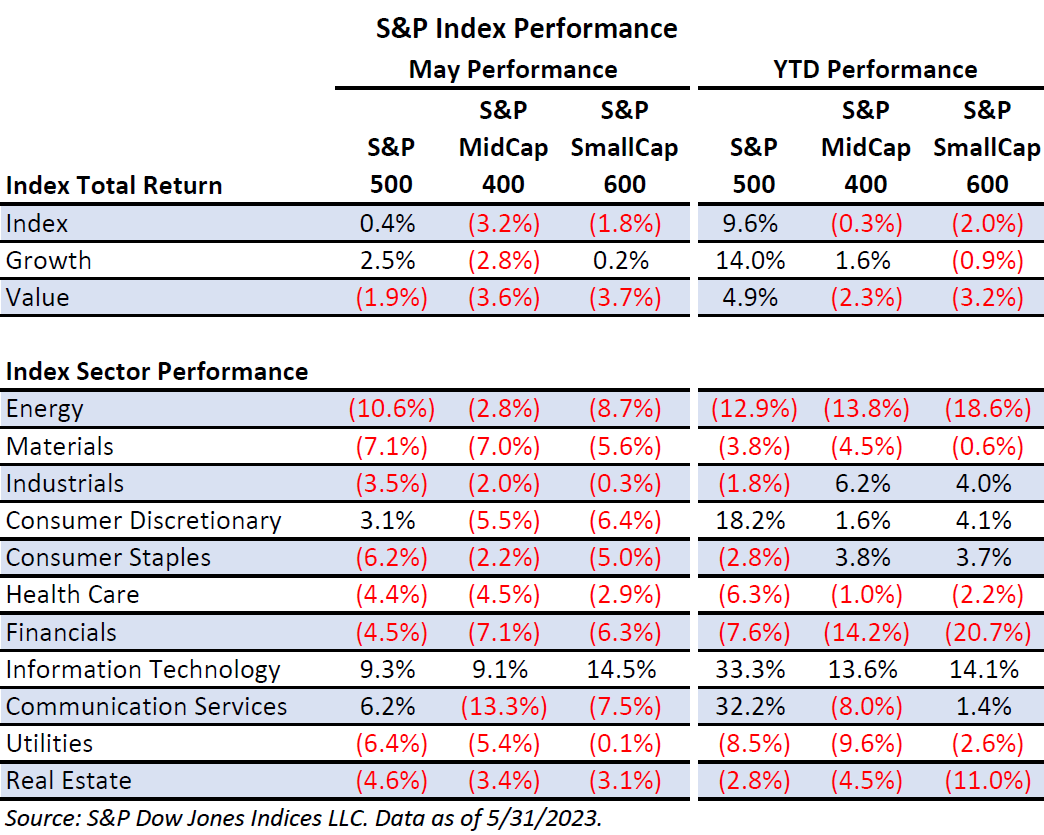
In the mid-cap segment, value stocks are down 2.3% for the year, after losing 3.6% during May. Mid-cap growth stocks are up 1.6% for the year, after losing 2.8% during the month.
Small-cap value stocks are down 3.2% year to date, while small-cap growth stocks are down 0.9% for the year. Small-cap value stocks lost 3.7% during May, while small-cap growth stocks gained 0.2% during the month.
The top-performing sectors during May within the large-cap segment were information technology (+9.3%), communication services (+6.2%) and consumer discretionary (+3.1%). Within the S&P SmallCap 600 index, only one sector was up for the month of May: information technology (+14.5%). The other relatively best-performing sectors within the S&P SmallCap 600 were utilities (–0.1%) and industrials (–0.3%).
The weakest sectors within the S&P 500 during May were energy (–10.6%), materials (–7.1%) and utilities (–6.4%). Within the S&P SmallCap 600, the weakest sectors during the month were energy (–8.7%), communications services (–7.5%) and consumer discretionary (–6.4%). It is notable that some of the best-performing sectors in the large-cap S&P 500 were among the weakest sectors in the S&P SmallCap 600 during May. The theme seems to be that under the current uncertain economic environment, investors were more comfortable investing in larger companies until the last few weeks.
Since its inception in 1993, the AAII Model Shadow Stock Portfolio has a compound annual average return of 13.3% versus the Vanguard 500 Index fund’s gain of 9.7% per year on average over the same period. Over the same period, the Vanguard Small Cap Index fund posted an average annual gain of 9.4%.
The quarterly Model Shadow Stock Portfolio review was conducted with a strong uptick in the market during June. The model portfolio rules guided the actions. The quarterly portfolio review is tied to the quarterly earnings reporting cycle of domestic companies. Companies are normally removed from the model portfolio if earnings turn negative or if strong growth and positive expectations push the size of the company and its valuation above desired levels.
The review begins with an examination of the prevailing valuation segments of the marketplace. The Model Shadow Stock Portfolio selection criteria targets the “cheapest” 10% of domestic stocks as measured by the price-to-book-value (P/B) ratio. The decile breakpoint for value is determined by examining price-to-book levels of domestic companies listed on the New York Stock Exchange (NYSE) and then using the price-to-book breakpoint for stocks listed on all domestic exchanges.
We determined the maximum price-to-book value for the lowest decile (lowest 10%) value universe among NYSE-listed stocks using AAII’s Stock Investor Pro stock screening program. The price-to-book cutoff had decreased slightly from 0.88 in March to 0.85. With the current initial qualifying maximum price-to-book ratio at 0.90, we are leaving it unchanged. Qualifying stocks must have a price-to-book ratio of 0.90 or lower. Stocks in the model portfolio are removed for valuation if they exceed three times the minimum initial price-to-book ratio at the time of a quarterly portfolio review. In other words, for this quarter’s review we use a price-to-book cutoff of 0.90 to screen for stocks to add to the Model Shadow Stock Portfolio and 2.70 (0.90 × 3) as the maximum price-to-book ratio to keep stocks in the portfolio.
As of June 13, 2023, Ennis Inc. (EBF) had the highest price-to-book-value ratio in the Model Shadow Stock Portfolio. Ennis is engaged in manufacturing, designing and selling business forms and other printed business products, primarily to distributors located in the U.S. Its price-to-book ratio of 1.63 is well below the 2.70 value used to remove stocks from the model portfolio. Therefore, no stocks are being removed this quarter for exceeding the valuation limit of the model portfolio.
We then examined market-capitalization levels of the companies listed on the NYSE to determine the size cutoff for the lowest decile. Here the market-cap level maximum was $285 million, compared to $297 million in March 2023. The decline was not significant enough to warrant a change to the portfolio rules. The maximum market cap for inclusion in the Model Shadow Stock Portfolio is $300 million, and holdings are removed if their market cap goes above three times the initial criterion at the time of the quarterly review: $900 million.
Beazer Homes USA Inc. (BZH) had the highest market cap in the portfolio, with a value of $710.6 million as of June 13, 2023. Its market cap is well below the removal level of $900 million, so no stocks are being removed this quarter for exceeding the size limit of the model portfolio.

The other major factor that leads to portfolio turnover is tied to negative earnings. If a company reports trailing 12-month earnings from continuing operations that are negative, the stock is placed on probation; if a subsequent quarter has negative earnings prior to trailing 12-month earnings becoming positive, the stock is removed. When available, adjusted (non-GAAP) earnings are used to put stocks on probation or delete them. These are earnings that are reported in the media and have been adjusted to eliminate the impact of nonrecurring events such as markdown of inventory or goodwill. The I/B/E/S adjusted earnings reported in Stock Investor Pro are used for Model Shadow Stock Portfolio decisions when they are available. Diluted normalized earnings per share are calculated by Refinitiv. Diluted normalized earnings per share represent the bottom-line earnings available to common stockholders, excluding the effects of all nonrecurring/unusual/one-off/extraordinary items, adjusted by the effects of dilution. This value is adjusted by minority interest, equity in affiliates, the U.S. GAAP adjustment, preferred distributions and all other adjustments to earnings per share.
Earnings Deletion: Advanced Emissions Solutions, Inc. (ADES)
Coming into the quarter, only Advanced Emissions Solutions Inc. (ADES) was on earnings probation. Advanced Emissions Solutions provides solutions to customers in coal-fired power generation, municipal water and other industries through the proprietary emissions control and water purification technologies. The company reported a loss of $0.32 per share for the quarter ending March 31, 2023, while still on earnings probation. Advanced Emissions Solutions was added to the Model Shadow Stock Portfolio on March 14, 2022, at an average cost of $5.78 per share. It was removed on June 14, 2023, for $1.56 per share, for a loss of 71.4%.
During the quarter, five holdings reported losses great enough to push their trailing 12-month earnings into negative territory—Container Store Group Inc. (TCS), Hooker Furnishings Corp. (HOFT), SigmaTron International Inc. (SGMA), Strattec Security Corp. (STRT) and VOXX International Corp. (VOXX). The firms are now on earnings probation.
A stock can also be removed if it has been held for over four years if it also no longer meets the initial rules for qualifying and has not gained at least 10% annually from its purchase price and there is a new qualifying stock to replace it. The four-year rule is normally enforced during the year-end review.
Running the numbers, 23 stocks met the initial selection criteria for the Model Shadow Stock Portfolio as of June 13, 2023, down from 27 one month ago. AAII members can see and research which companies are currently passing the initial selection criteria in the Shadow Stock Ideas table on AAII.com. The list of Shadow Stock Ideas is updated daily—Tuesday through Saturday.
Six qualifying stocks were already in the Model Shadow Stock Portfolio at the time of the review. The remaining 17 stocks were examined to ensure adequate liquidity, timely financial filings and appropriate industry and foreign considerations. The Shadow Stock Portfolio Rules on AAII.com provide guidance on factors to consider when selecting stocks for your portfolio.
With the proceeds from removing the stock, as well as the cash held in the portfolio, one stock was added at roughly the average position size for the existing holdings in the tracking portfolio.
Lakeland Industries, Inc. (LAKE)
Lakeland Industries Inc. (LAKE) manufactures and sells a line of protective clothing and accessories for the industrial and public protective clothing market. The company’s product categories include limited use/disposable protective clothing, high-end chemical protective suits, firefighting and heat protective apparel, durable woven garments, high visibility clothing, along with gloves and sleeves. Lakeland Industries has a book value per share of $16.40 as of April 30. If you wish to stay within the 0.90 price-to-book-value maximum, you would pay no more than $14.76 per share ($16.40 × 0.90). However, if the stock price has moved up after being added to the portfolio, you can still purchase the stock unless the price-to-book ratio goes above 1.00, which equates to a price of $16.40 per share. To calculate the maximum purchase price based on the maximum desired price-to-book ratio, multiply the current book value per share ($16.40 for Lakeland Industries) by the maximum price-to-book ratio to be considered for the Model Shadow Stock Portfolio (currently 0.90, or 1.00 for loosened consideration).
Click here to see the current addition and deletion rules for the portfolio.
The next quarterly review of the AAII Model Shadow Stock Portfolio will take place around the beginning of September 2023, after most of the holdings have announced their quarterly earnings. Any changes to the portfolio will be announced at the time they are made in a special Model Shadow Stock Portfolio Update email (sign up at www.aaii.com/email).
Core Molding Technologies, Inc. (CMT)
(06/08/2023)
Core Molding Technologies is set to join the broad-market Russell 3000 index during the annual reconstruction. The Russell indexes are rebalanced and reconstructed every year on the fourth Friday of June. Core Molding is expected to join the Russell 3000 effective after the market opens on June 26, 2023.
Covenant Logistics Group, Inc. (CVLG)
(05/22/2023)
Covenant Logistics Group declared a quarterly dividend of $0.11 per share, in line with the previous declaration. The dividend is payable on June 30, to shareholders of record as of June 2. The stock will trade ex-dividend on Thursday, June 1.
(06/06/2023)
Ennis announced its acquisition of the operating assets of UMC Print in Overland Park, Kansas. UMC Print has been a leading trade-only printer and provider of commercial printing services since 1936. CEO Keith Walters commented that “the addition of UMC Print continues our commitment to adding strategic locations and capabilities to drive growth with our distributor partners.”
(05/23/2023)
Ennis announced its acquisition of the real estate and operating assets of Stylecraft Printing Co. in Canton, Michigan. Stylecraft is a trade only printer that specializes in business forms, integrated products and commercial printing.
CEO Keith Walters commented, “The addition of Stylecraft expands our product lines and geographical footprint, as well as adding a well-known brand that has been serving the distributor channel for more than 50 years. The acquisition of Stylecraft continues our strategy of adding quality companies to serve our customers and create return for our shareholders.”
(06/09/2023)
Global Ship Lease declared a quarterly cash dividend of $0.55 per depositary share, each representing 1/100th interest in a share of its 8.75% Series B cumulative redeemable perpetual preferred shares. The dividend will be paid on July 3.
Hooker Furnishings Corporation (HOFT)
(06/08/2023)
Hooker Furnishings reported fiscal-2024 first-quarter earnings per share of $0.13, beating the I/B/E/S consensus estimate of $0.11 per share. Consolidated net sales for the quarter were $121.8 million, down $25.5 million, or 17.3%, compared to the same quarter in fiscal 2023. Consolidated net income was $1.5 million, or $0.13 per diluted share, for the quarter, compared to $3.2 million, or $0.26 per diluted share, in the prior-year period.
(06/09/2023)
Hurco Companies declared a regular quarterly dividend of $0.16 per share. The dividend is payable on July 10, to shareholders of record as of June 26. The stock will trade ex-dividend on Friday, June 23. Hurco Companies has paid a dividend since 2020 and has increased its annual dividend payout in the last two years.
Kimball Electronics, Inc. (KE)
(05/18/2023)
Kimball Electronics reported third-quarter 2023 financial results. Diluted earnings per share were $0.65, compared to $0.54 per share in the prior-year period. Adjusted net income totaled $16.4 million, compared to $13.6 million in the third quarter of 2022. Net sales were $484.7 million, a 32% increase from $368 million one year ago. Operating income totaled $25.6 million versus $19.6 million one year ago, representing an operating margin of 5.2%, compared to 5.5% one year ago.
(05/18/2023)
NACCO Industries declared a regular quarterly dividend of $0.2175 per share, a 4.5% increase over the previous declaration. The dividend is payable on June 15, to shareholders of record as of May 31. The stock will trade ex-dividend on Tuesday, May 30.
(05/17/2023)
Rocky Brands declared a regular quarterly dividend of $0.155 per share, payable on June 15, to shareholders of record as of close on June 1. The stock will trade ex-dividend on Wednesday, May 31.
(05/25/2023)
Titan Machinery reported first-quarter fiscal-2023 adjusted net income of $27.0 million, up from $17.5 million in adjusted net income in the first quarter of 2022. Earnings per share of $1.19 beat the I/B/E/S consensus estimate of $1.02 per share by 14.3%. Revenue increased to $569.6 million for the quarter, compared to $461.0 million in the first quarter of 2022.
CEO David Meyer stated, “We are off to a solid start to fiscal 2024 with strong first-quarter results consistent with our expectations going into the year. We are well positioned to capitalize on the opportunities that lie ahead and are committed to providing world-class service to our customers and delivering strong results for our shareholders.”
 Get updates about the portfolio that has outperformed the market by 211.9%
since inception!
Get updates about the portfolio that has outperformed the market by 211.9%
since inception!