The most common withdrawal plan involves redeeming a fixed dollar amount over a year, often in monthly increments. The redemptions may be increased periodically for inflation. But if your withdrawal rate is too close to or exceeds the expected annual return after inflation, you would be redeeming an increasing percentage of your remaining balance each year.
Enter the fixed-percent option. As shown in the previous section, you might withdraw, say, 6% of your capital based on its value at the beginning of each year. Your annual dollar withdrawals would differ depending on the changing value of your principal. But if your withdrawal percentage is below the average total return the mutual fund generates, your dollar redemptions would gradually trend upward as your account grows. Naturally, there would be declines following years in which your fund had negative total returns. The fixed-percentage plan could be useful if you want to preserve your capital and perhaps even see it grow, but your withdrawals may not keep pace with inflation.
Fixed-Share Redemptions
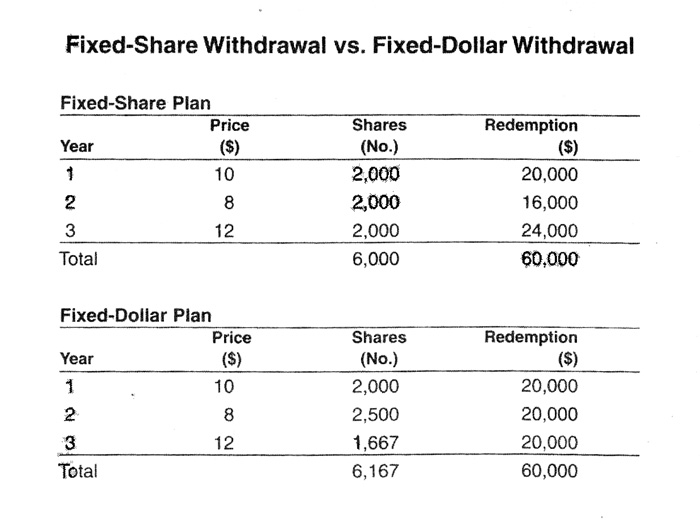
Redeeming a constant number of fund shares can be advantageous for some people. Your dollar withdrawals will fluctuate with changes in the fund's share price, but fewer shares will be sold over the years to generate a given sum of withdrawals. Conversely, with a fixed-dollar withdrawal plan you sell more shares when prices are low and fewer when they are high.
Table 2 illustrates a fixed-share program where 2,000 shares are redeemed annually. The dollar amount withdrawn equals the net asset value multiplied by 2,000. In total, 6,000 shares are withdrawn over three years. Conversely, 6,167 shares would need to be redeemed to accommodate a $20,000 fixed yearly withdrawal. In both cases, $60,000 is redeemed over three years.
The more volatile the fund's price, the fewer shares you would have to redeem to withdraw a given sum of money. But more volatility results in greater variations in monthly withdrawals.
In any case, if you can tolerate the fluctuations you might want to consider the fixed-share withdrawal plan.
Since a number of mutual funds do not formally offer a fixed-share withdrawal option, you could simply phone in periodically and request that the shares be sold and the money transferred to your money fund or sent to you by check.
Liquidation Over a Fixed Period
You could withdraw an increasing percentage of your account balance each year in order to liquidate it within a fixed period. For example, if you want the principal paid out over a four-year period to a child attending college, you could withdraw one-fourth of the account in the first year, one-third in the second, half in the third and the remainder in the fourth.
You may be required to use this approach when making withdrawals from a traditional IRA or other tax-qualified retirement plan. Specifically, after age 70½ you must make your withdrawals over a maximum number of years based on an IRS life expectancy table or face a penalty tax for withdrawing less than your minimum required distribution.
Continue to Step 5 »