The potential of losing money by investing in the stock market has become front and center over the past several weeks. The decline in the S&P 500 index and the bigger drops in other indexes and stocks has drawn attention. It has also led to the usual chatter about what the downside volatility means and whether investors should be concerned.
At AAII, we believe there is too much focus on the short-term swings in stock prices. Yes, downward moves in stock prices are not enjoyable. They can inflict psychological pain and lead to temporary decreases in wealth. But price volatility is not how we define risk.
Rather, as our founder James Cloonan wrote in “Investing at Level3” (AAII, 2017), “Risk is the likelihood that when we must withdraw assets from our portfolio for consumption, they will have a lower value than we could reasonably expect based on our investment strategy.” It is the chance of losing all or a significant enough percentage of portfolio value to the extent that the wealth cannot be recovered.
In absolute terms, if one puts their money into safe assets such as short-term Treasury bills, money market funds, certificates of deposit (CDs) and savings accounts, the odds of losing wealth in absolute terms are near zero. In real terms, which factor in inflation, the risk of losing purchasing power is high.
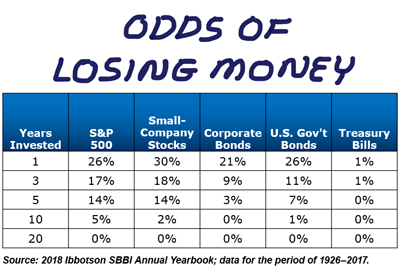
Putting the money into stocks does increase the chance of an impairment of value in absolute terms. Hold just a few stocks, make bad investment decisions or invest for too short of a period of time, and you will most likely end up with far less wealth than desired. Diversify properly, save regularly, follow a disciplined approach and invest for the long term, and the risk of wealth shortfall will drop considerably. As the table above shows, the odds of an absolute loss for investing in stocks over periods of 10 years or longer is extremely low. Even the so-called lost decade of 2000–2009 was an exception, not the norm.
This is why investors should think long term. Reacting to the short-term variations in returns or being fearful of the next large drop occurring carries the cost of missing out on the big long-term gains needed to grow your portfolio throughout your lifetime. There is a high price to pay in terms of forfeited wealth by trying to limit the pain of short-term volatility.
The pursuit of long-term returns does need to be balanced against the shorter-term needs of cash flow. This can be accomplished through allocation strategies that consider streams of income. Employment, savings accounts, Social Security, pensions, annuities and high-quality bonds can fund shorter-term needs and allow you to withstand higher levels of price volatility in your portfolio. You will be able to financially withstand a larger level of price volatility if either you have enough cash flow to cover expenses for the next two to five years and/or there is a long period of time before withdrawals will be needed from your investment portfolio.
As the pundits argue over what level of exposure investors should have to stocks, realize the discussion shouldn’t influence your portfolio allocations. Rather, the key determinant of how much you should have allocated to stocks is the length of your investment time horizon, the extent to which your shorter-term cash flow needs are covered and your psychological ability not to react to down markets.

- A Lifetime Investment Strategy – This AAII guide puts risk into perspective and gives practical steps for long-term investors.
- The Role of Risk-Free Assets in Your Long-Term Portfolio – This April 2009 AAII Journal article addresses a question some of you may have now, how much cash should your portfolio hold?
- Beyond the Index Card: Implementing the Advice of the Financial Experts – Harold Pollack, the opening keynote speaker at last week’s AAII Investor Conference, shares the lessons he’s learned and the story behind his now famous index card.
- Momentum Investing the Richard Driehaus Way – Based on the concepts espoused by the “father” of momentum investing, this strategy seeks outperforming smaller-cap stocks.
Earnings season will remain busy with 73 members of the S&P 500 scheduled to report their third-quarter results. Included in this group is Dow Jones industrial average component Walt Disney Co. (DIS), which will report on Thursday.
The Federal Open Market Committee (FOMC) will hold a one-day meeting on Wednesday. Interest rates are expected to be left unchanged. Currently, the CME’s FedWatch is assigning an approximate 70% chance of a 0.25% increase being announced at the December meeting.
Elsewhere on next week’s economic calendar, the October Institute for Supply Management (ISM) non-manufacturing index will be released on Monday. Tuesday will bring the September JOLTS report. Friday will feature the October producer price index (PPI) and the University of Michigan’s preliminary November consumer sentiment survey.
Four Federal Reserve officials will make public appearances: New York president John Williams on Monday and Friday, Dallas president Robert Kaplan on Monday and Philadelphia president Patrick Harker and Fed vice chairman Randal Quarles on Friday.
The Treasury Department will auction $37 billion of three-year notes on Monday, $27 billion of 10-year notes on Tuesday and $19 billion of 30-year bonds on Thursday.
- Using Beneficiary-Directed Trusts to Protect Your Heirs
- Well-Built 529 Plans Can Be a Great Option for College Savings
- Companies Surpassing Industry Norms
Optimism among individual investors about the short-term direction of stock prices rebounded strongly but continues to stay below average. The latest AAII Sentiment Survey also shows drops in neutral and bearish sentiment.
Bullish sentiment, expectations that stock prices will rise over the next six months, jumped by 10.0 percentage points to 37.9%. Bullish sentiment was last higher on October 3, 2018 (45.7%). Even though this is a four-week high, optimism remains below its historical average of 38.5% for the fourth consecutive week and the seventh time in eight weeks.
Neutral sentiment, expectations that stock prices will stay essentially unchanged over the next six months, fell 3.4 percentage points to 27.6%. Neutral sentiment was last lower on January 31, 2018 (26.5%). This is just the third time in 37 weeks that neutral sentiment is below its historical average of 31.0%.
Bearish sentiment, expectations that stock prices will fall over the next six months, pulled back by 6.5 percentage points to 34.5%. Even with the decline, pessimism remains above its historical average of 30.5% for the seventh time in eight weeks.
This week’s rise in optimism follows last week’s unusually low bullish sentiment reading of 28.0%. Year to date, there have been four weeks when optimism has risen by 10 percentage points or more and five weeks when optimism has fallen by at least 10 percentage points.
At current levels, all three indicators are within their historical average ranges.
The majority of the responses to this week’s survey were recorded before Tuesday’s and Wednesday’s rise in stock prices. Our survey period runs from Thursday through Wednesday with reminder emails to take the survey sent to a rotating group of AAII members each Monday.
Some AAII members were anticipating a decline in stock prices prior to the recent downward volatility and, as the responses to this week’s special question shows, some—but not the majority—used the recent drop to buy stocks. Tariffs and the possibility of an escalating trade war remain front and center in the minds of many individual investors. Also influencing sentiment is Washington politics (including President Donald Trump), midterm elections, economic growth, valuations and corporate profits.
This week’s special question asked AAII members what actions they have taken, if any, in response to the increased volatility that the market has experienced since late September. Approximately 37% of respondents did not take any actions, with several describing themselves as long-term or buy-and-hold investors. A nearly equal number of respondents (36%) say they sold stocks. Some of these respondents purposely reduced their exposure to equities, while others used the drop as a reason to pull out of underperforming or otherwise disappointing stocks. Just 21% say they bought stocks or entered orders to do so.
Here is a sampling of the responses:
- “Sold three losing stocks and nothing else. I’m taking the big swings in stride.”
- “I have strengthened my resolve to ride it out and reminded myself that my investments are for the long term.”
- “I have been selling and am waiting until I see a confirmed uptrend in the market.”
- “Bought new shares and added to existing shares. It’s a good buying environment.”
- “I rebalance quarterly and let it ride.”

Bullish: 37.9%, up 10.0 points
Neutral: 27.6%, down 3.4 points
Bearish: 34.5%, down 6.5 points
Bullish: 38.5%
Neutral: 31.0%
Bearish: 30.5%
AAII Asset Allocation Survey
Exposure among individual investors to fixed-income assets is at its lowest level in more than a decade. The October AAII Asset Allocation Survey also shows a drop in equity exposure and an increase in cash allocations.
Stock and stock fund allocations declined by 0.4 percentage points to 69.5%. October was the 67th consecutive month with equity allocations above their historical average of 61.0%.
Bond and bond fund allocations fell 0.9 percentage points to 13.3%. Fixed-income exposure was last lower in June 2008 (12.6%). Last month was also the 11th consecutive month with bond and bond fund allocations below their historical average of 16.0%.
Cash allocations rebounded by 1.3 percentage points to 17.2%. Cash allocations were last at this level in May 2017. Nonetheless, cash allocations remain below their historical average of 23.0% for the 83rd consecutive month.
Though bond yields have been rising, individual investors have now reduced their exposure to fixed-income assets for three consecutive months. The perception of yields remaining low on an absolute basis and expectations for a further decline in bond prices (and little upside) are causing many individual investors to eschew bonds or otherwise limit their exposure to them.
Last month’s special question asked AAII members if they think they personally are overweighting or underweighting stocks relative to their age. Three-fifths of respondents (60%) describe themselves as being overweight in stocks. Among the reasons given were a desire for higher returns, a lack of need for income and long investing horizons. Conversely, a little more than 25% say they are underweight in stocks, primarily out of concern for valuations and/or potential losses. Approximately 15% describe their allocations as being about right.
Here is a sampling of the responses:
- “Since I don’t need to live off of my investments, I have a lot invested in assets deemed a little riskier for a 78-year-old.”
- “Overweighted in stocks by general standards. I’m willing to gamble because I’m wary of bonds right now.”
- “I am underweighting stocks because I feel they are overvalued.”
- “I am about right. I have sufficient cash funds for a few years and some bonds. I like the rest in stocks for potential growth.”
- “Overweighting in an effort to get higher returns for my retirement.”
- Stocks and stock funds: 69.5%, down 0.4 percentage points
- Bonds and bond funds: 13.3%, down 0.9 percentage points
- Cash: 17.2%, up 1.3 percentage points
- Stocks: 32.2%, down 1.7 percentage points
- Stock funds: 37.3%, up 1.3 percentage points
- Bonds: 2.6%, down 0.1 percentage points
- Bond funds: 10.7%, down 0.7 percentage points
Take the Asset Allocation Survey.
Local Chapter Meetings

October 25, 2018 Credit Spreads Aren’t a Reason to Alter Bond Allocations
October 18, 2018 Actionable Steps for the Current Market
October 11, 2018 It’s Been a Tougher Year Than the Headline Numbers Suggest
October 4, 2018 Diversification Cushions the Blow of Drawdowns, But at a Cost