


Charles Rotblut leads a class in AAII's new Essential Investing Video Course. Go to https://www.aaii.com/ves for more information and to subscribe.
Article Highlights:
- The expert conversation on personal finance is much simpler than what is shared on financial television channels. The experts’ best advice is basically a set of simple things that can fit on an index card.
- Making savings automatic decreases the odds of spending the same dollars. Saving can also be made easier by considering the motivation for doing so, such as setting an example your child may someday repeat with their child.
- Investors should want advisers who follow the fiduciary standard and be prepared to pay for the adviser’s time. Allowing commissions and fees to compensate the adviser can cost an investor thousands of dollars more.
Editor’s Note: Harold Pollack is the Helen Ross Professor at the School of Social Service Administration at the University of Chicago and co-author with Helaine Olen of “The Index Card: Why Personal Finance Doesn’t Have to Be Complicated (Portfolio, 2016). We spoke about his 4x6 index card, which listed all of the best free financial advice the average person would need. We discussed how he came up with the idea, the financial lessons he’s learned and steps investors can take to improve their finances.
—Charles Rotblut
Charles Rotblut (CR): What was the inspiration for creating your index card? I know you first publicly raised the idea as a very brief comment during an online chat with Helaine Olen in 2013.
Harold Pollack (HP): I guess I would say that there were two inspirations.
One was in my personal life. I had basically done nothing to be planful about investing or saving. I remember getting the 401(k) paperwork for my first job 30 years ago. I stashed it into the drawer and never really looked at it. I believe the Dow was about 1,500 then. I kept on like that for many years. I was a graduate student and then a young academic, very consumed with the day-to-day and making my way in my career. My wife and I had two kids in day care. She was in graduate school and I was an assistant professor. We were at the stage where we were just trying to make it to the end of the month without bouncing checks or having to borrow money. I assumed I would get academic tenure, and things would be okay.
At age 40, I got tenure and moved for a great new job at the University of Chicago. Then four months after we arrived, my mother-in-law tragically died suddenly. My wife’s brother, who is intellectually disabled, needed to move into our home. We faced a real financial crisis from all of the responsibilities that came with that. He was 340 pounds at the time. We had to buy new furniture that he could comfortably sit in. I bought a chair that cost approximately $900. I remember distinctly thinking, I am just going to hemorrhage all my money. I became obsessed with personal finance.
One of the first things that I realized was that the expert conversation on personal finance was much simpler than the cacophony of stuff that you get from the financial cable TV channels and outlets like them. Much of the stuff people get from financial TV is actually harmful, such as encouraging people to time the market. Experts have known for years that this is a really bad strategy for the average investor. I found that the experts’ best advice was basically a set of very simple things that could fit on an index card if you wrote them down. That was kind of the origin of this whole thing.
CR: You’ve spoken previously about going to the library and reading a lot. Were there any books that stood out in your memory as being influential?
HP: I would say “A Random Walk Down Wall Street” (by Burton Malkiel, 11th edition, W.W. Norton & Company, 2016). I knew very well who Malkiel was. Once I got into that book—and learned some of the insights from John Bogle—it was immediately very clear about the power of a low-cost, low-fee index fund over the long run. It really influenced me.
I did read a little bit more deeply into portfolio allocation and things like that. I developed a new respect for some of the very simple things people wrote about household budgeting and the ways you could really help people save more and invest more.
Over time, I developed a lot of respect for even simple things like “Personal Finance for Dummies” (8th edition, For Dummies, 2015). There’s a real craftsmanship, and the best of that stuff is surprisingly good. “The Behavior Gap” (by Carl Richards, Portfolio, 2015) was phenomenally well done. There’s much insight under the hood that the writer has to understand and then translate and distill. I really gained a lot of respect for the craft of the people who really bring their A game to this.
CR: How did you end up having that first webcast with Helaine where you raised the idea of the index card? You have a health care background and Helaine is a financial writer.
HP: I looked at her book “Pound Foolish” (Portfolio, 2012), which is really fantastic. It’s very consistent with the themes that I was interested in. Helaine was the kind of person I would turn to for advice myself. “Pound Foolish” distilled for me my frustration with the way that people in financial distress are desperate for help.
There are people who give that help in a really giving way, and there are people who use it as an opportunity to sell things that people really don’t need or that are overpriced. She captured well my sense of outrage over that. I think of the dinner seminars held for seniors who were terrified about not having enough money for retirement. They were sold dicey financial products. I totally understood what those seniors were feeling. For people to exploit it—the discussion about it really struck me.
CR: When you first did the webcast with Helaine, you hadn’t yet created the index card. You did so after that initial webcast, correct?
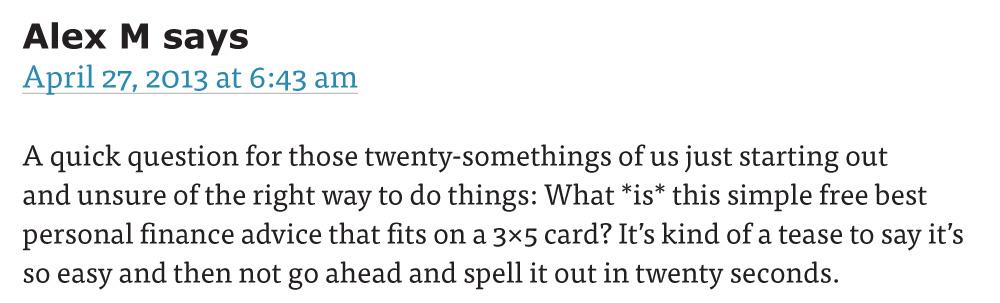
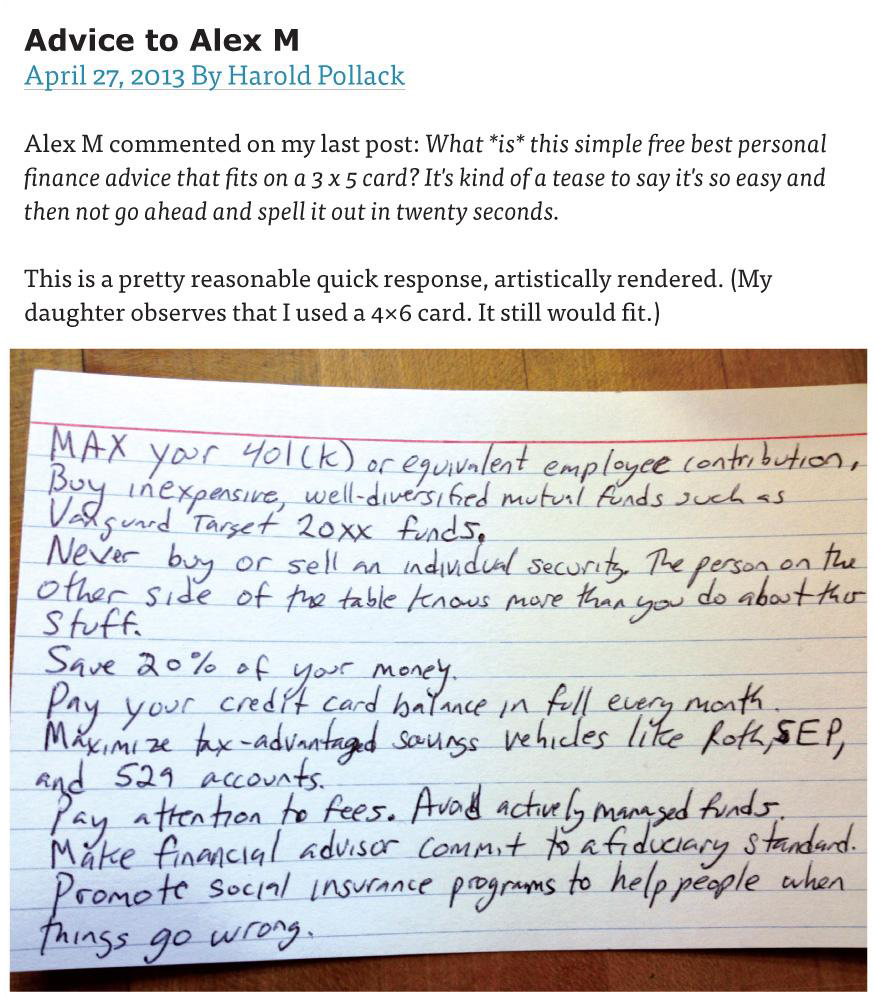
HP: This was a total throw-away line. It wasn’t the first time I joked about all of the necessary advice fitting on a card, but that was the first time that anybody noticed. After that webcast, I started getting all these comments and emails asking where the index card was. I had been joking, but I had planted a flag in the ground and I had to defend it. So, I just took out one of my daughter’s 4x6 index cards, scribbled for about two minutes, grabbed my iPhone and posted it (Figure 1). I didn’t expect it to have nearly the impact that it actually had. These viral things are just unpredictable, but there was something about this little card saying that you don’t have to understand everything about saving and investing. Rather, you just have to understand some rules that fit on an index card. Somehow, it powerfully reached people.
Figure 1. The Original Index Card Blog Posts
In April 2013, Harold Pollack posted the first two segments of his interview with Helaine Olen, where he made the quip about the best financial advice fitting onto an index card. The first response to this post requested to see the index card.
In a subsequent post published later the same day, Pollack posted a photo of his index card. It was this post that went viral, attracting much attention to Pollack and his index card.
It’s been plagiarized a million times, and it’s been reproduced a lot. I’m at the University of Chicago where there are Nobel laureates in economics and an entire group of outstanding financial economists. When they looked at it, they kind of had this reaction of “you’re kidding.” Well, that was the point; it communicates the essentials in a way that people find valuable.
CR: Did you have a written plan before this or did you just have an idea in your mind of how you should be managing your finances?
HP: Somewhere in between. By the way, I should say that I made a lot of stupid investment choices earlier in my career. I decided to go for growth stocks just before the tech bubble burst, for example.
When I joined the University of Chicago, I was introduced to a gentleman from Harris Bank who helped with my mortgage. He bluntly told me: “Dr. Pollack, you’re not a good customer because you’re 40 years old and the only money that you’re bringing to the table is the money that the university has given you. If you have to leave that job, the university is going to ask for that money back. I’m willing to work with you, but not give you the size of mortgage you are asking for.”
I was pretty rude in response, but I did buy a less expensive home than I had originally intended. I realized a few years later that he had the integrity to be straight-up with me, even though he knew that I wasn’t going to be overjoyed about it. He saved me from making a huge mistake. When my brother-in-law moved into our home, the fact that we had a modest mortgage payment saved us. While you can stop going to Starbucks, you can’t stop paying your mortgage when you hit a financial problem.
To get back to your question, I did realize well before that point that I was investing in low-fee index funds. I wasn’t day trading or trying to do things that were beyond my skill set, but I wasn’t following a plan either. My definition of a good plan was not letting my credit card balance get too high.
CR: Have you found that just having something in writing is really helping you stick with your plan?
HP: Absolutely, it does. The fact that I have written that I want to save 20% of my pretax income lets me plan on it.
It’s especially helpful so that people don’t run a credit card balance and don’t do goofy things in the stock market. There’s a bunch of “don’t” things that are easy to avoid; having them written down has helped me.
CR: Since we’re talking about savings, I’d like to address some of the things on the index card (Figure 2). You suggest saving 10% to 20%. If someone is trying to do that, do you have any suggestions on how they should prioritize in terms of where they direct the money first?
HP: There are a couple of things that are very helpful. The first is to make it automatic.
There are two advantages to making savings automatic. One is that money that is not in your hot little fingers is much less likely to be spent. Second, you’re more likely to do things like maximize your employer contributions to your 401(k) if you keep saving automatically.
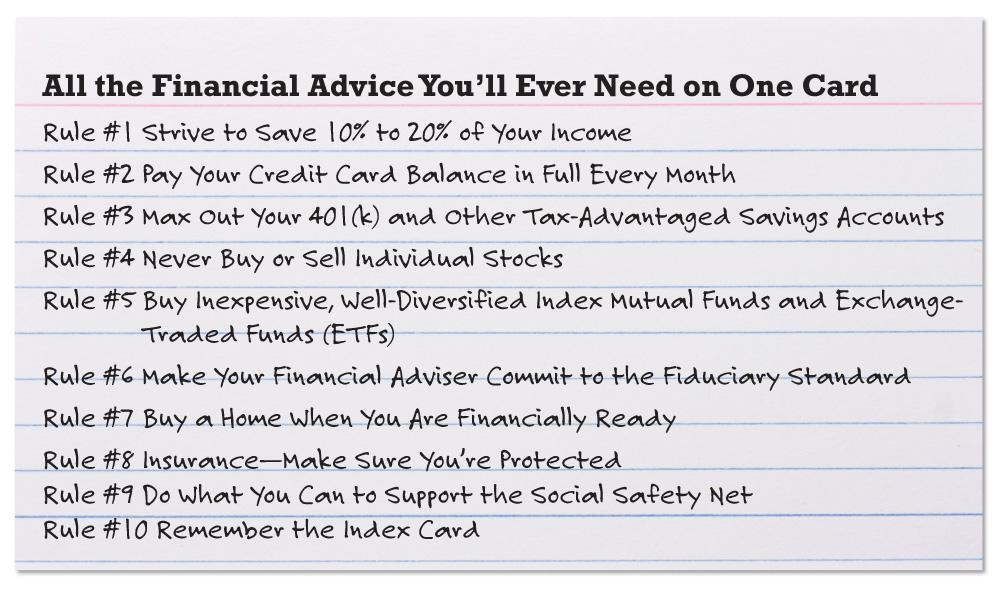
by Helaine Olen and Harold Pollack, Portfolio, 2016.
There are different ways that people can do this. You should match your method with what gives you the mojo to actually do it. I’ll give you an example. Suppose that I’m a young parent and I’m choosing between prioritizing my retirement and saving for my kid’s college. Mathematically, retirement tends to be the answer for most people, but your kid’s college gives you mojo in a different way. If you’re walking with your seven-year-old daughter in a store and you see a sweet $500 camera lens, you can point to it, and tell your daughter: “I really want that lens. I’m not going to buy it, because I’m going to put that $500 toward paying for your college. Maybe someday you’ll do that for your daughter.” That’s powerful and motivating.
How you actually save is another question. You have to know your own psychology and do the thing that gets you going.
I also believe paying attention to the big things is really important: Your home, your car, the big expenses that you have—these are really important. When you buy a home, you want to understand the things you care about and don’t care about and make sure that you are only paying for the things that you care about. You shouldn’t think of it as a major financial investment because it’s too leveraged and undiversified to be a good cornerstone as the foundation of your wealth.
CR: In your book, you seem to be comfortable with financial advisers as long as they adhere to that fiduciary standard. What should people consider when deciding whether to work with a particular adviser?
HP: I think the fiduciary standard is essential. Otherwise you’re getting a sales pitch. You want your financial adviser to provide sound basic advice that can be very practical. There are some people who say you don’t need financial advisers if you follow some sort of a sensible algorithm for your investing. That logic holds true for a lot of people, but not for everyone. People have complicated life issues that sometimes require expertise. For instance, should I be buying an annuity as I near retirement? How do I think about life insurance? If I have a child with a special need, how do I think about that? Financial advisers can be very helpful within this fiduciary framework.
I do think there are two things to keep in mind. You want simple solutions. It raises a red flag when something is complicated. Second, you want to be the only person paying the adviser. You want to understand all the different incentives that an adviser has, and how you will have to pay. This is one genuine challenge facing the financial advice industry: Many of the good things advisers do for people don’t match the business model and the structure of their compensation.
If you have an adviser who is a fiduciary and who is doing a good job, you’re going to have to pay for their time. People feel some sticker shock when this happens because they’re used to having those fees hidden.
I’ve talked to many people who say things to me like “my financial adviser is free.” That always makes my heart sink. “If it’s free, then you’re the product” is a good insight. I do think that people are sort of unfair to the industry in the sense that they don’t want to actually pay the explicit fee for the adviser’s time. Therefore, they gravitate toward advisers who have a payment model with hidden fees. When someone is advising you on your retirement and they give you an investment that has higher fees when they know something cheaper is available, it’s going to cost you many thousands of dollars more. You’re much better off paying for an hour of the adviser’s time getting the straight-up advice.
CR: In terms of mutual funds, I know that some financial planners actually promote index funds. It sounds like you’re a big believer in favoring low-cost funds over individual securities.
HP: Basically, that’s right. Maintaining a broadly diversified portfolio is what you’re aiming for. It’s generally unwise to guess which sectors will grow faster than others. The person on the other side of the table whom you’re essentially betting against is a financial professional. Investment is their full-time job. They are probably better at it than you are.
All the data suggest that most people are really bad at investing in individual stocks. There’s a series of papers by professors Brad Barber and Terrance Odean on individual investors’ efforts to pick individual stocks. The research shows that we’re just so horrible at it that it’s embarrassing. The stocks that we sell outperform the stocks that we buy. We chase after shiny objects in all sorts of ways, and it’s just a waste of our time.
CR: Regarding insurance, you think people should buy term life and not whole or universal life policies?
HP: Yes. You want to use life insurance as a tool to protect your loved ones in case something really bad happens in your life. I do think that this is something where a fiduciary financial adviser might be able to give you more nuanced advice if you have a complicated life situation, because I think there are scenarios in which what I’m saying may be oversimplified. But I think it is the best general advice.
CR: What about health insurance? I’m bringing this topic up because of your background and expertise in health care. Increasing premiums, copays and deductibles obviously creates a strain on many households’ finances. Are there insights you can share regarding factoring health care costs into financial plans?
HP: That’s a big challenge, and there’s no beautiful answer. Obviously, you want to have insurance. If you’re healthy and you have the financial ability, some of the high-deductible policies are effective. These would be for people who are worried about a $50,000 and a $200,000 expense, but not a $5,000 expense. You should have the cash reserves on hand to handle these smaller expenses so you don’t need to get the absolute lowest copay and deductible around. You also want to be thinking about the long game, and this is where a financial adviser can be helpful.
Very often, the human resources and benefits staff at your employer can be very helpful in answering your questions regarding health insurance. I think for most people who are going to be reading this, looking at some of the health savings accounts is worthwhile. I work for a large employer, so one of the good things is that I can talk to people to see if there are any pitfalls to a particular option. It’s definitely worth paying serious attention to potential pitfalls before anyone in your family needs care. You don’t want to have a nasty surprise of having bought something that didn’t cover the things that you need it to.
I also have disability insurance; while it’s expensive, I think it’s worthwhile.
I do think that as a society we’ve completely screwed up health insurance, disability insurance and long-term care. As part of my day job, I spend a lot of time on Medicare and Medicaid. I wish that we had a better health care system, one more generous to poor people and also more functional than the sort of health insurance marketplaces that we have now after the Affordable Care Act. The exchanges are a huge step forward, but they also have a lot of problems and we need to do a better job in public policy for middle-class people than we’re doing right now.
The subject could encompass a whole separate book, but I think protecting yourself against big things is the overall insight. You want to have cash reserves for the little things. So, for example, you want to get the biggest deductible possible for your homeowner’s and automobile insurance. Just have the deductible amount in reserve. You don’t really need insurance for the baseball that goes through your front window—that’s something you should just be able to pay for. It is when the really bad thing that can happen happens that you will need your insurance.
CR: What about long-term care insurance? Any thoughts or observations you can share? I know premiums are being raised and many policyholders are being forced to reduce their benefits.
HP: I think that’s where you need help from an expert. I do think it’s important to have it, and it’s important to be planning for such a need. If you’re an older person or if you’re a person with a health problem, don’t wait. Find out what your options are and do something. Depending on what your situation is, you may need to talk to an elder care lawyer. I think this is something where one can help their parents figure out what the issues are. You don’t want to have to make decisions like this when you’re in a crisis. One of the things that I remember most painfully after my mother-in-law died so suddenly was how we hadn’t attended to many of the issues we had when we were in a crisis and mourning a tragedy.
Nobody really wants to talk about what will happen to them if they have to go into a nursing home or can’t think as clearly as they used to. It’s kind of the definition of stuff we don’t like to think about, but it is important to attend to it in a careful way.
CR: Is there anything else that I haven’t asked you that I should have?
HP: The one thing I would say is that I do think that we have to be good investors, and be good stewards of our personal and family wealth and of protecting each other against risks that would just crush any one of us if we had to face it on our own.
In the years since my brother-in-law moved into our home, we’ve done a good job as a family in attending to finances. I’ve actually been a very good saver and investor. We would still have been absolutely crushed if it weren’t for the Social Security, Medicare and Medicaid. My brother has been hospitalized maybe 20 times since he’s been with us. We would have just been wiped out.
We have to think about ourselves as individuals, citizens and as members of the community. I admire the self-help ethos in the investor community. I think that’s really powerful, valuable and it often goes with tremendous generosity toward other people. That’s also a bigger picture we can’t lose sight of.
Discussion
FREE REPORT

DAVID S from TN posted over 5 years ago:
You need to log in as a registered AAII user before commenting.
Log InCreate an account