Sonali Pier is a managing director and portfolio manager at PIMCO's Newport Beach office, where she is the lead portfolio manager for diversified income. Cynthia McLaughlin and Charles Rotblut, CFA, talked with Pier in early March about PIMCO Multisector Bond Active ETF (PYLD) and what makes it unique.
Cynthia McLaughlin (CM): What does PIMCO Multisector Bond Active aim to do for investors?
Sonali Pier: PIMCO Multisector Bond Active is PIMCO's multisector, benchmark-agnostic, credit-oriented exchange-traded fund (ETF). Today, it has over $12 billion in assets under management (AUM).
The fund focuses on three areas. First, it highlights yield orientation and capital appreciation, expressing PIMCO's strategic views on relative value across credit spreads in different parts of the bond market for yield generation. It's also focused on resilience, meaning that we manage against downside risk. The third area of focus is diversification: A key tenet of PIMCO's multisector portfolio is emphasizing diversification using a full macroeconomic toolkit to incorporate active views on duration curve, credit selection and foreign exchange. [Editor's note: Duration is a measure of a bond or bond portfolio's sensitivity to changes in interest rates.]
CM: How is the ETF different from a typical bond ETF or investment-grade bond fund?
Given its diversification, PIMCO Multisector Bond Active is not a typical bond ETF or a standard single-sector solution. Its yield is not tethered to a benchmark. Rather, the ETF's yield represents relative value opportunities today, with a strong bias toward quality.
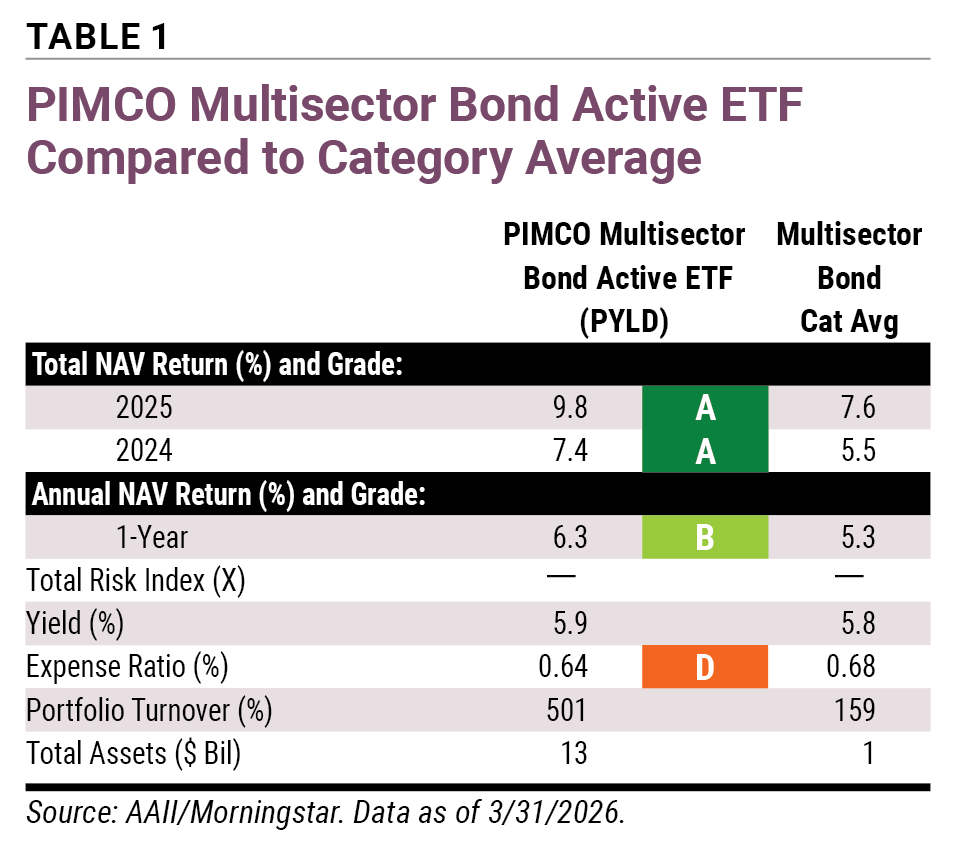
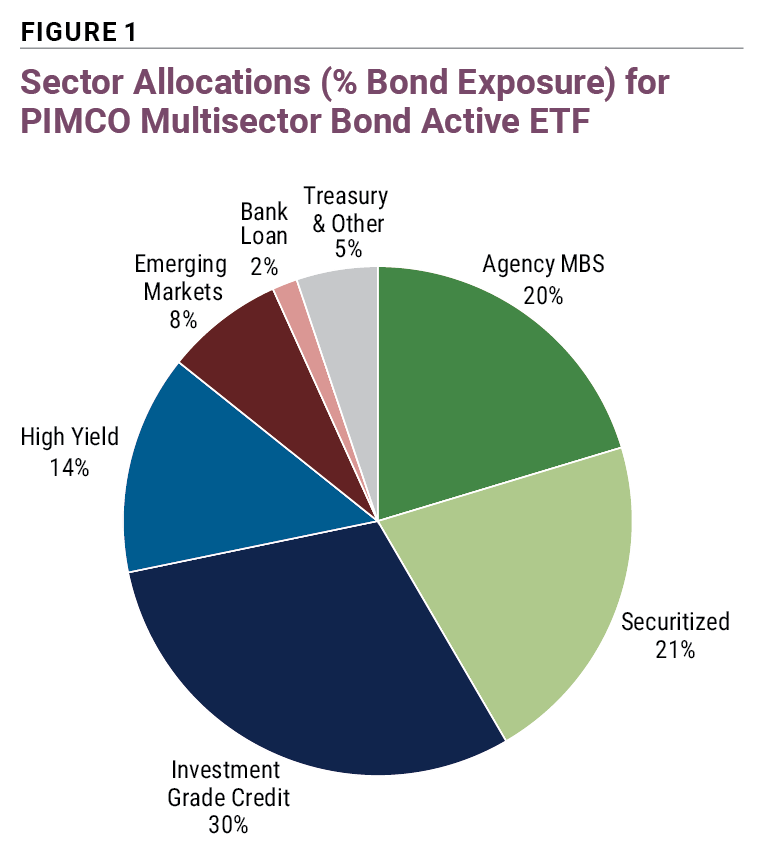
This is accomplished partly because the ETF's strategy allows access to high yield, emerging markets, leveraged loans and securitized credit. [Editor's note: Securitized bonds are backed by pools of individual loans.] These types of exposures are not typically found in traditional core or single-sector allocations. This makes the strategy hard to replicate passively—that is, by tracking an index. Given our outlook and where spreads are currently, we are leaning toward higher-quality parts of the fixed-income market.
Versus other parts of the market, diversification can subdue some of the volatility while providing the potential for a higher risk-adjusted return. [Editor's note: The Sharpe ratio measures risk-adjusted returns, with higher ratios indicating better relative returns.]
One of the other factors that distinguishes PIMCO Multisector Bond Active is its use of PIMCO's full macroeconomic toolkit.
CM: Would it be correct to say that the strategy defines sectors in terms of bond types and credit ratings versus industries that issuers operate in?
Sectors here are used to identify asset allocation and do not refer to industry sectors. Some of these asset classes, or sectors, are hard to replicate passively. Bank loans, emerging markets, securitized credit and, in general, fixed income are different from equities. There is more market inefficiency and complexity in fixed income, making active management a real contributor.
Active managers in fixed income tend to outperform passive managers, which is different than for equities (according to PIMCO research utilizing Morningstar category data). Active management works better in some credit asset classes. Rather than being dedicated to a single asset class, PIMCO Multisector Bond Active is focused on providing exposure to the broad fixed-income market.
CM: Under what circumstances might the ETF do well, and when might it do poorly?
PIMCO Multisector Bond Active is benchmark agnostic, so it's dependent upon the portfolio managers' positioning. Positioning can be by interest rate or spread sensitivity. In volatile or uncertain markets, diversification and resilience matter, and the ETF's multisector approach has the potential to lead to strong performance.
Today, the bond markets are more fragmented, with elevated levels of dispersion in lower-quality assets, so this ETF provides PIMCO opportunities to capture that relative value. Compared to expensive equity valuations—and cash, where we are predicting a potential interest rate cut or two (as of March 2026)—being in that intermediate part of the duration curve is attractive.
CM: What role do interest rates and duration play in performance, and how do you manage interest rate risk?
It's a distinguishing factor. Some multisector credit competitors' macroeconomic toolkits simply reflect the output of their credit holdings, whereas PIMCO Multisector Bond Active benefits from PIMCO's full macroeconomic toolkit. The toolkit is used to actively manage the overall level of duration and curve and emphasize regional diversification in both duration and foreign exchange. This has been critical because, since inception of the ETF, we've seen higher volatility driven by interest rates rather than credit spreads. [Editor's note: A credit spread is the difference in yield between bonds with strong credit ratings and those with weak credit ratings.]
Historically, credit volatility has been higher than interest rate volatility, but that hasn't been the case over the last few years. We've also looked to deploy views on inflation through the Treasury inflation-protected securities (TIPS) market. After the height of the coronavirus pandemic, markets were pretty synchronized across inflation, growth and policy. We're increasingly seeing more global divergence in policy and growth paths, which is partially why we've diversified some of that duration into the U.K. and Australia where we believe there is potential for stronger returns.
CM: Since PIMCO Multisector Bond Active is a comprehensive ETF, how would individual investors consider risk?
That's an important point. When we structure our portfolios, we want them to stand the test of time. This portfolio is robust in its construction across a wide number of economic scenarios.
When examining the corporate credit market, we start with investment grade and high yield, looking for high-quality spread. Structured credit is viewed as a resilient position and can help offer reasonable yield. Opportunistically, we'll also look for diversification in the bank loan market and in emerging markets. These two areas offer lower correlation to some of the broader fixed-income markets.
Diversification helps to be resilient over a wide number of economic scenarios. The takeaway is that we're actively managing our spread exposure as well as our interest rate exposure.
CM: What should individual investors know about the ETF's income distribution and consistency over time?
One goal in managing PIMCO Multisector Bond Active is diversified, resilient yield. In our management, we are not looking to deliver a consistent distribution. Instead, we're looking to deliver a diversified and attractive level of yield and capital appreciation.
We're emphasizing resilient portfolio construction, relative value and access to multisector credit managed across a full market cycle, rather than reaching for yield and return. We're thinking about how the securities in PIMCO Multisector Bond Active will perform in a wide number of environments considering the downside risk positioning and upside convexity. [Editor's note: Convexity measures how a bond's price reaction to interest rates accelerates or decelerates as rates change.]
CM: How do you approach credit risk, especially when economic conditions might be worsening?
While we have broad discretion in allocating to high-yield securities in PIMCO Multisector Bond Active, we have a high-quality bias in fixed income right now. We're looking for return potential from the asset allocation, as well as the regional, industry and security selections.
It is also helpful for us to look at what makes credit resilient. In today's market landscape, we don't feel that we need to be aggressive in the lower-quality, higher-yielding bonds. We're looking at a K-shaped economy when it comes to the consumer who has benefited from improving real estate and equity asset prices, and we're looking at a similar shape in credit markets.
Today's market offers a rare opportunity where you can still earn a potentially high return by moving into higher credit quality and improved liquidity. We're looking at relative value and ensuring that we're adequately compensated for liquidity, complexity and economic sensitivity.
When we look at artificial intelligence (AI), there are not only winners and losers but, importantly, those that are path dependent. A credit may be a winner today, but if another company adapts and improves its model, then the first company could become a loser over a cyclical period. We look at that diversification as a way to help protect the portfolio from evolving cross currents as a result of the AI trade dynamics and geopolitics.
Lastly, lower-quality, more labor-intensive companies can be more exposed to AI disruption. Downside also comes from areas like tariffs and from a lack of flexibility or options.
Securitized or structured credit is viewed as a resilient position in the portfolio, given the hard collateral backing of many of those securities. Agency mortgages have been attractive given the relative valuation versus investment-grade credit, as the Federal Reserve has been exiting that market and banks are not purchasing that agency mortgage supply. The strength of the high-quality consumer is supported in some of the other high-quality areas of securitized credit as well, such as consumer ABS [asset-backed securities] and non-agency mortgages. These are areas that are more resilient as a result of consumer strength.
CM: How do private credit issues fit into the fund, and what are the characteristics of those issues?
There isn't a meaningful amount of private credit in this fund. We want to make sure that the liquidity of the holdings matches the liquidity of the ETF. We are cautious on some of the crowded areas of private markets, such as direct lending, and we're focused on spread compression—a narrowing of the interest rates between higher- and lower-rated bonds.
This is a prudent spot to bring software to light. There have been headlines around AI and its potential impact. In terms of composition, the public bond markets are different than the private direct lending markets. The amount of software exposure in the high-yield sector is 3%. This exposure increases to 13% in the public bank loan market. The exposure to software is 20% to 25% in direct lending.
This is an area we expect will undergo significant change over the next few years. That is certainly going to lead to additional volatility where there's limited transparency in direct lending. Given the amount of money that's flowed into private credit, there's been eagerness to deploy that money.
We've seen a real shift of what's getting banked in private markets. This has led to a skew of lower-quality credit as you go from high yield to bank loans to private direct lending. These are some of the dynamics that have led to the significant volatility and deterioration in sentiment around some lower-quality areas.
CM: What metrics would you recommend that individual investors keep an eye on when evaluating PIMCO Multisector Bond Active?
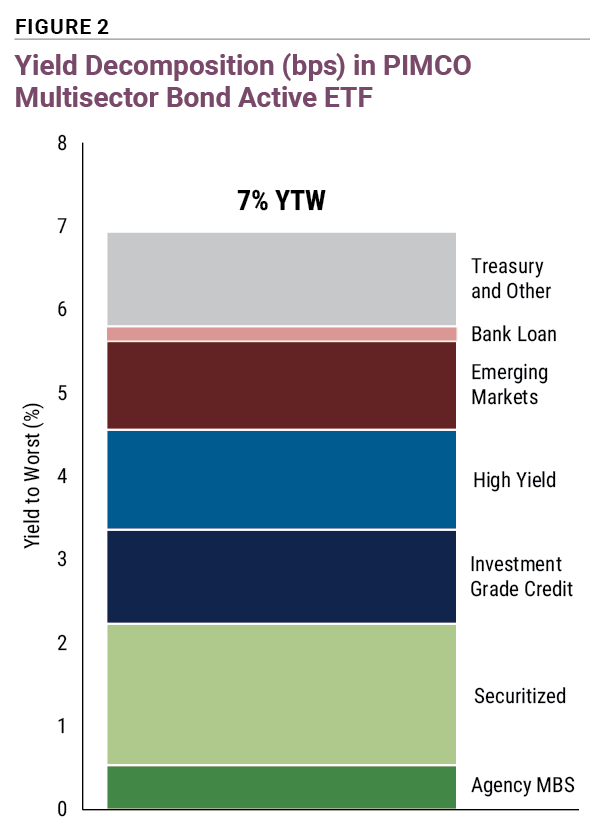
First and foremost, investors can look at risk-adjusted returns. They can also examine diversified yield. Starting yields are correlated with forward returns, so that starting point is important. But, as managers, we're also going to look for those strategic opportunities that come into the market. Lastly, risk is more commensurate with investment-grade bonds, while the ETF's yield is more commensurate with high-yield bonds. We have multiple dimensions in the portfolio that can contribute to returns.
CM: What is a misconception about multisector bond ETFs that investors need to understand?
A common misconception is that multisector bond ETFs are created equally. Recently, more multisector bond ETFs have launched. Many will say that their objectives are quite similar: diversified yield while exploring different parts of the asset classes. There's differentiation in how these ETFs are managed and what they ultimately offer investors.
The “how” is really important. For example, many other managers will sleeve out their credit selection to a different manager for each asset class. We're looking at this opportunity set holistically for our clients, meaning that we are watching for any unexpected correlated risks or concentrations. The portfolio management team is actively selecting each of the securities that is included in the portfolio, and we're looking at a wide number of economic scenarios. We're not trying to stretch for yield, especially in a late cycle.
Charles Rotblut (CR): Credit spreads have increased recently with the Iran war but, historically, they have been tight. This has resulted in a narrower difference between the yields of investment-grade and high-yield bonds. What should individual investors pay attention to when looking at high yields?
It is really important to look under the hood. Spreads are certainly tight from a historical perspective. It's also important to look at it on a quality-adjusted basis. That quality has improved dramatically over the last 10 to 15 years for high-quality BB-rated bonds. As a result, BB and BBB spreads have compressed a bit. The quality has improved because there's been so much growth in the public loan market, as well as in direct lending, both of which have deteriorated in quality relative to high yield.
Yields are attractive from a historical perspective. We are still expecting an additional cut or two in the back half of the year, and I think that helps fixed income. Volatility has increased, but that actually provides opportunity. And when we think about the potential interest rate cuts, they can lead to strong total returns.
CR: Most of our members get access to bonds through funds, but some buy individual bonds—often in odd lots. How much does the frequency at which bonds trade in odd lots make it tougher for investors to diversify across sectors?
Public credit liquidity has improved quite dramatically over the years due to the adoption in ETFs, electronic trading and portfolio trading. With spreads tight and dispersion high in low-quality credit, it's important to get selection right—by region, industry or security. That's where active management is so important.
We have seen situations where companies deliver poor earnings and bonds are down 10 to 15 basis points (bps) or where they are down significantly because there's a crisis of confidence. The liquidity is there, but with tight spreads, selection is critically important and having an active manager on your side could be helpful.
is a vice president at AAII and editor of the AAII Journal.
is a former financial analyst at AAII. While at AAII, she was the lead editor of AAII Retirement Investing and AAII Growth Investing and contributed to the AAII Journal.
is a managing director and portfolio manager at PIMCO’s Newport Beach office, focusing on multisector credit opportunities.

