


This week, we use AAII’s A+ Investor Stock Grades to provide insight into three automobile components stocks that have generated positive returns in harsh market conditions. For investors focused on opportunities in the automobile components industry, should you consider the three stocks of BorgWarner Inc.  (BWA), Lear Corp. (LEA) and Magna International Inc. (MGA)?
Automobile Component Stocks Recent News
Without a doubt, 2026 has been an interesting year in the equity market’s history so far. Increased volatility has stemmed from international conflict, trade tensions, supply chain concerns and inflation issues. Amid uncertainty, the automobile components industry has exhibited resiliency. Automobile component stocks are part of one of the largest ecosystems in the world—one that is going through a significant transition with the shift to electrified, connected and automated vehicles.
The total value of automotive components demand is expected to grow around 3.5% annually from 2025 to 2035, according to Boston Consulting Group. Auto suppliers are primarily driven by underlying demand for vehicles, as their revenue is closely tied to production volumes and the broader cyclical auto sales cycle. Post pandemic, manufacturers continue to hold leaner inventories and focus on high-margin content per vehicle. Currently, demand is driven by replacement needs and is affected by vehicle affordability.
U.S. motor vehicle production reached a record low in 2025.(according to the Centre for Economic Information and Communications. With fewer automobiles being produced, manufacturers are increasingly focused on creating value and strengthening pricing power through automation and greater production efficiency. Boston Consulting Group estimates that nonadvanced driver assistance systems (non-ADAS) vehicle software will grow 14% to 16% annually into the 2030s. Suppliers of auto components that help automakers add higher-value vehicle content may be positioned to benefit from this ongoing trend. Near term, suppliers grapple with supply chain efficiency, cost control and tariffs.
Sign Up to Receive a Free Special Report That Shows How A+ Investor Grades Can Help You Make Investment Decisions
Grading Automobile Component Stocks With AAII’s A+ Stock Grades
When analyzing a company, it is helpful to have an objective framework that allows you to compare companies in the same way. This is why AAII created the A+ Stock Grades. They evaluate companies across five factors that research and real-world investment results indicate identify market-beating stocks in the long run: value, growth, momentum, earnings estimate revisions (and surprises) and quality.
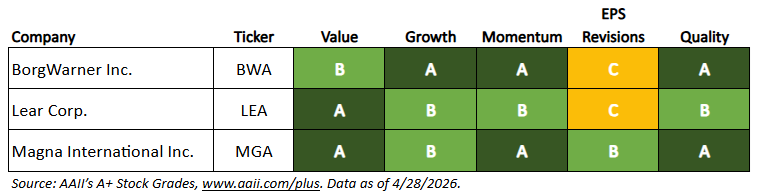
Using AAII’s A+ Stock Grades, the following table summarizes the attractiveness of three automobile component stocks—BorgWarner, Lear Corp. and Magna International—based on their fundamentals.
AAII’s A+ Stock Grade Summary for Three Automobile Component Stocks
What the A+ Stock Grades Reveal
BorgWarner Inc. (BWA) is a global automotive supplier that provides technology solutions for combustion, hybrid and electric vehicles through segments focused on turbo and thermal systems, drivetrains, power electronics, and battery and charging systems. Its products include turbochargers, emissions and thermal systems, transmission components, torque management systems, e-motors, inverters, onboard chargers, and advanced vehicle control modules. The company is also expanding its electrification portfolio with battery packs, battery management systems and integrated drive modules that support the transition toward hybrid and fully electric vehicles. BorgWarner was founded in 1928 and is headquartered in Auburn Hills, Michigan.
BorgWarner has a Value Grade of B, based on its Value Score of 72, which is good value. Higher scores indicate a more attractive stock for value investors and, thus, a better grade. The Value Grade is the percentile rank of the average of the percentile ranks of the price-to-sales (P/S) ratio, price-earnings (P/E) ratio, price-to-book-value (P/B) ratio, price-to-free-cash-flow (P/FCF) ratio, shareholder yield and the ratio of enterprise value to earnings before interest, taxes, depreciation and amortization (EBITDA).
The company has a shareholder yield of 4.1%, ranking in the 19th percentile among all U.S.-listed stocks. Its price-to-sales ratio of 0.82 ranks in the 28th percentile. The enterprise-value-to-EBITDA ratio is 5.5, ranking in the 12th percentile.
BorgWarner has a Momentum Grade of A, based on its Momentum Score of 81. This means that the stock’s momentum is very strong in terms of its weighted relative strength over the last four quarters. The weighted four-quarter relative strength rank is the relative price change for each of the past four quarters, with the most recent quarterly price change given a weight of 40% and each of the three previous quarters given a weight of 20%. The ranks are 74, 70, 80 and 74, sequentially from the most recent quarter, with higher ranks signaling stronger price momentum. The weighted four-quarter relative price strength is 10.3%.
BorgWarner has a Growth Grade of A, which is very strong. The components of the Growth Composite Score consider a company’s success in growing sales on a year-over-year and long-term annualized basis and its ability to consistently generate positive cash from its core operations. The company has a five-year annualized sales growth rate of 7.1% and has generated positive cash from operations in the past five consecutive years.
Lear Corp. (LEA) designs and manufactures automotive seating systems and electrical distribution systems for global automakers across North America, Europe, Asia and other international markets. Its seating segment produces seat structures, trim, comfort systems (heating, ventilation, massage) and interior materials such as leather and fabric, primarily for light trucks, SUVs and passenger vehicles. Its e-systems segment develops wire harnesses, connectors, power distribution modules, high-voltage systems, and software-enabled electrical and cybersecurity solutions that support both traditional and electrified vehicle platforms. Lear Corp. was founded in 1917 and is headquartered in Southfield, Michigan.
Lear Corp. has a Quality Grade of B, based on a score of 75, which is strong. Higher-quality stocks possess traits associated with upside potential and reduced downside risk. The Quality Grade is the percentile rank of the average of the percentile ranks of return on assets (ROA), return on invested capital (ROIC), gross profit to assets, buyback yield, change in total liabilities to assets, accruals to assets, Z double prime bankruptcy risk (Z) score and F-Score. The score is variable, meaning it can consider all eight measures or, should any of the eight measures not be valid, the valid remaining measures. To be assigned a Quality Score, though, stocks must have a valid (non-null) measure and corresponding ranking for at least four of the eight quality measures.
The company ranks strongly in terms of its return on assets, return on invested capital and buyback yield. Its return on assets of 3.0% ranks in the 61st percentile. Its return on invested capital of 18.6% ranks in the 60th percentile, and its buyback yield of 4.2% ranks in the 89th percentile. Lear Corp. also has an F-Score of 6, above the sector median of 5. The F-Score is a number between 0 and 9 that assesses the strength of a company’s financial position based on its profitability, leverage, liquidity and operating efficiency.
The company has a Momentum Grade of B, based on its Momentum Score of 66. This means that the stock’s momentum is strong in terms of its weighted relative price strength over the last four quarters. The ranks are 60, 78, 56 and 62, sequentially from the most recent quarter. The weighted four-quarter relative price strength is 3.1%.
Don’t Miss Your Free Report — Sign Up Here!
Magna International Inc. (MGA) is a global automotive supplier operating across North America, Europe, Asia Pacific and other international markets, providing engineering, manufacturing and full vehicle integration services through its four segments: body exteriors and structures, power and vision, seating systems, and complete vehicles. Its products and capabilities include advanced driver assistance systems, sensors and vehicle computing technologies that support electrified and automated vehicles. Magna International also provides complete vehicle engineering and contract manufacturing, along with electric vehicle (EV) solutions such as battery enclosures, energy management systems and integrated electrified powertrain technologies for hybrid and fully electric vehicles. The company was founded in 1957 and is based in Aurora, Canada.
Magna International has a Value Grade of A, based on its Value Score of 90, which is deep value. The company ranks in the 16th percentile for its shareholder yield of 4.8% and in the 11th percentile for its enterprise-value-to-EBITDA ratio of 5.2. A lower price-to-free-cash-flow ratio is considered better value, and Magna International’s price-to-free-cash-flow ratio of 10.0 ranks in the 23rd percentile.
Earnings estimate revisions indicate how analysts view a firm’s short-term prospects. Magna International has an Earnings Estimate Revisions Grade of B, based on a score of 76, which is positive. The grade is based on the statistical significance of its latest two quarterly earnings surprises and the percentage change in its consensus estimate for the current fiscal year over the past month and past three months.
Magna International reported a positive earnings surprise of 21.0% for the fourth quarter of 2025, and in the prior quarter reported a positive earnings surprise of 6.1%. Over the last month, the consensus earnings estimate for the first quarter of 2026 has increased from $1.008 to $1.013 per share based on one upward revision. Over the last month, the consensus earnings estimate for full-year 2026 has increased slightly from $6.679 to $6.696 per share.
 Included With AAII Platinum
at only 23.3%
Since Inception. Data as of 12/31/2024.

769.3% Stock Superstars Portfolio Total Return Since Inception

U.S. Index ETF (IYY)
SSR Group 3 O'Shaughnessy portfolio has a 411.2% gain since inception performance compared to IYY at only 119.1%% Performance as of 11/29/24.



FREE REPORT

BECOME A MEMBER FOR ONLY $2
Get access to powerful investment discovery tools and a wealth of investment education to help you achieve your financial goals.