

A Big Argument for Buying and Then Monitoring
by Charles Rotblut | September 28, 2017
A study showing that most stocks have failed to outperform one-month Treasury bills has been the topic of some discussion this year. The analysis, conducted by Arizona State University finance professor Hendrick Bessembinder, found that slightly more than four out of seven stocks have realized worse returns than one-month Treasuries. The finding drew attention, but there is far more to the study than just a quick soundbite. His study also reinforces the need to follow a disciplined approach toward investing.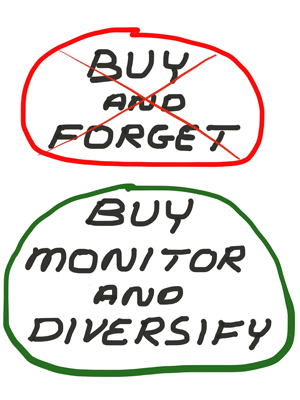
Bessembinder calculated lifetime returns for stocks. He looked at all stocks included in the Center for Research in Security Prices (CRSP) database for the period of 1926 through 2016. A stock’s lifetime was measured as the first month and last month it was included in the database. A stock was removed if it was acquired, merged, liquidated or delisted from an exchange. Out of the nearly 26,000 stocks that Bessembinder analyzed, more than a third (35%) were delisted. Fewer than one of 10 stocks within this subset realized a positive lifetime return, and an even smaller number had lifetime returns in excess of one-month Treasury bills.
Obviously, if the long-term return for stocks in aggregate is positive and a big group of losers exists, then there must be winners. Three out of five stocks (60%) categorized as “Still Trading” have lifetime returns in excess of one-month Treasury bills. A slightly higher proportion (63%) of stocks in the “Merger, Exchange or Liquidation” group beat one-month Treasury bills over their lifetimes.
It’s not just winners versus losers; skewness also plays a role, particularly in terms of big winners. The 50 best-performing stocks accounted for more than 39% of the net stock market’s wealth creation. Furthermore, slightly less than 1,100 stocks “collectively account for all of the net wealth creation in the U.S. stock market since 1926,” wrote Bessembinder. This is possible because while the lowest lifetime return a stock can have is 100% (a drop in price to $0), the highest possible return is infinite on a theoretical basis. As such, big positive returns realized by a small group of stocks can more than offset negative returns by a large number of stocks.
It should be emphasized that Bessembinder looked at lifetime returns for individual stocks. These returns are not representative of the returns investors actually realize. Most investors buy a stock after it has already been listed and sell it before it is delisted. During this interim period, a stock could realize large positive returns even if its lifetime return is negative. The key to catching a stock during its favorable period(s) is to have a disciplined approach for buying and selling. Business, economic and competitive conditions evolve over time. What may have once been a high-flying stock can go on to experience years of disappointing returns or even disappear. It is always better to buy and then monitor, to determine whether or not the stock still meets your investment criteria, than it is to buy and forget. Holding a stock for the remainder of your life may sound like a noble goal, but even low transaction investors like Warren Buffett periodically sell stocks from their portfolios.
The study had two other findings worth paying attention to. The first is the benefits of diversification. Bessembinder found that “rates of underperformance relative to benchmarks decline as more stocks are added to the portfolio,” after looking at portfolios ranging from one stock to 25 stocks in size. The second is the positive impact of companies returning capital to shareholders. General Motors Corp. ranked eighth in Bessembinder’s list of the top 10 wealth-creating stocks. He attributed this to the more than $64 billion the company paid to shareholders as well as its share buybacks prior to filing for bankruptcy in 2009.
Finally, for those of you who are curious, the stocks Bessembinder credits for creating largest amount of wealth are Exxon Mobil Corp. (XOM) ($1.002 trillion in shareholder wealth), Apple Inc. (AAPL) ($745.7 billion), Microsoft Corp. (MSFT) ($629.8 billion), General Electric Co. (GE) ($608.1 billion), International Business Machines (IBM) ($520.2 billion), Altria Group Inc. (MO) ($470.2 billion), Johnson & Johnson (JNJ) ($426.2 billion), General Motors ($425.3 billion), Chevron Corp. (CVX) ($390.4 billion) and Wal-Mart Stores Inc. (WMT) ($368.2 billion).

- Nine Rules for Smarter Investing – The best way to ensure your lifetime returns are positive is to have a disciplined approach. Here are fund manager Guy Spier’s rules.
- Rules-Based Investing Essential for Stock Investors – For those of you who prefer a more active approach, here are Scott O’Neil’s trading rules.
The percentage of individual investors describing their short-term outlook for stocks as “neutral” is at its highest level in nine weeks. The latest AAII Sentiment Survey also shows a drop in optimism and an increase in pessimism.
Bullish sentiment, expectations that stock prices will rise over the next six months, fell 6.8 percentage points to 33.3%. The decline puts optimism back below its historical average of 38.5% for the 34th time this year.
Neutral sentiment, expectations that stock prices will stay essentially unchanged over the next six months, rebounded by 5.3 percentage points to 37.9%. Neutral sentiment was last higher on July 26, 2017 (41.2%). This is the 22nd consecutive week that neutral sentiment is above its historical average of 31.0%.
Bearish sentiment, expectations that stock prices will fall over the next six months, rose 1.5 percentage points to 28.7%. The increase was not large enough to prevent pessimism from staying below its long-term historical average of 30.5% for a third consecutive week.
The drop in optimism follows what had been the first back-to-back weeks of above-average bullish sentiment since January. This week’s changes bring optimism and neutral sentiment back to levels more typical of what we’ve seen throughout this calendar year.
Political drama in Washington remains at the forefront of many individual investors’ minds. Valuations are also playing a role, creating concern among some about stocks being overpriced and potentially leading to a drop in stock prices. Others, however, are encouraged by continuing economic and earnings growth.
This week’s special question asked AAII members what they thought about last week’s decision to begin unwinding the Federal Reserve’s balance sheet. Two-thirds of respondents (67%) either approved of the decision, described it as being expected or view the action as being overdue. Most of the other respondents either did not expect the decision to have an effect or weren’t sure what the impact will be.
Here is a sampling of the responses:
- “It was going to happen. Hopefully, it will be done slowly and won’t shock the market.”
- “It’s overdue. Kudos for the gradual nature of the unwinding.”
- “I don’t think it will have much effect.”
- “It’s a good decision. I agree with it.”

Bullish: 33.3%, down 6.8 points
Neutral: 37.9%, up 5.3 points
Bearish: 28.7%, up 1.5 points
Bullish: 38.5%
Neutral: 31.0%
Bearish: 30.5%
September 21, 2017 It’s Not Just the Fed’s Balance Sheet That’s Changing
September 14, 2017 Equifax, Plus Observations From the Morningstar ETF Conference
September 7, 2017 Would You Pay $800 for an Asset Worth $432?
August 31, 2017 Trades Are About to Settle a Day Sooner

Discussion
No comments have been added yet. Add your thoughts to the discussion!
You need to log in as a registered AAII user before commenting.
Create an account