

A Few Observations About the Dow’s Latest Change
by Charles Rotblut | June 21, 2018
General Electric Co.’s (GE) long run as a member of the Dow Jones industrial average will end on Tuesday morning. As you have probably already heard, the stock is being replaced by Walgreens Boots Alliance Inc. (WBA).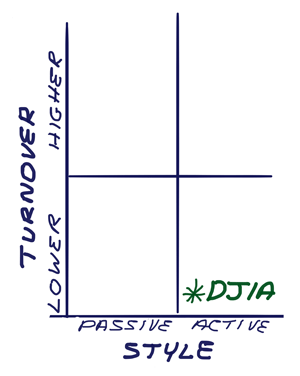
General Electric was an original member of the Dow, first added back in May 1896. According to S&P Dow Jones Indices senior index analyst Howard Silverblatt, the stock was briefly booted from the average in September 1898 before being added back seven months later in April 1899. Two years later, in 1901, it was kicked out again before being readmitted six-and-one-half years later in 1907. Now nearly 101 years later, the stock is being shown the door again.
Will it be added back again? We’ll see. General Electric has evolved over the years and will likely continue to do so. In the meantime, there are problems that the company has to deal with. Profit margins have been declining, cash flow is negative and the debt-to-equity ratio is worsening. Plus, its dividend is in danger of being suspended.
None of this even touches on how the Dow is managed. While turnover is low—the last change occurred three years ago when AT&T Inc. (T) was replaced with Apple Inc. (AAPL)—the average is actively managed.
The Dow’s methodology states, “While stock selection is not governed by quantitative rules, a stock typically is added only if the company has an excellent reputation, demonstrates sustained growth and is of interest to a large number of investors. Companies should be incorporated and headquartered in the U.S. In addition, a plurality of revenues should be derived from the U.S. Maintaining adequate sector representation within the index is also a consideration in the selection process for the Dow Jones Industrial Average.”
A guiding principle for which companies are included in the Dow is its stated objective of representing “large and well-known companies.” The average is not intended to hold solely the 30 largest U.S. stocks. Rather, the Dow is intended to be a representative list of blue-chip companies. Membership in the average is determined by a committee of five individuals, two from The Wall Street Journal and three, including David Blitzer, from S&P Dow Jones Indices. Blitzer previously told me that the committee starts with the S&P 500 index and then considers various factors, including which industries are and are not represented in the average. Though the average’s methodology does provide guidelines, it leaves the door open for subjective decisions.
Also determining what is included in the Dow is a stock’s share price. The average uses a price weighting instead of market-capitalization weighting, which the S&P 500 and many other indexes use. This means a stock like Amazon.com Inc. (AMZN), which closed at $1,750.08 yesterday, would have a significant impact on the Dow had it been added instead.
To put Amazon’s share price into perspective, consider the current makeup of the Dow. Share prices range from $12.88 for General Electric to $342.69 for Boeing Co. (BA), using yesterday’s closing prices. The median price is $107.35, approximately the price of Walt Disney Co. (DIS) and JPMorgan Chase & Co. (JPM). Even if Amazon were to do a 10-for-1 split, it would still have the seventh-highest price tag of any Dow stock. Walgreens, in contrast, will have the ninth-smallest price of any Dow stock at $68.00 per share.
The weightings within the Dow will be reset prior to the open of trading on Tuesday, June 26, 2018. At that time, the Dow’s divisor will be recalculated based on the average share price of the updated list of 30 stocks. This divisor will then determine how much influence each stock will have going forward. The level of the Dow will not change, though its movement going forward will with Walgreens having more of an influence on the average’s performance than General Electric currently does.
The Wall Street Journal calculates an average 12-month return of 6.4% for the last 10 companies to be kicked out of the Dow versus an average 4.6% decline for those added to the average. The past five companies to get the boot have jumped by an average of 42%. The sample size is small, however, and is not predictive of what will happen to General Electric. Rather, GE’s challenges will have a far greater impact on how its shares perform than the stock’s exclusion from the Dow.
(For purposes of disclosure, General Electric is in a family trust that I co-manage. It only represents a very small portion of the portfolio, however.)

- Market Barometers: A Look at Stock Indexes and How They Work – This 2008 AAII Journal article explains the various weighting methodologies that indexes use.
- Dogs of the Dow Screen – This simplistic strategy suggests buying the 10 members of the Dow Jones industrial average with the highest yields. Once General Electric is booted out, Johnson & Johnson (JNJ) should replace it as a “Dogs of the Dow” stock.
Optimism among individual investors about the short-term direction of the stock market pulled back, but remains above its historical average (albeit barely so) in the latest AAII Sentiment Survey. Meanwhile, pessimism rebounded and neutral sentiment rose.
Bullish sentiment, expectations that stock prices will rise over the next six months, fell 6.1 percentage points to 38.7%. Optimism is above its historical average of 38.5% for the fourth time in five weeks.
Neutral sentiment, expectations that stock prices will stay essentially unchanged over the next six months, rose 1.6 percentage points to 35.1%. Neutral sentiment remains above its historical average of 31.0% for the 18th consecutive week.
Bearish sentiment, expectations that stock prices will fall over the next six months, rose 4.5 percentage points to 26.2%. Even with the increase, pessimism remains below its historical average of 30.5% for the 10th consecutive week and the 24th time out of the past 28 weeks.
This week’s rebound puts bearish sentiment back into its recent 1.5 percentage-point range. Pessimism has fluctuated between 25.2% and 26.7% during six out of the past nine weeks.
At current levels, all three sentiment indicators are within their typical historical ranges.
The recent record highs for the Nasdaq composite and the Russell 2000 index are helping to keep optimism above where it was over the past few months. Nonetheless, many, but not all individual investors anticipate continued volatility and/or think that the current political backdrop could have a further impact on the stock market. Trade policy is influencing some individual investors’ sentiment as well. While many approve of the Federal Reserve’s plan to continue gradually raising interest rates, some AAII members are concerned about the impact that rising rates will have. Also influencing sentiment are valuations, tax cuts, earnings growth and economic growth.
This week’s special question asked AAII members what they thought about the Federal Open Market Committee (FOMC) potentially raising interest rates one or two more times this year. Nearly half of all respondents (48%) think it is a good idea. Many of these respondents say that the central bank needs to continue normalizing rates, that it’s the right time to keep raising rates, that it’s a sign of sustained economic growth or that the hikes help to counteract inflation. Approximately 24% expect more rate increases this year, with more respondents anticipating two hikes instead of one. Nearly 13% think further increases would be a bad idea because of the potentially negative impact on the economy and/or stocks. Some respondents add that a trade war would alter their opinions.
Here is a sampling of the responses:
- “Great idea. Get back to some degree of normalcy.”
- “I think that it is pretty much expected and would not hurt dramatically if that was the only influence.”
- “Interest rate hikes probably need to happen. However, trade wars and a lack of wage increases is a concern.”
- “Not much. I believe expectations for further rate hikes are already baked into the market.”
- “Could pose a danger to the financial markets and asset prices.”

Bullish: 38.7%, down 6.1 points
Neutral: 35.1%, up 1.6 points
Bearish: 26.2%, up 4.5 points
Bullish: 38.5%
Neutral: 31.0%
Bearish: 30.5%
June 14, 2018 Kahneman on Decision-Making, and Other Morningstar Conference Notes
June 7, 2018 The Number of Investments to Hold in Your Portfolio
May 31, 2018 Paying a Premium to Take on More Risk
May 24, 2018 Global Stock and Bond Diversification With Just 2 ETFs

Discussion
No comments have been added yet. Add your thoughts to the discussion!
You need to log in as a registered AAII user before commenting.
Create an account