

Avoiding Overconfidence by Knowing What Type of Investor You Are
by Charles Rotblut | February 21, 2019
Among the many unintended consequences of the internet is an unrealistic sense of overconfidence. Researchers are finding people who believe they possess a level of skill or expertise after watching instructional YouTube videos. For example, some people believe that they can impersonate Michael Jackson’s moonwalk dance by merely watching a video about it, according to NPR’s Shankar Vedantam.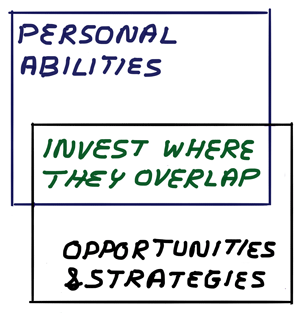
Overconfidence, especially when it comes to overestimating one’s abilities, is nothing new. The well-documented Dunning–Kruger effect is the failure of people to recognize their own level of incompetency. This mental misinformation drives investment decisions and causes people to believe their returns are higher than they actually are. This is why behavioral scientists, such as Daniel Kahneman, advise tracking actual performance to see how you are doing.
Among the ways overconfidence can manifest itself in a person’s portfolio is prompting them to invest in a manner or in securities that they shouldn’t. Examples include options and currencies. Skilled salespeople and instructors pitch seminars and online courses with the promise of training investors on how to realize BIG returns. Often, it’s the sponsor of the course who is raking in the dollars, not the participants.
A skilled instructor can make a strategy seem simple to follow with carefully selected charts and an inspiring personality. When energized course participants go out into the real world, they are met with much more challenging conditions. This is because, as Vedantam discussed, there is a difference between observing and experiencing an activity. Unlike a controlled setting, investing in the financial markets pits a person against thousands of professionals as well as many individuals who may themselves possess higher levels of skill.
This doesn’t mean a person can’t learn by watching videos, reading books and going to conferences. We at AAII believe individuals can become better at investing through education. If we didn’t, we wouldn’t have much of a reason to exist as an organization. Nonetheless, there is a difference between learning and doing. Reading and watching can only take you so far; you still have to jump in the water and make decisions. Some of the decisions will be good and others won’t be so good. The ability to look at both types of decisions, separate outcomes into what is attributable to skill, luck or mistakes and apply that knowledge going forward is what will make you a better investor.
Part of the knowledge acquired through experience is identifying the type of investor you are most successful at being. This ties back to a quote attributed to the Greek poet Archilochus: “A fox knows many things, but a hedgehog knows one big thing.” Knowing what type of investor you are has two benefits. First, it allows you to identify the types of strategies you can stick with no matter what the prevailing market conditions are. Secondly, it allows you to tune out the many ideas existing beyond the walls of your strategy.
You can certainly have a box big enough to move around in and expand as needed, but the ability to stay focused on a defined strategy—say long-term value investing—will keep you from making the mistake of buying something you shouldn’t. Having a well-defined strategy based on your personality and skillset will also be a good weapon to wield against the temptations that may lead to you doing something beyond your actual sphere of competency.

-
Common Mistakes Made When Investing in Quality Companies – In discussing how overconfidence can cause problems, George Washington University professor Lawrence Cunningham wrote, “Straying beyond the boundaries of one’s knowledge and experience increases the risk of error.”
-
Biology and Life Experiences Influence Investing Style – Many people are predisposed to one style of investing or another due to their genetics and their life experiences, as this study found.
AAII Sentiment Survey
Bullish: 39.3%, up 4.2 points
Neutral: 35.3%, down 4.5 points
Bearish: 25.4%, up 0.3 points
Bullish: 38.5%
Neutral: 31.0%
Bearish: 30.5%
See more Sentiment Survey results.

February 14, 2019 Your Returns May Be Anything but Average
February 7, 2019 Some Perspective on Buybacks Given Recent Criticism
January 31, 2019 How to Invest Differently Than a Mutual Fund
January 24, 2019 AAII Members Share Their Memories of John Bogle

Discussion
No comments have been added yet. Add your thoughts to the discussion!
You need to log in as a registered AAII user before commenting.
Create an account