

Diversification Cushions the Blow of Drawdowns, But at a Cost
by Charles Rotblut | October 04, 2018
One fear many investors have is incurring a large drop in the stock market. “Major drawdowns,” as defined by AQR Capital Management, are those where prices drop by at least 20% from peak to trough. The investment firm counts 11 such drops as having occurred in the stock market since 1926, or about one per decade.
Though stock prices have fully recovered within 27 months, on average, according to AQR’s data, realizing the recovery requires an investor to stay fully invested in stocks. This is something that’s much easier said than done. Various studies show a tendency to pull out of stocks when their prices are down. Even if someone sticks with their allocation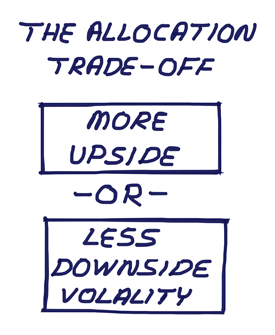 to stocks, the drops can be painful. Major drawdowns can even be problematic from a timing standpoint, especially for those who had the unfortunate luck of reporting shortly before the drop occurred.
There is a simple solution for cushioning against the blow of such drops: diversify. Holding assets whose returns are affected by different risks than stocks lessens the impact drawdowns have on portfolio wealth. However, diversification can come at the cost of lower long-term returns, as an analysis from AQR shows.
Among the diversifiers looked at were 10-year U.S. government bonds (e.g., Treasuries). These are uncorrelated to stocks and have, on average, experienced positive returns during major drawdowns for stocks. A basket of commodities is comparatively more correlated to stocks than bonds but has historically had low correlations with stocks. Commodities do have higher long-term average returns than bonds, but with far longer tails. In other words, bonds offer better odds of cushioning the blow, while commodities offer greater average upside albeit with much larger upside and downside returns. (Expenses do not appear to have been factored into AQR’s data.)
Cash can also be used to diversify. Just moving 10% of the equity allocation into stocks has historically led to 2.8% better drawdown returns. While this may sound enticing, the trade-off is a 0.8% reduction in long-term returns. As is the case with bonds and commodities, the price of easing short-term pain is less long-term wealth.
What about other sources of protection? AQR looked at a few, the easiest to understand being gold and puts. Since 1986 (a short time period for this type of analysis), including an allocation to gold has led to positive returns during stock market drops of at least 10%, at the cost of lower average returns. Puts—options that allow the contract holder to sell at a preset price—have good defensive properties but lead to negative long-term returns. (Various factors affect the actual return of a put strategy, but AQR’s findings should serve as a warning sign in regard to continuously holding onto puts.)
As far as timing the market is concerned, it’s harder than it looks. AQR looked at the drawdowns relative to Yale professor Robert Shiller’s CAPE (cyclically adjusted price-earnings) ratio. They found no consistent patterns between the level of the long-term valuation indicator and when drawdowns occur. More so, stocks tended to continue to rise when the markets were “very expensive.” Such increases occurred “more than half of the time.” (To be fair, AQR is not completely opposed to making small tactical tilts based on valuation or momentum indicators but have suggested investors just “sin a little.”)
The only way to truly protect against stock market drops is to not be in the stock market. Hedges, such as puts, do pay off during drops, but the stock market rises far more than it falls; most calendar months have positive average monthly returns. Diversifying into uncorrelated assets, such as bonds, reduces the volatility of an all-stock portfolio, but at the cost of lower long-term returns.

- The Importance of Diversification in Retirement Portfolios – Including small-cap stocks and Treasury bills can enable a retiree to take larger withdrawals.
- The Permanent Portfolio: Using Allocation to Build and Protect Wealth – This alternative allocation adds cash and gold to a traditional stock/bond portfolio.
Optimism among individual investors about the short-term direction of the stock market is at its highest level in eight months according to the latest AAII Sentiment Survey. Both neutral and bearish sentiment pulled back below their historical averages.
Bullish sentiment, expectations that stock prices will rise over the next six months, jumped 9.4 percentage points to 45.7%. Optimism was last higher on February 14, 2018 (48.5%). The increase puts bullish sentiment above its historical average of 38.5% for the first time in four weeks.
Neutral sentiment, expectations that stock prices will stay essentially unchanged over the next six months, fell 3.5 percentage points to 29.2%. Neutral sentiment was last lower on July 11, 2018 (27.8%). This is just the second time in 33 weeks that neutral sentiment is below its historical average of 31.0%.
Bearish sentiment, expectations that stock prices will fall over the next six months, fell 6.0 percentage points to 25.1%. This is a five-week low. It is also the first time pessimism is below its historical average of 30.5% in four weeks.
At current levels, all three indicators are within their typical historical ranges.
This week’s results put bullish sentiment at its fifth-highest level of the year. Since the end of February, optimism has only been above average nine times. It has not stayed above average for a span of more than three consecutive weeks since January.
Tariffs and the possibility of an escalating trade war remain front and center on the minds of many individual investors. Also influencing sentiment are Washington politics (including President Donald Trump), midterm elections, economic growth, valuations and corporate profits. The record highs in the Dow Jones industrial average likely gave encouragement to some individual investors, but not all.
This week’s special question asked AAII members for their opinion on the Federal Reserve’s ongoing course of raising interest rates. Nearly three-quarters of respondents (73%) think the Fed is doing the right thing by raising rates. The overwhelming majority of these respondents favor gradual rate hikes. Others in this group of respondents believe that the Fed needs to keep raising rates to keep inflation in check or otherwise view the hikes as being overdue.
Almost 20% of all respondents expressed concern about the ongoing rate hikes. Some of these respondents believe the Fed is being too aggressive, while others expressed concern about the hikes causing a correction.
Here is a sampling of the responses:
- “They have to raise from zero so that they have a tool against a recession, inflation, etc. As long as the raises are small and gradual, I see no harm.”
- “I think it’s good; interest rates need to be above the inflation rate and high enough for reduction when the economy weakens.”
- “Let it be stable for a few quarters. I don’t want it to stunt growth.”
- “I’m concerned about raising rates too quickly. They need to keep a very close watch on the economy and adjust their policy as needed.”
- “It is about time. I am happy to see the improved interest in cash accounts.”

Bullish: 45.7%, up 9.4 points
Neutral: 29.2%, down 3.5 points
Bearish: 25.1%, down 6.0 points
Bullish: 38.5%
Neutral: 31.0%
Bearish: 30.5%
September 27, 2018 Increasingly, Just One Analyst Is Behind a Stock’s Long-Term Earnings Forecast
September 20, 2018 SEC to End Five-Cent Spreads on Small-Company Stocks
September 13, 2018 Mr. Market Has Reverted Back to a Calm State
September 6, 2018 Helpful Steps My Late Father-in-Law Took

Discussion
No comments have been added yet. Add your thoughts to the discussion!
You need to log in as a registered AAII user before commenting.
Create an account