

How to Keep Headlines From Driving Your Portfolio Decisions
by Charles Rotblut | November 10, 2016
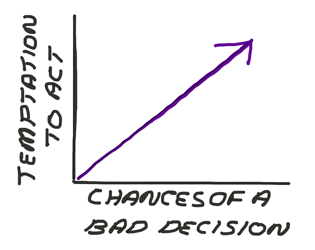
Big, unexpected events commonly trigger strong emotional reactions. The wiring in our brains triggers us to quickly respond to new stimuli. The initial course of action is often the wrong one when we’re not in physical danger. This is particularly the case when it comes to managing our portfolios.
Long-term investing success comes in large part from simply sticking to a plan no matter what is going on around you. This is far easier said than done when big events occur. Our desire to do something conflicts directly with what is best for achieving our long-term financial goals.
So, I’m not going to tell you those of you feeling a strong emotional response to yesterday’s election to not do anything. Rather, I want you to act. Take a deep breath. Turn off the television and go for a walk. Read a good book that has nothing to do with investing, such as “Proof: The Science of Booze” (Houghton Mifflin Harcourt, 2014). Do something that does not involve thinking about politics or the market. After the past several months of campaigning, the break will do you some good.
After you have cooled down emotionally, come back and reassess your financial strategy and situation. Start with your short-term needs. Money needed to cover anticipated expenses for the next six months to two years should be in cash. If you are a retiree, consider putting the equivalent of four years of expenses into cash and short-term savings vehicles (money market funds, CDs, Treasury bills, etc.) Yes, interest rates stink right now, but it’s better to earn a low amount of interest than to risk losing money you will need in the short term.
Then start thinking long-term. What are your needs? What are your goals?
If you are retired, ensure that you have a strategy for funding your living expenses beyond the next two to four years. There are disagreements on the best way to do this, but it is important to determine the combination of annuities, bond ladders and stocks/stock funds that makes the best sense for you. Annuities guarantee income; stocks grow wealth. Think about your ability to not panic, your desire to bequest assets and your willingness to stick to a long-term withdrawal strategy.
If you are working, keep saving. If you are working and are now nervous, save more if you can. (It’s also a good idea to save more if you are now feeling optimistic.) While you can’t control the economy or what happens in Washington, to the extent that your spending is discretionary, you can control how much you save.
You can also control your ability to stay invested and maintain a consistent allocation to equities. Though it’s difficult to think beyond the short term when headlines are front and center, the odds favor those who stick with stocks. Large-cap and small-cap stocks have gained during 74 out of the 86 rolling five-year periods that have occurred since 1926—a win rate of 86%, according to the 2016 SBBI Yearbook (Duff & Phelps, 2016). Extend the time frame to rolling 10-year periods and the win rate is 77 out of 81 (95%) for large-cap stocks and 79 out of 81 for small-cap (98%). These are very favorable odds and they encompass both the previous good and bad periods the U.S. has experienced since 1926.
If none of this helps you resist the urge to alter your portfolio in reaction to yesterday’s election—or the overall macro/market environment—then you need to reassess your strategy. The optimal investing strategy is always the one you can stick to no matter what the market is doing and what the headlines are. If you believe your optimal strategy is one that limits risk, realize that your savings rate will have to be significantly higher than it would be if you were willing to accept a higher level of market and headline risk.
If, on the other hand, the outcome of yesterday’s election has you feeling optimistic, the same guidelines still apply. Base your allocation decisions on your long-term goals, not the day’s headlines. Just as negative feelings can cause investors to unnecessarily reduce their equity allocations, positive emotions can cause investors to unnecessarily increase their exposure to stocks. Your goal should be to maintain an allocation that’s appropriate for achieving your financial goals, regardless of what the headlines are.

-
The Danger of Getting Out of Stocks During Bear Markets – Pulling out of stocks because of fear has a lasting negative effect on your wealth.
-
Comparing a Bucket Strategy and a Systematic Withdrawal Strategy – Allocating assets by time can help some investors better handle market volatility and uncertainty.
Optimism among individual investors about the short-term direction of the stock market surged to its highest level since last November in the latest AAII Sentiment Survey. Neutral sentiment plunged to its lowest level in more than 10 months. Bearish sentiment is lower as well.
Bullish sentiment, expectations that stock prices will rise over the next six months, jumped 15.3 percentage points to 38.9%. As noted above, optimism was last higher on November 4, 2015 (39.0%). The large increase puts bullish sentiment above its historical average of 38.5% for the first time in 53 weeks and just the third time during the past 88 weeks.
Neutral sentiment, expectations that stock prices will stay essentially unchanged over the next six months, plunged 10.3 percentage points to 31.8%. This is the lowest neutral sentiment has been since January 27, 2016 (30.3%). Even with the large drop, neutral sentiment remains above its historical average of 31.0% for the 41st consecutive week.
Bearish sentiment, expectations that stock prices will fall over the next six months, fell 5.0 percentage points to 29.3%. Pessimism remains in the approximate 10-point range it has fluctuated within over the past 11 weeks. This week’s drop does, however, put bearish sentiment below its historical average of 30.5% for the first time in four weeks.
This week’s jump in bullish sentiment is the largest since an 18.4 percentage-point spike on July 15, 2010. It is also the biggest one-week change in either direction since a 16.2 percentage-point drop on April 11, 2013. This week’s large upward move follows what had been the 104th lowest level of optimism registered over the 29-year history of our Sentiment Survey.
The survey period runs from Thursday through Wednesday. Given Tuesday’s election, we analyzed our database to determine the timing of when AAII members actually took the survey. Approximately 80% of the responses were recorded by Monday night. We send out reminders to take the survey to a revolving group of AAII members each Monday and, not surprisingly, more than half of this week’s survey responses were recorded on Monday.
Giving some individual investors reason for optimism are the perceived lack of investment alternatives, corporate earnings, low/stable energy prices and sustained, albeit slow, economic growth. Causing others to have reason for concern is this fall’s previous weakness in stock prices and the possibility of the stock market experiencing a larger drop, angst heading into the election, valuations, global economic uncertainty, the pace of corporate earnings growth and a forthcoming rate hike.
This week’s special question asked AAII members how the possibility of a December rate hike by the Federal Reserve is impacting their sentiment towards stocks. Nearly two-thirds (65%) of respondents said that a rate hike will have no or only very little change on their sentiment and/or portfolios. Many of these respondents view a rate hike as already being priced in. Slightly more than 14% say that a rate hike would cause them to be more negative on stocks. Nearly 12% say they would be more optimistic if the Federal Reserve raised rates.
Here is a sampling of the responses:
- “I think the rate hike has been built into the market for a long time.”
- “The rate hike will most likely drive down prices and create buying opportunities.”
- “Confirms my thoughts that the overall economy is improving, and therefore it is a positive.”
- “I am not changing my stock or bond allocations when interest rates rise.”
- “No impact. A Fed rate hike of 25 basis points has been priced into the markets for some time now.”

Bullish: 38.9%, up 15.3 points
Neutral: 31.8%, down 10.3 points
Bearish: 29.3%, down 5.0 points
Bullish: 38.5%
Neutral: 31.0%
Bearish: 30.5%
November 3, 2016 Thanks to Mr. Market, My Portfolio Doesn’t Need Altering
October 27, 2016 An Election Trend That Might Not Be Repeatable
October 20, 2016 Earnings Estimates’ Effect on Stock Prices
October 13, 2016 You Could Spend More Years Being Retired Than Working

Discussion
No comments have been added yet. Add your thoughts to the discussion!
You need to log in as a registered AAII user before commenting.
Create an account