

Tariffs and the Market Environment
by Charles Rotblut | March 08, 2018
As the bull market nears its ninth anniversary, the backdrop is evolving. This year has already seen more days with the S&P 500 index closing up or down by 1% or more than we saw during all of last year. Deflation—a concern not so long ago—has been replaced by worries about inflation and a potential trade war. The prospect of three interest rate hikes has gone from being sheer speculation to seriously considered, along with the possibility of a fourth rate hike this year.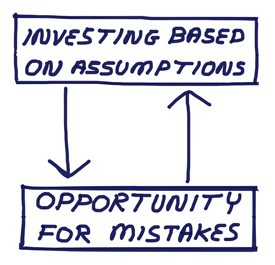
It’s a lot to digest. Market and economic conditions can and do change, often without much notice. Though a return to more normal volatility may give the sensation of Mr. Market trying to find his footing, it’s likelier a situation of new information being priced in. Certainly, many eyes are focused on what will come of the new tariffs on steel and aluminum.
Before discussing the tariffs, let’s step back from the trees and look at the forest. Inflation remains at moderate levels, with the consumer price index (CPI) rising by 2.1% in January. (We’ll get an updated CPI reading on Tuesday.) Yields on the 10-year Treasury appear to be stabilizing, at least temporarily, and have so far stayed below the 3% line. Traders are continuing to price in just three, not four, rate hikes by the Federal Reserve for this year. Fourth-quarter revenues for many corporations grew—an important point because the tax law led to adjusted fourth-quarter profits for many companies. The economy is still in growth mode, and the Tax Cuts and Jobs Act (TCJA) is expected to boost growth this year. (If you’re working, you may want to crunch the numbers with the IRS’ new withholding calculator.)
Trade policy could, of course, throw a wrench into the works. The 25% tariff on steel and 10% tariff on aluminum won’t have much impact on the price of a can of beer or soup, but it could have a noticeable impact on the prices of far larger goods including cars, machinery and materials used in infrastructure projects. The tariffs also have the potential for retaliation from the European Union as well as from other countries. North American Free Trade Agreement (NAFTA) negotiations could also become even more difficult to make progress on. The danger is a combination of weaker demand for U.S. exports and slowing domestic growth at the same time that prices on goods rise. Whether such a scenario actually occurs and the magnitude of the impact is currently unknown.
It’s tempting to speculate and easy to feel self-assured about being able to forecast the outcome in advance. Even though President Donald Trump ran on an “America First” platform, the extent to which his protectionist leanings will be implemented into actual economic and trade policy is unknown. Even with the tariffs announed today, the reaction from other countries is another question.
Then there is the reaction from the financial markets. By making allocation decisions based on potential trade policy, an investor is betting on the direction(s) the stock, bond and currency markets will move in as well as the magnitude of those moves. Such decisions come with a very large margin of error. While it can be emotionally satisfying to be reactive or seemingly proactive, the potential for forfeited wealth far outweighs any amount of comfort derived over the short term.

- The Top 10 Economic Indicators: What to Watch and Why – This article, which was originally published in the August 2003 AAII Journal, lists the top economic reports and shows where to access them.
- Which Economic Indicators Matter – A senior economist for Moody’s explained which economic reports investors should pay the most attention to.
The percentage of individual investors describing their outlook for stocks as “neutral” rose to its highest level in nearly two years. At the same time, optimism is at its lowest level in more than six months according to the latest AAII Sentiment Survey.
Bullish sentiment, expectations that stock prices will rise over the next six months, plunged 10.9 percentage points to 26.4%. Optimism was last lower on August 31, 2017 (25.0%). The drop keeps optimism below its historical average of 38.5% for the third time in five weeks.
Neutral sentiment, expectations that stock prices will stay essentially unchanged over the next six months, jumped 5.9 percentage points to 45.2%. Neutral sentiment was last higher on May 25, 2016 (52.9%). The historical average is 31.0%.
Bearish sentiment, expectations that stock prices will fall over the next six months, rose 5.0 percentage points to 28.4%. Though a four-week high, pessimism remains below its historical average of 30.5% for the 12th time in 13 weeks.
Neutral sentiment has now risen for five consecutive weeks, increasing by a cumulative 18.7 percentage points. Conversely, optimism has fallen by a cumulative 22.1 percentage points since Valentine’s Day. At current levels, neutral sentiment is unusually high, while optimism is unusually low. Since our survey was started in 1987, the S&P 500 index has experienced average six-month returns following unusually high neutral sentiment readings and better-than-average returns following unusually low bullish sentiment readings.
Trade policy appears to have had some impact, though it’s uncertain how much. Tariffs and trade policy were specifically mentioned by some respondents to this week’s survey even though we did not ask about it. Many individual investors are also anticipating continued volatility and/or think the political backdrop could have a further impact on the stock market. Higher interest rates are having an influence on some, but not all individual investors. Also playing a role are valuations, tax cuts, earnings and economic growth.
This week’s special question asked AAII members to share their thoughts about the current duration of the bull market, which will mark its ninth anniversary tomorrow. Responses varied. Slightly less than two out of five respondents (38%) believe the bull market will continue at least through the end of this year, if not longer. Some of these respondents cited expectations for sustained economic growth, while others conditioned their forecasts on a sharp rise in interest rates or a political event not occurring. Nearly 26% of respondents think the bull market is near the end of its run. The possibility of higher interest rates or tariffs were given as reasons. Approximately 22% see risks and/or uncertainty as having increased, with many of these respondents expecting stock prices to be more volatile going forward. Some of these respondents cited politics and tariffs as risks.
Here is a sampling of the responses:
- “I expect the bull market to continue as long as no ‘crisis’ events occur.”
- “I think we are in for a roller-coaster ride this year.”
- “The market is looking very tired after running for nine years.”
- “I am amazed at how the long the bull market has run, seemingly oblivious to the nature of politics.”
- “Should go at least one more year unless the Fed kills it.”
- “It’s a little long in the tooth, but so am I. I don’t believe either of us is quite finished.”

Bullish: 26.4%, down 10.9 points
Neutral: 45.2%, up 5.9 points
Bearish: 28.4%, up 5.0 points
Bullish: 38.5%
Neutral: 31.0%
Bearish: 30.5%
March 1, 2018 Warren Buffett on Market Volatility, Risk and More
February 22, 2018 The Size Premium Lives, But Not for All Small-Company Stocks
February 15, 2018 IRAs and an Opportunity for Tax Arbitrage
February 8, 2018 Volatility, and Not Seeing the Forest for the Trees

Discussion
No comments have been added yet. Add your thoughts to the discussion!
You need to log in as a registered AAII user before commenting.
Create an account