

Too Much Confidence Is Bad for Your Portfolio
by Charles Rotblut | October 06, 2016
Higher levels of confidence about one’s ability to invest leads to worse returns. I realize that this may seem counterintuitive to some of you, but this is the conclusion of a study accepted by the Journal of Behavioral and Experimental Finance (an earlier version of the study is available on SSRN). It’s yet another example of how our brains can be harmful to our portfolios.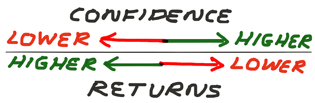
The researchers accessed the brokerage records and demographic data for clients of the largest discount broker in the Netherlands. Brokerage statements were matched up with the results of monthly surveys measuring investors’ confidence. One advantage of studying Dutch investors is that there are no capital gains taxes in the Netherlands, therefore eliminating the influence of tax-loss harvesting decisions. The sample period was April 2008 through March 2009. Authors Arvid Hoffman and Thomas Post of Maastricht University say the high level of volatility that occurred during this period was “beneficial” for their analysis.
Those investors with above-average levels of confidence traded more. Their average monthly turnover was 8.6% higher than investors with below-average confidence. The most confident investors traded even more frequently, with 10.3% greater turnover than other investors. This higher level of trading did not lead to better returns. Rather, the average monthly returns realized by investors with above-average confidence were 0.88% worse than the monthly returns for investors with below-average confidence.
Commenting on their findings, Hoffman and Post wrote, “Investor confidence is not correlated with superior skills. If we exclude from the model variables that are related to investor confidence, that is, return expectations (related to confidence when forming beliefs) and trading indicators (related to confidence as confidence triggers trades through changing beliefs), investor confidence has a significantly negative impact on investor returns.”
Naïve reinforcement learning drives the higher trading. Positive experiences increase the odds of an action being retaken, while negative experiences decrease the odds. Some of you might be more familiar with the concept from sayings such as “the worst thing that can happen to a gambler is to win his first bet” or “the worst thing for an investor is to have the first investment be profitable.” Initial or early success can cause a person to confuse skill for luck. What might be perceived as ability or a good trading strategy is just a favorable combination of luck and a lack of sufficient outcomes to draw a better conclusion from.
Confidence, in and of itself, is not a bad thing. It can give an investor the ability to adhere to a long-term strategy during volatile periods or when a strategy is out of favor (e.g., value stocks are lagging growth stocks). Too much confidence is a problem when it leads investors to change their beliefs and rely on intuition instead of data—particularly long-term data on what does and does not work.

-
Trading More Frequently Leads to Worse Returns – One of the most cited studies about the adverse impact of making more transactions was conducted by Terrance Odean and Brad Barber. Terry discussed their findings in this November 2014 AAII Journal article.
-
Think Twice, Even Thrice, Before Trading – A separate analysis by Mark Hulbert found that returns for many newsletters would have been higher if they had issued fewer buy and sell alerts.
The percentage of individual investors describing their short-term outlook for stocks as neutral rose to a two-month high as pessimism plunged in the latest AAII Sentiment Survey. Optimism, though still low, rebounded to a four-week high.
Bullish sentiment, expectations that stock prices will rise over the next six months, rose 4.8 percentage points to 28.8%. This is the 48th consecutive week and the 81st out of the past 83 weeks with a bullish sentiment reading below its historical average of 38.5%.
Neutral sentiment, expectations that stock prices will stay essentially unchanged over the next six months, jumped 4.4 percentage points to 43.3%. Neutral sentiment was last higher on August 3, 2016 (43.4%). The rise keeps neutral sentiment above its historical average of 31.0% for the 36th consecutive week.
Bearish sentiment, expectations that stock prices will fall over the next six months, plunged 9.2 percentage points to 27.9%. The drop puts pessimism at a seven-week low. The drop also puts pessimism below its historical average of 30.5% for the first time in four weeks.
This week’s drop in pessimism is the largest weekly decrease since February 10, 2016, when bearish sentiment fell 10.9 percentage points. We have also seen big weekly increases this year, with pessimism rising by 14.0 percentage points on February 10, by 9.7 percentage points on June 15 and by 7.4 percentage points on September 14. The median weekly change (in either direction) for bearish, and bullish, sentiment over the life of the survey is about 5.0 percentage points.
The pullback in bearish sentiment occurred after pessimism hit 38.3% two weeks ago. A settling down of market volatility appears to have helped calmed the nerves of anxious investors. Nonetheless, some investors still have concerns about the possibility of the stock market experiencing a larger drop than what occurred in mid-September. Further adding to pessimism about the short-term direction of stock prices are concerns about valuations, global economic uncertainty and the pace of corporate earnings growth. Giving other individual investors reason for optimism are this summer’s rise in stock prices, the perceived lack of investment alternatives, corporate earnings, low/stable energy prices and sustained, albeit slow, economic growth.
This week’s special question asked AAII members how much influence the election is having on their expectations for the stock market relative to other factors such as earnings growth, the economy, the Fed, valuations, international factors, etc. Just under half of all respondents (49%) said that the election is either having just a small/minimal impact or no impact on their stock market expectations. Several said that other factors matter more. Nearly a quarter of all respondents (23%), however, said that the election is having a large influence. Many of these investors are bracing for a drop in stock prices, or at least increased volatility. An additional 5% say that the election is creating uncertainty and 4% said that the election is having some influence on their market outlook. We included the phrase “regardless of which candidate you support” in the actual question and most respondents did not state which candidate they favor.
Here is a sampling of the responses:
- “I believe the presidential election has less of an impact than the other factors you mention, earnings growth, the Fed, international factors, etc.”
- “Like the market, I’m not making a move until I feel comfortable with who the new president might be.”
- “I think the election will only have a short-term effect, if any.”
- “My expectations for the aforementioned factors will change with which party is in control.”
- “The election is creating uncertainty, which I view as a negative for the market.”
- “The election, a real disappointment to Americans, will likely trigger a downward slide to stocks.”

Bullish: 28.8%, up 4.8 points
Neutral: 43.3%, up 4.4 points
Bearish: 27.9%, down 9.2 points
Bullish: 38.5%
Neutral: 31.0%
Bearish: 30.5%
September 29, 2016 The Federal Reserve’s Falling Growth Forecasts
September 22, 2016 Purposely Not Seeking Revenue or Profit Growth
September 15, 2016 The Earnings Quality Indicator Used by ETFs
September 8, 2016 Jeopardy! Shows Humans Don’t Maximize Profits

Discussion
No comments have been added yet. Add your thoughts to the discussion!
You need to log in as a registered AAII user before commenting.
Create an account