


When a fund has a range of share classes with different 12b-1 fees, an incentive exists for distributors to steer investors to the class with the higher fee.
The 12b-1 fee is a distribution and service fee that is paid directly out of fund assets to cover the costs of marketing and selling the fund shares and sometimes shareholder service expenses. A study investigated the dynamics of investor behavior and broker/adviser 12b-1 incentives from October 1999 to September 2019 by analyzing how sensitive fund flow was to performance. The research focused on 1,860 actively managed domestic equity mutual funds and 5,022 unique share classes.
The researchers found that investors in a fund’s share class that has a high 12b-1 fee show a lower likelihood of selling their shares when the fund performs poorly compared to investors who purchased a share class of the same fund that had a low 12b-1 fee. The reduced sensitivity to past poor performance in high-fee share classes suggests a misalignment between broker/adviser incentives and investors’ interests.
Investigating the impact of differentials in 12b-1 fees between share classes within a fund also indicates that conflicts of interest are amplified when there is a larger spread in 12b-1 fees between the share classes. Results from a placebo test showed no significant sensitivity to poor performance for share classes with higher 12b-1 fees, supporting the study’s conjecture that flow sensitivity is driven by broker/adviser incentives.
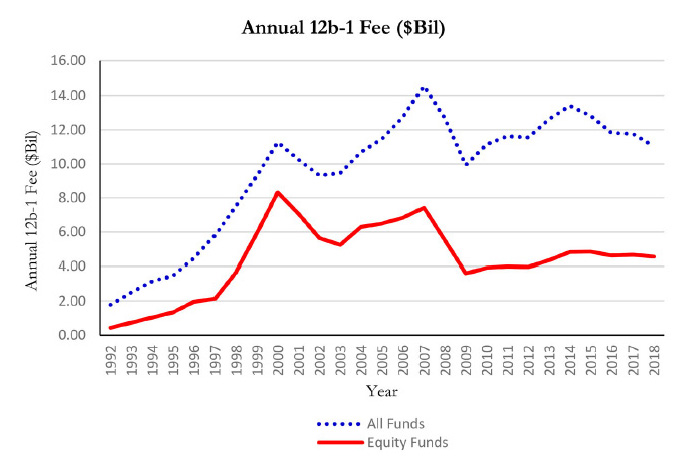
Results suggest that enhancing broker/adviser monitoring could potentially reduce conflicts of interest. Outside the U.S., concerns regarding distribution fees have sparked recent discussions and led to the implementation of bans in certain countries. The study recommends a reevaluation of 12b-1 fee policies in the U.S. Proposals include consideration of alternatives like allowing brokers and advisers to set their own fees and requiring transparent conflict disclosures as a fiduciary duty for broker-dealers and financial advisers, along with future research to explore conflict mitigating approaches.
Source: “Intermediaries’ Incentives across Share Classes in the Same Fund,” by Ivalina Kalcheva and Ping McLemore; Financial Analysts Journal, September 2023.

Discussion
FREE REPORT

Get your free copy of our special
report analyzing the tech stocks
most likely to outperform the
market.
No comments have been added yet. Add your thoughts to the discussion!
You need to log in as a registered AAII user before commenting.
Log InCreate an account