

Related

Financial Statements
Using Book Value to Judge a Stock's Worth

Mutual Funds
Mutual funds that claim to focus on investments having factors shown be associated with higher long-term returns are found to be doing the exact opposite.
by AAII Staff | February 2019

Mutual funds that claim to focus on investments having factors shown to be associated with higher long-term returns—such as small size, low investment growth, high momentum and high book-to-market ratios—are found to be doing the exact opposite. Most of the mutual funds that portray themselves as ‘value’ funds are investing in growth-type investments, according to a recent study.
The researchers focused on fund-level characteristics, such as the popular book-to-market ratio. This ratio divides the book value of a stock by its market value (shareholder’s equity/market capitalization). A high book-to-market ratio (above 1.0) implies that the stock is undervalued, and a low book-to-market ratio (below 1.0) implies that the stock is overvalued (the book-to-market ratio is the inverse of the price-to-book-value ratio).
The study consisted of a sample of 2,638 mutual funds, where 574 identified as ‘value’ funds and 1,130 as ‘growth’ funds. The book-to-market ratios of the funds were ranked based on quintile scores that ranged from 1 to 5, corresponding to low to high book-to-market ratio quintiles, respectively.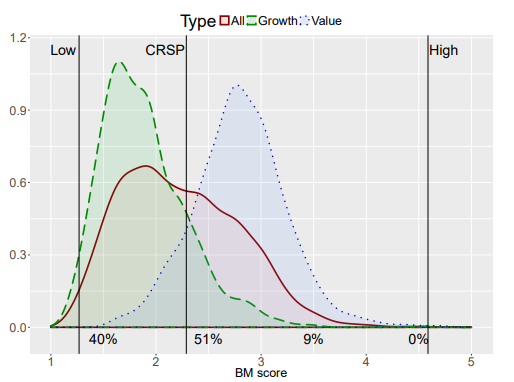
Forty percent of all mutual funds have a book-to-market score between 1 and 2 (indicating book-to-market ratios ranking in the lowest 20% and 40%, respectively) and 51% score between 2 and 3. Only 9% of all funds have a book-to-market score between 3 and 4, and only 0.26% of the funds in the sample have a score higher than 4. The bulk of the ‘value’ funds have book-to-market scores between 2 and 3.5. This contrasts with the S&P 500 index, where 46% of stocks have a book-to-market score above 3 and 18% above 4, according to the study.
The authors conclude that 95% of portfolios of ‘growth’ funds hold over a quarter of their portfolios in low book-to-market stocks, while ‘value’ funds hold a larger portion of their portfolio in stocks with low book-to-market ratios. This is in opposition to the definition of ‘value’ investing, which looks for high book-to-market investments.
Source: “Characteristics of Mutual Fund Portfolios: Where Are the Value Funds?,” by Martin Lettau, Sydney Ludvigson and Paulo Manoel; Centre for Economic Policy Research discussion paper, December 14, 2018.
Financial Statements
Mutual Funds

Jim from Kentucky posted over 7 years ago:
Doug from NY posted over 7 years ago:
You need to log in as a registered AAII user before commenting.
Log InCreate an account