Individual investors tend to follow market trends to determine their portfolio allocation, while institutional investors are more likely to have a highly contrarian attitude and financial advisers often land somewhere in the middle.
Researchers from a Massachusetts Institute of Technology (MIT) laboratory conducted multiple surveys over the span of three years of individual investors, financial advisers and institutional investors. The surveys measured risk preferences and asset-allocation decision analysis.
First, the representatives measured the reaction among individual investors, financial advisers and institutional investors to the S&P 500 index correcting (falling) 10% to 20%. Individual investors were more likely to take no action in the equity allocation of their portfolio. Financial advisers and institutional investors were more likely to increase equity allocation. When the market rises by 10% to 20%, equity allocation for the industry professionals tended to decrease. Individual investors were evenly split in their responses, but on average would increase equity allocation as the market rises.
The survey proceeded to ask the participants to choose the best among hypothetical gambles. As the risk increased for the choices, the number of individual investors willing to gamble decreased. Institutional investors, on the other hand, were more likely to take the riskier gamble, perhaps because institutional investors have performance evaluations more often. Financial advisers fall between these two groups when regarding risk aversion and willingness to gamble.
The final part of the study involved putting individual investors in one of five clusters, based on responses to different market predicaments: passive investors, risk avoiders, extrapolators (those who follow past trends), contrarians and optimistic investors. While the team also collected data based on gender, generation and wealth, the overall study led to these conclusions: passive investor describes about 35% of individual investors, about 27% were extrapolators, risk avoiders accounted for 19% and about 11% were considered optimistic investors.
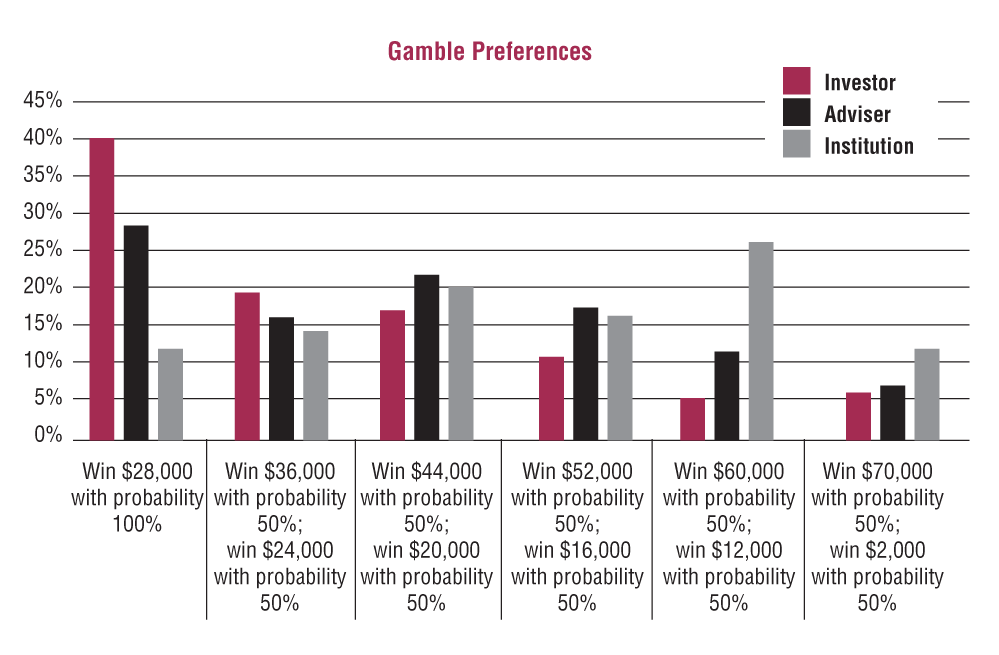
Source: “Measuring Risk Preferences and Asset-Allocation Decisions: A Global Survey Analysis,” by Andrew W. Lo, Alexander Remorov and Zied Ben Chaouch; SSRN, January 2019.







No comments have been added yet. Add your thoughts to the discussion!
You need to log in as a registered AAII user before commenting.
Log InCreate an account