

AAII Survey: Retail Investors Divided on Trump’s Handling of Economy
by Wayne A. Thorp | May 20, 2019
Wayne Thorp recently spoke at the AAII Investor Conference 360. Video replays of all sessions are available for purchase. Go to www.aaii.com/investorconference for more details.

The U.S. is in the midst of one of its longest periods of economic prosperity in recent memory, and the current stretch of economic expansion has gone on much longer than usual. If economic growth continues for the next five months, the U.S. economy will have gone 10 years since the Great Recession ended in October of 2009.
How does this rate historically? There were 33 business cycles in the U.S. between 1854 and 2009, according to the National Bureau of Economic Research. The average length of a growing economy during that span was 38.7 months or 3.2 years. The average recession lasted for 17.5 months or 1.5 years. A full business cycle, on average, is 4.7 years. By historical measures, then, the current expansion in the U.S. economy is three times longer than average.
Managing the U.S. economy has been compared to steering an aircraft carrier. In other words, it takes time to change course. The U.S. economy also does not operate in a vacuum. Global factors can have local impacts and, given the size of the U.S. economy, local developments can have global implications.
Since taking office in 2017, Donald Trump has taken much of the credit for the strength in the U.S. economy and the rise in the U.S. stock market. There is an adage that the president receives too much of the credit (and criticism) for the economy. However, it is undeniable that the occupant of 1600 Pensylvania Avenue has a bully pulpit from which to impact the economy.
However, how much of an impact can the president have? Analysis performed by FiveThirtyEight.com in 2016 attempted to answer that question. What they found was that, on average, presidents don’t have that much control over the economy like the public often thinks.
However, they do cite exceptions. Most economists believe the stimulus package signed by President Obama early in his administration helped dampen the effects of the recession. And many (but not all) experts believe that the broader set of government actions—by both Obama and Bush, as well as the Federal Reserve—helped avert a full-blown depression.
FiveThirtyEight.com also discovered that, outside of crises, presidents can’t do much to boost the economy in the short term. But they can hurt it. Economists point to President Nixon’s 1971 decision to impose price controls in response to inflation as an example of a policy that had a clear and negative effect on the economy, one that took years to reverse fully. Economists all along the political spectrum say there are various decisions—defaulting on the national debt or sharply limiting trade, for example—that could have a similar effect today.
While campaigning for the White House, then-candidate Trump said the “foundation for everything” was trade. Since taking office, Trump has taken a hard line on trade pacts with many of our closest allies, including Canada, Mexico and Japan. He also hasn’t been afraid with our rivals, too. And as a result, over the last couple of weeks, the ongoing trade “war” with China has once again taken center stage, with the stock market reacting to every piece of news related to global trade policy. Many investors are worried that higher tariffs with slow economic and corporate profit growth.
Two weeks ago the president threatened to raise U.S. tariffs on $200 billion in Chinese imports to 25%, up from the 10%, ahead of a new round of trade talks that were set to begin that week. This was followed by statements by U.S. Trade Rep. Robert Lighthizer, saying China was “reneging” on its previous commitments in trade talks. Since then, the market has seemingly been reacting to every piece of news related to global trade policy. However, trade talks have continued, and this past week Treasury Secretary Steven Mnuchin said U.S. negotiators are likely to travel to Beijing soon and reports emerged that the Trump administration is putting off a final decision on whether to impose broad tariffs on automobile and auto-part imports.
AAII Weekly Survey Question
The uptick in market volatility related to the U.S.-China trade talks has put investors on edge and opinions differ as to how well the president is handling the process. Before the recent uptick in trade tensions, the president was, overall, receiving strong marks for this handling of the economy. I was curious to see how sentiment may have changed over the last to week, so our latest weekly survey question asked:
Do you approve or disapprove of the way President Trump is handling the economy?
Here are the results (as of noon Central Time on May 18):
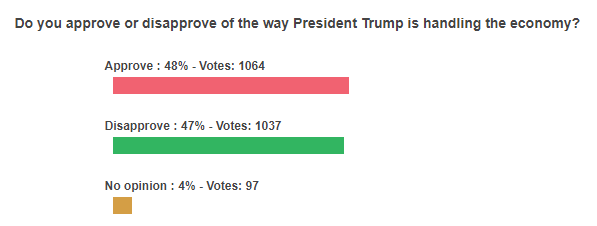
In all, 2,198 readers participated.
There is almost an even split between our members as to how they feel the president is handling the economy. Only 27 votes out of nearly 2,200, (1.2%) separated those approving (48.4%) and those who disapprove (47.2%). Only 4% of those voting did not have an opinion.
Weekly Special Question
Since trade policy can have an impact on the economy, I wanted to get an idea of what our readers thought about the current state of Chinese-U.S. trade relations and the impact on the U.S. economy.
So last week’s special question asked:
What are your thoughts on the escalation of the “trade war” with China? Do you think it will have an overall positive or negative impact on the U.S. economy?
In all, we received 307 responses, which is significantly higher than usual.
Overall, our readers think that a trade war with China would hurt the U.S. economy—51.5% to 43.3%.
Here is a sampling of the responses from our readers as to whether a trade war with China would benefit or hurt the U.S. to which ESG factors are most important to our readers, as well as those offering comments as to why they don’t invest based on ESG factors:
-
“The trade war will invariably result in higher prices for the American consumer. It will not result in bringing back industry to the U.S. but force businesses to search out new supply chains in other third world countries. This will be good for emerging markets, so that is where I’m placing my bets.”
-
“Short- to intermediate-term ‘negative’ impact as both business/capital and consumer spending could decline if the trade war escalates. It seems that the U.S would be in a stronger position had we elected to stay in the Trans-Pacific Partnership (TPP) deal, as China was excluded.”
-
“The China trade policy does not seem well thought out, especially the impact on the U.S. economy and specific segments of our domestic economy, e.g., farmers.”
-
“Something certainly needed to be done, and I applaud Trump for stepping up. However, his team, lack of planning and follow-through have been abysmal failures.”
-
“[Trump’s] playing with levers for which he either cannot see or does not understand the fulcrums.”
-
“Trade and tariff wars are not good for an economy and they are not easy to win, despite what some people say. It will not help the U.S. economy, nor that of China, nor the world economy.”
-
“Adjusting the relationship with China is long overdue. It should have been a U.S. priority since China began violating World Trade Organization (WTO) standards after entering the WTO in the 1990s.”
Everybody has an opinion! Why not give us yours? Participate in our weekly member poll, updated every Monday, and see the results online at www.aaii.com/memberquestion.
Discussion
Mike Weller from WA posted over 7 years ago:
A better example of negative impacts by the President would be the tight-money policies of both Hoover and Roosevelt administrations not providing liquidity for the economy to recover. Regulatory behavior can also adversely (or positively) affect the economy, such as the repressive regulations of the Obama administration or the removal of regulations by the Trump administration. Stimulus packages only assist an economic recovery when it provides an economic benefit. Providing stimulus to solar companies that contribute to political campaigns or interest free loans to Pennsylvania government union workers did not help the economy, possibly delaying and dampening the economic recovery. Much of the economic recovery from the last recession was more likely attributable to the Federal Reserves quantitative easing.
You need to log in as a registered AAII user before commenting.
Create an account