

Related

Financial Planning
Increasing Your Retirement Resources: The Power of Working Longer


Financial Planning
The more time an individual spends working part time or is self-employed, the more likely it is that they will work after retirement.
by AAII Staff | June 2019

The more time an individual spends working part time or is self-employed, the more likely it is that they will work after retirement.
Researchers examined data from the European SHARE survey that combines life history information with retirement information to understand the role of earlier work experiences in deciding whether to work after retirement. The study looked at the work histories and retirement data for 11,369 individuals from the years 2004, 2006, 2011 and 2013.
For men, the odds of working after retirement increased by 1.14 given the more part-time work they had over their careers; for women, the odds of working after retirement increased by 1.05 with more part-time work in their history. With self-employment in the individual’s work history, the odds for men and women working after retiring increased by 1.12 and 1.09, respectively, with each additional year of self-employment.
In men, relative job status and job changes were also found to increase the chances of a person working after their retirement. Those with “a low average occupational status” had a 6.7% increase in the likelihood that they would work after retiring, while those with a “high average occupational status” had a 13.9% increase. Men who spent their whole careers at the same job had a probability of working after retirement of 8.2%, while those who had more than 10 jobs had a 16.3% chance.
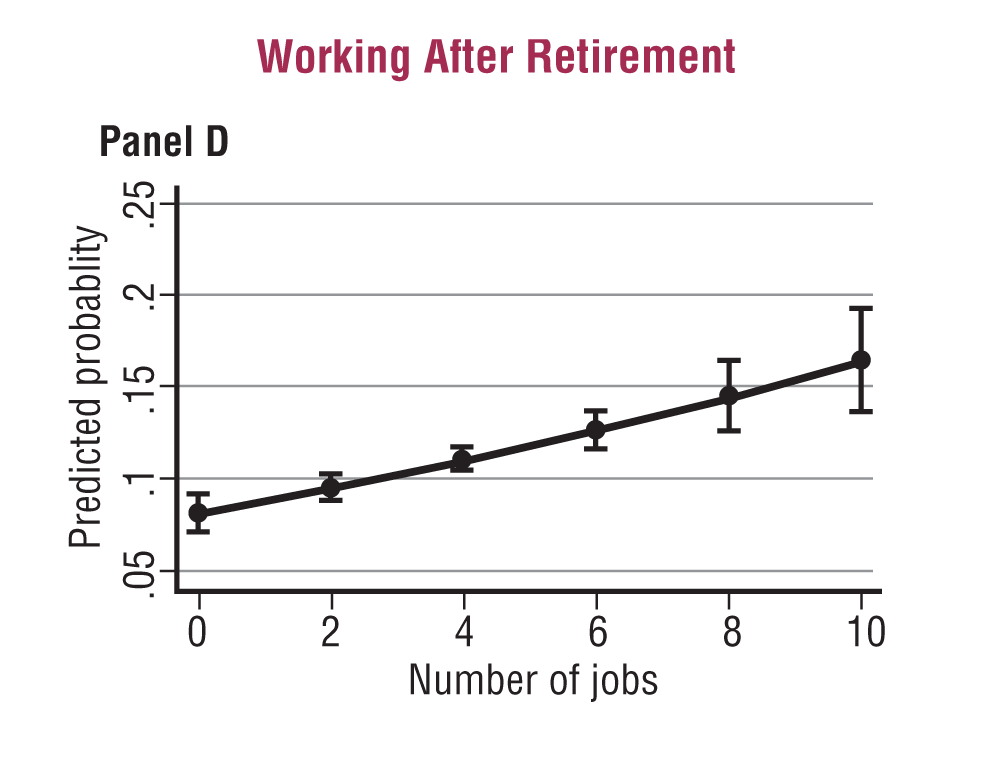 For women, the number of years in full-time employment and the number of jobs held were also found to increase their post-retirement working odds. Women who worked full time up to 10 years had a 7% chance of working after retiring, while those with more than 40 years of full-time work had a 10% chance. Women who spent their careers in one job had a 6.4% probability of working beyond retirement and an 11.5% chance if they had more than 10 jobs over their careers.
In reviewing the possible work histories, the researchers concluded that “inequalities that develop across the life course continue to play a role after retirement.”
Source: “A Life Course Perspective on Working After Retirement: What Role Does the Work History Play?,” by Ellen Dingemans of Netherlands Interdisciplinary Demographic Institute & University Medical Center Groningen and Katja Möhring of University of Mannheim & Mannheim Centre for European Social Research; Advances in Life Course Research, February 2019.
Financial Planning
Financial Planning

No comments have been added yet. Add your thoughts to the discussion!
You need to log in as a registered AAII user before commenting.
Log InCreate an account