


An update on the digital advice industry reveals growing popularity as services are added, along with a few regulatory challenges and other missteps that require investor diligence.
Backend Benchmarking publishes The Robo Report, a free, comprehensive quarterly newsletter reporting on the digital financial advice industry. Our project started in 2015 when we opened and funded accounts at the largest robo-advice providers to track their performance, trading and other activities. We track our accounts using an institutional-level portfolio management system and publish the calculated performance of our accounts quarterly.
Since the project’s inception, we have expanded to report on more than 65 accounts across more than 35 digital advice providers. Our research has also expanded beyond performance to include a holistic review of the services, customer experience, financial planning and other features of the various robo-advice providers, published semiannually as The Robo Ranking.
Currently, we are the only independent source for comprehensive performance returns of digital advice products, and our research is frequently sourced by industry professionals. As we grow, our mission remains the same: to bring transparency to the financial services industry.
10 Years of Progress for Robos
Over the past decade, robo-advisers have emerged as a popular option for individuals seeking professional and affordable money management. While initially offered as a stand-alone product, robo-investing has experienced a convergence with more traditional wealth management. Large banks, discount brokers and others in financial services have quickly adopted emerging technology, while robo-advisory firms have expanded to offer the human-based services that more closely represent their traditional investing counterparts.
 While robos providing access to live advisers was the first industry-wide trend, continuous changes are necessary to attract new customers. Consumer-facing “fintech” companies—firms that use technology to automate the delivery of financial services—are becoming increasingly involved in personal cash management, as apparent by the widespread release of cash savings vehicles across platforms. For many of these companies, this is a step toward the goal to become a one-stop shop for a consumer’s financial needs. Robo-advisers are also building on their success of democratizing financial advice by creating a model to efficiently manage smaller clients. As robo-advisers’ rock-bottom portfolio management fees have been stepping up competition with traditional advice providers, this wave of cash vehicles will increase competition with banks over checking and savings accounts.
 While expanding access to professional money management is a net positive, the rise of robo-investing platforms has not always been smooth. Over the years we have reported on events that have brought into question some providers’ priorities, as well as witnessed incidents of actions brought against fintech companies by regulators. While digital advice can be a good solution for many investors, individuals still need to monitor their accounts and hold providers accountable.
Although the lines are now somewhat blurred as to what constitutes a robo-adviser, a few things are certain. Consumers will be increasingly exposed to these types of products as banks, discount brokers and other financial institutions launch their own automated investing platforms, and digital investing products are here to stay.
Giving More Access to Pro Advice
Overall, digital advice is changing how many individuals interact with their investments and, so far, these products are proving to be a quality solution for those in need. The largest impact that robo-advisers are having is increasing the access to professional advice and portfolio management to new groups of individual investors. We have heard across the industry that digital advice platforms are most successful at attracting do-it-yourself investors. One reason: Digital investing platforms charge a fraction of the cost of full-service advice firms. In the past, many self-directed clients have chosen to manage their own portfolios, as they understand that management fees can have a significant impact on long-term performance and prefer to have control over their own assets. For the first time, there are options to access professional money management at a low enough cost to attract fee-sensitive investors.
 Another reason for their success with the self-directed segment is that many self-directed clients have historically been unable to find reasonable professional management at their level of wealth and stage of life. The reality is that many of these clients are in self-directed accounts not by choice, but because they do not have enough assets to gain access to most full-service advisers. Digital advice products are platforms that can effectively manage small accounts and provide simple financial planning for customers who previously had limited access to investment professionals.
Robo-advice products’ success in the self-directed space is well-earned and is a positive for companies and consumers alike. Access to professional management is becoming commoditized to the extent that clients with lower asset levels now have somewhere to turn. Fee-sensitive clients have multiple low-cost alternatives between full-service advice and self-management. Platforms like Acorns and Stash are proving successful at attracting droves of first-time investors. Full-service advisers feel pressure to defend their value proposition, justify their fees and make sure they are providing value-add services—beyond just the construction and rebalancing of, say, a portfolio of exchange-traded funds (ETFs). Ultimately, consumers, particularly those who have been historically underserved by investment advisers, have benefited from this competition.
What Differentiates the Platforms
The level of access to live support, advisers and planners is an important differentiator of the platform.
 As the robo-advice industry expands, the model has continuously evolved. When robo-advice products started to gain popularity, they were online platforms where users would walk through an automated onboarding process to quickly establish an account, select a model portfolio and contribute funds. As this process was usually a digital-only experience, users did not have options to receive help from advisers. Since then, the lines have blurred between traditional advisers and robo-advisers. Now, most digital advice platforms either include live support or higher service levels with access to live advisers. While robo-advisory Wealthfront has stuck to the digital-only advice model, most other providers now have some option to speak with a person over the phone. Robust digital platforms with access to live advisers at a low cost is an attractive product and one we welcome in the industry.
When deciding between robo-advisers, consumers should determine their financial planning needs and how much live advice they are seeking. It is also important to understand the professional accreditations and quality of planning that company representatives can provide. Some representatives are there solely for technical support, to help walk prospective clients through the onboarding process. Often these representatives fall short in their ability to provide customer- or account-specific advice and meaningful planning. Other platforms have licensed professionals and/or access to certified financial planners (CFPs), representing more comprehensive financial planning services; these are more comparable to a full-service financial adviser relationship. Determining what services you are seeking ahead of time will help you select the right digital advice provider for your needs.
Adding Cash Management & Personal Finance Services
Another trend we are witnessing is digital investing companies becoming more involved in personal cash management. We have tracked multiple companies launching debit card products, high-yield savings or self-directed trading accounts. In a bid to maintain market share, Wealthfront announced their high-yield savings account earlier this year, following Betterment’s cash management program announcement late last year. These are just two examples of high-interest cash accounts that have come to market recently.
Companies have further evolved from financial advice providers to more comprehensive consumer finance platforms. After putting pressure on financial advice fees, robo-advisers have turned to challenging banks in their core businesses. Offerings that include free-spending accounts with debit cards combined with high-interest savings vehicles are undeniably attractive.
 One company we track, SoFi, has been particularly aggressive in its expansion. Originally a lending company focused on refinancing student loans, in the past two years it has released automated digital investing, no-commission trades in self-directed accounts, proprietary ETFs and a high-interest cash account with a debit card. Their cash vehicle earns a very competitive interest rate, their automated investing does not have a management fee, their self-directed accounts have commission-free trades and their two new ETFs have no expense ratio until June of 2020. Just five years ago this product lineup would be unthinkable. In their current form, we do not see how these products can be profitable in the long term, and it is unclear what the costs will be if the company needs to make adjustments to achieve profitability.
Consumers should understand that a platform that offers everything for free may be doing so temporarily to increase its customer base and that the underlying costs will probably not be waived indefinitely.
Setbacks to Investor Confidence
Despite the positive impact digital advice is having on individual investors, there have been regulatory challenges and the inevitable growing pains that come with innovation. Most recently, SoFi came under fire for releasing proprietary ETFs and immediately executing trades to invest all of their managed clients into them. These trades triggered capital gains in our SoFi managed taxable account and raised the question of whether this shift in portfolio holdings was done in the best interest of the client. The move by SoFi highlights the age-old conflict of interest that exists with advisers who use proprietary products in portfolio construction.
 Unfortunately, this is not the only instance of questionable trades within digital investing products. For example, Wealthfront came under similar scrutiny when it released a proprietary risk-parity mutual fund. When introducing the fund, they set the default for eligible accounts to own the fund instead of setting the default to allow clients to opt-in if desired. An opt-in option would have meant only introducing the fund into client accounts where the owner had proactively agreed that they wanted to include the new fund in their portfolio. At least Wealthfront did provide an opt-out option, unlike SoFi, which did not give advance notice before the trades were executed.
Questionable trades have not been the only missteps by robo-advice providers. Unrelated to their trading issues, Wealthfront also ran into trouble with the U.S. Securities and Exchange Commission (SEC) earlier this year for misrepresenting features of its tax-loss harvesting capabilities. Hedgeable, a company that no longer offers a robo-advice product, ran into trouble with the SEC for misrepresenting performance returns. Betterment caught the attention of investors in 2016 after halting trading for hours the day after the Brexit vote. Betterment was also fined by the Financial Industry Regulatory Authority (FINRA) in 2018 for issues identified with their broker-dealer arm, Betterment Securities. Robinhood, a popular no-commission trading platform, released a high-interest cash account product with a debit card that they quickly pulled off the market after regulatory concerns were raised. Additionally, poorly executed tax-loss harvesting trades caused a significant drag on the performance in our TD Ameritrade SRI (socially responsible investing) account.
Each of these events serves as a reminder that investors should not blindly trust any financial service provider. Many of the issues described above can be attributed to growing pains, as these companies continue to innovate in a highly regulated industry. Other issues raise concerns about company priorities, responsibilities to clients and how conflicts of interest are handled.
Although these platforms allow clients to set automatic contributions and let the software and investment management teams take care of the rest, individuals still need to be diligent about whom they choose as a provider and not be tempted into a set-and-forget mentality. As a whole, the positive impacts these companies are making for individual investors outweigh their setbacks, but investors need to be aware and hold providers accountable.
Low-Cost Indexing Portfolios
At the core of Backend Benchmarking’s research is the performance of various robo-advisers’ portfolios. In general, these portfolios are lightly traded, rebalanced regularly and are mostly composed of low-cost, index-tracking ETFs. For example, our Vanguard account holds just five funds and our Wealthfront account just seven. Vanguard’s weighted-average expense ratio of the underlying funds in our account is just 0.07%, and our Wealthfront account expense ratio is 0.11%. While each portfolio is slightly different, they perform in line with other well-diversified, regularly rebalanced, low-cost and passive portfolios. This shows that properly diversified portfolios do not need to be complex to capture market rate returns. With rock-bottom management costs, these properly diversified portfolios are anticipated to perform well over the long run as well.
 That said, there are still some notable differences between the portfolios. Fixed-income holdings vary widely: Some robos—like Vanguard and Fidelity Go—hold all municipal bonds within their fixed-income portfolios, while others—like Schwab, Betterment and SigFig—hold international fixed income. High yield is selectively seen within robo portfolios. There are also differences in the allocations as they relate to international exposure. Although a vast majority of portfolios have highly diversified equity holdings, some hold nearly half of their equity holdings in foreign funds, while others are as low as just a fifth. Although many of these products appear to be similar, we have found that portfolio construction does vary between providers, and some portfolios are emerging as longer-term performance leaders.
Two- and Three-Year Leaders
Table 1 presents returns for our robo accounts that are at least two years old and Figure 1 shows risk statistics in the form of Sharpe ratio and standard deviation for the same group.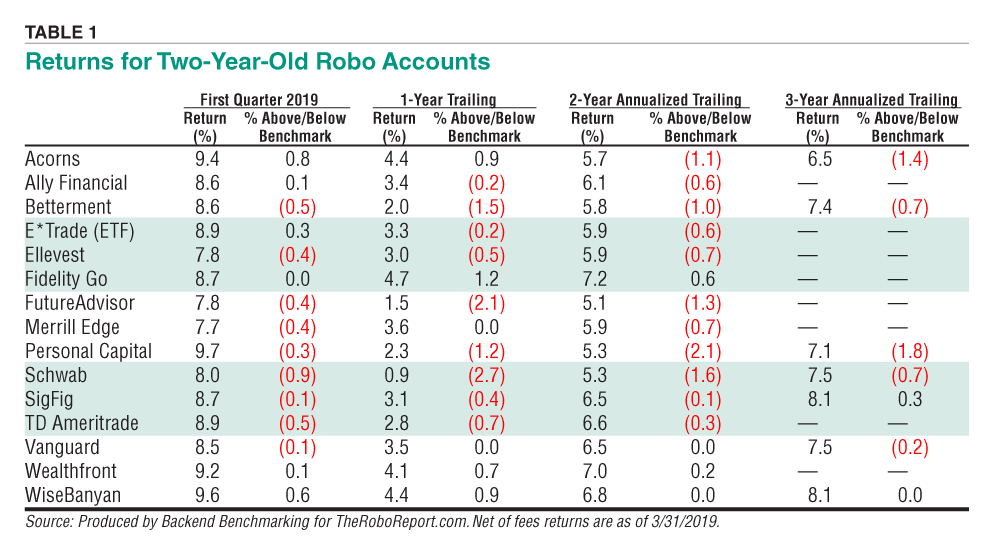
Among the robos with longer track records, we are witnessing SigFig and Fidelity Go emerging as leaders.
Fidelity Go has earned the top total portfolio return over a two-year term, among the robo-advisers we track. Spurred on by a lower-than-average allocation to international and higher-than-average allocation to large-cap domestic stocks, Fidelity Go’s equity portfolio has outperformed. Although Fidelity Go has a higher management fee than some of its lower-cost peers, the portfolio holds funds with no expense ratio, which levels the playing field with other low-cost counterparts. In their fixed-income portfolio, the performance was driven by a large allocation to the Fidelity Municipal Income Fund. Within this fund, there is a large allocation to long-term bonds, which have outperformed over the past two years.

SigFig led the three-year returns for total return above the benchmark and for the equity portion of the portfolio. Although SigFig has a large international equity allocation, which has held other portfolios back, they have a much larger-than-average allocation to emerging markets within their international holdings. Emerging markets trailed far less than developed international markets over the past three years. SigFig’s small allocation to emerging market debt also helped their fixed-income portfolio perform well.
Foreign debt holdings, as well as exposure to high-yield bonds, have helped Schwab’s fixed income perform at the top of the group for the three-year period. Wealthfront’s fixed-income portfolio has done well over the past one- and two-year time frames by holding municipal bonds with a tilt toward longer maturities.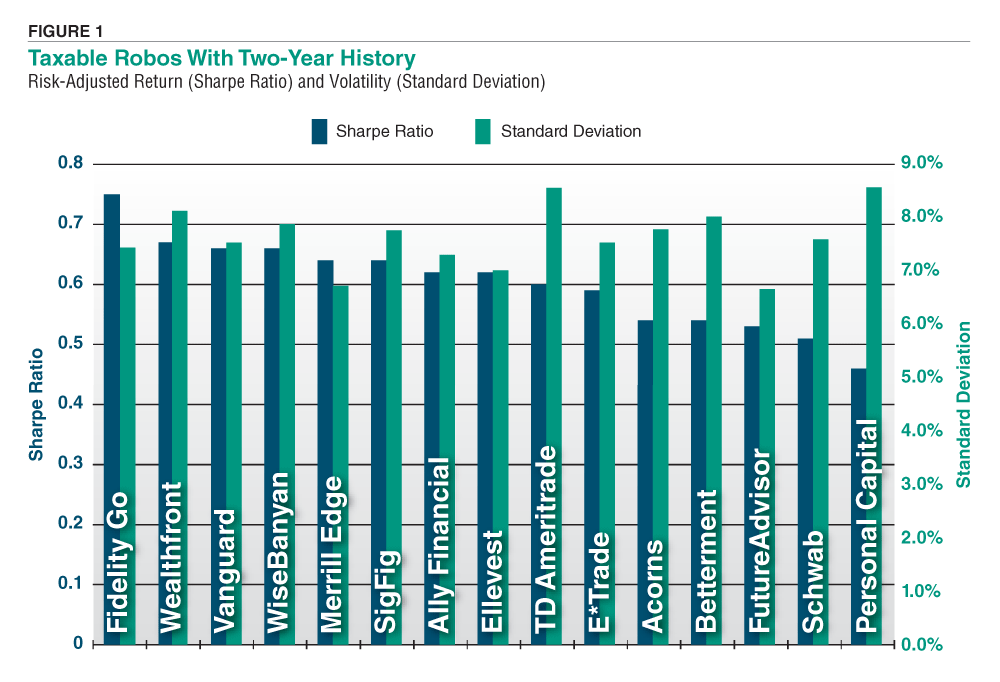
Year to date, we saw lots of new names on the leaderboard. Prudential and Acorns fall at the low end of international allocation, and this, combined with strongly performing corporate and foreign debt exposure, helped both portfolios post strong quarterly performance.
Active Portfolios Shine in 1st Quarter
Some of our actively managed portfolios stood out in the first quarter. TIAA’s actively managed portfolio took the top spot for returns above the normalized benchmark for the quarter, largely due to the outperformance of the underlying mutual funds. TIAA accomplished this performance despite holdings in value-oriented funds and a 38% allocation of equity internationally, two areas that underperformed this quarter.
Swell led our IRA universe by a wide margin. Although their primary focus is socially responsible investing, they take an active management approach and are one of the few portfolios we track that holds individual securities.
Looking Ahead
As our accounts age and we have a longer range to analyze the performance of different robo-advisers, we look forward to gaining a better perspective on how automated investing portfolios perform over the long term.
Available for Download
The Robo Report, First Quarter 2019
Read the entire report with complete performance figures.

Related

Related

Financial Planning
Why Your Financial Adviser Should Be a Fiduciary
Discussion
FREE REPORT

Get your free copy of our special
report analyzing the tech stocks
most likely to outperform the
market.
Chris Byer from CA posted over 7 years ago:
You need to log in as a registered AAII user before commenting.
Log InCreate an account