

Human actions are causing our planet’s climate to become increasingly unstable. We are beyond the point where that fact is open to debate. Most Americans now accept the reality of climate change that’s based on fascinating data visualizations provided by the Yale Program on Climate Change Communication.
The Climate Consensus
By “consensus,” we mean “a general agreement” and, in particular, “a general agreement among those whose qualifications have earned them the right to a professional judgment.”
The short version is that every serious inquiry reaches the same conclusion: The climate is becoming unstable, human activity is driving the change, the instability is immediate and the effects are potentially catastrophic. At base, there have been seven studies of the beliefs of scientists who actively research the world’s climate; depending on the particular study, you find between 91% and 100% of climate scientists in agreement. For folks who would like to learn more about the subject from a source that’s expert, unbiased and accessible, NASA’s Global Climate Change is quite informative and easy to follow.
 The basic physics of greenhouse gases has been understood since the 1890s. Certain gases in the atmosphere—not just CO2, but also methane, nitrous oxide and others—trap a portion of the energy from the sun and hold it near the surface of the earth. Without those gases, our temperatures would look a lot like those on Mars. The problem is that more gases trap more heat, and we now have the highest levels of CO2 in three million years. The rising levels of heat-trapping gases have both physical and biological effects. There is very good evidence on the physical risks—temperature rise, sea level rise, greater intensity of storms, greater frequency of extreme weather events—and quickly rising concern on the biological risks. In May 2019, IPBES released a report based on a three-year review of 15,000 scientific and government sources by a team of 150 scientists. They found that up to one million plant and animal species—something like one-tenth of all the world’s species—are now at risk of extinction. They conclude that we can make a difference, but need to act boldly and quickly.
Authoritative voices abound: The Lawrence Livermore National Laboratory (2019) calculates that there’s less than one chance in a million that the changes we’re seeing are natural, U.S. National Climate Assessment (2017, 2018) agrees that there is no convincing alternative explanation to the view that humans are changing the climate, the U.S. Department of Defense (2019) reports that almost all military installations are threatened by increasingly extreme weather, the U.S. Director of National Intelligence (2019) warns that the hazards are intensifying and the Intergovernmental Panel on Climate Change (2018) calls on us to do “as much as possible, as fast as possible.”
According to Jeremy Grantham of Grantham, Mayo, van Otterloo (GMO), in his “The Race of Our Lives,” keynote address at the Morningstar Investment Conference (2018): “Fossil fuels will either run out, destroy the planet, or both. The only possible way to avoid this outcome is rapid and complete decarbonization of our economy. Needless to say, this is an extremely difficult thing to pull off. It needs the best of our talents and innovation, which almost miraculously, it may be getting. It also needs much better-than-normal long-term planning and leadership, which it most decidedly is not getting yet. Homo sapiens can easily handle this problem, in practice; it will be a closely run race, the race of our lives.”
Individual investors need to care and need to act in order to safeguard both the planet and their portfolios.
Climate-Conscious Investing Options
Our individual actions, whether it’s buying LED bulbs or not buying fossil fuel stocks, will neither save nor doom the planet. Too much of our energy consumption is determined by factors beyond our control: If it’s a two-hour commute to work (welcome to Chicago!) and there’s no plausible alternative to driving, then we drive and our choice of a smaller Toyota Corolla versus a larger Toyota Sequoia makes a marginal difference to the planet. At base, collective action, that is, public policy, determines whether the $30 trillion in needed infrastructure gets built or not.
Worldwide, though, recognition of climate destabilization is not a partisan issue. With relatively minor differences, conservatives and liberals elsewhere both look at the evidence, gulp and nod. Figure 1 shows results from a survey of citizens in the U.S. and eight other developed nations where typically 60% to 75% of conservatives and 80% to 90% of liberals agree that their countries are threatened by climate change.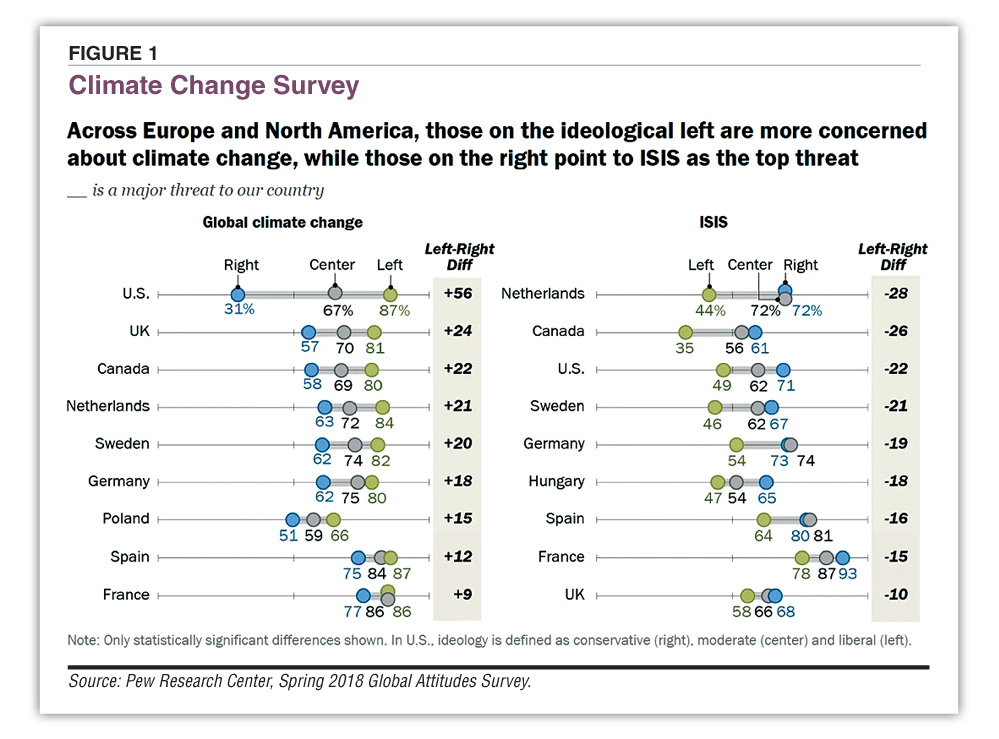
Source: https://www.pewglobal.org/2019/02/10/climate-change-still-seen-as-the-top-global-threat-but-cyberattacks-a-rising-concern/
Folks often disagree on how to address the problem, but they tend to agree that there is a real problem. As a result, there’s broad support (outside the U.S.) for vigorous regulatory action.
One popular proposal is setting a price on, and charge for, carbon emissions. Homeowners pay now to have their waste—whether it’s trash or sewage—disposed of. The charges reflect the cost of neutralizing a pollutant in which raw sewage full of pathogens leaves homes and businesses, resulting in water that can be safely discharged and—here in Iowa, anyway—in bio-solids that can be turned into finished compost that’s sold at a profit. At base, it’s possible to treat waste released into the air in about the same way we treat solid waste or sewage.
The popularity of those ideas is important, because they introduce regulatory risk into the mix of factors for investors to consider. If oil and gas company British Petroleum plc (BP) is suddenly paying, say, $50 billion (to pick a random number) a year for the carbon pollution their product creates, the value of their stock might require dramatic adjustment. Likewise, as the European Central Bank continues to allocate money toward “green” bonds and trillion-dollar sovereign wealth funds shift in the same direction, folks holding bonds in more problematic industries might find that their portfolios get repriced substantially downward.
 Finally, the popularity of investments screened on environmental, social and governance (ESG) factors is soaring. Morningstar recently reported that the number of ESG mutual funds and exchange-traded funds (ETFs) rose 50% (from 235 to 351) in just one year, while flows are 30 times greater than they were just a few years ago. Jon Hale, Morningstar’s director of sustainable investing, reports that “… the average inflow per year for [ESG] funds was about $135 million [each year from 2009–2012]—very, very small, tiny. Now, for the past six years the average flow has been about $4.5 billion and $5.5 billion just in the last year.”
This reflects the fact that investors, institutional and retail alike, are expressing steadily rising levels of concern about investing in unsustainable or seemingly irresponsible businesses. As millennials enter their peak earning (and investing) years, the movement of capital away from “irresponsible” businesses and toward “responsible” ones will increasingly burden corporations. That’s sometimes referred to as reputational risk.
To recap, the four sorts of risk are physical, biological, regulatory and reputational. While the big picture narratives about the state of the planet in 2050 or 2100 seem reassuringly distant and abstract, these risks can impact your portfolio in the short term. That’s evidenced by the recent bankruptcy of utility PG&E Corp. (PCG) triggered by two years of raging wildfires in California; PG&E stock made up 3% of the portfolios of bunches of mutual funds. For example, Vanguard announced that it holds a substantial amount of PG&E debt in its funds; 52 ETFs have been identified that hold PG&E stock, many of them broad-based ETFs; and mutual funds that hold PG&E stock include T. Rowe Price Mid-Cap Value fund (TRMCX), Fidelity Low-Priced Stock fund (FLPSX), FPA Crescent fund (FPACX), Vanguard Total Stock Market Index fund (VTSMX), Vanguard Mid-Cap Index fund (VIMSX) and Vanguard Value Index fund (VIVAX).
Your options as an investor are: 1) Divest yourself of the stocks most exposed to carbon and related risks; 2) invest in stocks—and, though this is harder, bonds—of firms that might benefit from new regulatory regimes and public demands; 3) invest in stocks of resilient firms—those that are adept at adapting and reallocating capital; and 4) speak up.
Divesting Firms With Large Carbon Footprints
The good news is that indexes that exclude carbon polluters slightly outperform indexes that include them. For example, the S&P 500 index has about the same return whether energy companies are included or excluded, so a low-carbon strategy costs little. The bad news is that some of the firms central to fossil fuel extraction and refinement are also central to renewable energy development and battery tech.
The website Fossil Free Funds tracks the carbon footprints of hundreds of mutual funds by analyzing the exposures in their portfolios. They list a number of funds, often growth-oriented, with zero exposure to the extraction, processing or combustion of fossil fuels. Options include Brown Advisory Sustainable Growth fund (BIAWX) and Green Century Balanced fund (GCBLX). Brown Advisory is what we at the Mutual Fund Observer (MFO) call an MFO Great Owl fund, meaning that it has posted risk-adjusted returns in the top 20% of its peer group for every tracked period greater than one year. My colleague Dennis Baran recently profiled this fund (you can read his article at www.mutualfundobserver.com), and I recently added it to my own portfolio.
Green Century got a new management team 11 years ago, and that team has modestly but consistently outperformed its peers, as shown in Table 1. Green cells highlight places where the fund has outperformed its peer group over the 11-plus years of the current market cycle.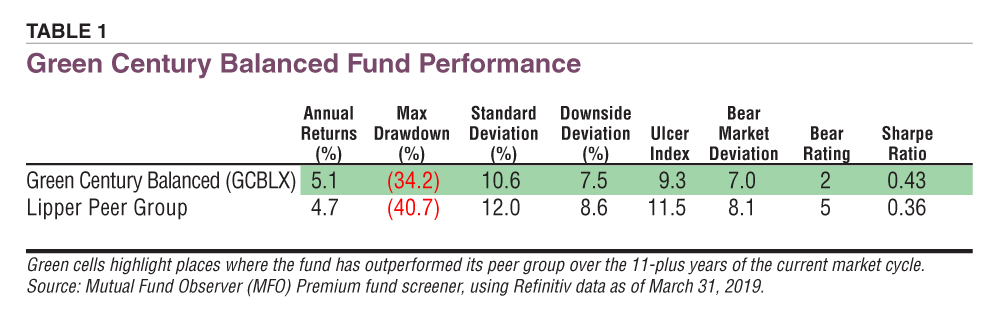
Exchange-traded investors have choices like SPDR MSCI ACWI Low Carbon Target ETF (LOWC) and SPDR S&P 500 Fossil Fuel Reserves Free ETF (SPYX).
Investing in Environmentally Conscious Firms
There is compelling evidence that a broad ESG-screened fund can form the core of a long-term portfolio, with no loss of returns or escalation of risk.
MFO, which draws its data from Refinitiv (formerly Thomson Reuters, formerly Lipper), currently identifies 339 “socially conscious” funds and ETFs, combined. In either case, ESG-conscious investors have a wealth—and possibly a welter—of choices to contend with.
To help create a more manageable short list of ESG funds that might be worth consideration, we combined three datasets and two sets of measurements to identify 10 first-tier options for you.
-
Screen one: We looked for “socially conscious” funds in both the Morningstar and MFO datasets.
-
Screen two: We selected funds with strong risk-adjusted returns. Those were defined as funds that have an MFO rating of 5 for risk-adjusted performance (and noted the Great Owl funds, GO on the table, which have been incredibly persistent outperformers) or a Morningstar rating of four or five stars (and noted the presence of a positive analyst rating).
-
Screen three: We selected funds with the most promising records of environmentally sustainable investments by looking at their Morningstar sustainability ratings and the Fossil Free Funds badges.
Then we added three bits of important information: age (since excellence over long periods is especially notable), expenses and fund size. To make it easy to scan, we color-coded each cell with blue for the highest score, green for second and so on. Finally, we sorted the table by score. Brown Advisory ranks first with 20 of a possible 20 points, Calvert is second with 19 of 20 and so on. Table 2 shows the results. Remember: These are all really solid performers, whether at the top of the table or at the bottom of it. Our basic starting point for inclusion was outstanding risk-adjusted returns.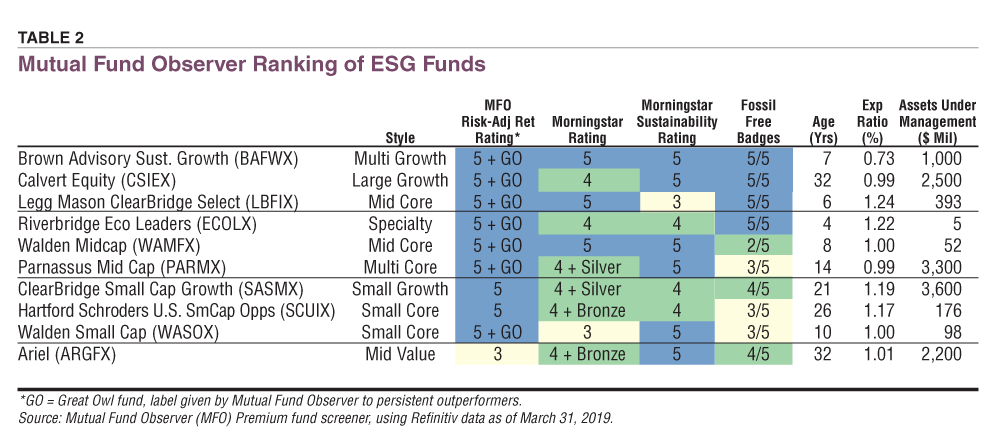
While they did not qualify for our short-list of finalists, fans of smart beta ESG investing might look to the work of the Northern Trust Asset Management which, as we noted when we profiled Northern U.S. Quality ESG fund (NUESX) on our website, “has made a major commitment to responsible investing.” That includes active funds, indexes and smart beta ETFs.
 Finally, with most future growth in greenhouse gas emissions coming from Asia, it can make sense to consider investing in innovators in that half of the world. The cleanest option is Matthews Asia ESG fund (MASGX), which has substantially outperformed its Pacific stock peers since inception and which benefits from Matthews’ depth in the Asia arena. More broadly, a handful of exceedingly solid emerging markets equity funds—Morningstar medalists—also receive Morningstar’s highest sustainability rating: Harding Loevner Emerging Markets fund (HLEMX), Seafarer Overseas Growth & Income fund (SFGIX) and Virtus Vontobel Emerging Markets Opportunities fund (HEMZX). The last fund is still highly regarded despite the loss of star manager Rajiv Jain two years ago.
Targeting Innovators
Some managers look for companies that are, in a way, resilient. Such corporations have a structural and cultural commitment to innovation, which might give them a built-in advantage in dealing with unprecedented change and instability. Two funds with such a focus are Guinness Atkinson Global Innovators fund (IWIRX) and Seven Canyons World Innovators fund (WAGTX, formerly Wasatch World Innovators). Table 3 gives their performance stats. Green cells indicate places where the funds have outperformed their respective peer groups over the 11-plus years of the current market cycle.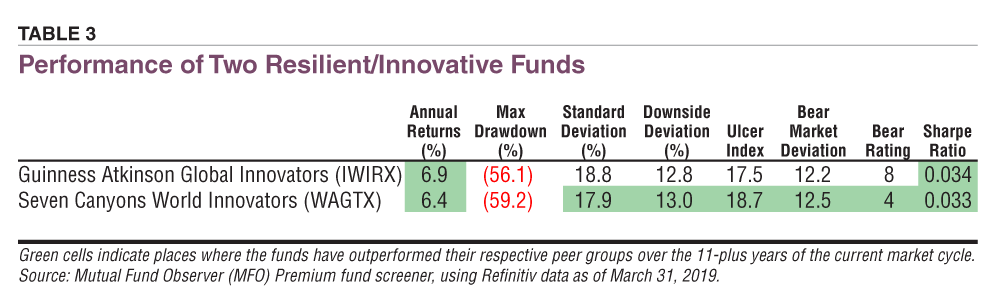
The two funds have earned four- and five-star ratings, respectively, from Morningstar. Both are flexible, global funds run by small, stable management teams. Both have outperformed their peers over the 11-plus years of the current market cycle. Guinness Atkinson has a purely large-cap portfolio, while Seven Canyons invests the vast majority of its portfolio in micro- to mid-cap stocks.
Speaking Up as a Shareholder
In my day job, I’m a communication studies professor. My doctorate is in rhetorical theory and practice. For a quarter century I was a debater, then a debate coach. You had to see this coming, right?
If you invest directly in equities, contact the management of corporations in which you invest and express your views to them. You can find out how the executives of those companies think about, and respond to, the environmental risks around their activities by reading their annual Form 10-K, which is available in the U.S. Securities and Exchange Commission’s (SEC) EDGAR database. The 10-K will list all of the risks that the corporation faces and how it’s responding to them. By way of illustration, General Motors (2018) writes:
“To mitigate the effects of our worldwide operations on the environment, we are converting as many of our worldwide operations as possible to landfill-free operations, which reduces greenhouse gas emissions associated with waste disposal … approximately 50% of our manufacturing operations were landfill-free.
We continue to search for ways to increase our use of renewable energy and improve our energy efficiency … We have committed to meeting the electricity needs of our operations worldwide with renewable energy by 2050 ... We continue to seek opportunities for a diversified renewable energy portfolio including wind, solar, and landfill gas.”
And so on, in some detail. Like what you read? Congratulate them. Don’t like it? Chastise them.
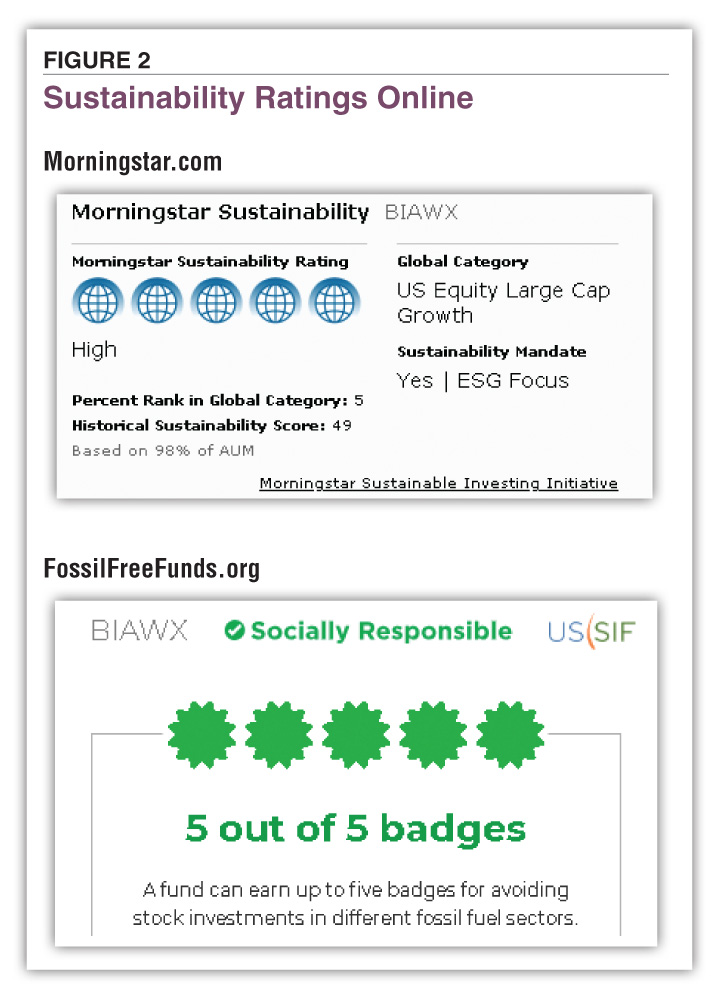
 If you invest indirectly through funds or ETFs, contact the adviser of the fund. I do this all the time. They’re people. They answer the phone. Morningstar publishes a sustainability grade for every domestic equity fund and FossilFreeFunds.org does a similar five-star sort of rating (Figure 2).
Check your holdings’ rating. Like what you see? Congratulate the advisers. Don’t like it? Chastise them.
You can also contact the people you elected to represent you. The League of Conservation Voters publishes an environmental voting record for every member of the U.S. Congress. Check out your representative. If you like what you see … well, you know the rest.
Doing Good for the Planet and Your Portfolio
Individual responsibility alone can’t save the planet. And yet, it’s still the right thing to do. My home is over-insulated and all of the lights are LEDs. My car gets 40 miles per gallon on the highway, and still I walk rather than drive whenever I can. I eat no red meat and only sustainably harvested seafood. None of this will save the planet, and yet all of it saves me.
Collectively, such actions are good for my health—physical, mental and spiritual. Increasingly, that same ethos is good for my financial gains. And, for all of us, that should be quite enough reason to do them.

Related

Portfolio Strategies
The Next Generation of Socially Responsible Investing
Related

Portfolio Strategies
Does Social Investing Generate Higher Returns?
Discussion
FREE REPORT

Get your free copy of our special
report analyzing the tech stocks
most likely to outperform the
market.
John Lambert from NJ posted over 7 years ago:
Van Farris from AL posted over 7 years ago:
Bill Anderson from NC posted over 7 years ago:
mike from KS posted over 7 years ago:
mike from KS posted over 7 years ago:
Steven Turiano from NY posted over 7 years ago:
van farris from AL posted over 7 years ago:
Vic from NV posted over 7 years ago:
Allen Crawford from PA posted over 7 years ago:
Karl from MD posted over 7 years ago:
Nolan Cummins from OK posted over 7 years ago:
Tim from MD posted over 7 years ago:
John Lambert from NJ posted over 7 years ago:
Edmund Roache from NY posted over 7 years ago:
Bob Rea from AZ posted over 7 years ago:
John Graves from NC posted over 7 years ago:
Tim from Rate of Ice Melting Increasing posted over 7 years ago:
Ken Washer from NE posted over 7 years ago:
Randall Jones from TN posted over 7 years ago:
David Hill from OK posted over 7 years ago:
Carlis Faler from TN posted over 7 years ago:
Ray Niemiec from TX posted over 7 years ago:
Wayne Maybach from VA posted over 7 years ago:
Tom Spalding from CA posted over 7 years ago:
Hal from PA posted over 7 years ago:
Tim from MD posted over 7 years ago:
Hal from PA posted over 7 years ago:
Stephen from CA posted over 7 years ago:
Hal from PA posted over 7 years ago:
Stephen from CA posted over 7 years ago:
Hal from PA posted over 7 years ago:
Joe Ogrinc from OH posted over 7 years ago:
mel from MD posted over 7 years ago:
mel from MD posted over 7 years ago:
Gilbert from TN posted over 7 years ago:
Kay from NY posted over 6 years ago:
You need to log in as a registered AAII user before commenting.
Log InCreate an account