

Related

Portfolio Strategies
This classic article from the October 1996 AAII Journal offers up general asset allocation guidelines for a “typical” investor.

It is widely agreed that the asset allocation decision is the most important one an investor will make. How you split your investment funds among stocks, bonds and cash (that is, short-term debt) is more important than your choice of stock mutual funds.
Experts, not surprisingly, do not always agree on the precise allocations that different types of investors should adhere to. Yet, in comparing recommendations from published advisory sources, it is clear that there exists a broad consensus about the appropriate mix among stocks, bonds and cash for most individuals during each stage of their life cycle. Of course, all recommendations carry a disclaimer that individual circumstances may dictate a mix that is quite different.
Many individual investors, though, resemble at least roughly the “typical” investor profile. This article discusses some of the general guidelines that can be gleaned from these broad recommendations for the “typical” investor. And it notes some of the special circumstances that could dictate an asset mix that differs from the consensus.
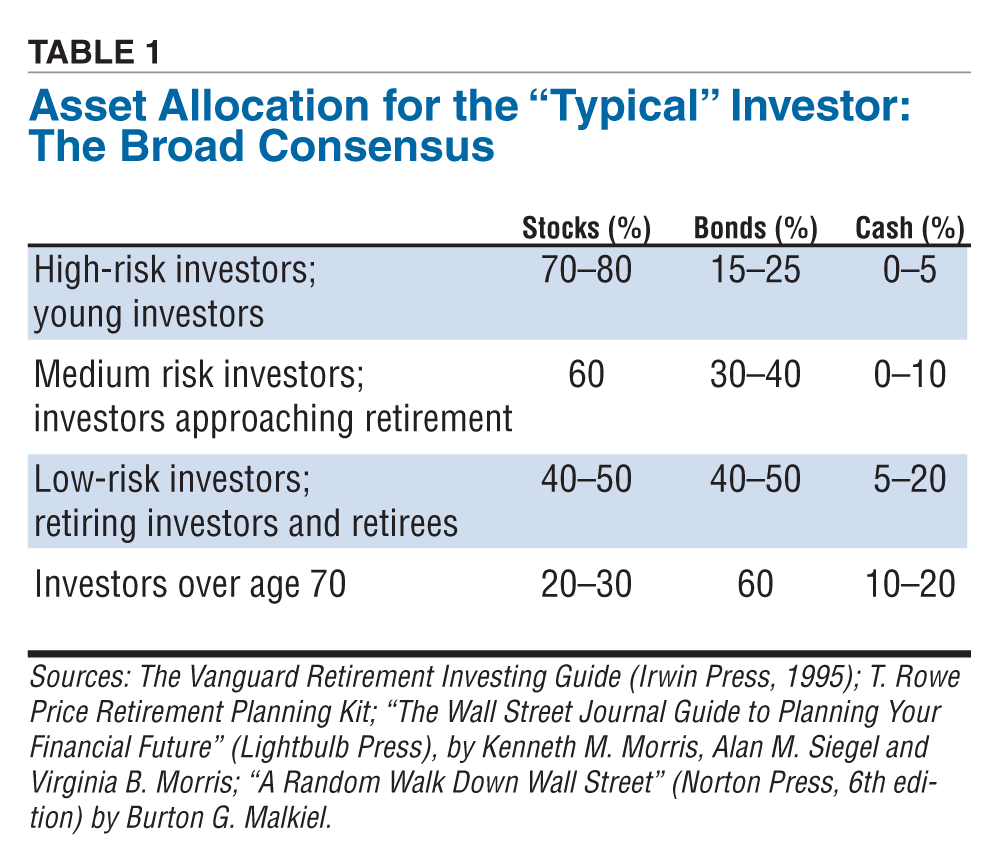
Table 1 summarizes the recommended mixes of stocks, bonds and cash from four well-known advisory sources. The suggested asset mixes include stocks, bonds and cash; they do not include real assets such as one’s home or other real estate. While one source explicitly assumes that investors own their home, it is most likely that the other sources implicitly make this assumption as well, and thus assume investors have a real estate exposure.
While the recommendations vary, they are more similar than dissimilar, and reflect key investment truths. Some of these truths are self-evident, but they are so basic to investing that they are worth explicitly restating. Others are not self-evident, but they are important elements of a sound portfolio. Here is a run-down of the “investment truths” derived from the recommendations’ common elements:
• A fixed-weight strategy, with rebalancing at least annually, is an excellent strategy.
Each of the sources recommends specific asset mixes at different points in an investor’s life cycle. In order to maintain a given asset mix, the portfolio must be periodically rebalanced. The simple idea is that a stable asset mix gives an investor a stable risk exposure that is appropriate for their financial needs, which are typically dictated by the stage in life.
A fixed-weight strategy is a long-run contrarian strategy. When stocks rise from being fairly valued to overvalued, the investor sells the overvalued stocks and buys bonds (or cash), or when putting new money into the portfolio purchases bonds or cash rather than stocks. When stocks fall from being fairly valued to undervalued, the investor sells bonds and buys the undervalued stocks, or uses new money to buy stocks. In short, a fixed-weight strategy allows someone to profit from market misvaluations while maintaining a stable risk exposure.
• Avoid market timing.
Market timing calls for sharp swings in the stock/bond/cash mix based on expected near-term market prospects. For example, a market-timing service may recommend shifting the stock allocation from 80% one month to 10% the second and to 60% the third. By definition, market timing advocates an unstable risk exposure. All sources are unanimous in their discouragement of market timing.
• A portfolio’s risk can be moderated by mixing stocks and debt.
Stocks are claims against real assets. Bonds and cash are debt, usually promising fixed returns. Stock and debt are fundamentally different animals and, consequently, their returns tend not to follow similar patterns to each other. Consequently, combining stocks and debt moderates the portfolio’s risk.
On a broader scale, individuals who hold stocks and debt in their investment portfolio and own their own home have their broad portfolio diversified among stocks, debt and real estate—three asset types whose returns do not vary closely together.
 • The longer the investment horizon, the larger the portion of the portfolio that should be allocated to stocks.
Young investors who are years from retirement can invest more of their portfolio in stocks than the elderly. Although year-to-year stock returns are volatile, the young can be reasonably confident that the good years will more than offset the bad years over their investment horizon. As you age and your investment horizon shortens, you are less confident that there will be enough good years to offset the bad, and the recommended allocation to stocks decreases.
• Everyone should have some exposure to stocks, even a conservative 80-year-old couple.
Historically, the returns on a portfolio of long-term Treasury bonds have been more volatile (that is, riskier) than a portfolio with 90% bonds and 10% common stocks. Stocks held alone are riskier than bonds held alone, but due to the magic of diversification you can add some stock to an all-bond portfolio and actually reduce the portfolio’s risk.
Diversification means not putting all your eggs in one basket even if the basket looks safe. Since 1926, the volatility of an 80% bond/20% stock portfolio has been equal to that of a 100% bond portfolio. This helps explain why no one recommends a stock weight of less than 20%.
Examination of the detailed recommendations of the sources reveals other widely held investment truths:
• Diversify within the stock portion of the portfolio. In particular, an investor should always have an exposure to large-value and large-growth stocks.
There are two dimensions to investing in the stock market: size and style. Size refers to the size of the firm. In general, the 500 stocks comprising the S&P 500 index are considered “large” stocks, which account for almost 75% of the market value of all U.S. stocks.
Style refers to the investment style or philosophy to which a company is most likely to appeal. Growth investors seek growth stocks—firms with fast-growing earnings. They tend to have low dividend yields, high price-earnings ratios and high price-to-book-value ratios. Value investors seek value stocks—firms whose shares are selling below their “real” value. They tend to have high dividend yields, low price-earnings ratios and low price-to-book ratios.
Diversification within a stock portfolio would consist of investing some portion in each of these areas—large- and small-capitalization stocks (with proportions roughly equal to their weighting in the total stock market, a 75%/25% large-cap/small-cap mix) and growth and value stocks.
• International stocks should be a part of everyone’s portfolio, with the possible exception of the elderly.
Recommendations for international exposure start at about 15% to 20% for younger investors, and gradually decrease as one gets older. One source recommends no exposure for those who are 75 or older.
 • Young investors should put more emphasis on international stocks, small stocks and growth stocks while older investors should put more emphasis on large-cap stocks, especially value stocks.
While broad diversification is always encouraged, younger investors can take more risk, and can therefore place greater emphasis on the riskier portions of the stock market; older investors can still invest in these areas, but their emphasis should be on more stable, large-capitalization companies.
• Investors can avoid the emerging international stock markets.
Emerging stock markets promise a wild and bumpy ride. Only one source mentions emerging markets, and that source does not advocate an exposure to emerging markets for investors who are in their late 30s or older. The consensus view is that an investor can safely avoid these stocks.
• As one ages, shift the bond portion of the portfolio from primarily long-term bonds to primarily intermediate-term or short-term bonds.
Bond prices become more stable as maturity shortens. Thus, the advice to shorten bond maturity as one ages is consistent with the other advice to move toward assets with more stable prices.
• As one ages, the cash portion of the portfolio increases.
Increasing cash assets is part of shortening the bond maturity for increased price stability.
• High-grade corporate bonds and Treasury bonds of similar maturity are close substitutes.
No one distinguishes between buying high-grade corporate bonds or Treasury bonds of similar maturity, because the returns on these bonds move very closely together, although high-grade corporate bonds tend to have slightly higher yields. In contrast, high-yield bonds have a much higher default risk and consequently are lower-graded; these are not close substitutes for high-grade corporate or Treasury bonds.
It is clear that there is a broad consensus about the appropriate mix of stocks, bonds and cash for “typical” investors at different life cycle stages. But are you a “typical” investor for your age, or should your portfolio be different from the consensus portfolio?
There are at least three reasons why your portfolio may differ from that of the consensus:
How do you know if you have an average risk tolerance? While an investor’s risk tolerance is of critical concern, it is difficult to measure. Probably the best approach to this tricky issue is to examine downside risk, which indicates the amount a given mix could be expected to drop during a severe bear market. If the recommended asset mix entails too much risk, you should adopt a more conservative mix, reducing the recommended stock allocation by 10 percentage points; if you believe you can tolerate more risk, you can increase the stock allocation by 10%. Table 2 presents average returns, the average loss, worst annual loss and the loss during the 1973–1974 bear market for portfolios at four different stages of a typical investor’s life cycle that fall within the consensus view; the figures are based on historical returns from 1926 through 1994.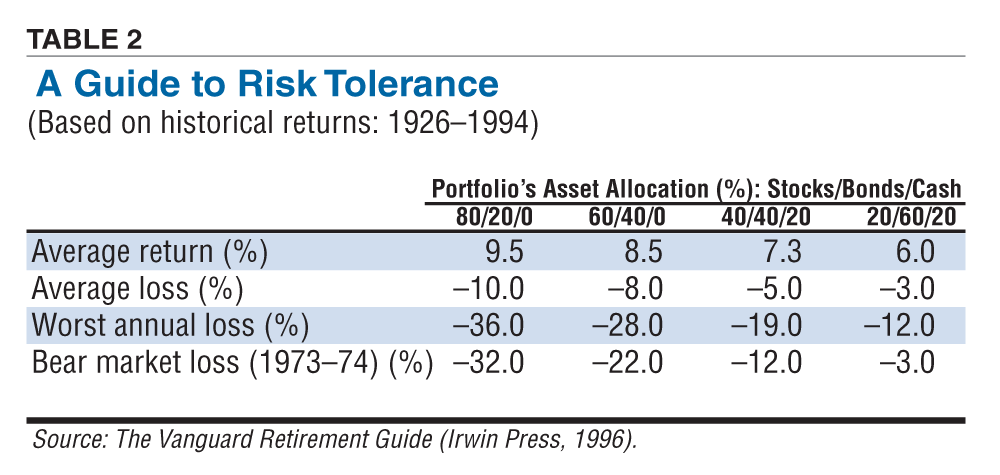
The second factor affecting an individual or family’s target asset mix involves its nonfinancial assets and liabilities. These include real assets such as the family home, other real estate, a family business and prospects for inheritance (whether certain or very likely). It also includes liabilities like a mortgage and the future costs of college education. It may also include the individual or family’s human capital (that is, future income). [For more on this, see “An Expanded Portfolio View Includes Real Estate and Human Capital,” by Charles Delaney and William Reichenstein, in the July 1996 AAII Journal.] While there are an infinite number of potential unique circumstances that may affect one’s target asset mix, here are the most common circumstances:
The third factor that may cause you to stray from the consensus mix concerns market prospects. Recall the unanimous disapproval of market timing, which calls for sharp swings in the asset mix based on short-term market prospects. However, the current state of investment knowledge is mixed on the question of whether one should make modest changes in their asset mix based on long-term market prospects. Theory and some empirical evidence suggests that we have a limited ability to predict whether, for example, stocks will do better or worse than average over the next three years. Nobel laureate Paul Samuelson looked at the evidence on this issue and argues that it is sufficient to warrant changing your target weights plus or minus 10% at most. However, others would strongly argue that investors should stick with a fixed-weight strategy, with rebalancing at least annually.
A careful study of recommended asset mixes from four prominent financial firms and eminent experts indicates that they share much of the same advice: a fixed-weight strategy is an excellent one; avoid market timing; diversify across stocks and bonds; diversify within the stock portion of the portfolio; and, as you age, shorten the maturity of the fixed-income portion of the portfolio.
The recommendations also reflect a broad consensus about the appropriate mix of bonds, stocks and cash for the “typical” individual during each stage of his life cycle.
However, there are times when an individual will not reflect the “typical” profile and may need to stray from the consensus. An individual’s target asset mix could vary from the consensus mix due to: his risk tolerance and atypical nonfinancial assets and liabilities, including human capital. In addition, an investor may reasonably decide to let the actual mix vary modestly from his target mix due to market prospects over the longer term.
Most of the shared advice is basic—it reflects common elements of a sound portfolio.
But then, most of what one needs to know about investing is basic.
Portfolio Strategies

Portfolio Strategies

MMM from VA posted over 7 years ago:
D S from CA posted over 7 years ago:
Jean from AAII posted over 7 years ago:
Mike Weller from WA posted over 7 years ago:
Jim from Wisconsin posted over 7 years ago:
Charles Rotblut from IL posted over 7 years ago:
Chief Howe from colorado posted over 7 years ago:
Gordon Robinson from NC posted over 7 years ago:
Bill from HI posted over 7 years ago:
Steve from CT posted over 7 years ago:
ROBERT A from NC posted over 4 years ago:
BARRY J from TX posted over 1 year ago:
You need to log in as a registered AAII user before commenting.
Log InCreate an account