

AAII Survey: Retail Investors Offer Thoughts in Primary Market Drivers for Rest of 2019
by AAII Staff | July 15, 2019

According to the Investment Company Inc. (ICI), more than $21 trillion was invested in mutual funds and exchange-traded funds at the end of 2018. This money is invested in tens of thousands of mutual funds, open-ended funds and exchange-traded funds, each with a specific investment objective and style.
AAII Weekly Survey Question
With so many funds to choose from, how does an individual investor decide which one(s) in which to invest? Last week’s member question set out to answer this by asking:
What is the primary factor you use when choosing a mutual fund or exchange-traded fund (ETF)?
Here are the results:
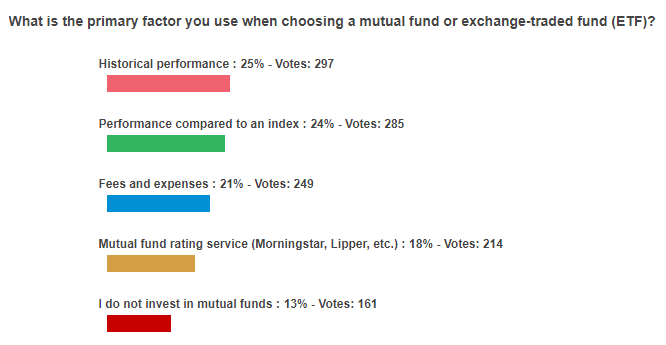
In all, 1,206 readers participated.
Almost half of those participating said that performance is the primary factor these use when selecting a mutual fund or ETF. This could be the historical performance of the fund itself (25% of all votes) or performance relative to a benchmark or index (24% of all votes).
Coming in third as the primary factor when choosing a mutual fund or ETF is fees and expenses. Many investors unwittingly buy mutual funds that have great performance but have above-average fees that, in the long run, can have a materially negative impact on your overall performance.
Eighteen percent of participants say they primarily choose funds and ETFs based on the ratings given to them by the likes of Morningstar or Lipper.
The remaining 13% of participants say they do not invest in mutual funds or ETFs.
Weekly Special Question
U.S. stocks posted a strong first half to 2019, although the gains in the second quarter were hard-won. The S&P 500 closed on June 28 0.42% away from its all-time high of 2,954.18 after posting its best first half of a year since 1997. Since the close of June, the large-cap index cracked the 3,000 barrier.
On July 1, the current economic expansion became the longest in U.S. history, breaking the previous record of 120 months of growth from March 1991 to March 2001, according to data from the National Bureau of Economic Research.
The upcoming earnings season will set the table for the rest of 2019 for stocks, with many analysts warning of declining earnings growth. The ongoing tariff situation between the U.S. and many countries, but namely China, could also impact the economy in coming quarters, as will the direction the Federal Reserve takes on interest rates. As of now, the market is fully expecting a rate reduction at the FOMC’s month-end meeting.
While there are many levers that can move the market, we wanted to know what our members think will be the primary driver of the stock market over the second half of 2019. So last week’s special question asked:
What do you think will move the stock market the most in the second half of 2019?
In all, we received 213 responses.
Our members expect tariffs to be the biggest driver of the stock market for the rest of 2019, garnering 45% of the votes.
Nearly 22% of readers feel that the Fed, and the interest rate actions it takes, will be the key driver for stocks in the second half of the year.
Fourteen percent feel that President Trump will move the stock market the most for the remainder of the year, which could include tariffs, trying to remove Fed Chair Powell or any of a number of actions.
Some of the other issues that our members feel could drive the market the rest of the year include:
-
Geopolitical affairs
-
Corporate earnings
-
The 2020 election race
Here is a sampling of the responses from our readers as what they feel will move the stock market the most in the second half of 2019:
-
“A big blunder by Trump.”
-
“An agreement between the United States and China on imports/exports.”
-
“Concerns about everything, an unstable white house, an aging bull market, a contentious election cycle, international instability. The list goes on.”
-
“Looming recession fear.”
Everybody has an opinion! Why not give us yours? Participate in our weekly member poll, updated every Monday, and see the results online at www.aaii.com/memberquestion.
Discussion
No comments have been added yet. Add your thoughts to the discussion!
You need to log in as a registered AAII user before commenting.
Create an account