

Related

Stock Strategies
Three important actions by corporate heads suggest that business confidence is solid. While they won’t cure all that ails the earnings cycle, they are optimistic signposts that bolster the prospects for positive financial market trends.

Nothing can destroy business leader confidence more than flagging profitability. Hence, surveys portraying a decline in CEO, CFO and general business confidence have raised alarms about future earnings growth. Added to this are growing fears that businesses may be curtailing spending plans.
Actions, though, often speak louder than words. Three important actions by CEOs suggest that business confidence is solid: dividend payments, staffing and capital expenditures. This optimism is further reinforced by largely ignored positive factors surrounding the profit cycle, and by the character of corporate spending itself, which has been completely transformed in recent years and is now driven by more stable and healthier undercurrents.
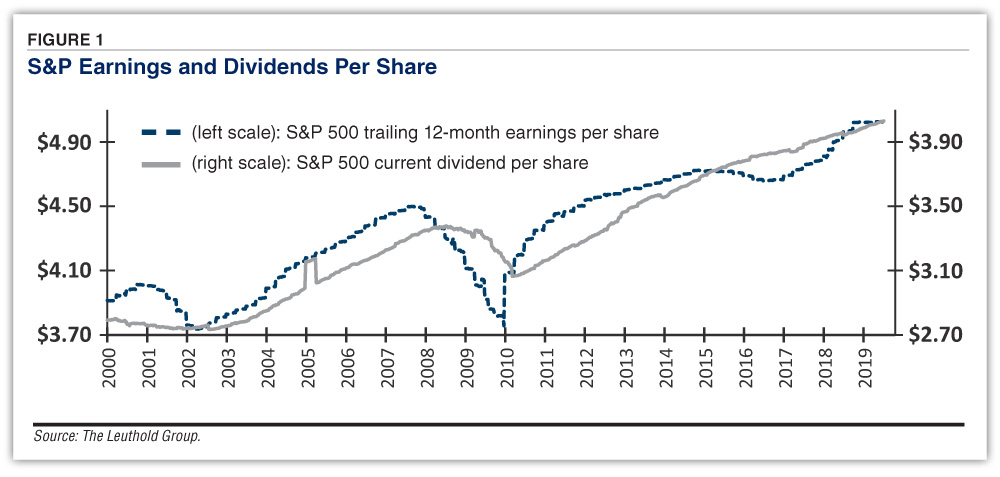
Despite listless profitability of late, companies have not halted dividend payments. When profit growth stalled in the early 2000s and early 2008, dividend hikes were suspended. In contrast, when earnings for the S&P 500 index declined during the 2015–2016 period, companies continued to raise dividends and the earnings advance was rekindled (Figure 1). With earnings per share being flat since last September, the absence of a dividend freeze says companies are confident in their future earnings potential.
From an expense standpoint, staffing is typically a firm’s primary cost decision; however, ostensive concern about profits has not caused CEOs to back away from adding employees. Rather, U.S. employment strength is presently highlighted by low unemployment claims, low layoff announcements and a high level of job openings reported by the Job Openings and Labor Turnover Survey (JOLTS). When profit growth peaked in both 2000 and 2007, companies were quick to begin slowing, if not reducing, employment. Earlier in this recovery, back in 2015–2016, a hefty profit lapse also occurred yet CEOs maintained hiring policies throughout that slowdown. Today’s slower economic growth has likewise not troubled CEOs to the point of reducing head counts.
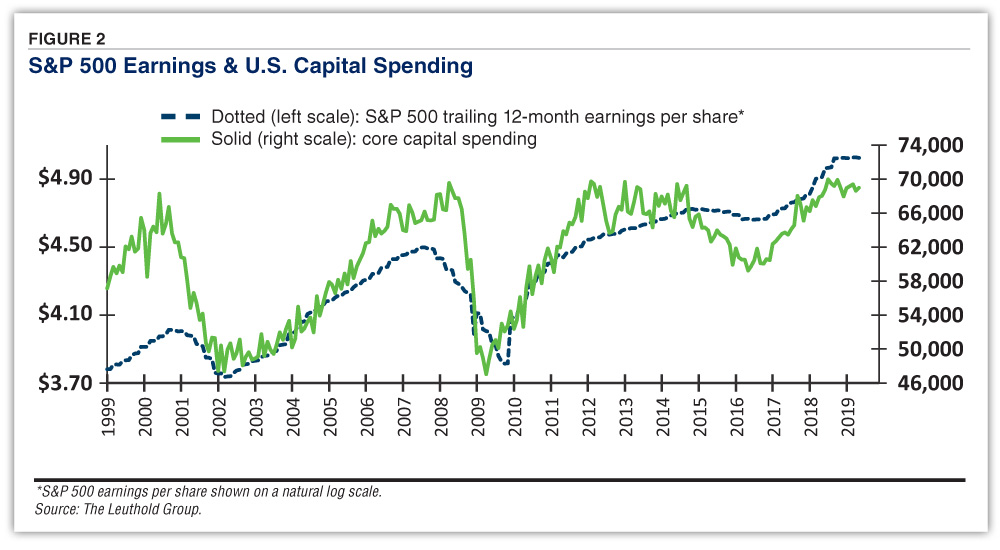
Another CEO action that requires considerable confidence in the future is capital expenditures, and that has held up far better than widely perceived. Many economists, including Federal Reserve chairman Jerome Powell, have named weak capital spending as evidence of subdued corporate conviction. However, while overall capital spending has diminished, core capital spending is not only at recovery cycle highs, it is near a 20-year high. In spite of last year’s flatlining of S&P 500 earnings, core capital spending has proved far stronger than during the global manufacturing slowdown of 2015–2016 (Figure 2). (Overall capital spending has declined primarily due to one-off events like major Boeing aircraft order cancellations; core capital spending measures nondefense, ex-air capital goods orders.)
From a profit margin stance, pressure is easing on a variety of fronts. Last year, overheated economic growth, in a fully employed economy, pushed costs higher across the spectrum (labor, capital and materials). This phenomenon led to the bulldozing of profit margins in 2019. In the meantime, economic growth has slowed, which has alleviated the overheated forces, and this may be paving the way for a revitalized profit-margin boost.
Predictably, changes in labor costs are inversely associated with profit margins, and this measure can be a “leading” indicator as to whether margins are poised to rise or fall. For example, in 1992, 2002 and 2008, a meaningful drop in labor-cost growth preceded substantial improvements in profit margins. In this decade, the two-quarter moving average in the annual growth of unit labor costs peaked at about 2.4% at the end of 2017; it has now faded to near –0.2%. The historic lagged response of profit margins to changes in labor costs implies that many companies may be reporting margin enhancements in the coming year.
Capital costs also have a close inverse relationship with profit margins, as would be expected. Indeed, until this year, profit margins rose in tandem with the steady decline in interest expense. While this was interrupted in 2018 when yields rose, pressures have mostly reversed from a year ago, which adds another level of margin relief for most firms.
Finally, companies are enjoying cheaper materials costs. After a steady upsurge in industrial commodity prices from 2016 to mid-2018, they have since decreased 15%. Labor, capital and materials costs have all dropped in the last year, again suggesting “improved profit margins” could become a theme during earnings seasons over the next 12 months, as cost pressures tend to front-run changes in company profit margins.
This year’s economic anxieties are being further fueled by mounting fears that businesses may be curtailing spending plans. Business investment is widely recognized as a highly volatile component of GDP (gross domestic product), often considered a primary cause of the conventional capitalistic boom/bust cycles. Recent years have been no exception. In the second quarter, real nonresidential investment outlays declined for the first time since early 2016. However, this decrease was entirely due to “old-era” investment spending.
As in 2015–2016, the global economic expansion is suffering from weakness in traditional old-era manufacturing, if not recession, and a slowdown in old-era spending (manufacturing and utility-construction and/or industrial and transportation equipment purchases). On the other hand, “new-era” spending (proxied by information processing equipment and intellectual property products) is healthy. The character of “new” versus “old” investment expenditures is strikingly different and U.S. business investment currently reflects a bifurcation that is evident throughout the economy.
This distinction between old- and new-era expenditures is more important than ever because this is the first time in which new-era business spending has formed the biggest share of business investment. A significant deterioration in old-era spending was often a precursor to recession. Growthier new-era business expenses are now the largest part of business budgets, and this is lessening the effect of cyclical weakness from the traditional old-era disbursements.
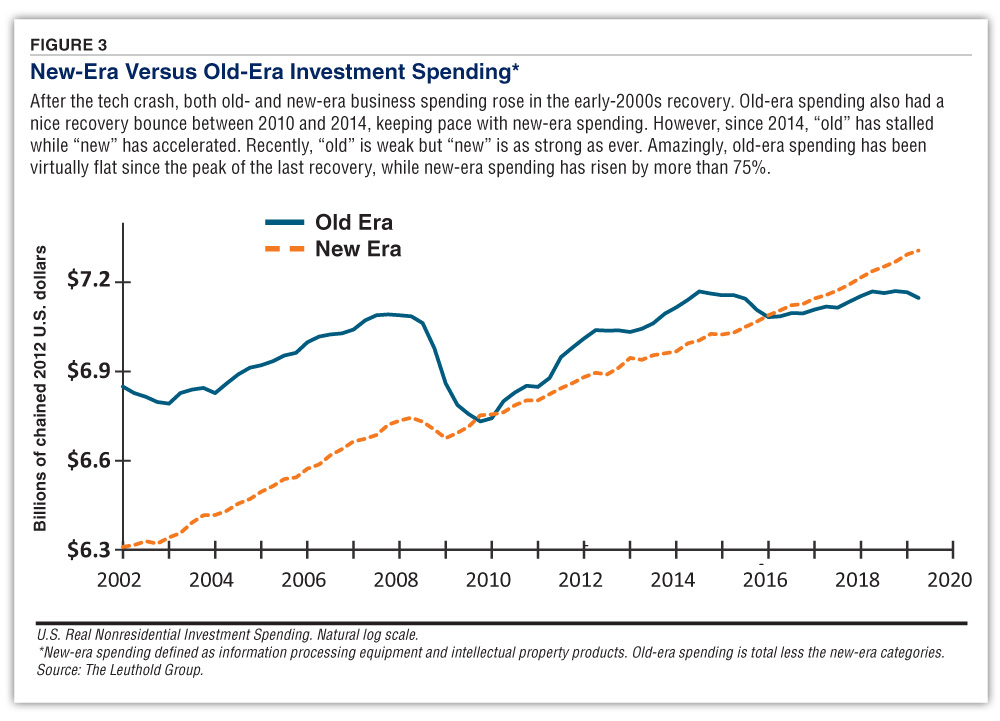
Old-era business spending boomed during the latter part of the early 2000s economic recovery and busted in the 2008–2009 recession. It has shown a similar character in the current recovery: booming early and experiencing substantial volatility since 2014. Conversely, new-era investment is typically quite stable, persisting at a healthy growth rate even during periods when old-era expenses are volatile. During the Great Recession of 2008, new-era business spending suffered only a short and shallow setback before returning to its solid consistent growth pattern; old-era spending underwent a precipitous drop (Figure 3).
At the start of 2002, old-era investment expenditures comprised two-thirds of the total, but now new-era spending tallies 54%. In other words, contemporary concerns about anemic investment programs are based on a segment of overall business investment that is much smaller than it was at the start of the current economic recovery. Given such a dramatic shift in the composition of business investment, the old notions and conventional methodologies that are used to assess the health of business spending may no longer be relevant.
Akin to economic growth in general, total business investment has been feeble during this recovery. Despite a record-long economic expansion, old-era business spending has barely grown. From the peak of the last economic recovery in 2007, old-era real investment has risen by only 5.7% (less than 0.5% per annum). Conversely, new-era outlays have surged by more than 75% over the same period—a 5% real (inflation-adjusted) annualized pace.
For the second time in this recovery, old-era business spending has contracted while new-era investment continues to swell. Consequently, softness of investment expenditures may be less about the rising risk of a collapse than about an ongoing divergence between old- and new-era allotments.
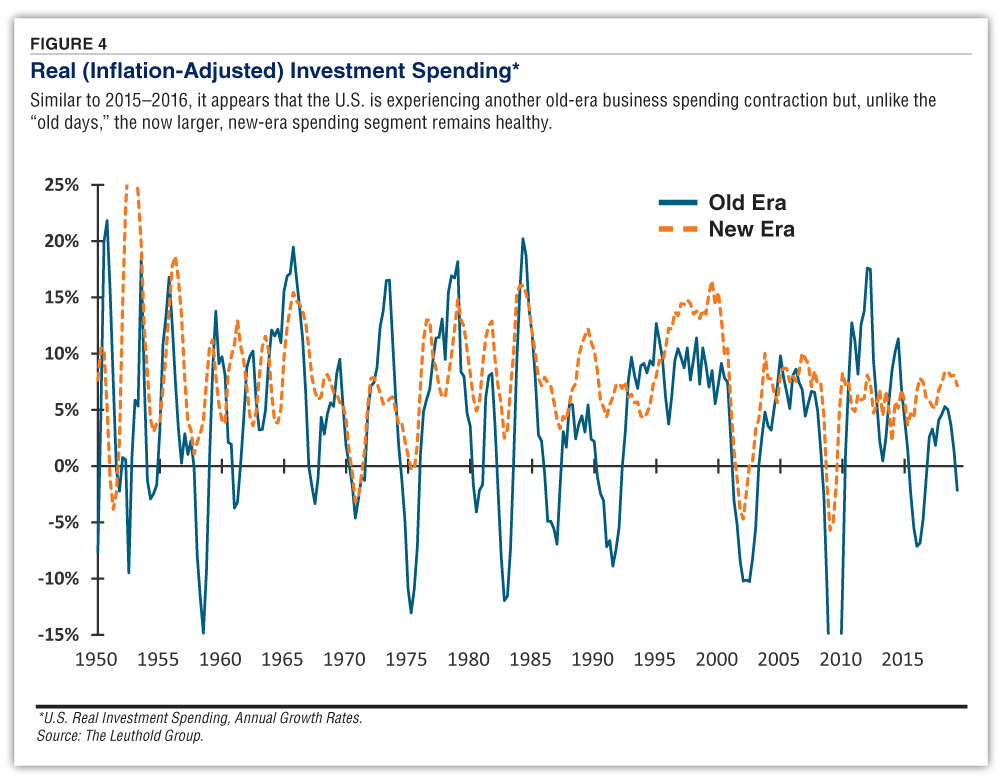
The importance of new-era business investment has changed dramatically from what it represented just a few years earlier. Until 1980, new-era allowances were small and immaterial. Consequently, overall U.S. business investment was driven by the character of old-era investments. By the start of 1990, old-era investments still constituted about three-fourths of total business spending and, despite the dot-com boom, the new-era share of outlays rose to only about one-third of the total by the year 2000. Even at the start of the current recovery, new-era investments made up less than 40% of total nonresidential investment. Today, new-era investments have grown to encompass over half of business spending, and if this trend endures, it will soon represent two-thirds of total company outlays (Figure 4).
Rapidly growing new-era investments combined with very sluggish growth in the old-era allocations have quickly and notably transformed the character of U.S. business investment. Until recently, it was a highly cyclical spending category, based and driven importantly by the vagaries of economic policy and business confidence. Suddenly, within the last few years, it has become dominated by new-era expenditures. As a result, business investment is less sensitive to policy changes and company confidence; it is driven more by new product cycles, is much more stable during both expansions and contractions and tends to grow at a persistently faster pace.
Size matters. Because new-era spending has gone from irrelevant to dominant in such a short time, economic policy officials, forecasters, businesses and investors are still adjusting to the new character of business investment. Flimsiness in old-era business budgets does not have the same implications this time around, and the signals from “old” style business investment, of late, may be misleading.
In the past, when old-era investment suffered a one-year decline, the economy almost always suffered a recession. Prior to the current recovery, this happened 13 times resulting in 10 recessions. By contrast, new-era spending has had only five episodes of contraction in the post-war era. Historically, old-era expenses drove the business cycle regardless of the health of new-era spending. Now that new-era outlays are robust, contractions in old-era investment are not as damaging to the general recovery.
In the last two recessions, both old-era and new-era investment contracted. But during the global manufacturing recession of 2015–2016, only the old-era variety experienced a large drop, and the economic expansion eventually resumed. Old-era business investment is now shrinking while that of the new-era category is seeing its strongest growth rate of the entire recovery. When new-era spending was small and inconsequential in years past, a contraction was an indication of great peril for the economic recovery. Conversely, today, with the new-era segment of U.S. business investment continuing to grow at a sturdy clip, widespread unease about business confidence and deteriorating old-era investment may be overblown.
From an investment perspective, as long as new-era disbursements continue to steer overall business outlays, we expect the technology sector will continue to benefit in spite of its long-time popularity and high valuation. Although there is legitimacy in these worries, the relative performance of tech stocks is being driven by businesses reallocating spending toward new-era investments. This positive undertow for technology stocks should be in place at least until the next recession.
Measures of business confidence have dwindled this year, perhaps due to nervousness about the ongoing trade war. Understandably, many are watching business activities for an indication that companies are pulling back on both investments and hiring decisions—a sign of recession. At the same time, corporate earnings are being pressured by sagging global sales growth.
Notwithstanding these fears, dividend payments are still on the rise, employment is strong and capital spending has held up far better than generally recognized. Even though corporate CEOs are expressing anxieties, they are “acting” confidently, which suggests they continue to expect satisfying earnings results in the coming year.
Furthermore, the nature of investment spending has refashioned away from old-era manufacturing/industrial type of dynamics to information/intellectual-property applications, and cost pressures have noticeably lessened—a positive signal for profit margin trends that has been ignored. Behind the scenes, a considerable package of expansionary economic policies employed about the globe since late 2018 should also soon quicken the pace of total economic growth and improve sales trends.
None of these favorable facets will cure all that ails the earnings cycle, nor totally rejuvenate an aging recovery, yet these are optimistic signposts that bolster the prospects for positive financial market trends to be prolonged in coming months.
Stock Strategies

Value Investing


Don from ND posted over 7 years ago:
Donald Myers from AZ posted over 7 years ago:
Wm. F. Fusco from CT posted over 7 years ago:
Jim from NJ posted over 7 years ago:
You need to log in as a registered AAII user before commenting.
Log InCreate an account