

Related

Financial Planning
Modest estates are particularly susceptible to the vicissitudes of life, whether financial, health or legal. Failure to plan well can be catastrophic. An explanation of the essential documents you need.

As attorneys specializing in estate planning, we find that the average client’s net worth is far below the threshold for gift, estate or generation-skipping transfer tax planning. The estate may be very healthy, but it is not going to be taxable. Let’s call it a “modest estate.”
In this article, we explore the basics of planning for modest estates, including essential estate planning documents everyone should have in place. We also discuss the differences when planning with a will and when planning with a revocable living trust. Finally, we cover how and when to effectively use direct beneficiary designations for various types of assets to avoid probate.
Regardless of your age or financial circumstances, everyone needs an estate plan. For the benefit of your loved ones, you should have at least the following basic estate planning documents in place:
Your will sets forth the disposition of your estate upon your death and can include the creation of testamentary trusts upon your death for young beneficiaries or for beneficiaries with other special circumstances. In addition, your will designates the executor of your estate. In most states—such as in Wisconsin, where we practice law—the modern term is used, namely “personal representative.”
Similarly, your will should set forth the guardians for your minor children, if any. Under Wisconsin law, there are two types of guardians—a guardian of the person and a guardian of the estate. The former is the child’s caretaker; the latter is the child’s money manager. These roles may be held by the same person or two different people. We prefer to bifurcate the roles so there is a check and balance in place. In any event, guardianship under Wisconsin law (and most other states, too) is handled in the probate court. Many people do not realize this.
Accordingly, if you are depending on your will to transfer your assets, a probate proceeding will be required after your death. And, with children, the guardianship of the person and the estate will remain open inside the probate court until your youngest child reaches age 18. This could be years and years!
As an alternative, you may want to consider creating a revocable living trust. This way, you can avoid probate and guardianship of the estate. In that case, your children would have a trustee (free of courts and attorneys) for money management and only a guardian of the person as caretaker.
Your property power of attorney (sometimes called a “financial power of attorney” or “durable power of attorney”) authorizes your agent to manage your financial affairs. Your property power of attorney can become effective either immediately or only in the event you are unable to manage your financial affairs yourself. A comprehensive property power of attorney can avoid the need for an adult guardianship process (sometimes called “living probate”) in which the court appoints a legal guardian of your estate during any period of mental incompetence. In Wisconsin, this is written right into the statutes. A guardianship of the estate may be denied if the property power of attorney is sufficient. This is very advantageous. But you have to plan it—you can’t do it once the cows have left the barn. (And, for the Wisconsinites among our readers, Swiss Brown cows are definitely not going back in there—very stubborn.)
Naturally, there are trade-offs to consider. A slew of articles in national newspapers and magazines have highlighted the drawbacks to property powers of attorney. Chiefly, powers of attorney are viewed with great scrutiny by big banks and brokerage houses: They are often not accepted or the acceptance is terminated, and full guardianship demanded.
Therefore, a revocable trust is generally superior to a power of attorney. But, the power of attorney is certainly a step in the right direction!
Your health care power of attorney authorizes your designated agent to make medical decisions for you when you cannot. A comprehensive health care power of attorney, like a financial power of attorney, can also help to avoid the need for an adult guardianship process (living probate) in which the court appoints a legal guardian of your person during any period of mental incompetence. As discussed above, Wisconsin courts can refuse to impose a guardianship of the person if a health care power of attorney will do the job.

But, beware! Many health care powers of attorney—especially those legislated, statutory forms found online—are only activated when you are deemed mentally incompetent. The problem is that you may be mentally competent but still in need of help from your health care agent. You may be in shock, on morphine, in the middle of surgery or just really stressed or tired due to your medical condition. Why can’t your trusted agent make some decisions for you here?
In Wisconsin, as in many other states, an attorney can help you draft an immediate health care power of attorney among other improvements to the legislated, statutory forms. In our practice, this has saved lives! And, when has your legislature ever articulated your particular health care wishes?
Some state legislatures have even doubled down and comingled financial powers and health care powers together into one document. What a mess!
Planning with an attorney is key to good health care powers.
Your living will (sometimes called a “directive to physicians”) states your care directions about end-of-life decisions—life-support machines, breathing tubes or feeding tubes. This applies if you become terminally ill or you lapse into a persistent vegetative state or permanent coma. In Wisconsin, this can be a document unto itself, or it can be written into your health care power of attorney.
If it is a separate document, we find that a large number of folks have issued contradictory instructions in their health care power of attorney versus their living will. In Wisconsin, the parents of a soldier with a head wound sustained in Afghanistan sued to keep him on life support under his living will, while his wife counter-sued to remove support under his health care power of attorney. Tragic!
HIPAA is the Health Insurance Portability and Accountability Act of 1996, which gives you rights over your health information.
Your HIPAA authorization (sometimes called “authorization for release of protected health information”) authorizes the release of your health information to designated persons. Again, this is typically handed out as a form and is only effective if you are incapacitated, rather than effective immediately. Surprisingly, it may include waivers, wriggling and other legerdemain added by the hospital who gave it to you! This protects them.
What about you? Plan ahead and do it with a knowledgeable estate attorney.
This is relatively new to Wisconsin; your state may or may not be on board yet. In short, an Authorization for Final Disposition authorizes a designated individual to make funeral arrangements on your behalf. It should also include a statement of your personal wishes as to burial or cremation services. Sadly, without this authorization, we have seen bodies sit at the funeral home for months while the spouse and children argue about the funeral arrangements.
If your state does not permit the appointment of an official “agent” who can work out your funeral arrangements, then you should definitely consider a funeral plan or prepaid arrangements.
Your personal property memorandum provides instructions directing the disposition of your personal effects such as jewelry, family heirlooms and special collections. Instructions regarding digital property can also be included in a memorandum. In order for this type of memorandum to be legally enforceable, your will must contain language specifically referencing the document. Although this is a Wisconsin statute, it is based on a national “model” statute, which has been adopted by many other states. It may be available to you outside of Wisconsin.
If you have named a direct beneficiary on your life insurance policy, retirement account or annuity, then that asset will pass directly to the named beneficiar(ies) on your death, outside of probate.
Payable on Death (POD)—If you have designated a POD beneficiary on your bank account, then the account will be paid on your death directly to the named beneficiar(ies).
Transfer on Death (TOD)—If you have designated a TOD beneficiary on your investment account or real estate, then that asset will be transferred on your death directly to the named beneficiar(ies).
 Using beneficiary designations in support of your comprehensive, professionally prepared estate planning is essential. However, using beneficiary designations as the sole means of passing your property is generally foolhardy. We have written and spoken extensively about this across the country. (See our article “Avoid the Top 10 Mistakes Made With Beneficiary Designations” in the November 2014 AAII Journal.) But it all comes down to this: a beneficiary designation consists of one entry with a name (or a few names) listed on it. This is simplistic and very often problematic or fatal to your estate planning. Remember: “for every problem there is a simple solution ... and it’s wrong.”
A quick example: Many individuals name their children or grandchildren as beneficiaries of insurance policies, bank accounts or financial accounts. What they may not know yet is that the child or grandchild is receiving, or will later apply for and receive, a governmental benefit such as Supplemental Security Income (SSI) or medical assistance based on a disability. Thus, if named as a direct beneficiary, you could unintentionally disqualify that individual from receiving their valuable governmental benefits. This can happen with as little as a few thousand dollars! The individual must then “spend down” the inheritance and, after virtually all the money has been spent, go through the grueling application process again. Success there is not guaranteed.
If you wish to leave an inheritance for a loved one who is receiving this type of assistance, it is much better to create a special needs trust, also known as a supplemental needs trust, within your will or living trust to hold the inheritance for the benefit of that individual for their lifetime without jeopardizing their benefits.
And, if the child or grandchild is very young, for example, then you have no idea what life holds for them; it is often advisable to include precautionary, contingent provisions for special needs in your will or trust, even though the need is not then present. In such case, your designated beneficiary becomes the trust rather than the individual themselves. Following your death, the funds pass through your will or trust plan. If your beneficiaries are fine—no government benefits in play—then the funds are distributed directly to the beneficiary. If not, then the funds pass into the special needs trust for your beneficiary to use.
Even if your intent is for an insurance policy or bank account to be used to pay your funeral expenses after your death, the individual you have named as the direct beneficiary is under no legal obligation to use this money for its intended purpose.
Further, this approach using beneficiary designations, alone, offers no asset protection to your beneficiaries. By contrast, set up a beneficiary-directed trust. (See our article “Using Beneficiary-Directed Trusts to Protect Your Heirs” in the October 2018 AAII Journal.)
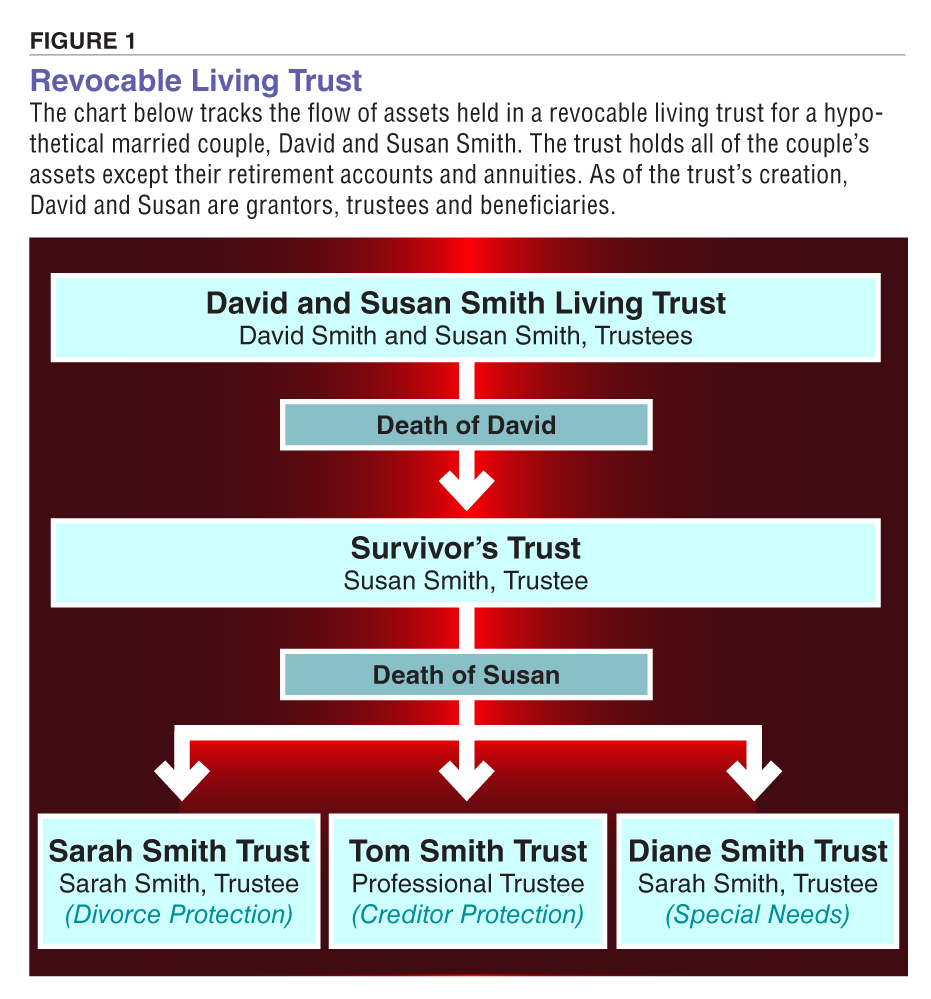
A revocable living trust (also known as an “inter vivos” trust) is an estate planning tool used primarily to establish who will manage your assets during your incapacity and how your property will be distributed upon your death. Most living trusts are “revocable” because you retain the power to amend them as your circumstances or wishes change. Revocable living trusts are “living” because they are created and become effective during your lifetime.
Generally, one of the primary purposes of creating a revocable living trust is to avoid the necessity of a probate proceeding upon your death. Upon your death, any asset titled solely in your name, with no direct beneficiary designation, is typically subject to the probate process—even if you have a valid will in place. Probate is the court-supervised process of validating your will, if you have one, of ensuring your final debts and expenses are paid and then distributing the remaining probate estate to the beneficiaries named in your will or to your heirs at law if you have no valid will in place (i.e., you died “intestate”). Probate can be expensive and time consuming and is generally a public court proceeding. If you own real estate in multiple states, a separate probate proceeding in each state in which you hold property at the time of your death is often necessary. Property owned by your revocable living trust at the time of your death will pass according to the terms of your trust, without the necessity of a probate proceeding.
(Wisconsin has a procedure allowing any heir of the decedent, trustee of a revocable trust created by the decedent or person who was guardian of the decedent at the time of the decedent’s death to use an affidavit to transfer estate property without more formal probate procedures or court involvement. This affidavit procedure is available when a decedent leaves property subject to administration in this state that does not exceed $50,000 in value.)
The three primary positions of a trust are:
A revocable living trust agreement is a written document, signed by the grantor(s), typically in the presence of two witnesses and a notary public (note that legal requirements of a validly executed trust document vary from state to state). The agreement should name an initial trustee and successor trustees in the event the grantor becomes incapacitated and upon the grantor’s death. The agreement should also specify how the property in the trust will be distributed upon the grantor’s death. Beneficiaries can include individuals and/or charities and can specify how each beneficiary’s share is to be distributed. For example, the trust language can create separate trusts to protect minors, young adults, beneficiaries with special needs and financially irresponsible beneficiaries. With proper drafting, the trust can provide its beneficiaries with both divorce and creditor protection (note that the laws regarding these types of trusts vary from state to state). For example, a Wisconsin statute provides that real property or tangible personal property that is owned by a trust and used by, but not distributed to, a beneficiary may not be reached by a creditor of the beneficiary. As noted above, this was discussed extensively in our October 2018 AAII Journal article.
After the trust agreement is created, the grantor must transfer any property they want managed and distributed under the terms of the trust into the name of the trust—this is known as the funding process. The funding process must be done properly and thoroughly, or the property could wind up in probate. An effective funding process involves:

The bottom line: Revocable trusts are the best way to incorporate most, if not all, of your assets and beneficiary designations into one comprehensive and protective vehicle for your family and survivors. This includes avoiding probate, avoiding juvenile guardianship, avoiding adult guardianship and creating protective structures for your beneficiaries that the law would not otherwise allow them to create for themselves.
Figure 1 traces a hypothetical flow of assets held in a revocable living trust.
In most circumstances, an irrevocable trust cannot be modified or terminated. The grantor, after transferring their assets into the irrevocable trust, effectively removes all of their rights of ownership in the assets and in the trust. This is the opposite of a revocable trust, which allows the grantor to modify the trust. However, note that a revocable living trust generally becomes irrevocable upon the death of the grantor. Irrevocable trusts can take on many forms and can be used to accomplish a variety of estate planning objectives.
For modest estates, a Medicaid planning trust is a type of irrevocable trust that enables individuals or married couples to transfer some of their assets into an irrevocable trust, to hold and manage the assets throughout their lifetimes, for the purpose of Medicaid qualification while protecting an income stream for the benefit of the well spouse. Upon death, the remainder of the assets will be transferred to the designated beneficiaries in accordance with the provisions of the trust and are not subject to estate recovery. A Medicaid planning trust must be tailored to the laws of your state of residence and are subject to a “look-back” period.
In Wisconsin, a Medicaid planning trust works perfectly, following a five-year look-back period. However, the technique should be employed surgically rather than universally. As a rule of thumb, if a client has a house and less than $200,000 in liquid assets, then it certainly makes sense to consider the possibility of financial disaster because of a future nursing home stay. It is a very personal decision; and many clients with modest estates set the bar a lot higher for employing a Medicaid planning trust. Depending on the circumstances, we would probably agree. In other cases, a family history of Alzheimer’s disease or a suspected onset of Alzheimer’s will increase the risk, and therefore the need for Medicaid planning. In such cases, a Medicaid planning trust should be discussed.
An Overview of Essential Estate Planning Documents
The following documents can help protect your estate from the probate courts, assure your wishes are carried out and even allow you to claim Medicaid benefits without exhausting most of your assets first.
Modest estates are particularly susceptible to the vicissitudes of life, whether financial, health or legal. However, here is where individuals often fail to plan well. Wisconsin, for example, is a classic Midwestern state, bursting with middle-class families and modest estates. Yet, studies have variously indicated 40% to 60% of Wisconsinites have no planning in place whatsoever! Nationally, we doubt the statistics are much different.
If your estate is modest, make absolutely sure to create and sign essential estate planning documents. For the best, most reliable and protective results, these should be professionally prepared. The plan should include a will or trust, financial powers, health care powers, properly coordinated beneficiary designations and perhaps even a Medicaid planning trust.
Financial Planning

Financial Planning
Financial Planning

drdtucker from NC posted over 6 years ago:
Charlie from PA posted over 6 years ago:
Scott from WI posted over 6 years ago:
James Sidinger from CO posted over 6 years ago:
Nick from NY posted over 6 years ago:
Gus Carlson from California posted over 6 years ago:
Dave G from WA posted over 6 years ago:
JEROME M from NY posted over 5 years ago:
Ed B from CA posted over 5 years ago:
VICTOR S from NC posted over 4 years ago:
TOM G from VA posted over 3 years ago:
MARK H from CA posted 9 months ago:
You need to log in as a registered AAII user before commenting.
Log InCreate an account