


Charles Rotblut leads a class in AAII's new Essential Investing Video Course. Go to https://www.aaii.com/ves for more information and to subscribe.
One theory of valuation is that a stock is worth the cash it distributes to shareholders.
Most often these distributions are thought of as being dividends. A dividend is a payment of cash to every shareholder proportionate to the number of shares they own.
Dividend yield—calculated by dividing the indicated dividend by the current stock price—can be used as a valuation indicator. Higher yields are associated with cheaper valuations and lower yields are associated with more expensive valuations.
A company can also return cash by repurchasing its stock. Though cash is only directly received by shareholders who sell their shares directly back to the company, buybacks reduce the number of shares outstanding, thereby increasing the ownership interest each remaining share represents. The impact of share repurchases is measured through the buyback yield: The change in the average number of outstanding shares for the most recently reported quarter relative to the average number of outstanding shares for the same quarter a year ago.
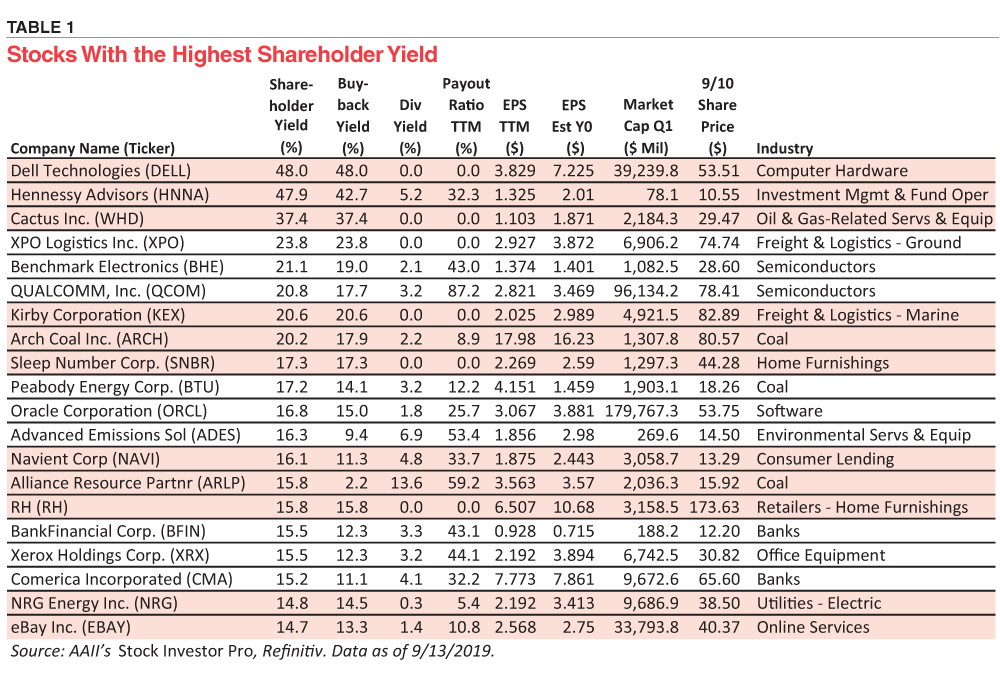
Shareholder yield combines the two into a single measure. It is calculated by adding the dividend yield to the buyback yield. The larger the shareholder yield, the more cash a company is returning to shareholders through dividends and/or buybacks on a relative basis.
This First Cut identifies the 20 U.S. exchange-listed stocks with the highest shareholder yield. All 20 are profitable and are expected to be profitable for their current fiscal year. We set an upper limit on the payout ratio of 90% to ensure earnings are in excess of the dividend payment, if one was paid. Since shareholder yield does not require a dividend be paid, we purposely did not exclude non-dividend payers from consideration.
Be sure to examine the company’s financial condition before buying to ensure it is able to continue returning capital to shareholders and otherwise has traits that would suggest a higher future price is warranted.
—Charles Rotblut, CFA, AAII Journal editor
Discussion
FREE REPORT

Jane from FL posted over 6 years ago:
Hugh from WA posted over 6 years ago:
Richard from FL posted over 6 years ago:
Ms. Sneha Joshi from VA posted over 6 years ago:
Fred from FL posted over 6 years ago:
David from Utah posted over 6 years ago:
Joe from Texas posted over 6 years ago:
John from Ohio posted over 6 years ago:
Tom from FL posted over 6 years ago:
Claude from GA posted over 6 years ago:
You need to log in as a registered AAII user before commenting.
Log InCreate an account