


Related

Stock Strategies
To understand quality holistically and correctly, you need variant perceptions and unconventional frameworks that go beyond the typical clichés and checklists.

Non-consensus investors care about what they are getting (the quality of the underlying business), not just what they are paying (the headline valuation metric). Other types of value investors care predominantly about what they are paying, not about what they are getting—which is why they often end up owning a value trap rather than a value bargain. Knowing how to correctly distinguish quality from junk is a prerequisite to generating higher returns with lower risk—which is a central aspiration of non-consensus investing.
In this excerpt from my book (“Non-Consensus Investing: Being Right When Everyone Else Is Wrong,” Columbia Business School Publishing, 2019), I debunk some of the conventional criteria that are commonly used to assess quality and give you the contrarian but correct ways of thinking about it. I have peppered this article with actual case studies, so you can see real-life applications of this concept. It is worth reiterating that all stock examples or theses expressed are meant to be illustrations, not recommendations.
In fact, “competitive advantage” is a misnomer. To be a high-quality business, it is not enough to beat the competition today; you must also remain competitive and relevant tomorrow. That requires a Darwinian advantage.
You know the phrase “survival of the fittest.” What Charles Darwin meant was not that the strongest or smartest of the species survive, which is how most people interpret it. It is those who are most capable of adapting to their environments over time who gain the upper hand. The same is true of a business. A so-called competitive advantage will take you only so far. To succeed, you cannot have just one ace up your sleeve; you need many intertwined capabilities. That is your Darwinian advantage.
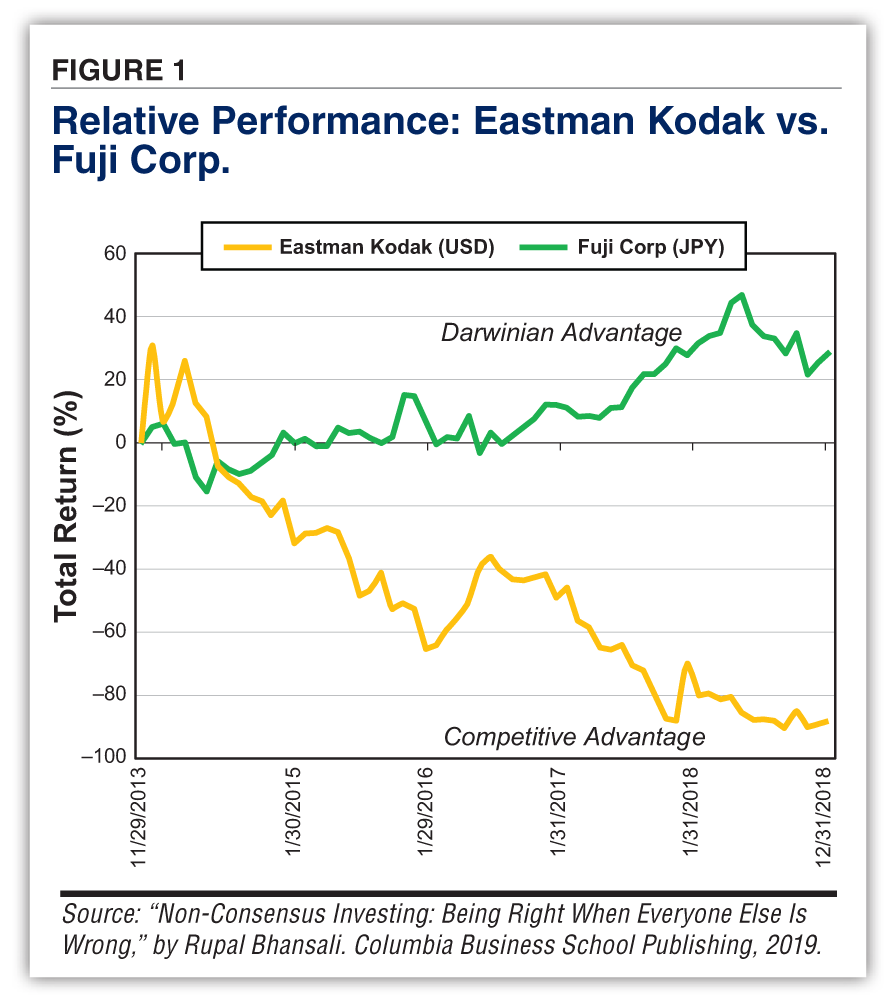
Take Eastman Kodak Co. (KODK) and Fujifilm Holdings Corp. (FUJIY), for example (Figure 1). They were rivals for years. Kodak had the advantage in the world of analog film, but as digital technology disrupted the film business, the company failed to evolve. Like Kodak, Fuji faced the same existential headwinds, as its analog film business also faced digital threats. But unlike Kodak, Fuji adapted and built evolutionary advantage by applying its knowledge of chemistry and film coatings to new applications and end markets. Today, Fuji is thriving, with multiple streams of earnings, ranging from high-tech copier toner to film coatings for LCD panels used in TVs.
In building evolutionary advantage by adapting to a new world, Fuji rose to new heights while Kodak self-destructed by depending on its limited, point-in-time competitive advantage. Darwinian advantage yields lasting quality; competitive advantage represents lazy quality.
People are quick to talk about a company’s high profitability as a metric of success. But over time, capitalism dictates that excess profits will get competed away. The longer you can prevent this from happening, by building Darwinian advantages that keep competition at bay, the longer you can earn excess returns. That is earnings power with staying power.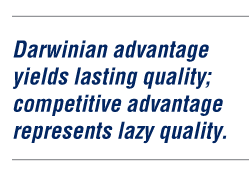
Competitive advantage focuses mostly on barriers to entry, which may prove short-lived. Darwinian advantage is about continuously raising the bar not just on barriers to entry but also on barriers to success. It’s a process of developing interlocking advantages that are layered on top of one another to provide a wide and long lead over the competition.
Toyota Motor Corp.  (TM) does this by deploying kaizen, a system of continuous improvement, on a whole host of fronts, from investing in superior engine technology to implementing just-in-time manufacturing to cross-training workers to developing best-in-class global supply chains and manufacturing footprints to delivering a high-quality yet low-cost, reliable and durable product to its consumers.
Now let us consider the smoke and mirrors of leading market share versus the more powerful indicator of quality: growing market share.
Baby Bells in the U.S. used to enjoy leading market share in the telecommunications industry. But their lead did not last because they took it for granted and failed to invest in next-generation networks to deliver broadband data connectivity and high-speed internet. The cable-TV industry sensed an opportunity and outsmarted the telecom incumbents by investing in a high-speed network that could carry both pay TV and high-speed data/internet. That meant they could add telephone services at low marginal cost. Many Americans now get triple-play services (voice telephone, high-speed broadband and pay TV) from their local cable TV company, and the once-dominant telecom companies have been relegated to losing market share instead of expanding it. Not surprisingly, many cable TV stocks have been star performers, while telecom stocks have lagged.
Now, I would not want you to construe this as an invitation to buy any challenger business model that is expanding its market share. This case study is meant to be a reminder of how conventional frameworks that equate high market share with quality is a false positive. Indeed, we appear to be on the cusp of another big shift. The cable TV business model itself is being upended by new challengers, such as Netflix Inc. (NFLX), that are expanding their market share by offering better value propositions to consumers.
 In contrast, cable companies keep raising prices, which sends customers in search of more compelling alternatives such as Hulu or Disney+, a soon-to-be-launched video streaming subscription service by Disney.
While expanding market share is better than not, it is a means to an end, not an end in itself. Pursuit of market share should not come at the expense of developing strategic advantage and pursuing long-run profits. Markets are dynamic, and winners and losers are continuously shifting. Companies that assiduously focus on offering consumers compelling value propositions get rewarded and win market share, while those that simply make hay while the sun shines ultimately prove to be lazy, not lasting, quality.
Many people believe that pricing power or captive customers are unambiguous signs of quality. But they may not be.
Recall that legacy airline carriers in many countries had pricing power—not because they ran their business well but because they had a monopolistic hold over prime routes and airport landing slots. They abused that power by keeping prices high. You know what happened next. Upstarts such as Southwest Airlines in the U.S., Ryanair in Europe and WestJet in Canada jumped in to develop low-cost airlines and gain customers by lowering fares instead of raising them.
The point to remember is that soaring prices can become a source of vulnerability, rather than a symbol of strength, if consumers balk at the deteriorating value proposition. Case in point: Gillette. For years, it regularly raised prices, seeming immune to the laws of gravity. Then in 2016, it got a rude reality check when consumers began moving in droves to the upstart alternative, Dollar Shave Club. Gillette was forced to lower prices. Quality may not necessarily be defined by who can raise prices but by who can lower them.
Companies that can lower costs and offer more for less may be the success stories of tomorrow. Silicon Valley readily comes to mind here, but there are examples even in the traditional manufacturing sector. This was the case with Rational AG (RTLLF), a Mittelstand (midsize German company) renowned for making the best industrial-grade convection ovens for the hospitality industry. For decades, despite constant product improvement, it had spurned the easy path of raising prices. By offering such unbeatable value to its customers, it raised the bar for the competition, not its prices. This kept the customers happy and kept the competition at bay. Result? In the decade that ended in May 2018, Rational stock has increased tenfold.
Another marker of quality is repeat purchases by customers. But beware: If the cause of the repeat purchase is lack of choice, this measure becomes meaningless. Remember that many legacy telecom companies took their captive customers for granted and neglected to provide value. They mistook captive customers, who had nowhere else to go, for loyal customers. The moment those customers got a choice, they shifted their business en masse, exposing the business model for the low quality that it was. Captivity is not loyalty. High-quality businesses are those where customers willingly do business even if they could go elsewhere, because they are getting real value for their money.
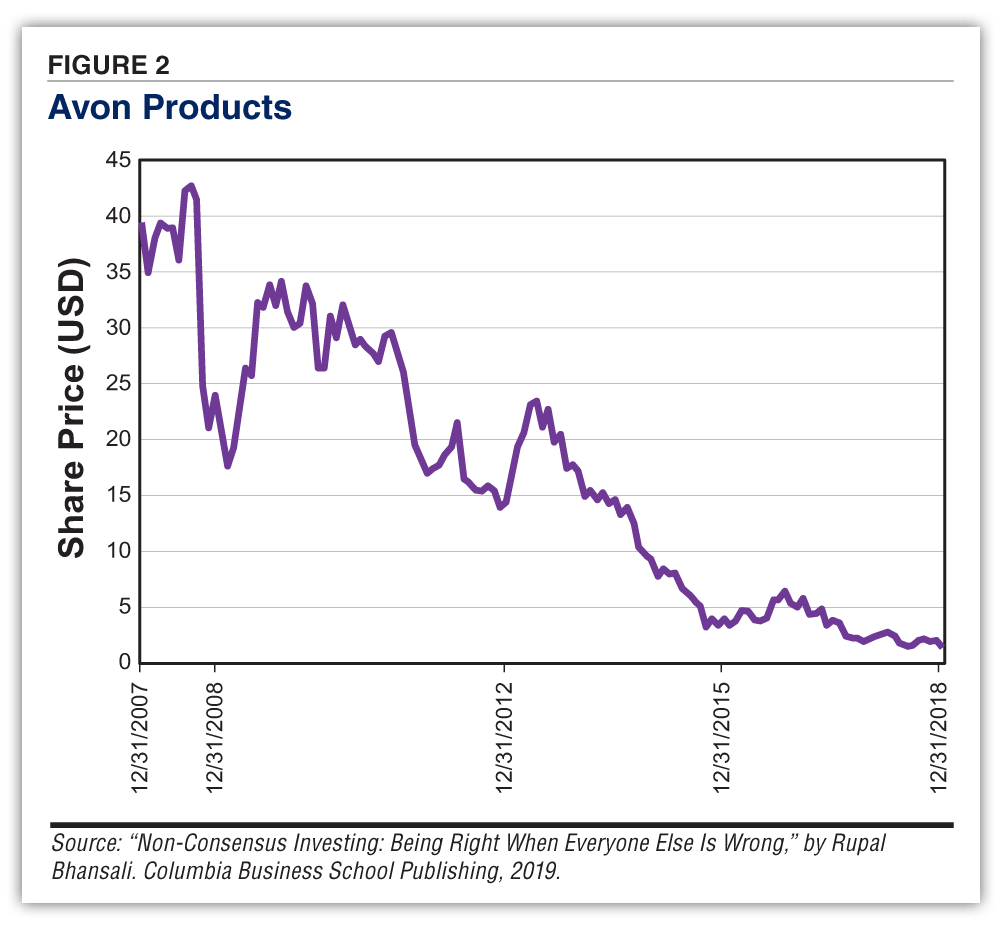
Businesses spend billions of marketing dollars every year on brand recognition. Unfortunately, the size of marketing spend is no guarantee that the brand will always be on top. No amount of advertising or public relations can rejuvenate a brand when the product itself does not live up to the promise (look at Figure 2). Avon Products Inc. (AVP) was once an iconic cosmetic brand and remains well known even today, but that did not protect it from weak consumer demand.
The businesses suffered, and so did the stock. From December 2007 to December 2018, Avon stock fell more than 90% while the S&P 500 index has gone up by almost 66% over the same time frame.
The worst offenders are those that rely excessively on their brands to do the heavy lifting of increasing revenues.
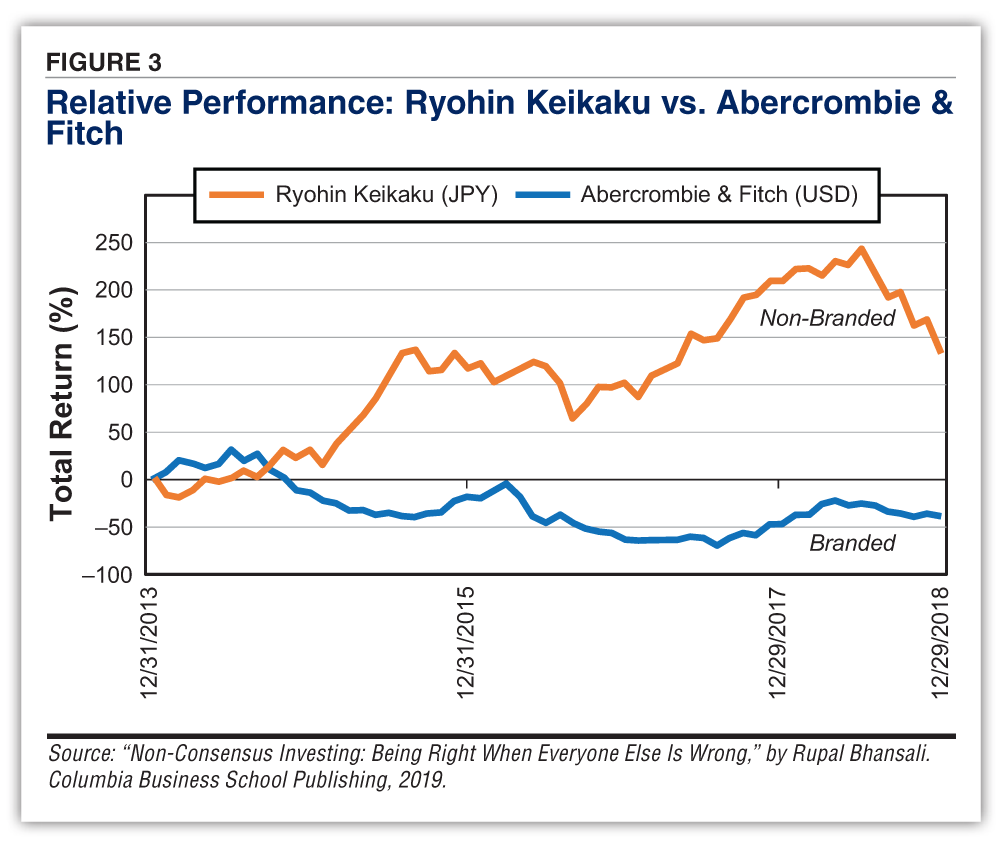
Abercrombie & Fitch Co. (ANF) thought it could buck the trend by relying on its brand to justify high prices when its peers were offering far more compelling product or value propositions. After consumers gasped from sticker shock, the company debased its signature label by offering widespread discounts and ongoing promotions. The stock collapsed as the halo around the brand evaporated. Abercrombie & Fitch had pricing power—until it did not.
This is why I am not a fan of ascribing value to brands as a special asset on the balance sheet. Not only can they be ephemeral and hard to estimate, this practice may be tantamount to double counting. The value of the brand is implicitly captured in the revenues, earnings and cash flow of the company, so the contribution is already embedded in the valuation of the firm.
Also note that many consumers are starting to care more about the authenticity and origin of a product than just its brand. The Muji brand (the word translates to “no logo” or “no brand” in Japanese) has become a runaway success worldwide by offering a minimalist design at affordable prices. Muji devotes little money to advertising or traditional marketing, relying instead on word of mouth, a simple shopping experience and the anti-brand movement. Muji’s no-brand strategy also means its products are attractive to customers who prefer unbranded, generic products for aesthetic reasons. Lower branding costs enable lower prices despite the high quality, which in turn results in such a compelling value proposition that customers keep coming back for more. This creates loyalty and provides longevity to a business.
I am not against brands per se but want to point out that what works well in life may not translate well into investing. Familiar household names with strong brands such as Avon and Abercrombie do not necessarily make good investments, while lesser-known companies such as Ryohin Keikaku (the company behind the Muji brand) that base their appeal on compelling product attributes may well prove to be the winning ideas.
Over the five years ending in December 2018, Abercrombie stock was down 40% and Ryohin Keikaku stock was up more than 130% in local currency (Figure 3).
The trouble with relying on a single metric, even a bedrock attribute such as a brand, is that it makes investors complacent. You may be so in love with the brand that you completely overlook deeper problems, such as deteriorating product quality or changing market trends. Indeed, Kodak still has a brand that many recognize, but it doesn’t help. Even in the company’s new incarnation, its stock fell from $25 in 2013 to $9 in June 2017.
Understanding true quality requires one to look at subtleties rather than superficialities. Brands, no matter how vivid or familiar they may seem, are not a free pass that lets you ignore deep, full-fledged research on a business. Nor do they offer some innate immunity from failure or loss. Brands are the cost of doing business. They may raise the stakes for new entrants who can’t afford to spend millions on advertising or may buy companies some time and leeway if they face a public relations fiasco, but they are not a magic wand that can ward off all challenges or challengers. The product or service must perform and continue to satisfy customer wants or needs.
Investors are typically impressed with companies that own patents but often fail to evaluate a more powerful form of intellectual property—know-how. Patents are tangible but perishable; they eventually expire. They can also be copied (with some tweaks) or challenged in court. Did you know that some of the worst-performing stocks over the past several years, such as Xerox Holdings Corp. (XRX), IBM Corp. (IBM) and Canon Inc. (CAJ), are some of the largest patent owners? In my experience, patents are overrated, know-how is underrated.
 Know-how is accumulated knowledge about a process or technique that is hard to decipher or reverse engineer. That means it can yield a competitive advantage for a long period of time. Consider ceramic resistors and capacitors made by Murata Manufacturing Co. (MRAAY). These components are used in smartphones to minimize interference in the complex electrical circuitry embedded in most modern electronics. We use them every day but do not realize their value because they are not visible. Making a ceramic product is like making pottery. It is a complex mix of engineering design, carefully calibrated composition of materials, as well as the precise duration and temperature at which it is heated in the furnace. This is extremely hard if not impossible to reverse engineer. Such know-how is more precious and less perishable than a patent. Know-how can create high barriers to entry and yield not just superior but supernormal profits in a company.
To sum up, then, when it comes to investing, quality is not black or white but has many shades of gray. Neither businesses nor their stocks come marked with quality labels (unlike bonds, which at least have credit ratings). To understand quality holistically and correctly, you need variant perceptions and unconventional frameworks that go beyond the typical clichés and checklists.
In assessing quality, you must be vigilant about circular logic, in which you confuse cause and effect or conflate numbers with the narrative. As we have seen, often a business can appear successful because of a favorable trend, with a rising tide lifting all boats, or a competitive advantage that proves fleeting or fickle. The symptoms of success do not explain the source of success—or its sustainability. It is crucial to understand that sustainability, because earnings power without staying power can be a recipe for losing money. In markets, low quality often masquerades as high quality, and that is among the worst possible investment traps you can fall into.
Although quality does not come with a label, I will take a stab at providing a working definition. A genuinely high-quality business is one that offers exclusive and enduring value propositions to consumers and generates a fair return to justify both the costs and risks of lawfully engaging and reinvesting in that business.
Excerpted from “Non-Consensus Investing: Being Right When Everyone Else is Wrong” by Rupal J. Bhansali Copyright © 2019 Contrarian Intrinsic Value Investing, LLC. Used by arrangement with the publisher. All rights reserved.
Stock Strategies

Portfolio Strategies
Stock Strategies

Rick DeMattia from OH posted over 6 years ago:
Andrew Blakeney from FL posted over 6 years ago:
You need to log in as a registered AAII user before commenting.
Log InCreate an account