

Related

Financial Planning
Retirees should consider having their investments reflect the age of whom that money is likely to be passed on to.

Individuals and couples who have accumulated fairly sizable estates are unlikely to spend it all. The same may happen to those with more modest resources. After all, most who built up their estates have done so the old-fashioned way, by living modestly. Despite my entreaties to “spend it all before you die,” these seniors are unlikely to suddenly become big spenders in their later years.
Of course, it’s important to consider how your estate should be passed on. Rare is the family where all children and other heirs are in fine financial fettle, and this may influence how an inheritance should be structured. For example, giving a spendthrift child an inheritance outright may do more harm than good.
While estate planning tends to emphasize matters that arise after death, you should also consider whether the way your money is invested now reflects the age of those who are likely to receive it later on. All too often, retirees invest money that is likely to be passed on to younger-generation family members—children, grandchildren, nieces or nephews, for example—the same way they invest money that they’re going to need for retirement. So, the money might be invested in Treasuries, utility stocks and other income-producing securities. But shouldn’t they be investing this money not like, say, a 75-year-old, but more like a 45-year-old (an adult child) or a 20-year-old (a grandchild nearing adulthood) would be investing it? In effect, they should invest the portion of their wealth that is likely to be passed on to their heirs more aggressively, emphasizing growth investments rather than income-producing securities.
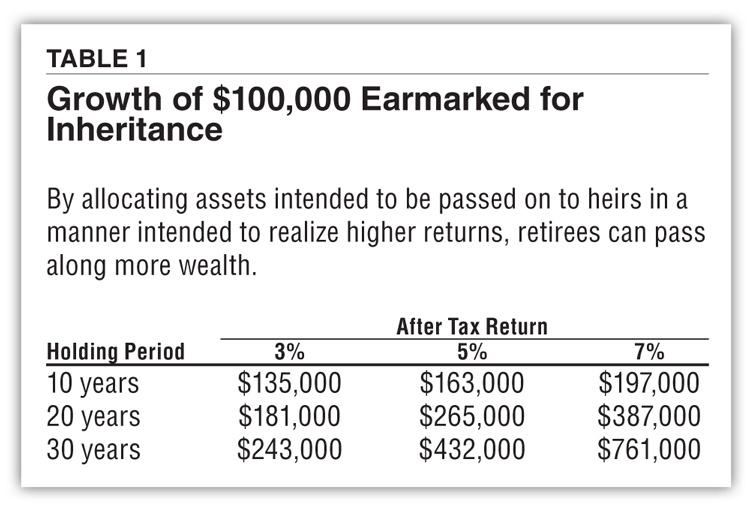
Table 1 illustrates how much might be accumulated over various holding periods under three different return scenarios. There is a big difference in terminal values between the 3% return assumption—reflecting a conservative, income-oriented portfolio—compared with the two higher-return assumptions, reflecting higher equity exposure.
There are additional things to consider when investing amounts intended to be left for heirs. Here’s a brief overview.
If this fits your situation and you agree with the strategy, your first inclination might be to set up a separate “inheritance” account that would be invested differently than the money you’re going to rely on.
That approach, while elegant, probably isn’t necessary. Instead, you can simply change your overall investment diversification to increase the percentage you allocate to growth securities.
If you inherited low-basis stocks from your own parents or other family members, chances are they were shares of well-known blue-chip companies. That was wise investment and estate planning at the time. With the advent of tax-efficient exchange-traded funds (ETFs) and index mutual funds, much more choice is available for the portion of your investments residing in brokerage accounts that will be earmarked for inheritance.
You can now invest tax efficiently (see below) not only in large-cap stocks, but also in other important stock sectors like small companies and foreign equities. Stock ETFs and index mutual funds hold many—scores, if not hundreds of—stocks. You have the best of both worlds: similar tax advantages to holding individual stocks but with better diversification.
In addition to investing the intended inheritance to maximize growth, the money should also be invested to minimize income taxes if the money will be held in currently taxable (as opposed to tax-deferred) accounts. (The question of whether the intended heirs actually deserve an inheritance may also be relevant, but it is beyond the scope of this article, lest the author get in trouble with his own heirs.) The tax rules favor buying and holding individual equity investments as well as tax-efficient ETFs and index mutual funds, since taxes on undistributed capital gains are not due until the investments are sold.
Those who inherit appreciated securities held outside retirement accounts receive the so-called “step-up in basis,” which is the cost basis as of the benefactor’s date of death. For example, consider someone who inherits stock that had a cost basis of $4,000. But the date of death value of the shares is $10,000, which becomes the cost basis for the heir. Thus, passing on low-cost-basis securities can be very advantageous to your heirs.
With respect to IRAs that are likely to be passed on, to the extent you can afford to convert traditional IRAs to Roth IRAs, the Roth IRA is a very effective way to maximize wealth transfer to heirs. As long as the Roth IRA has been opened and initially funded for five years prior to your demise, your heirs will owe no federal income taxes on inherited Roth IRA holdings.
Here’s an example of one person’s plan for passing on wealth:
I recently reviewed my overall financial status and concluded that I was unlikely to spend all of my investment money over the remainder of my life, hopefully 20 or more years. I’d like to set aside this “extra” money to pass on to my children and grandchildren. Since I first retired, I have been somewhat more cautious with my investments, but it seems that I should take more risk with the money that probably won’t be needed for at least a couple of decades.
So, my plan is to invest the long-term money almost entirely in equities, just as I had done in my earlier working years. The total amount to be earmarked for the heirs is $200,000, divided equally between investments in a traditional IRA and holdings in a brokerage account.
Roth conversion: I want to convert the traditional IRA money into a Roth IRA over a period of a few years. (I would like to convert more to a Roth, but this level is all I can prudently afford to convert.) The conversion will cost some money, of course, but the Roth has some big advantages. First, I won’t have to make required minimum distributions from the Roth; second, a Roth is a great asset for the kids to inherit, since no taxes will be due on the money eventually withdrawn from the inherited Roth. The icing on the cake with respect to both Roth and traditional IRAs is the ability to actively trade in the account without incurring capital gains taxes.
Brokerage investments: In order to minimize income taxes on the $100,000 in the brokerage account, the plan is to invest in individual stocks and tax-efficient ETFs—holdings that can likely be held indefinitely. While it’s unrealistic to think that there will be no trading in the account, I want to keep trading to a minimum to maximize total return without sacrificing a lot of it on the capital gains tax altar.
I’m confident that holding equities over a multi-decade period will prove beneficial for my heirs. Should the stock market go through a long funk, I’m not jeopardizing my own financial well-being. But for younger-generation family members, the ultimate reward potential of an equity-heavy portfolio justifies the risk.
Parents, grandparents, aunts and uncles who are in a position to move some money down to lower generations may want to consider whether to do so during their lifetime, via annual gifts in addition to or in place of postmortem transfers. As long as lifetime gifts are easily affordable, the money can probably go to better use sooner rather than later. But the elders need to avoid setting unrealistic expectations with the gifts. Here’s one couple’s plan:
We have concluded that we can afford to make annual gifts to our three adult children. We had always intended to pass on an inheritance to them, but they could certainly benefit from receiving some of the money now rather than 20 or more years hence.
The problem is, and we see it from many of our contemporaries, that once a gift is made it risks being perceived as an annual annuity. So, we plan to put some discipline into our largesse by making the amount of the annual gift, if any, contingent upon how we, the parents, and our money have fared over the previous year.
If we haven’t suffered any financial hiccups and the investments have performed well, a more generous holiday gift can be made to each child. On the other hand, if we now have or anticipate extra expenses and/or the investment markets took a drubbing, the amount of the annual gift will be reduced if not eliminated.
That way, the kids will not feel that they are entitled to the money and they learn a valuable lesson that if times are temporarily tough, we all have to tighten our belts.
One final note: While the tax regulations are generally advantageous for those who pass on appreciated securities, there has been talk in Washington, D.C., about tightening the rules—e.g., limiting the time over which inherited IRAs can be held and even restricting step-up basis on inherited non-retirement securities.
It’s important to keep abreast of any developments in the regulations that may make intergenerational transfers somewhat less attractive.
Financial Planning

Financial Planning

Financial Planning

Peter from MI posted over 6 years ago:
Harrison from Va posted over 6 years ago:
Richard from Pennsylvania posted over 6 years ago:
Scott from WI posted over 6 years ago:
Greg from GA posted over 6 years ago:
You need to log in as a registered AAII user before commenting.
Log InCreate an account