


Derek Hageman leads a class in AAII's new Essential Investing Video Course. Go to https://www.aaii.com/ves for more information and to subscribe.
The Dogs of the Dow is a simple and purely mechanical approach that focuses exclusively on blue-chip companies and purchasing them when they become undervalued relative to each other. It is a disciplined approach for individuals seeking value-oriented, large-cap stocks and a steady source of dividend income.
The Dogs of the Dow strategy calls for an investor to buy the 10 highest-yielding stocks in the Dow Jones industrial average at the start of every calendar year. An equal dollar amount is allocated to each of those 10 stocks and the portfolio is held for 12 months. On the first trading day of the next calendar year, the process is repeated, and the portfolio is reconstructed with the newest highest yielders.
The theory behind Dogs of the Dow is that a high yield implies that a stock is undervalued relative to the other Dow stocks. Investors seek to purchase often supposedly out-of-favor, high-yielding stocks whose relative yields suggest that their valuations are underpriced. This is not always the case, as a stock could have a high yield and trade at high multiples of both earnings and book value.
According to the Dogs of the Dow approach, identifying undervalued Dow stocks is most effectively done by examining the dividend yield—a company’s total dividends expected to be paid over the next 12 months divided by current share price.
If a stock’s price rises faster than its dividend, the yield may be low, indicating that the price may have been bid up too far and may be ready for a decline. Conversely, if the dividend yield is too high, the stock may be poised for an increase in price, if the dividend can be sustained. Yield can increase if either the stock price falls or the company raises its dividend payment. Obviously, the latter is always preferable.
While stocks pass the Dogs of the Dow screen because of their high current dividend yield relative to other Dow stocks, a study of the company’s historical dividend yield can be equally revealing. A current dividend yield higher than its historical average would be a sign that a stock is potentially undervalued.
The Dogs of the Dow philosophy is a contrarian approach. Like all basic value-oriented techniques, the dividend-yield strategy attempts to identify investments that are out-of-favor. Contrarian techniques such as this are based on the premise that markets tend to overreact to news—both good and bad—and push the price of a security away from its intrinsic value.
The biggest challenge with the Dogs of the Dow strategy is that it limits its universe to a highly restrictive group of stocks—the 30 stocks that comprise the Dow Jones industrial average. These are large, well-known companies with long histories of profitability. Investors looking at high-yield stocks should always ensure that the company can continue to pay its dividend.
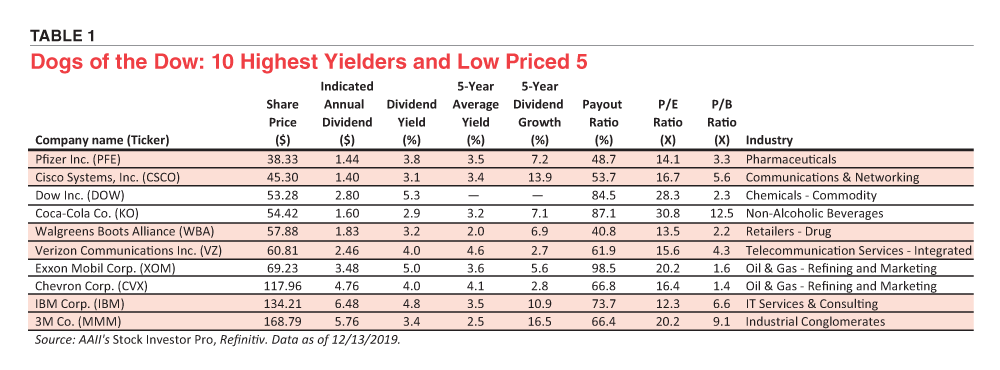
The stocks making this month’s First Cut are sorted by price, low to high. Doing so makes it easy to identify those also passing the Dogs of the Dow Low Priced 5 screen, which selects the five lowest-priced Dow Jones industrial average components from the 10 Dow stocks with the highest dividend yields. The latter approach is even more concentrated and is more vulnerable to a major setback in one particular stock.
A. Richter from Florida posted over 6 years ago:
Tom Pulaski from Maryland posted over 6 years ago:
Sudutoo from WA posted over 6 years ago:
Anthony P reres from N J posted over 6 years ago:
Robert W Moore from VA posted over 6 years ago:
Sudutoo from WA posted over 6 years ago:
Barry C Johnson from Texas posted over 6 years ago:
You need to log in as a registered AAII user before commenting.
Log InCreate an account