

Many individual investors currently going without financial advice might realize greater wealth if they took advantage of financial advice.
The International Longevity Centre U.K. (ILC), a self-described think tank on longevity, conducted a study that divided its participants into two groups: those who received financial advice and those who did not. Researchers then framed respondents into ‘affluent’ and ‘just getting by’ groups for purposes of analysis. In order to see how the group that didn’t receive financial advice would fare if they had received advice, the researchers focused on five different categories of income: accumulated pension wealth, net financial wealth, occupational pension income, the probability of saving income between 2014 and 2016 and the probability of owning equity assets.
For each of the five categories, the study found that certain incomes were more monetarily affected by financial advice than others. Considering pension wealth, the benefit of financial advice was higher for the just getting by group and lower for the affluent group. For financial assets, financial advice had more of an impact on the affluent group. Financial advice for occupational pension income had a slightly larger effect for the affluent group than the just getting by group (increases of 50% and 40%, respectively). When it comes to the probability of investors having savings, the addition of financial advice increases the odds by 4.1 percentage points. However, the study found that financial advice can also increase the probability of investors having risky assets by 7.5 percentage points.
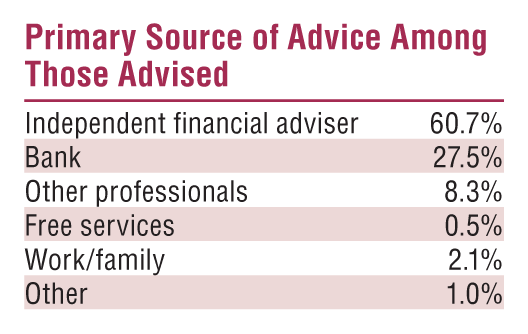
The study found that the total value of financial advice is about $62,900. For the investors receiving financial advice, their primary sources for that advice included: independent financial advisers, banks, other professionals, free services, work/family and other. The study’s authors explained that nearly nine out of 10 investors who received financial advice had an independent financial adviser or bank as their primary source.
In conclusion, the study suggests that advisers communicate clearly about the costs and benefits of advice and harness technology to ensure high-quality advice and tools are available to those who do not receive professional advice.
Source: “What It’s Worth: Revisiting the Value of Financial Advice,” by Brian Beach; ILC, December 2019.
Discussion
FREE REPORT

Larry U from CA posted over 6 years ago:
John Lambert from NJ posted over 6 years ago:
John McKeon from Vermont posted over 6 years ago:
You need to log in as a registered AAII user before commenting.
Log InCreate an account